Showing posts with label Historical. Show all posts

Friday, January 30, 2015

Film Friday: 12 Years A Slave (2013)

12 Years A Slave is an historical drama based on the true story of Solomon Northup, a New York-born free black American who was kidnapped and sold into slavery in the American South in 1841. Like Lone Survivor, this is an excellent and intense film which I would prefer never to see again.

Plot

12 Years A Slave begins by introducing Solomon Northup’s life in New York. This moment of the film is perhaps a little idealized with the whites around him being too colorblind compared to their historical counterparts, but the film nevertheless conveys the foundation of a smart, talented and competent man -- a man who would in other contexts be considered the type of solid American who made America great – who has established a happy, respectable family life in New York. Helping this presentation is the truly compelling screen presence of Chiwetel Ejiofor as Northup. Ejiofor is an actor who easily conveys emotion and inner thoughtfulness.
Northup is a musician and finds himself approached by two men who claim to be looking for a musician to accompany them to Washington. Northup could use the money and it’s only for two weeks, so he agrees. Things appear to go well until Northup wakes up in a cell in Washington, D.C. He has been drugged and he wakes up with several other blacks who appear to be runaway slaves or, like him, kidnapped freemen.

Helpless to free himself, Northup is smuggled to Louisiana where he is sold to his first slave master, William Ford (Benedict Cumberbatch). Northup is forced to go by the name Platt, and has been warned never to share the truth of what happened to him or he would never escape.
Northup impresses Ford with his intelligence and wins him over. He tells Ford what has happened, but Ford is unable to free him because of debt concerns. Unfortunately, Northup also makes an enemy of a white plantation enforcer (Paul Dano) at this point and Ford is forced to ship Northup to another plantation to hide him. He believes he has chosen well, but the new owner Edwin Epps (Michael Fassbender) is a sadistic owner who believes that he has a Biblical obligation to own slaves.

On the surface, Epps seems respectable, but things are not as they seem. He repeatedly rapes one of his slaves and eventually has a child with her, despite the fury of his wife. He also abuses the other slaves out of frustration at his inability to stand up to his wife’s abuses of the slave with whom he is sleeping.
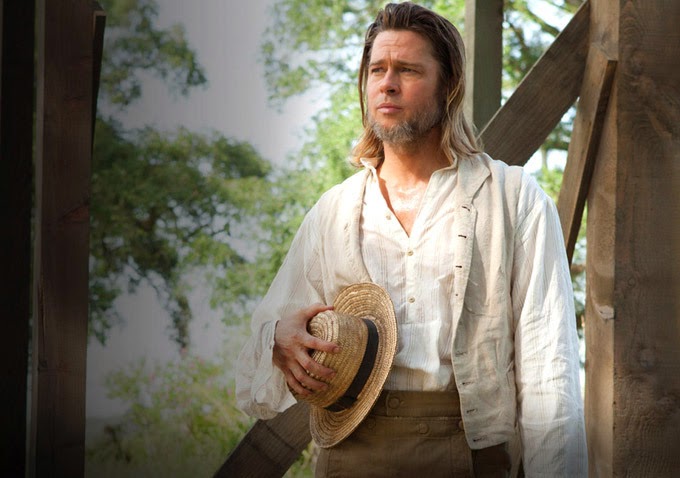
Finally, Northup meets a Canadian builder (Brad Pitt) who convinces him that he can contact Northup’s friends in the north and have him freed. I’ll leave the rest up for you.

Why This Film Works

This film works on many levels. It is an excellent period piece, done in such a way that it truly feels like you are getting a glimpse into a world long gone. It has beautiful cinematography. Indeed, some scenes are shot as beautifully as if you were watching a National Geographic Channel travelogue. It has an excellent ensemble cast who actually fit their roles for once, rather than being wedged into roles just to get their names in the credits.
What ultimately makes this film work, however, is the excellent way this film presents its material. First off, there is nothing in this film that anyone who is aware of slavery doesn’t already know. So the film is not relying on presenting something new or fresh. What it does instead is present things we already knew about in a way that is both realistic and graphic, and thus very visceral. However, the director also smartly uses cutaways to shield the audience from much of the horror. This makes the horror more palatable.
In fact, these cutaways are genius. By cutting away at these points, the film seems to spare the audience by telling the audience that they don’t need to see this play out to understand how horrific it was. Yet, at the same time, cutting away openly reminds the audience of how horrible this was and it is essentially telling the audience that what they would see would be too graphic for them to take. In effect, in appearing to spare the audience and avoiding a charge that the violence was gratuitous, the director actually ingeniously highlights the violence and makes it seem all that much stronger. Indeed, as an aside, while the film doesn’t show much of the horror, you still hear it and will see it your mind. We’ve noted before how powerful this technique can be.

The other thing the film does, and perhaps the most important point, is that it seems to make no comment on what is going on. The film tells the story as it happens, lets each character speak his or her mind, and then leaves it up to the audience to decide whether what is going on is evil or justified, and whether these people are good or bad. Even with the slaves, the film doesn’t do the Politically Correct thing and make them all angelic as it demonizes the whites. To the contrary, the film makes it very clear that there are good and bad people all around and that, many times, those people get swept up in events.
The end result of this approach is a truly gripping and compelling film. As with Lone Survivor, this film produces an incredible array of strong emotions. You feel true hatred for the people who have done this and anger that they did this in our country. You feel despair for the hopelessness of some people. You feel contempt for some who would not do what they could to help. And in the end, you feel a great deal of pride that Northup survived this ordeal, that others did stand up to help him, and that we went to war to end slavery.

All that makes this film worth seeing: great actors, great direction, gripping emotional script, and a film that rises far above the generic crap being put out today. But again, as with Lone Survivor, this is a difficult film to watch because it is so disturbing to think this really happened and that people can treat each other this way, and I would not like to see the film a second time.

Thoughts?
[+] Read More...

Friday, December 5, 2014

Film Friday: Monuments Men (2014)

I should have loved Monuments Men. It had so many things in it that I usually love. The cast is great. The idea is solid. The production values are first rate. And it's obvious this film was made with the idea of creating something lasting rather than yet another Big Shiny. But this film just bored me. Sad.

The Plot

Loosely based on the non-fiction book “The Monuments Men: Allied Heroes, Nazi Thieves and the Greatest Treasure Hunt in History,” Monuments Men is the story of a unit of Allied soldier during World War II, who were assigned the task of tracking down all the great art works the Nazis plundered from the lands they conquered and to save them from destruction as the war came to a close and the desperate Nazis were destroying or hiding these things to cover their tracks.
The unit, called the Monuments, Fine Arts and Archives Program, was created by FDR at the urging of Frank Stokes (George Clooney), who convinced FDR that letting the Nazis destroy the artistic history of Western Civilization would amount to a disaster, even if the Allies won the war. Stokes is directed to assemble a unit of museum directors, curators and art historians to find these treasures and make sure they are ultimately returned to their rightful owners. Joining him are the likes of John Goodman, Bill Murray and Matt Damon. The film follows their efforts.

On the other side of the story is Claire Simone (Cate Blanchett), a French museum curator who has been forced to assist Nazi Viktor Stahl as he finds and steals great art for Hitler and his cronies like Goering. Her brother is a resistance fighter who seems to specialize in stealing these items back.
The film is largely disguised episodic in nature with a loose narrative tying these events together. The main theme seems to be the resistance of regular soldiers to helping Clooney's team, and the plotlines tend to involve them learning the location of some missing art and then going to find it. Toward the end of the film, the team discovers that the Nazis are hiding vast amounts of art in abandoned mines. They must get to this art before the Soviets do, or the Soviets will steal it and take it back to Russia as a “war reparations.” They also capture Stahl and there are a couple moments where they briefly walk into combat scenes.

Why This Film Didn’t Work

The film received mixed to negative reviews. The Guardian said there were too many characters and the film never felt satisfying because it sent them all off to do little tasks, which often weren’t that interesting. The consensus at Rotten Tomatoes was that the film has “noble intentions” and a great cast, but they couldn’t overcome the “stiffly nostalgic tone and the curiously slack dialog.” Some Spanish rag called it “Hollywood war propaganda.” Yeah, leave Hitler alone, Hollywood! On the other hand, Rolling Stone liked it, calling it a movie about “aspiration” and “a proudly untrendy, uncynical movie.” Talk about true irony! Rolling Stone peddles pure cynicism and always has.
In any event, many of these critics have put their fingers on part of the problem: this film relies too heavily on its premise to sell the film rather than its execution. This was the same problem in The Family, which I reviewed recently, and with most of Clooney’s other recent films. Look, I like Clooney and I want to like his films, but in film after film it feels like he thinks that the concept itself is strong enough that he doesn’t need to offer more than his character walking through the film, discovering the concept and then acting upset or outraged at what he discovered, see e.g. Syrianna, Burn Before Reading, The Men Who Stare at Goats, Solaris, Michael Clayton, etc. These are all films with great concepts, solid casts and much promise, but they underwhelm as they end up more like a series of vignettes rather than real plots, and they rely on the audience feeling shocked that such things exist rather than feeling entertained by the plot.
Shocking audiences with something they never guessed existed before is a great start to any story. In fact, if you can find such a story premise, you are a major step ahead of all the formulaic crap out there. But that is only a beginning. For Monuments Men to be entertaining, they needed to develop the characters, put them into some sort of situation of conflict, and take us on that journey to resolve it one way or another. This film never does it.

For starters, as noted by the critics, there are too many characters for us to focus on which characters to care about. They try to make up for this by giving us actors who come with a history of goodwill already in place. This includes guys like Bill Murray and John Goodman and Clooney himself and Matt Damon. But liking the actors doesn’t compensate when I can’t tell you who the characters they played are or what they did. Moreover, I have to say that my goodwill for Murray and Damon is long gone and my goodwill for Clooney is waning.
So the audience doesn’t know who to care about or why or even what they really do that the others don’t. And that’s the next problem: we know in a broad sense what these guys do, but the film never manages to make it seem challenging. To the contrary, they seem to get tips from out of the blue. They never need to fight their way into those areas. The other American soldiers don’t seem to like them, but they don’t really stand in their way. The Nazis all surrender quickly and seem harmless as villains. Even the race against the Soviets is never presented as a race so much as a theoretical challenge.

The end result of this is that characters you don’t know or care about follow tips that seem to fall from Heaven and are always right to go pick up treasures with no genuine obstacles standing in their way. That’s not exciting... it’s not interesting. I honestly suspect that a documentary would have managed to be more exciting than this film turned out to be, and that’s sad.

Thoughts?
[+] Read More...