Showing posts with label Pierce Brosnan. Show all posts

Friday, February 20, 2015

Film Friday: Transcendence (2014) vs. Lawnmower Man (1992)

ed. ScottDS reviewed this film (LINK), but I wanted to add my own take. I recommend reading his take as well.

Perplexing. That’s what Transcendence is... perplexing. I don’t mean that the film weaves questions and concepts into a riddle that will leave you perplexed. No. I find the film perplexing because this should have been a better film than it ultimately is and I don’t entirely know why. But I think I know how to figure it out. Let’s compare this film to The Lawnmower Man.

The idea of our technology racing beyond our limits to control it and then enslaving the human race is an old one. The first time it appears on film, of which I’m aware, is Fritz Lang’s Metropolis (1927). Over the years since, this theme has repeated itself in many films, in everything from the disturbing Colossus: The Forbin Project (1970) to The Lawnmower Man (1992) to... well, Transcendence. In each case, the formula remains the same, it’s only the technology that changes.

Transcendence begins with an anti-technology terrorist group killing a group of scientists who are working to build the first true artificial intelligence. In the process, Dr. Will Caster (Johnny Depp) is shot, but appears to be ok. Unfortunately, the bullet is poisonous and Caster is given only a few weeks to live. In his last few days, he works with his wife Evelyn to try to finish the AI. He fails and dies. But as he lays dying, his wife comes up with a radical idea. Rather than build an AI, she records Will’s brain inside the computer. Caster has done this already with a monkey and his wife thinks she can do it with him.
Despite the odds, Evelyn succeeds with the help of family friend Max Waters (Paul Bettany). However, Max immediately recognizes that what they’ve created is not Will... it is something else, something dangerous. The grieving Evelyn dismisses Max and flees with the new computerized Will to where they can be safe. Will then begins to grow. Indeed, unfettered by the limitations of the human brain, the computerized Will soon becomes super smart and quickly learns to reach out to other computers everywhere to increase his power.

Soon, Will is creating amazing inventions, but using them to enslave the humans he helps as he builds a massive base in the desert. Eventually, the government realizes the danger and they struggle to defeat Will. The only option they have is to unplug the entire internet and in the process destroy all of modern society because everything is networked now.
Lawnmower Man is rather similar. Lawnmower Man begins with Pierce Brosnan as Dr. Angelo, a pacifist scientist who’s researching using virtual reality to enhance human intelligence. Like all good scientists, Pierce decides to experiment on his retarded gardener Jobe. Jobe responds quickly to the treatments and soon becomes normal. Then he becomes super-smart. Then he becomes so smart he transcends the limits of the human form and can begin manipulating computers and then even molecules themselves. He soon threatens to take over the entire world.

Why Transcendence Didn’t Work

Let me start by saying that it’s perhaps unfair to say that Transcendence didn’t work. My viewing experience was decidedly mixed. I began by almost turning off the film at the intro, which felt so derivative I felt offended. But I persevered and soon found a functioning, though hardly enjoyable film. Depp’s character is unlikable. Depp’s wife is bland. Paul Bettany is excellent as always, but gets sidetracked and removed from the film for too long. Morgan Freeman is solid, but is barely in the film. The plot is so predictable that it feels like the characters are rolling their eyes to pretend they don’t know what will happen next. And the pacing is very, very slow. But I will admit that the film offered just enough to make me curious to see how it all played out, though it felt like a chore to watch it.
I think what went wrong can best be demonstrated by a comparison to Lawnmower Man. Lawnmower Man offered nothing special. The actors are nothing special. The story is hardly unpredictable or creative. And the effects, while cool when released, felt old within a month of release and feel positively stone-ageian today. But what the film had going for it was three things: (1) the pacing kept the movie zipping along, (2) how each scene would turn out was unpredictable, and (3) you sympathized with the characters.

Consider the pacing. In Lawnmower Man, the film does a lot through montages. It skips ahead from key point to key point with only a few character development moments interspersed. Each scene moves swiftly and efficiently and you never feel like time is being wasted. By comparison, Transcendence wastes a ton of time. Its scenes are drawn out with huge pauses and long moments of reflection. This is how bad directors think they can fake drama when the screenplay itself lacks drama. Unfortunately, doing this robs Transcendence of any sort of rhythm and it leaves you feeling like the movie could be cut in half without missing a beat.

Moreover, the scenes in Transcendence all end the way you would expect. There is little in the way of drama or surprise either in the overall story or in the individual scenes. Even scenes like Johnny Depp being shot are so telegraphed that you never once feel an ounce of surprise. What made films like The Forbin Project work was that you never knew exactly how things would go. Was the good guys’ plan working? You didn’t know. In Lawnmower Man, you have all these moments where you just don’t know how they will play out, even if you know how the film must ultimately end. In Transcendence, nothing happens that you don’t see coming a mile away.
Finally, as lame as Lawnmower Man can be at times, you do come to sympathize with the characters. Jobe is a nice kid who twists into something evil because of the twisted logic of absolute power. Pierce is kind of an ass who starts to realize the mistake he’s made and you begin to pull for him, especially as the powers that be try to stop him so they can exploit Jobe. In both instances, it is the growth within the characters that causes your emotional reaction. Jobe is a good kid destroyed and Pierce is an ass redeemed, and it forces you to care about what is going on.
In Transcendence, there is no growth whatsoever. Depp is an arrogant ass from the first frame and he stays that way. His wife is bland and stays that way. Paul Bettany is the hero who is right from the opening and never needs to redeem himself or prove himself... nor does he ultimately do anything. The other characters are pointless. So ultimately, there isn’t a character journey in this entire two hour film even as nothing else happens except “character building” moments. This just reinforces the idea that the film is just wasting time.

These differences are key. Because of these differences, Lawnmower Man (which I repeat isn’t a great film, but is enjoyable in a B movie sort of way) comes across as a shallow film that holds your interest with decent action and an unpredictable story throughout, even though you know the ultimate ending. Its characters aren’t great, but they are interesting enough to keep you invested. Transcendence, by comparison, feels like a forced march. This is a long and needlessly dull film because it never once challenges or surprises you. Its characters are one-dimensional and indifferent; you won’t feel anything for any of them. So while the film appears like it should have worked, it really never does.

Thoughts?
[+] Read More...

Thursday, November 7, 2013

Bond-arama: No. 0012 Goldeneye (1995)

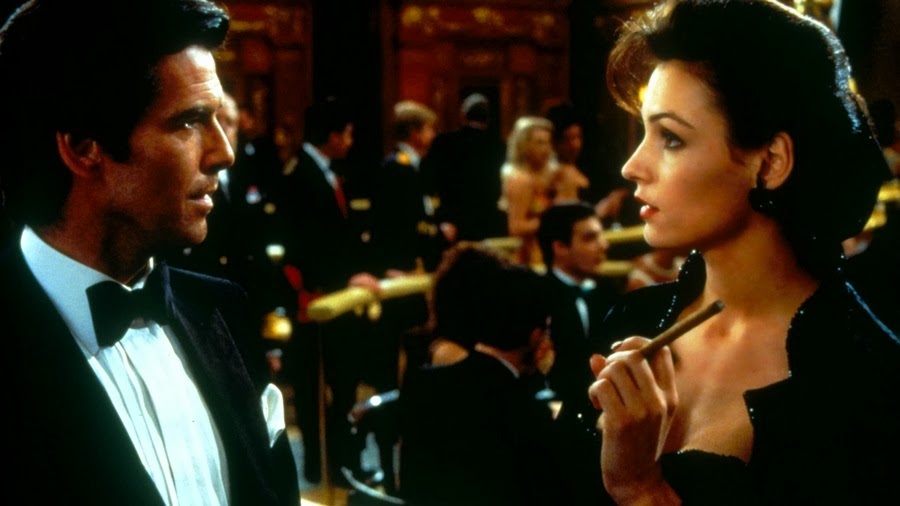
From hereon out, the films are all pretty good and the competition gets stiffer, and that makes this the perfect place to put Goldeneye. Goldeneye is the best of the Pierce Brosnan James Bond films. It’s a complete film with an engaging plot, a decent villain made better by the actor, some nice cinematography, and some good action. It does have some problems, but it’s worthy of being ranked No. 0012 of 0023.

Plot Quality: As a film, this one is pretty decent. The film begins with Bond and Agent 006 Alec Trevelyan (Sean Bean) breaking into a Soviet chemical weapons plant to blow it up. Alec is caught and a gun is held to his head by Colonel Arkady Ourumov in an attempt to get Bond to surrender. Of course, it doesn’t happen that way. Ourumov shoots Alec, Bond shoots his way out and blows up the plant, and Bond escapes in an impossible to believe airplane stunt.
Nine years later, Bond is following Xenia Onatopp, a Russian woman suspected of being part of a crime syndicate. She murders a Canadian admiral and steals a prototype Eurocopter which can withstand an electromagnetic pulse. Xenia takes the chopper to Severnaya, where the Russians put the control center of a satellite weapon called GoldenEye, which just happens to fire an electromagnetic pulse. This facility is under the command of now-Gen. Ourumov, who is commander of Russia’s Space Division. In reality, however, Ourumov works for the crime syndicate. Thus, when Onatopp arrives, she, Ourumov and a traitor computer programmer named Boris Grishenko massacre the staff and fire the weapon at the facility. This causes everyone to think the ability to control the satellite has been lost. They then escape in the chopper, which isn’t damaged by the EMP blast.

Bond, of course, quickly realizes that this was a setup and they identify a survivor, Natalya Simonova. He is sent to St. Petersburg to investigate. There he fights with Onatopp and discovers that Alec faked his death because he had some Rube Goldberg plan to get revenge against Britain for the death of his parents during World War II. Bond escapes and ends up racing a Russian T-55 tank through the streets. Bond then learns that there is a second satellite facility in Cuba. He and Simonova go to Cuba where they fight Alec and Boris to the death and save the day.
All told, the film is nicely shot. The travelogue feel is back. There are some good moments of humor. The fight scenes are excellent and the finale is up to the level one expects from a Bond movie. Joe Don Baker plays a surprisingly likable CIA character, Jack Wade. And the tank chase through St. Petersburg is really top notch.

Bond Quality: This is Brosnan’s first outing as Bond and he’s not horrible. He’s not great either. What keeps him from really being a great Bond is that the writers injected a morose element into the character; this is not a Bond who ever enjoys himself and that makes this film feel darker than it should. Another part of the problem is that Brosnan doesn’t project as a cold-blooded killer, particularly as his character is bereft of joy, and his cold-blooded lines don’t work. Brosnan would improve with each film as Bond, though sadly his scripts tended to get worse at the same rate. Still, he was an improvement of dour Timmy Dalton and the aging Dame Roger Moore.
The Bond Girl: The Bond girl was Izabella Scorupco as Natalya Simonova, a computer programmer and the only survivor of the attack on the GoldenEye facility. She knows the system hasn’t really been destroyed and she saw the villains behind the attack. As Bond girls go, she’s cute, but bland. She fits the Bond-as-depressed-monogamist theme that the producers were trumpeting at the time as their response to the AIDS epidemic. She also shows some feminism, which was something else the producers tried to inject into the film. Unfortunately, most of the scenes involving her amount to padding.

The other Bond girl, who is more of a henchman, is Famke Janssen as Xenia Onatopp. She’s an over-the-top sex fiend and killer. Janssen is a quality actress and she adds some life to the film. She particularly manages to liven up Brosnan during a scene in a steam bath, so she definitely adds value to the film. She is a bit “too much,” especially for such an otherwise staid film, but she works.
Villain Quality: There are technically two villains here. The first is Gen. Ourumov, who is the commander of Russia’s Space Division. He is also secretly an agent of the crime syndicate Janus, who run a huge mutual fund. There isn’t much to him because aside from betraying the Russian government, he’s basically just a henchman for the syndicate, which is run by Alec. There are problems with his character, like how he ever got involved in this in the first place and what his motives are: he kind of implies a nationalist motive when confronted by the Minister of Defense (TchĂ©ky Karyo), but his real motive is probably more like money. But since he isn’t really the focus, you can overlook that and just go with it.
The real villain is Alec. Alec begins the film as 006 and a friend of James Bond. But then Bond learns that Alec lived through the mission on which he appeared to die. In fact, he faked his death. Why? Well, Alec’s motive at first appears to be revenge against the British. But upon closer inspection, Bond learns that Alec’s real goal is to steal money from the Bank of England before erasing all their financial records by blasting Britain with an EMP blast. This will cover up the theft and ruin Britain’s economy in the process.

If you don’t use your brain, then this is a decent motive and plan. Alec seems cold-blooded enough to really do the damage he’s threatening. His plan is well above the level of a common theft, so it is worthy of James Bond, and there is a strange revenge element, which gives the story a bit more heart. Add to this that Sean Bean does an excellent job in terms of displaying menace and hatred of Bond and Britain, and the whole character does manage to come alive as a real threat. That makes him a decent villain and the film enjoyable.

Unfortunately, there is some silliness here. By tying Alec, the crime syndicate, the GoldenEye device and Alec faking his death together, you end up with a plan that feels like Alec set it up before he would even have known the GoldenEye existed or that his Colonel buddy would have been promoted to become the head of Russia’s Space Division. It also makes you wonder how MI-6 didn’t realize that their own 006 was running this massive crime syndicate which apparently had tentacles deep into the Soviet Union at the height of the Cold War. They would have been better off leaving out the opening scene. Still, you can overlook this because it just muddies things, it doesn’t actually make the film nonsense.
What really lifts Alec above the writing, however, was Sean Bean who is an excellent actor. He has a way of coming across as likable, interesting, and yet menacing all at once, and it feels like his rage at Bond is real in this film. That helps you buy into the character in ways that many Bond villain actors simply aren’t able to achieve. Indeed, too often, Bond villain actors feel like they are phoning in their roles, but Bean is the first to make you feel like he really got his hands dirty and really, really means it. It helped that he and Brosnan had excellent chemistry too as friends turned against each other.

In the end, this is a solid enjoyable movie that is definitely better than its screenplay because of solid acting by a few talented actors, a couple of great images like the EMP pulse blasting the Severnaya facility and the tank chase, and solid cinematography which brought places like St. Petersburg to life. All of this makes for a high rating. Unfortunately, these positives are also weighed down by Brosnan not feeling like Bond yet, particularly as the writers made him morose, and the overall scheme never feeling like much of a threat because it wasn’t fully developed how this would hurt people in the audience... some bank records vanish, big whoop -- they should have really talked about electric grids, food distribution, loss of data, etc., but they didn’t. Hence, while this one is good, it’s not good enough to beat the competition. Ergo, we rank this one No. 0012 of 0023.
[+] Read More...

Thursday, September 26, 2013

Bond-arama: No. 0014 Tomorrow Never Dies (1997)

Tomorrow Never Dies holds a lot of promise. The plot is Bond-like. Teri Hatcher is beautiful. Pierce Brosnan was a solid James Bond. And Jonathan Price is an excellent choice as a villain. Even the idea of a newspaper man manufacturing news to manipulate the world is a great idea. But the film never fully achieves its promise, which is why it’s only No. 0014 of 0023 on our countdown.

Plot Quality: Tomorrow Never Dies is essentially You Only Live Twice with media mogul Elliot Carver (Jonathan Pryce) replacing SPECTRE and a stealth ship replacing the volcano lair. Unfortunately, even though the plot is less fantastic than You Only Live Twice, it is actually less credible. Still, the story is quite decent.

The story begins with Carver sending the British frigate H.M.S. Devonshire off course into Chinese waters by manipulating their GPS signal. They think they are in international waters. This provokes a Chinese military challenge. As that is on-going, Carver uses a secret stealth ship to sink the British frigate. He then films his own crew shooting the survivors in the water and he uses a missile obtained from the frigate to shoot down a Chinese jet fighter sent to investigate. Carver then uses his media empire to drum up the claim that the Chinese sank the frigate and shot the survivors. His goal is to start a war between Britain and China, which would result in the Chinese government being replaced by one willing to give him exclusive rights to the Chinese media market.

On the surface, this sounds good. The sinking of a naval vessel in what the aggrieved side believes to be international waters and the cold-blooded murder of her crew is certainly cause for war. But there’s a problem: Britain. I’m sorry to our British readers, but Britain is just not a credible military power and it is inconceivable that Britain would (or could) actually go to war with China. To non-British audience this sounds a bit like Belgium planning to invade the US. Also, Bond is given 48 hours to stop the war, which stretches credibility again because there is no way the Royal Navy could be assembled and shipped to China in anything under a couple weeks. Still, if you can overlook the British hubris of this entire idea, the idea of starting a war is a solid one.
Bond then travels to Hamburg to investigate Carver because Carver released details of the attack before they were even known and because MI6 noticed strange signals on one of his communications satellites when the frigate was sunk. In Hamburg, Bond discovers that Carver’s wife (Teri Hatcher) is an ex-girlfriend of his, and she helps him steal the GPS encoder Carver used to divert the H.M.S. Devonshire. Naturally, she is killed for her troubles and Bond escapes with the help of a remote control BMW. This produces one of the better moments in the Brosnan Bond films as he navigates the BMW through a parking garage.

Bond next travels to the South China Sea to investigate the wreckage. He is captured by Carver, along with Chinese spy Wai Lin (Michelle Yeoh), and taken to the Carver Media Group tower in Saigon. This results in an escape down the outside of a glass high-rise and a chase scene with Bond and Lin handcuffed together on a motorcycle as they are chased by a helicopter. For all the skill involved in the stunts in this chase, the chase feels remarkably pro forma and staged, and there’s never any real sense of danger.
Bond and Lin then attack Carver’s stealth ship. They need to stop Carver from firing a stolen British cruise missile at Beijing. Bond damages the stealth ship, making it visible to radar, and allowing the British navy to sink it as Bond stops the missile and kills Carver. Unfortunately, before this climax began, the filmmakers made a strange mistake. They allow Bond and Lin to explain to their governments what Carver had done. This effectively sucked the drama out of the ending and, to fix this, the filmmakers create fake drama by presenting the Royal Navy as bloodthirsty fools who are unwilling to wait to hear what Bond has discovered. This needlessly makes the ending a mess.

All in all, this film is enjoyable. The plot is sufficiently fantastic to be worthy of James Bond, yet it’s also grounded enough that the audience can see how the plot would work and why a villain would do this. The writers made some mistakes which kept the film from hitting its potential, but this is a worthy Bond film.

Bond Quality: This is Brosnan’s best performance. He was comfortable in each aspect of the role by this point and he could easily be both suave and cold-blooded. Moreover, he’d developed a sense of humor which comes out at the right times to enhance his sexual appeal and to soften his brutality without losing the seriousness of it. At this point, Brosnan is the equal of any of the others at their best.

The Bond Girl(s): The Bond girls are a different story. The primary role of the Bond girl is to add sexual tension to the film and to give Bond a reason to care personally about his fight against the villain. That didn’t happen here. Indeed, the Bond girls were a weakness in this film as neither proved to be very sexual.
Teri Hatcher played Paris Carver, the trophy wife of the villain and a former girlfriend of Bond. Hatcher was pregnant when she played this role and apparently that limited her, and it shows. She’s also rather cold. A better choice would have been Monica Bellucci, who was turned down for the role – she oozes sexy. Hatcher seems more trouble than she is worth as a trophy wife. Also, Brosnan proves incapable of selling the idea that he cares about some forgotten ice queen girlfriend, and she is forgotten so quickly after she is killed that her inclusion in the film almost seems like an afterthought.

The main Bond girl is Michelle Yeoh, who played Chinese spy Col. Wai Lin. A former Miss Malaysia, Yeoh starred in several Jackie Chan films before this. At this point in her career, she honestly lacks the sex appeal to be a Bond girl. Indeed, she treats the role more as a buddy cop story, which is what she played with Chan, and she never develops more than a “pal” chemistry with Bond. She and Bond don’t even compete effectively, like Barbara Bach did in The Spy Who Loved Me. She also lacks a personal motive which would give her character fire. Essentially, she becomes a sidekick rather than a Bond girl.

Villain Quality: The villain quality here is difficult. Jonathan Pryce is an excellent actor and he’s extremely well-suited to play a Bond villain. And on the one hand, Elliot Carver sits among the greats. He is ruthless. His scheme sounds intelligent and is grand and is certainly worthy of the attention of Mr. Bond. His acting is also the perfect pitch to give the character the right amount of credibility that he got to where he is and the right amount of ruthless insanity to make his villainy believable.

But on the other hand, the flaws in his plan are what doom the film. For one thing, his scheme is about securing ratings for his news empire. But it’s not clear how ratings will translate directly into anything the psychopathic Carver would care about. In other words, how does this plan really help him personally? We can infer that he would gain influence or become richer as his company’s share price goes up, but that’s never explained nor does it seem to be a fitting motive for a megalomaniacal psychotic.
And as an aside, as so often happens, if the writers had answered this motive question fully, they may have found a much more interesting film. Indeed, it’s within the idea of a media man manufacturing his own news to reshape the world where a truly inspired tale lies, not in him gaining ratings for some nebulous profit motive.

The other problem with the plan is that it’s ludicrous to believe that Britain could be a credible opponent for China. They have no ability to project power around the world. Indeed, a war between Britain and China would go like this: Day One, Britain declares war. Two hours later, Hong Kong surrenders. Britain sends its tiny fleet as a show of impotent rage. China showers the fleet in missiles. China sends the survivors home on a China Air flight after Britain agrees to pay the airfare. That’s the best case for Britain. More likely, Britain would demand an apology, China would laugh, and the whole thing would be forgotten. And audiences know that, so the stakes of Carver’s scheme never feel real because no one really believes a war would erupt. It would have added a lot to the film if it had been an American frigate or if it had been a Chinese frigate and China threatened an invasion of Hong Kong in retaliation. But the idea that Britain could threaten China militarily just doesn’t wash.

Conclusion

This was an enjoyable film with the potential to be one of the best, but a couple mistakes stopped that. The Bond girls were miscast and the villain was mis-written. Essentially, you have a potentially excellent villain played by an excellent actor whose plan doesn’t really pass the sniff test because it doesn’t fit his psychosis and because it can’t really happen the way they’ve outlined it. A couple of tweaks would have made a world of difference. And even more to the point, if they had answered the question of what a psychotic would really do with near-total control over the media, they may have discovered a much stronger film. Unrealized potential is why this film sits at No. 0014 of 0023.
[+] Read More...

Thursday, June 6, 2013

Bond-arama: No. 0018 The World Is Not Enough (1999)

Today we continue our journey through the James Bond films with No. 0018 of 0023: The World Is Not Enough. Bond films always seem to have a theme. . . sometimes intentionally, sometimes not. The theme in this film was “confused.” The motives, the plot, and even the action were all confused. This film probably should have been lower on our countdown except for the stiff competition it faced.

Plot Quality: The plot stinks. World revolves around the assassination of a billionaire oil tycoon by KGB agent-turned-terrorist Renard (Robert Carlyle). This turns into a scheme to trigger a nuclear explosion near Istanbul so that a Russian oil pipeline would be useless, which would increase the value of a competing pipeline. The plot is hatched, possibly, by Renard. I say “possibly” because the film isn’t all that clear. It might also have been hatched by the billionaire’s daughter Elektra (Sophie Marceau). She was a kidnap victim of Renard who now seems to be his lover and his boss, though she also answers to him. . . depending on the scene.
Anyhoo, the story begins with Bond and the billionaire visiting a Swiss banker to buy a report stolen from MI-6. The banker gets killed. Why? Something to do with the plot. Then Bond and the banker return to MI-6 Headquarters, where the billionaire gets blown up by booby-trapped money – this is one of those booby traps which takes precognition to work. Bond, of course, sees the killer, who just happens to be hanging around outside in the Thames river waiting to be spotted. A boat chase ensues, which results in a hotair balloon escape... because those are fast and agile escape vehicles.

Bond then flies to scenic Upper Krapistan (f.k.a. Azerbaijan) where villainess Elektra tries to convince him that he’s got nothing to worry about. She then has him attacked by winged monkey, i.e. guys on paraglider-equipped motorcycles, which kind of contradicts her plan of telling Bond there’s nothing to worry about. Bond then discovers that Elektra’s head of security is linked to Renard. Oh no!

Bang! We’re off to scenic Lower Krapistan (f.k.a. Kazakhstan) where we meet silicon-based ditz Denise Richards who is actually playing nuclear scientist Christmas Jones. Bond and Renard fight and everyone gets trapped in a nuclear silo. Bond escapes and goes back to Krapistan, where M gets kidnapped by Elektra because she’s angry at M as well. Bond is then attacked by helicopters with tree-cutting blades because that looks cool. He is captured by Elektra, but freed by a Russian mobster, and kills Elektra and saves M. Eventually, they all end up on a submarine where Renard intends to inject plutonium taken from the missile in Lower Krapistan and blow up Istanbul. Good riddance, I say. Of course, Bond saves the day.
Bond Quality: This was Brosnan’s third film and overall he was a decent Bond. He was always suave and, once his confidence grew, he handled the other aspects of Bond quite nicely as well. Unfortunately, he probably peaked in his prior film, Tomorrow Never Dies, and this was not his best outing. For one thing, Brosnan was stuck with some very poor material. By and large, he was just a tourist in his own movie as he rarely drove events. Even worse, he seemed to struggle with his chemistry with the Bond girls. Elektra was too much in control of their relationship for him to come across as Bond and he seemed too uninterested in Jones. In fact, the only person he really had solid chemistry with was M (Judy Dench).

The Bond Girl: This film has two Bond girls, but I’m only going to talk about Denise Richards here. Casting Richards as anything more than a stripper or cheerleader is a stretch and casting her as a nuclear scientist fell flat. She’s a ditz who adds little to the film. Most Bond girls add a sense of glamour, she didn’t. Most Bond girls add a high degree of sexual tension with Bond, Richards didn’t. Most Bond girls present a challenge for Bond; they are always involved some way in the scheme and they either need to be won over, controlled or killed. Not Richards. She’s just a bystander Bond runs across. If most Bond girls are on unobtainable object of desire wrapped in a dangerous package, Richards is a stripper looking for a ride home.
Villain Quality: There are two villains in this film, if you exclude the writer. Unfortunately, neither is all that great. On the one hand, you have Robert Carlyle as Renard. He’s an ex-KGB agent who has become a world famous terrorist. The other is Elektra, the daughter of the dead billionaire.

The problem here is that the relationship between the two isn’t clear and it appears contradictory. Renard kidnapped Elektra at one point and they became lovers. Yet, Elektra kills her father as revenge for using her as bait to catch Renard. That is a confused motive as one would assume that she would feel happy to have found Renard. Moreover, as the plot moves forward, it is implied that Renard is taking orders from her. I say “implied” because the film is never clear, but the film basically shifts midway through from having Renard driving the scheme to having Elektra driving the scheme. At one point, Elektra even seems happy to let Renard die. This doesn’t make a lot of sense. If he’s the evil terrorist mastermind, why is he taking orders from his former victim? I suspect we’re supposed to believe that Elektra is a psychopath and Renard fell for her in some sort of reverse Stockholm Syndrome, but the story just never makes any of this clear.

Moreover, Elektra’s revenge motive doesn’t mesh with her motive being economic, which is the motive driving the main plot. According to the main plot, Elektra wants to blow up Istanbul to destroy a Russian pipeline. She wants to do this to raise the value of her own pipeline and she’s clearly been planning this for months. But think about that. Until she killed her father a few days ago, she didn’t own the pipeline, so why is she so obsessed with coming up with insane ways to improve its value? That doesn’t make a lot of sense. You would think she would own it for a while and see how it works before she decided her best plan was to set off a nuke to destroy a competitor.
Further, the scheme itself is bizarre. Bond schemes always need to be larger than life, but they simultaneously need to sound plausible. This scheme sits on the border of plausible. The problem here is the proportionality. There are easier ways to increase the value of a pipeline. And even if she pulls this off, she still won’t even own a monopoly as there are other pipelines and thousands of tankers that could be used as alternatives. Nor is a monopoly all that great in this instance because she doesn’t own the oil, she just transports it, and with oil being a commodity, there no chance she can demand more than market prices.

Ultimately, everything here is confused. Is her motive personal or business? And if it’s business, why be so psychotic about a business she didn’t own until a couple days ago and without more reason to believe it will really benefit her? The whole relationship with Renard feels like an add-on just to give the plot a “big reveal” halfway through as Bond discovers she’s the real villain. Beyond that, their relationship is simply confused and inconsistent. Why she thinks she can get away with playing innocent as she has Bond attacked and then kidnaps M isn’t clear either. And if she really wanted to kill Bond, why not just shoot him on one of their dates? Why try any number of low-probability-of-success attacks? It feels like the writer was writing a caricature of a James Bond story.

All in all, the film has the elements of a Bond film, so you can’t complain about that. It just doesn’t use them very well. It’s not that the film ever insults you, it just doesn’t quite come together. That’s why this film is No. 0018 of 0023.
[+] Read More...

Thursday, February 21, 2013

Bond-arama: No. 0023 Die Another Day (2002)

We begin our countdown at the bottom... the very bottom. Die Another Day is a repeat of Diamonds Are Forever and it jumps so many sharks they should have called this film James Bond: Shark Jumper. It’s just awful and that’s why it sits at the bottom of our list at No. 0023 of 0023.

Plot Quality: The plot to this one is simple. A villain gets gene therapy to turn himself from a Korean into a British person because he has daddy issues. Said villain buys “conflict diamonds.” Boo hoo. He uses those diamonds to create a satellite which somehow converts sunlight into energy to be used on Earth. He and Bond fence. Bond escapes an ice palace in his invisible car. This now Caucasian villain orders the North Korea military to invade South Korea. The satellite turns out to be a weapon that puts the Death Star to shame, but can’t blow up a plane it hits with a direct shot. The film ends. Sounds wonderful, doesn’t it? (if you’re an idiot)
Where to begin? James Bond does not get captured and held prisoner for 14 months only to be retrieved in a prisoner exchange. And what prisoner exchange? Why would North Korea spy on Britain? Why would anyone? Koreans cannot turn themselves British/Caucasian with gene therapy. And even if they could, no one goes to Cuba for gene therapy. An ice palace? An invisible car? John Cleese as Q? WTF? Let me repeat. . . an invisible f*cking car designed by Monty Python. Also, James Bond does not surf. North Korea is not an imposing military power that deserves to be on film. Someone who turned himself into a honkey cannot start giving orders to the North Korean military after killing his father the general. A satellite sending out a flame-like beam that could consume miles of the Earth at a time is beyond ridiculous. That such a weapon could hit an airplane and not cause it to disintegrate immediately is ridiculous. That you can sword fight on a transport plane for twenty minutes as it burns to pieces all around you is ridiculous. You cannot drop a helicopter out the back of a transport plane and start it in mid-free fall.

And that’s just for starters.

This film was a joke. It was ridiculous. It was clearly an attempt to piggyback on the success of XXX and to dumb that film down, and everyone associated with this film should be ashamed. . . and shot.

Bond Quality: This was Brosnan’s final film and I don’t think that was a coincidence. The film made a ton of money, but after turning Bond into a cartoon, Brosnan had no credibility to move back to a more serious Bond. Thus, they needed to start over. Hence the reboot of Casino Royale.
Even setting aside the ridiculousness of the film, this was a difficult Bond to like. He was angry and depressed throughout. He’d lost the suaveness, the inner calm and the sense of humor he had finally developed in Tomorrow Never Dies. Indeed, Brosnan is so indifferently angry in this one that he comes across like a man making the film under protest.

The Bond Girl(s): As usual, there were two Bond girls. The main Bond girl is Halle Berry, who plays NSA agent Giacinta “Jinx” Johnson. She’s investigating a North Korean terrorist with links to Gustav Graves, the villain. Beyond that, it’s not really clear why she’s in this film except to have sex with Bond. She is attractive and has decent chemistry with Bond, but she’s ultimately just a forgettable extra.

The other Bond girl is Miranda Frost, played by Rosamund Pike. She’s an undercover MI6 agent who also happens to be a traitor. She has infiltrated Graves’ organization and works as his assistant, but in reality she’s working for Graves. She doesn’t move the plot either and, like Jinx, she lacks motivation and pretty much could have been deleted from the film.

Villain Quality: Imagine your daddy is a general in the most repressive, backwards insane dictatorship in the world. Imagine you are a colonel in his army. Imagine you are trading “conflict diamonds” for weaponry. But daddy doesn’t understand you. He doesn’t like that you’re a nutjob. What do you do? What do you do?
Apparently, you move to Britain, turn yourself into a honkey using gene therapy, and become a billionaire industrialist named Gustav Graves. You build an ice palace and invent a death ray that can destroy the planet in mile-wide increments of walls of fire. Why do you do this? So you can wipe out American landmines so the North Korean military can invade South Korean. And while you do this, you somehow take control over the North Korean military without daddy the top General finding out and with no one questioning why the British honkey is issuing orders.

Did an idiot write this?

Really, the only good thing about this villain is a fencing scene between Graves and Bond, which is pretty well done. But that’s also before we realize just how retarded a villain this guy is.
Beyond that, there is literally nothing I can praise. His backstory is impossible. His satellite is impossible. Turning himself white is impossible. His controlling the North Korean military is impossible. His plan is impossible. Indeed, his plan is retarded. If they want to clear the area of mines, just drive a bunch of peasants across the area or shell it. And if you have such an amazing deathray, hold the world hostage like Blofeld did in Diamonds Are Forever. Destroy some mines? Give me a break.

Even the choice of making him North Korean is suspect. North Korea and Britain have no connection whatsoever. So using North Korea is difficult to begin with. Secondly, North Korea is not intimidating to the world. They are a forgotten menace, a third rate joke at best. Third, this film crawls with a politicized agenda – opposition to landmines, conflict diamonds, green energy and making Cuban medicine look advanced? Really? The Bonds films have historically avoided politics entirely, so throwing this in is downright offensive.

Conclusion

This film is a disgrace to the series. That’s why it’s No. 0023 of 0023, and it’s a distant No. 0023 at that.
[+] Read More...