Showing posts with label Toon-arama. Show all posts

Tuesday, July 19, 2016

Toon-a-Rama Tuesday: Wolf Children (2012)

“This is a story about my mother, and it’s true. Every word of it.”

One of the great things about the speculative fiction genre of sci-fi and fantasy is that it allows you to tell stories about everyday life in very exciting ways. At its heart, director Mamoru Hosoda’s 2012 animated movie Wolf Children is the story of a single-mom struggling to raise her 2 children after their father, who is referred to only as the Wolfman, dies. It’s just that here, the two children happen to be werewolves.

What makes Wolf Children especially unique is that it really is a slice-of-life story, about the day-to-day lives of the main characters. That means no over-arching villains. The closest you have to an external threat is the fear of the children’s true nature being found out, but it’s not like there are any government agents looking for them. Instead, the movie is simply about the trials of parenthood and growing up, as seen through the eyes of a rather unique family.

What’s even more amazing is that Wolf Children pulls it off.

The movie is told by the daughter who begins the story with the future mother, Hana, in college where, one day, she sees a mysterious young man in a plain t-shirt and pants. Eventually, they grow close and fall in love, prompting him to reveal his secret to her; he is a werewolf and is the last of his kind. He quickly dispels the stuff about full moons, silver, and the rest as “dusty myths and bad movies.” He simply transforms into a wolf, at will, at any moment, daylight or nighttime.

They soon have a daughter, our narrator, named Yuki, and one year later she becomes pregnant again. Unfortunately, before the boy is born the father dies (in a truly heart-wrenching scene), leaving her to care for Yuki and her soon-to-be-born son, Ame. And, if raising human children on your own is a headache then just imagine raising children who can shift from human to wolf to human to wolf at a moment’s notice.


Hana struggles to raise her two children. In many ways, it’s a fairly normal story of a single mom, only again, her children are “wolf children.” For example, she has to deal with the question of whether to take her children to the Vet or to the hospital and, when the obvious difficulties of raising wolf children in a city become too much, she moves to the Japanese countryside. And that is the first 30 minutes of a roughly 115-minute movie.

From here on out the movie’s focus becomes less Hana’s struggles as a single mom, though it’s still a huge focus, and more about how Ame and Yuki handle growing up. That means you have things like first day of school, making friends or struggling to make friends, and so on. As I said, it’s about their day-to-day lives.

Now, it would be very easy for this movie to become slow or episodic. Instead, the movie is as engrossing as can be. That, I think, is because the movie’s conflict derives largely from two questions: First, obviously, is “Will Hana succeed as a single mom?” Will she manage to raise her kids well and will she end happy, or at least contented, with how the kids turned out?

The second question drives the kids’ storyline and it is one posed to a toddler-aged Yuki early on in the movie: “Would you rather be wolves or people?” Ame and Yuki are growing up with essentially two separate aspects of themselves that must be reconciled, their wolf side and their human side. So, the movie asks, will they live at the end as wolves or people? Or will one choose to live as a wolf and the other as a human?

This means the movie is also a coming-of-age story for the two children and therefore every scene involving the children, at least the ones in the country, raise questions, the answers to which move the two children closer to their respective answers to that big question. How will they do in school? Can they make friends? With whom will they choose to make friends? Will they find a friend or friends who can accept them for who they are? And will they be happy with where they are? This, of course brings us back to Hana because the answers to those questions, especially that last one, will tell Hana whether or not she has succeeded as a single-parent.

These questions are rather moot if you don’t really care enough about the characters. Fortunately, the characters are handled quite well.

The children, Yuki and Ame, in their mannerisms, behavior, and dialogue come across like real children. Further, as younglings they both act exactly as you would expect a toddler/puppy. They cry (or howl) in the middle of the night, run around as if they’d been given IV shots of sugar, and chew on, well, everything in sight. Then, as they grow older and start to come into their own as wolves or people, it does not feel forced. Because their personalities are both well-established by the half-way point (Yuki, being an out-going extrovert, and Ame, a shy introvert) their choices about who and what they want to be flow naturally from the story. It’s hard to think of a moment where I thought, “this is how the director/writer thinks children behave.” Nothing felt artificial.

Then there is Hana, who is probably one of the best movie moms I have ever seen. She gets points for her determination alone. There are movie moms who can dual-wield pistols or who can do karate movies like a martial arts master while others can lift 20 tons as if it weighed a feather, but I doubt many of those could hold a candle to the maternal awesomeness that is Hana. This woman never quits. Without a boast, brag, or complaint she perseveres through all her obstacles to raise her kids the best she can. The movie never feels the need to tell us she is awesome because we know it and we admire her because of it.

And the movie doesn’t shy away from the fact that with the death of Wolfman, she might as well be hopping around on one leg. Even though he dies less than a quarter of the way into the movie his presence, as well as the lack of it, is felt constantly throughout the movie. And from the glimpses we had of him early in the picture, it is clear he would’ve been a fine dad. So, in a way, this movie is not just a coming-of-age drama and a motherhood film, it’s also a love story, too, and a good one.

By the end of the movie we feel whatever Hana is feeling. When she is crying, we are crying. When she is happy, we are happy. We want things to turn out well for her. We want her to have a happy ending. And what more can you ask?

The technical aspects are near flawless. The animation is wonderful. Now, Tristan Gallant, the Youtuber behind the anime review series Glass Reflection, who loved the movie, has pointed out that the animation style is rather rougher than most, saying that “the farther a character is from the camera the less distinction they have to the point where some of the characters don’t even have faces.”

Whether this was due to budget constraints or not I don’t know but if it was, they spent their money well. Because of the characters’ body language as well as their placement in the frame, and everything in the frame itself, not to mention the voice acting and the superb score (more on that in a bit) the movie nearly always managed to convey whatever emotions and information it needed to. In short, when the emotional demands of the story permitted it, rougher animation was used and when the story demanded more, such as the ending or the amazing scene of Yuki and Ame running through the snow, it was as finely detailed as anything out of Studio Ghibli.

The score composed by Takagi Masakatsu is probably one of the best movie soundtracks I’ve heard in a long, long while. There are two requirements for a soundtrack to be great and it hits both of them. The first is that it perfectly complement and enhance whatever is being shown on screen. Tracks like “Nene” have a bouncy, upbeat theme for the scenes of their childhood antics while the more tender, lullaby-like tunes such as “Lullaby in the Peaceful Light” fit Hana's storyline and development perfectly. Also, there are lush, orchestral themes to fit the bigger, more sweeping moments of the movie.

The other requirement is that the score makes for great listening separate from the movie. And here, Wolf Children knocks it out of the park. Much of the soundtrack makes for great listening on a long drive or when I’m just trying to relax. In fact, I’m listening to it while I’m writing this review. I recommend “Maternity Sky,” “Kito Kito - Dance of Your Nature,” “All the Warm Lives,” and “Home After Rain.” “Mother’s Song,” which plays during the end credits, is good too, despite being in Japanese.

Walt Disney once said that “For every smile there should be a tear.” Wolf Children, with a story that is both fantastic and immediately relatable, has plenty of both. By the end you will be crying but you’ll be smiling too. And you’ll walk away with a warm, tender feeling that will last you long after the credits have finished rolling.


Wolf Children is available on DVD and Blu-Ray at Amazon.com: LINK.

[+] Read More...

Monday, March 21, 2016

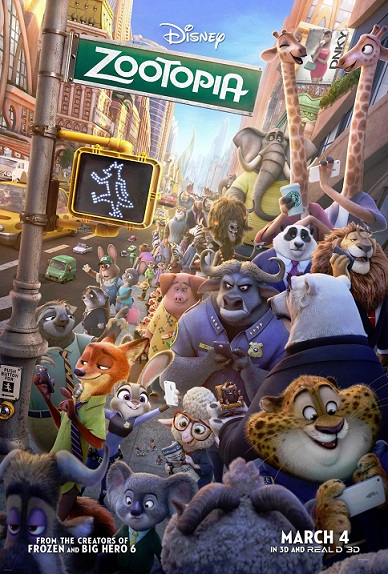
Zootopia: Not the Allegory You Were Expecting

by tryanmax

I’ve got to hand it to Disney. I think they’ve really pulled one over on the identity politics crowd. With their latest smash-hit Zootopia, the studio has given the usually unquellable race-baiters, gender-warriors, and plain ol’ Disney haters an allegorical placebo to shut them up. So satisfied are they that Disney finally “gets it” that one outlet went so far as to regard the new film as an apology for Song of the South, a film known almost solely by distorted reputation alone.
Spoiler Alert
All Disney really did, though, is recognize identity politics as a thing. The only message they conveyed with Zootopia on the matter is probably the best one that anyone can actually offer. Simply, “It’s complicated.” Let’s take a look at what they did.

I won't be discussing the plot, which is a twisty noir-ish tale, directly. As such, this article assumes the reader has already seen the movie. For a film synopsis, see here.
Lookin’ Good
In more than one way, Zootopia is all about appearances. For one, it is a visual treat to the eyes. Disney imagination is on full display in creating a world where animals of every species, from tiny hamsters and mice to giant giraffes and hippos, live alongside one another in an urban landscape. I remarked more than once how the characters looked so fluffy on screen that I wished I could reach out and touch them.
That’s a good segue for how Zootopia creates the appearance of handling identity issues. In one scene, a fox does just that, grabbing and handling a sheep’s bouffant while delightedly remarking how fluffy it is. His rabbit companion admonishes him that he can’t do that. This is clearly a reference to the supposed problem of white people always touching black people’s hair.

The script is peppered with little nods to so-called “micro-aggressions” such as this. The police force has a “Mammal Inclusion Initiative” which is clearly an affirmative action program. Judy Hopps, the beneficiary of said program and the first-ever rabbit on the force, asserts that she is not “some token bunny.” In another instance, she informs a cheetah that it’s okay for rabbits to call other rabbits cute, but not for other species. There’s a scene where an elephant store clerk asserts his right to refuse service to a fox. The assistant mayor believes she is only on board to court the “sheep vote.” The terms “articulate” and “patronizing” are conspicuously dropped into a conversation. The list goes on.

All of this is meant to signal that Disney is in-the-know on issues that virtually everyone is already aware of anyway. Otherwise the gags wouldn’t play. So, because Disney can demonstrate their consciousness, some have assumed that Disney is actually addressing the issues. But like the (literal) political animals in their film, Disney actually dodges the question entirely by re-framing it.
It’s Funny ‘cos It’s True
Probably the most memorable scene in the entire film is the one that takes place in the DMV. Judy Hopps is in a hurry but, to her chagrin, the entire office is staffed by sloths. She actually exclaims, “They’re all sloths!?” because she naturally assumes all sloths are slow and, well, they are. It’s actually amazing how well this works for laughs, not just once, but over a dozen times in the course of a couple minutes. At the same time, it totally reinforces that stereotypes do have a basis in real trends. Later, the film also breaks the stereotype when the main sloth is pulled over for street racing, but this is still in service to the same gag. Sloths are funny ‘cos they’re slow, but they’re even funnier if they’re fast.

Again, Zootopia is full of these types of gags. Being a rabbit, Judy has 225 brothers and sisters. Her sidekick, Nick, is a fox and a street hustler. Judy tries questioning an elephant who can’t remember anything. The city’s mayor is a lion. The mob-boss Mr. Big is revealed to be a tiny shrew. A group of lemmings mindlessly follow each other in buying popsicles. A hippie yak is unwashed and swarming with flies. This is Blazing Saddles style humor in a form that can slide past trigger-warning and safe-space sensibilities.

The very makeup of Zootopia (the city within the movie) itself is a gag. It is as much a theme park as a city and it is deliberately segregated by species, just as if it were a human-run zoo. Districts such as Tundratown and Sahara Square provide appropriate habitats for different species, while a neighborhood like Little Rodentia scales the urban landscape to its tiny residents. It’s both humorous and sensible, but it pushes aside any pat solutions to identity issues.
Where da White Bunnies At?
If there is one thing about Zootopia that has the identity politics crowd grumbling, it’s that they can’t quite figure out which animals represent which group of humans. I think that’s by design. Even though the animals of Zootopia inhabit a world very much like ours, even featuring similar political issues, it’s impossible to say that certain animals represent certain groups of people. Rather, all the usual signifiers are jumbled up.
At first, it looks like rabbits and other prey are the oppressed minority. After all, historically they suffered at the hands of predators, as the opening scene points out. But that isn’t the case. It turns out that Zootopia is 90% prey, and they are often openly prejudiced against predators. Yet, somehow, the mayor is a lion and predators occupy positions alongside prey everywhere. In most cases, it actually appears that size matters most, with large species like buffalo and bears filling the police ranks and big mammals generally throwing their weight around. Driving this home early in the film, the assistant mayor buddies up to Judy to say, “Us little guys have to stick together.”

The more you parse the animal groupings in the film, the more complicated it gets. Any attempt to draw straight lines between Zootopia and the real world is going to get uncomfortable really fast. As I already laid out, in Zootopia, minority = predator = savage. That equation ends careers if brought into the real world.

As I see it, the point is not to draw lines between the cartoon world and the real world, as tempting as it may be. Instead, by sidestepping the usual identity markers Zootopia is actually able to tell a compelling story while inserting a non-polarizing message of mutual respecting in a way that is better than simply mirroring current events.
[+] Read More...

Thursday, August 6, 2015

Toon-a-rama: Minions (2015)

We’re taking a break from the 1970’s tonight.

Let me start by saying that I enjoyed Minions quite a bit. It was a solid movie with some good laughs and a few memorable moments. It did some clever things and it made me like the Minions even more than I did after the Despicable Me films. Now let me tell you what disappointed me, and let me do it by comparing Minions to Wreck-It-Ralph.

For my money, Wreck-It-Ralph is the best animated film in a very long time, if not ever. It is nearly perfectly written. It is beautifully drawn. And it does all the things the best stories ever do. Indeed, let me explain what makes it such a special film.
Several things make Ralph such an amazing film. What underlies them all, however, is the nearly perfect writing. First of all, the story idea is brilliant. The idea that video characters have these real lives once the arcade shuts down is super creative. The only thing I’ve ever seen with a similar concept is Toy Story, but the characters in Toy Story are much narrower because their lives revolve around being toys, whereas the characters in Ralph are more like real people, complete with neuroses and infighting and different levels of self-awareness. This makes for a much richer world with many more possibilities. They are also capable of a much wider range of emotions, which make them more interesting.

Indeed, Ralph is much more interesting than Woody because Ralph is not the archetype Woody is. Ralph is a flawed character who is unhappy with himself and must figure out what he truly believes. By comparison, Woody just needs to protect the other toys. Because of this, there is never a moment where you feel genuine emotion for Woody, but I guarantee you that you will cry when Ralph decides to sacrifice himself and he repeats the Bad Guy Affirmation with a whole new meaning to let the audience know what has motivated him:
“I’m bad, and that’s good. I will never be good, and that’s not bad. There’s no one I’d rather be, than me.”
Minions sadly, doesn’t have great characters. Yes, the three lead minions are funny and you like watching them, but there’s little you get out of them in the way of emotions. (The humans are, frankly, dull.) Why? Because they don’t grow. Ralph began as a villain with a hole in his soul. He tried to fill that hole in all the wrong ways and found himself a failure, seemingly doomed to be the same miserable Ralph forever. But then he finally comes to realize how to fill that hole, but doing so requires him to give up his life to save a little girl. His moment of epiphany is also a moment of tremendous tragedy. That’s why you cry.
The Minions never have that. There is no hole within them. There is no epiphany. And there is nothing to suggest that any losses they suffer matter in the least. So while the characters are fun and funny, they are ultimately emotionally empty.

Just as importantly, the humor in Ralph is just perfect. Every joke seems to fit the situation perfectly. And what helps cause that is that the culture references are done right. Cultural references have become the go-to form of humor, but few do them right. To do them right, you need to do what Ralph does.

In Ralph, the references are much more personal in nature. These references tended to be shared experiences rather than generic cultural references, e.g. recognizing the way characters slid along walls on the PS2 or the secret code on the Coleco or the difference between low rez and high rez worlds. All of those were things that gamers got because they were things we laughed about along the way. By comparison, bad films simply provide cultural references that anyone can get from watching a History Channel or MTV show about the particular period. They are the most obvious iconic moments of an era, so everyone can get the joke, but they means nothing to anyone. The Ralph references, on the other hand, invoke the hours of game play we experienced and the things we laughed about with our friends. It is the difference between a loving trip down memory lane versus a dull read through a history book.
Minions, unfortunately, is full of these generic references. For example, the film takes place in the 1960’s, so you will see a reference to a much referenced Beatles album cover. You will recognize it immediately, as will everyone else, but it will have no personal meaning to you. What’s more, these references aren’t even tied to the story in any meaningful way, they just appear. It’s a lot like a David Letterman joke where he makes some reference, smirks like a jackass, and let’s his gullible audience pretend that he told a joke when all he really did was make a reference... the Emperor’s New Clothes phenomena.

Ralph never does that. Its references fit the action perfectly and they always result in a punch line. They become how the point to the scene gets across, rather than just appearing as an aside.
What’s more, the jokes in Ralph are deeply layered. Consider the line where Ralph angrily denounces Pac-Man as “that cherry chomping dot muncher.” To kids, the visual speaks for itself as Pac-Man eats dots and cherries; indeed, Ralph has previously stolen a cherry from him. But adults also recognize this as a double reference to giving oral sex to a female... something the kids will never get. Notice too how perfect the reference is too that it describes Pac-Man entirely accurately yet uses virtually the exact words used for the oral sex reference. This reference is so perfect that it’s almost as if Pac-Man’s choice of foods was intentionally chosen to make the sexual reference. That is inspired writing!
Putting all of this together, in Ralph, you can laugh at the reference, if you get it, or at the joke if you don’t. And if you get the reference, then you can also enjoy the cleverness of how they worked the reference into the story, how they often twisted it slightly to fit the film, and the cleverness of how they turned the reference into a joke the kids get even if they don’t get the real reference. That’s a lot of humor packed into each joke. Minions had none of that. You either got the reference or you didn’t. There was no joke to go along with it, except that the Minions inserted themselves into the reference. There was no dual meaning either, with maybe only two exceptions (both visual jokes). Ultimately, the difference because of this is that you will laugh for many reasons at everything Ralph pokes fun at, whereas you will just recognize the things Minions references but you will feel no attachment to them.
This is what bothered me. Minions was fun and interesting, though it had the air of an Austin Powers copy, but it was ultimately very shallow and unsatisfying. It was good, but not great with only a couple memorable moments and nothing that raised emotions. Ralph on the other hand, grips you, makes you smile, digs deep into your memory and pulls out strong emotions.

Studying Ralph could have helped Minions a lot.

Thoughts?
[+] Read More...

Tuesday, November 18, 2014

The Lorax Teaches The Wrong Lessons

I had the misfortune of watching The Lorax (2012) the other day. In particular, I found myself shaking my head at the lessons it imparts. I guess I shouldn’t be surprised, but it still annoyed me. What lessons? Read on...

Throughout my life, I’ve discovered something interesting about the human race: we are a bell curve in all things. I’ve seen this over and over in every field I’ve encountered. I’ve seen it in early adopter rates, grade distribution, IQ distribution, and even advertising theories on how to influence the public. It’s everywhere. And where it has been most interesting to me is in the discovery that the human race can be broken into three groups when it comes to societal benefit, for lack of a better phrase. The theory works like this:
● 10% of the human population are good people who drive humanity for the better. The most obvious example of these people are inventors, artists, writers, and others who provide things that enrich or improve other people’s lives. But this category isn’t limited to those people. It also includes people who start businesses, early adapters, the rare teachers who inspire their students, and even just average people who become mentors to others and make the world a better place. Big or small makes no difference, these are just people who make things better.

● At the other end, 10% of the human population are malicious people who do bad things. Interestingly, only some of these people realize that they are villains. The majority of these people think of themselves as the good 10%, even though their instincts are malicious and their actions and ideas are highly destructive. You can see an example of this, believe it or not, with Hitler. If you ever see interviews of his staff, you will be shocked to learn that Hitler genuinely thought he was the good guy. You see this sometimes with serial killers too, who think they are doing God’s work, with busy-bodies who delude themselves that their desires to control others come from their “deep sense of caring” about others, and with people who just get off on causing problems.

● The other 80% of the human population are essentially sheep. They do what they are told by the people they recognize as authority figures. Interestingly, however, these people often think of themselves as independent thinkers who “make up their own minds,” and they react very poorly to any suggestion to the contrary, even though they never actually think for themselves... as an aside, these people are the reason so much advertising simultaneously combines the ideas of keeping up with the Jones while ridiculously claiming that buying certain mass-produced products is only for “people who think for themselves.” Disturbingly, these people have a hard time spotting the difference between the good and bad 10%ers and will just as slavishly follow a vicious negative 10%er as they would a good 10%er if they come to see them as the authority.
So what does this have to do with The Lorax? Well, The Lorax very clearly demonstrates these groups and how they work. Unfortunately, it presents the wrong lessons in doing so.

The Lorax is the story of a 12 year old Ted Wiggins. Wiggins lives in a walled city made of plastic and metal. It contains no trees. The reason it doesn’t have trees is that the mayor, Aloysius O’Hare, sells bottled oxygen. He knows that trees provide oxygen for free, so he works hard to make sure there are none in the city. What destroyed the trees originally was a man called Once-ler. He was an entrepreneur who cut down the trees to make his product. In so doing, he ignored the objections of the Lorax, which was a being who protects the trees. Once-ler didn’t intend to cut down all the trees and he came to realize his mistake, but he did it nevertheless... all except for one seed. He gives that seed to Ted, who tries to plant it.
As Ted tries to plant the seed, the mayor tries to stop him. The mayor even warns the people that what Ted is trying to do is dangerous because trees produce sap and other pollutants. Upon hearing this, the public turns on Ted and essentially forms a lynch mob. But then Ted denies the charge and one of the locals decides that Ted is right. He states his support for Ted. Suddenly, the mob declares Ted to be right and turns on the mayor. The story ends happily.

Here’s are the problems.

First, this film clearly breaks into the three groups. Ted is a good 10%er who wants to make the world better. He sees a way to improve it and sets out to do so. The mayor is a bad 10%er. He knows he’s the villain and he thinks nothing of using evil means to get what he wants, which is profit and control. Once-ler is also a bad 10%er, though he is one who doesn’t understand his own evil. He thought he was the good guy, making use of the trees in a way he thought was responsible to produce a product that people wanted and employ people who needed jobs. It was only later that he learned his mistake. Finally, the public are exactly what the 80% are like: fickle, stupid, and mindless followers of whomever they see as the authority figure in their lives.

It is interesting to see a film break down these groups so clearly. Unfortunately, the film doesn’t know what to do from there. Thus, for example, rather than pointing out that Once-ler is a villain, it essentially sells him as a victim. It shows him suffering at “the mistake” he made and being imprisoned for what he has done. It also let’s him protest over and over that he never intended to kill all the trees, without ever requiring him to explain why he ignored the obvious warning signs and took no care to prevent the problem that was so obvious. In effect, it removes his villainy and makes him a helpless victim of a mistake and thereby forgives his villainy without true remorse or even understanding. This teaches the wrong lesson as it eliminates the element of personal responsibility so long as you had good intentions. But good intentions are not and should never be considered an inoculant to criminal or evil or immoral or stupid behavior.
Compounding this, the film then sells the audience the standard comfortable view of evil through the mayor. Essentially, the film tells the audience that evil is easy to spot because it knows it is evil and it knows that it’s actions are wrong. This is absolutely the wrong lesson to teach. Basically, rather than teaching kids that you need to watch all of your actions regardless of your intent, lest you act in an evil or rotten manner, the film sends the message: “Don’t worry, evil is obvious and unless you set out to be evil, you’ll be fine.”

Finally, you have the 80%ers. This is the truly obnoxious message. These people mindlessly followed the mayor for years. Once someone pointed out his crime, they absolutely failed to rationally assess the claim and to decide if they had been mistaken in supporting him. Instead, they turned into a lynch mob, determined to silence the dissident. This failure should have been highlighted in a major way to the audience. But the film didn’t do that. To the contrary, it excused the 80% by having them switch sides moments later when the worker announced that he had decided to back Ted.
But this represents yet another horrible lesson. Whether Ted was right or not, the 80%ers undertook no independent investigation. They never thought through what he said, looked at his claim or even demanded answers. They simply switched sides because they felt the herd had changed horses when the workman announced his decision to switch his support. This is a horrible lesson. The 80%ers need to be taught to conduct an actual analysis, not merely to follow whomever they see as the most authoritative person at the time. For all they know, Ted is an even bigger villain or fool and they are about to make things much worse. They don’t know because they never stopped to investigate. And the film rewarded this kind of false reasoning by letting audience know that Ted is right. Essentially, the message remains: just make sure you follow the nicer guy, when it should be to truly think for yourself for once. That’s how Hitlers get made, because evil, which is never bounded by reality or reason, makes much better promises.

This is my problem with this film. The film correctly identifies these groups but then acts as a sedative to calm the 80% into thinking that evil will be easy to spot and fixing evil is as easy as watching to see whom the crowd prefers. These are ridiculous messages to send.

Thoughts?
[+] Read More...

Tuesday, September 23, 2014

Is Disney’s Princess and the Frog Racist?

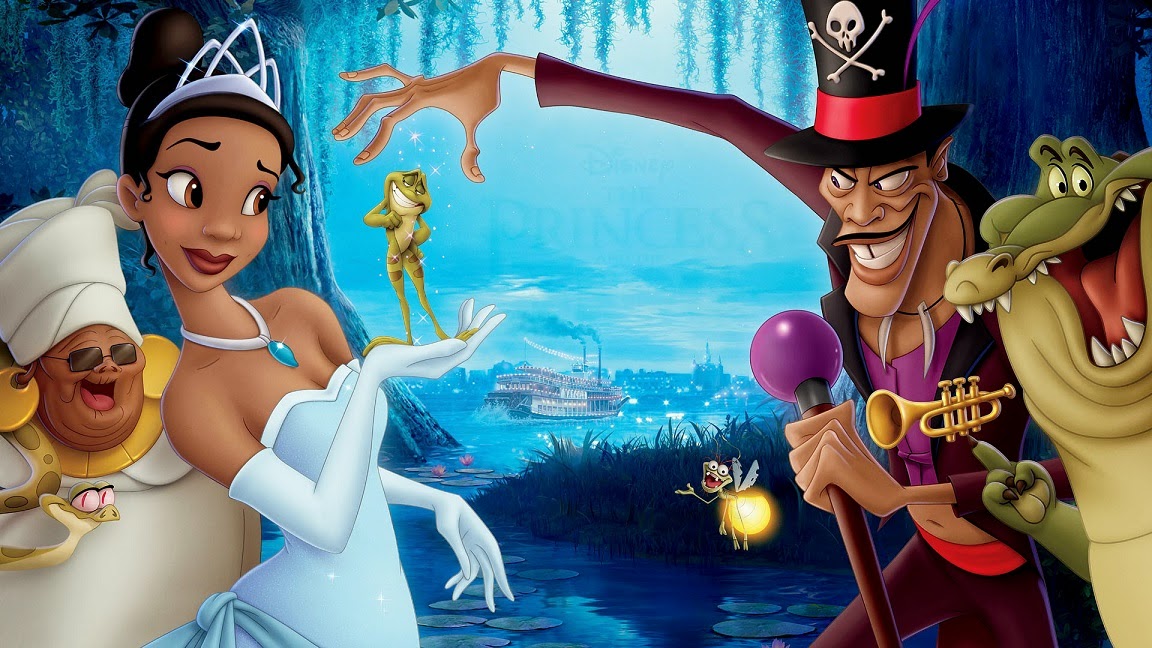
In its whole history, Disney has never had a black princess, at least until 2009 when it released The Princess and the Frog. But The Princess and the Frog is not a cause for celebration, claims the aggrieved-left, because the film is racist! Only, it’s not.

The Princess and the Frog is the story of Tiana, a black woman from New Orleans circa 1930s. She is a talented cook with dreams of opening her own restaurant, a dream she got from her father who has since passed. The story opens with Tiana working hard in a restaurant to save up enough money to buy an abandoned building to start her restaurant. She has finally saved enough! Hurray! Only, she's told that another buyer has appeared and she has only twenty-four hours to raise her offer, something she cannot do. Boo!
Tiana's friend is a spoiled, rich white girl named Charlotte, who wants to marry a prince, and it just so happens that a prince has come to town. This is Prince Naveen, who has been cut off by his family because he’s worthless and lazy. He and Charlotte are a perfect match -- he has the title, she has the money. However, the next time Tiana meets Naveen, he has been turned into a frog by a Voodoo witch doctor, who is plotting with Naveen’s servant to replace the prince, marry Charlotte and steal her fortune. Naveen convinces Tiana to kiss him to change him back into human form so he can prevent this. In exchange, he promises to buy her the restaurant. She agrees, but when she kisses him, she turns into a frog herself.
At this point, Naveen and Tiana must venture into the swamp to find Voodoo priestess Mama Odie so they can become human again. Accompanying them are Ray, a Cajun firefly, and Louis, a trumpet-playing alligator who wants to play jazz with the humans. Trying to stop them are the witch doctor and his army of shadow creatures.

All in all, this was an excellent Disney film, easily the best after a miserable decade for Disney. The story is fast paced and relatable despite being both ethnic and deeply Louisiana. The art work is beautiful. Bits of the film are clever. And the songs are well done in a Broadway sort of way, which is greatly appreciated after Disney’s two decade use of ultra-bland, entirely forgettable corporate pop, like the song Elton John and Phil Collins kept passing off as different songs throughout the 1990s.
So what could possibly be racist about this? Well, that’s a good question. Several attacks were made on this front. Some argued that it was racist that Disney's first and only black princess wasn’t born a princess and had, instead, to marry into it. Others argued that the film used black stereotypes. Neither argument is valid.
That Tiana isn’t a princess is a key plot point which makes the story work. It isn’t meant as a sleight or to devalue her character either. To the contrary, her character is easily the most noble in the story. Nor is there any suggestion of a racial component to her lack of princess status. In other words, there isn’t a single suggestion, spoken or implied, that her race is the reason she isn’t a princess to begin with. And it’s not like all Disney females are princesses (see e.g., Penny, Jenny, Alice, Eilonwy, Meg, Jane). Essentially, the only way to see the decision to start her as a commoner as being a decision based on race is to assume that based on her race alone.

The stereotype argument is even worse. For one thing, there are no negative black stereotypes presented. Each of the black characters is presented as smart, capable, and (except for the villain) strongly pro-family and pro-community. Nobody is living on welfare, selling drugs or having kids out of wedlock. Nor are there any presentations that fit the “Uncle Tom” mold. The closest would be Tiana’s mother, but she’s not a servant; she’s an ultra-talented seamstress and business owner.
Indeed, the more you look, the harder it becomes to find any black stereotypes. What you see instead are Louisiana stereotypes aplenty. You have toothless Cajuns, everyone being a jazz player, voodoo princesses and witch doctors, corrupt-but-lovable parish politicians, gumbo-lovers, etc. Similarly, you have all the trappings of New Orleans: the bayou, gumbo, riverboats, the light rail, gators, etc. Everything in this film is regional rather than racial.

I think where the “racist” argument springs from is the idea that it’s somehow racist to show blacks in roles they occupied historically if they are shown to be happy and not the victims of white oppression. Hence, the fact that Tiana doesn’t struggle against white oppression offends the aggrieved left as a whitewash. That is ridiculous, however. In fact, if you think about it, this argument would relegate every black story to being about white racism, and blacks could never tell their own stories without the focus being on whites. Now THAT would be racist!

Thoughts?
[+] Read More...

Tuesday, August 19, 2014

Summer of Films: WALL-E (2008)

WALL-E is a great film. On the surface, it’s a cartoon about a silent robot which falls in love with another robot. But it’s really so much more. In fact, WALL-E is the first Pixar film to truly show me the depth of their storytelling prowess.

Plot

Here’s the plot. In 2105, the Earth is ruled by a single corporation, Buy-n-Large Corporation (BnL). Because of pollution and garbage, the Earth has become uninhabitable. To solve this problem, BnL shoots the population of the Earth into space aboard luxury starliners, where they live in great comfort and happiness. Unfortunately, having nothing to do, as the starliners are automated and robots wait on their every need, the humans become morbidly obese and essentially incapable of movement as they become dependent on the machines.
Meanwhile, robots like WALL-E are left behind to clean up the garbage as everyone waits for the Earth to become habitable again. BnL, however, concludes that the Earth cannot be saved and it orders the automated starliners to take care of the humans in perpetuity.

WALL-E takes place seven-hundred years after the Earth was abandoned. WALL-E is one of the garbage robots, and the story begins when WALL-E discovers a small seedling on the Earth. He nurtures it, only to have it found by EVE, a robot sent from the starliner Axiom to search the Earth for signs of life. She reports her discovery, but when she does, the ship’s automatic pilot Auto, suppresses her discovery and tries to have her reprogrammed. WALL-E, who has fallen in love with her tries to save her, and she, WALL-E and the figurehead human Captain must fight Auto to free the humans from their gilded cage. At the end of the movie, they return to Earth where they discover millions of seedlings, and like Noah, they set about rebuilding the world.

Why This Film Excels

WALL-E is an amazing story. Why? Because it’s really several different stories, all told simultaneously and beautifully. For example, on the surface, WALL-E is a love story in which a robot which cannot even talk thoroughly convinces the audience that it has fallen in love with another robot. This is truly an impressive achievement. Having an audience believe that two characters are in love is already a difficult challenge. Making them cartoons doubles the challenge. Making one of them mute ups the challenge exponentially. And putting them into a story that is not a love story makes this a nearly impossible task... yet, Pixar pulls it off without a hitch or hiccup.
Next, WALL-E is an allegorical version of the story of Noah’s Ark from the Bible, but that’s just the beginning. Consider that Noah’s story is not exactly a strong story when it comes to filmability. Not to mention that Pixar doesn’t even get to use the spectacle of the flood to pump up the story. Further, the film takes place in the future, and it cannot be overtly religious. Again, these are serious hurdles that make Pixar’s ability to pull this off pretty incredible.

But there’s more... WALL-E is essentially Aldous Huxley’s “Brave New World” brought to film. Yes, it is. Whereas Orwell warned of a brutal, oppressive government crushing freedom, Huxley provided a similar warning in “Brave New World,” only he pointed out that government need not be heavy-handed to be insidious. Instead, it can use hedonistic pleasure to control the people just as easily as it uses violence. WALL-E delivers this identical message. Consider this:
On the surface, the humans seem happy. They have food and entertainment. They want for nothing. Notice also that the “government” is not inspired by evil. Indeed, Auto genuinely believes he’s looking out for the welfare of the people. His job is to protect the humans by keeping them on the ship, and that is all he wants to do. There is no better example of a benign dictator on film.

But first impressions are misleading or at least incomplete. The idea that the humans are happy is shown to be a mirage when they realize how helpless and dependent they’ve become. This awakens something inside them, something which drives them to regain their freedom despite everything they will lose.
The idea of Auto as a benign dictator falls apart as well. First, note that Auto suppresses information which runs counter to his mission. His motives may be good, but this is tyrannical behavior which strips people of the freedom to make their own choices. He even tries to destroy EVE, because he sees her as a danger to his mission. Suddenly, Auto’s methods are those of dictators the world over. Then, when the Captain orders Auto to set the humans free, Auto ignores his orders and fights the Captain to keep the humans prisoners. Essentially, in the name of doing good, Auto hides the truth, eliminates those who know the truth, and use his power to deprive the humans of their independence.

This is a truly subtle and difficult story to tell, yet Pixar does it and it does it without any false shortcuts, such as making Auto defective or secretly programmed to be evil. Evil just becomes natural to him because he has absolute power. Pixar lays this out without adding fake motives to try to explain away difficult truths. That's a hard sell for a cartoon. Add in that at the same time it does that, Pixar tells the Noah story and the love story, and you have a true achievement here.

Truly impressive.

Thoughts?
[+] Read More...

Tuesday, August 5, 2014

Guest Review: Fantasia (1940)

Fantasia and its sequel are like nothing else Disney, or any other major American studio, has ever made or attempted and is today widely hailed as a pinnacle in animation. However, when it was released, though the critical reception was mostly positive, audiences were less than thrilled, in fact Walt Disney later said in an interview that Fantasia “nearly broke us”, but defended it as an “artistic masterpiece”. He is right.

Fantasia is an art film. There is no other way to describe it. It has no overall story, linear or non-linear, instead it is a series of vignettes with each one centered around a particular piece of music, each introduced by Deems Taylor with the music performed by the Philadelphia Orchestra conducted by Leopold Stokowski. They are, with summaries, in order:
Toccata and Fugue in D Minor by Johann Sebastian Bach:
The Nutcracker Suite by Pyotr Ilych Tchaikovsky:
The Sorcerer’s Apprentice by Paul Dukas: A sorcerer
Rite of Spring by Igor Stravinsky
Pastoral Symphony by Ludwig von Beethoven
Dance of the Hours by Amilcare Ponchielli
Night on Bald Mountain by Modest Mussorgsky & Ave Maria by Franz Schubert
The first two feature absolutely no plot or story and are largely images to fit the music, especially Toccata and Fugue, which is here played on the strings rather than the usual organ, where the visuals can only be described as “impressionistic” in that they give a visual “impression” in animation of the music you are hearing. You “see” the violin strokes, you “see” the music played. In The Nutcracker Suite you have mushrooms and flowers dancing to the various tunes you hear in the suite.

The Sorcerer’s Apprentice is the most famous, with Mickey Mouse as titular apprentice to the sorcerer, Yen Sid (Hint: spell “Yen Sid” backwards). You probably know the story, the sorcerer having told the apprentice to fetch pales of water goes to bed leaving his magic hat behind. The apprentice then uses the hat to make the brooms do it for him but soon finds he can’t control it.
Rite of Spring uses Stravinsky’s most famous ballet, and one of my personal favorites, to tell the story of Earth from its birth in the cloud of dust around the sun and the volcanic eruptions of its early days to the ultimate rise and eventual extinction of the dinosaurs.

Pastoral Symphony features various “pastoral” creatures of Greek mythology such as centaurs and faun dancing and frolicking with the Greek god Bacchus in the day until Zeus appears and scatters the partying flock with his thunderbolts. This one is mostly light-hearted after the dark Rite of Spring.

Dance of the Hours, famous for providing the music for Allan Sherman’s “Hello Muddah, Hello Faddah” is even more light-hearted and comical with dancing ostriches, hippos, and an alligator chasing his hippo, not because he wants to eat her but because he has fallen madly in love with her.
A Night on Bald Mountain & Ave Maria is the final one and tells of the slavic god Chernabog (read: Satan) calling the ghosts and demons to Bald Mountain where he holds a terrifying black mass until the morning church bells chase him away. Fantasia then ends on a chorus singing Schubert’s Ave Maria.
What is Good About It
The animation and the music. Each one is genius in its own way and will have you watching and re-watching again and again. From the stunning strings of Toccatta and Fugue in D Minor to the beautiful chorus at the end the music is fantastic and needs little praise. The presentation is fantastic whether its the dramatic death of the dinosaurs, the terrifying demon Chernabog on Bald Mountain, or the hopeful, heavenly chorus of Ave Maria that closes the movie out.

But splendid animation and music does not a great film make. The true genius of the movie is that it never tells you what to take from it. There is no dialogue and Deems Taylor’s narration only gives a basic outline of what you are going to see, so the interpretation of it is largely up to you. You are never told how to feel about the events of the movie. You are never explicitly told how to feel about the dinosaurs dying out. It is shown, it happens, and the emotional response is up to you.

This means you cannot watch it like a normal movie. You can’t listen to dialogue and say. You have to free your mind and let the movie, and its images, music, and emotions wash over you. You can’t watch it, you have to experience it.

If Snow White is prose, this is poetry.

I will acknowledge, however, that certain moments are rather dull, for example, the Nutcracker Suite can drag on too long. And the movie, as you might have guessed, may be too adult for young children. But its an “artistic masterpiece” and one that is definitely worth checking out.
[+] Read More...

Tuesday, July 15, 2014

Summer of Films: The Hobbit (1977)

One of my favorite animated films is The Hobbit. This classic blows away the sluggish, misguided six-hour bore-a-thon in theaters today. This one had heart. It fit the book perfectly, both in terms of content and feel. It was so well done, in fact, that once you see it, it becomes impossible to separate from the book.

Adaptations of books are always difficult. Should you do a straight up adaptation or should you only use the book as a guide? And even if do you a straight up adaptation, how do you handle the things that work well in books but simply don’t translate to film? These are all common problems, but none of these affected The Hobbit. Indeed, The Hobbit did it all perfectly.
The Plot: Unlike the Jackson film(s), which use The Hobbit as a base to make a completely different film, the 1977 The Hobbit follows the story very closely. In many ways, watching this version is the same experience as reading the book, and that is a good thing. In fact, not only does this version follow the plot as written, but it even gives you a similar feel. To me, this is the most remarkable aspect of this adaptation. When you watch this film, you get the same sense of timing, of tension, and of adventure that you get reading the book. That is rare indeed. By comparison, the modern film is nothing like the book in any of these categories.
The Images: Interestingly, the images presented in The Hobbit fit the story so well that it becomes impossible to separate the movie images from the book after seeing them. What the animators have done which helps them in this regard is that they’ve taken the time to make each named character distinct, they’ve paid attention to how they are described in the book, and most importantly, they’ve avoided the urge to “be cool.” This is the problem with Jackson’s interpretation. Jackson wants everything in his films to seem cool, so he basically copies the style of other modern films and comic books. The Hobbit copied nothing. The result is unique characters who appear as imagined rather than unrecognizable characters meant to compete with other action and superhero flicks.
The Characters: The best thing about The Hobbit is that it maintained the character arcs throughout the film. Bilbo has a brave imagination, but lives as a cowardly ninny. As the story progresses, he must learn independence and how to endure discomfort and the unexpected. From there, he must find confidence, cunning, and finally bravery. None of this remains in the Jackson version, but it’s all here and it truly makes this Bilbo’s journey from what he was to what he becomes, which is the point to the books. Similarly, the dwarves are selfish blowhards who need to learn to be better people. Again, Jackson skips this and makes them all accomplished warriors. This film doesn’t. The end result is a movie with characters who actually grow before your eyes, rather than just move from scene to scene.
The Music: Interspersed throughout the film are several songs. Some are sung by the dwarves, some by the elves, and some by the goblins. The songs in the Jackson version are overproduced and uninteresting. But the songs in The Hobbit are amazingly memorable. Indeed, I can still sing parts of each even when I haven’t seen the movie in a decade. Not only that, but they add a feel to the film that the Jackson songs do not. When the goblins sing, it feels ominous. When the elves sing, it feels wistful. When the dwarves sing, it feels mischievous. And the reason is that these songs are simple but telling of the inner-character of the characters. Since Jackson’s characters have no inner-character, those songs are just entertainment.

The one downside I would say with The Hobbit is that the animation is a bit stark. It’s a lot like Charlie Brown where a couple squiggles pass for a battle. But ultimately, that’s not much of a flaw because the story is so strong and the rest of the animation is so spot on. If you haven’t seen this one, you absolutely should.
[+] Read More...

Wednesday, June 25, 2014

Guest Review: The Lorax (2012) versus Fern Gully (1992)

by tryanmax

Those Holly-weird tree-huggers are always pushing their eco-weenie agenda onto our children. How dare they! Why can’t they leave us to trash the planet in peace? Apologies for the sarcasm, but it’s always been a point of irritation to me that conservatives have completely abandoned the cause of conservation. They share a root-word, people! I’m not saying that conservatives should start chaining themselves to giant sequoias, but knee-jerking against environmentalism looks like promoting pollution and destruction. Not good.
To better illustrate this point, let’s examine two animated films with similar themes: Fern Gully (1992) and The Lorax (2012). Both movies have been roundly criticized by the right as propagandizing to children by both pushing environmentalism and criticizing capitalism. But is this a fair assessment? In regards to Fern Gully, I say unequivocally, “yes.” But in regards to The Lorax, I think conservatives have leapt without looking.

First, a very brief synopsis of each:

Fern Gully is about a tribe of rainforest-dwelling fairies whose giant tree-home is threatened by a logging operation. The loggers are somehow being controlled by an ancient spirit of carbon emissions and petroleum byproduct. One fairy shrinks one of the loggers to her size so he can learn about the wonder and beauty of the blah, blah, Zzzzzzzzzz… Oops! I bored myself to sleep. Basically, it’s Avatar but it came first. Oh, and if the message that “humans are bad” isn’t driven home strongly enough, bat-Robin Williams raps about how evil they are.

The Lorax tells about a young boy living in a hyper-developed city who wants to find a real tree to impress a girl. To do so, he must find the Once-ler, who will tell him the tale of the short-sighted industrialist responsible for wiping out the Truffla trees that once covered the now barren and polluted land surrounding the town. At first the boy is impatient, wanting only to get his tree. But as the story unfolds, both come to realize the need to conserve the resources they depend upon.
I clearly have no love for Fern Gully. As propaganda, it’s about as subtle as a Molotov cocktail. It’s only saving grace is that its formulaic predictability works to undermine the intended message. Nature is worth protecting because it is magical and sacred and pollution is cast as opposing black magic. Responsibility is even shifted onto a giant black smoke monster who dupes the unwitting humans. At the end of the day, the message is simply to direct your faith/love/whatever toward the correct deity. This is pure emotionalism: pollution makes baby fairies cry.

While I’m poking at Fern Gully, I may as well point out its other flaws. This film traffics in the classic racist-liberal pairing of white man’s burden and the noble savage. The fairies are helpless to save themselves, despite possessing ancient wisdom and awesome magic, without the help of an obviously dimwitted youth of European descent. Plus, the film has aged terribly, not that timelessness is to be expected of every film. Stupid hairdos and ridiculous slang are forgivable, but having Mork from Ork rap should’ve been an obvious blunder at the time.
Just as obvious, I think better of The Lorax while admitting that it is hyperbolic in ways. However, that is how it achieves its impact, by extending real attitudes and actions to a satirical level. That Dr. Seuss imagined ends that remain fantastic to this day is impressive. Electronic trees and bottled air are ideas meant to be so absurd (for now) that everyone can’t help but agree about their badness. All can come together in the name of preventing something that likely wouldn’t happen anyway. Even the titular Lorax backs away from his absolutist cut-no-tree position.
However, conservatives don’t seem to be in on the joke. Reacting seriously to these absurd ideas, calling them indictments of industry or capitalism, ends up sounding defensive of wanton waste and pollution. Yet that is exactly how a lot of conservatives have reacted. They defend the obvious villain in the film and wonder why they are regarded as villains. Worse, they criticize the character who realizes the error of his material wastefulness which stands at odds with the usual conservative criticism of fiscal wastefulness. And if that weren’t enough, they equate The Lorax, a comparatively subtle fable, with Fern Gully which has even been dismissed by environmentalists as a blunt fairytale. In other words, conservatives come off as evil idiots.
It also doesn’t help that The Lorax is a pretty decent film in its own right. Dr. Seuss’ visual and narrative style is paired with catchy, Broadway-esque musical numbers. This bodes well for the potential longevity of the film, making it an even worse target for ridicule. Just to be clear, I’m not saying that conservatives should go soft on a film just because its production values are high. Unlike the ham-fisted, eco-magical Fern Gully, The Lorax ultimately finds a middle ground between conservation and modernity. Conservatives would do better to actually consider the content of a film before criticizing it.
[+] Read More...

Tuesday, June 24, 2014

Toon-arama: Spirited Away (2003)

Hayao Miyazaki's Spirited Away is a beautiful and enchanting fantasy film about a young, pre-teen girl's coming of age. This is a great movie for young children, especially girls who are around the title character's age, and for audiences in general who want an entertaining and gloriously made work of art that they will remember and return to for years to come.

Note: I’m reviewing the Disney dubbed release, not the Japanese release, which I have never seen.
The Plot
The movie is about Chihiro, a 12-year old girl who is unhappy that she is having to move to a new town. On the way they get lost and find themselves at an abandoned amusement park. But while they are there the sun sets, spirits awaken in the theme park, and her parents are transformed into hogs.
Panicked and afraid she flees and is saved by a mysterious boy who can change into a dragon named Haku. He helps her get a job at the place, which is revealed to be a spa of sorts for spirits/gods owned by Yuba, who has Haku under her control. There she hopes to work and keep her parents from being fed as hogs, with no idea if she will ever be free from Yuba.

This is about all I’m going to explain as I’ve pretty much set up the plot and the rest of the movie is Chihiro undergoing a series of fantastical events and trials involving such things as a spirit that feeds on greed, what appears to be a sludge spirit, and a mysterious train.
Why its Awesome
The first reason is Chihiro. At the beginning of the movie she is sullen over having the move and at times early on in the movie she can be rather whiny. And when the ghosts appear, she reacts much like a 12-year old girl would react: she panics. Then she spends much of the first half scared and bewildered. This is not the super-capable and super-amazing girl that many movies feel the need to show us. This is a normal, pre-teen girl.

But we like her because we see the good in her. Once she realizes she is in this strange world for the long haul she shows incredible perseverance and strength, even when she is scared to death. Which makes us like her even more. Thus we have a character who is realistic enough to relate to but likable enough to root for.
The second reason is the animation by Hayao Miyazaki. This stuff is simply gorgeous and brings to life a world that is utterly alien. The work here tops even the best of Disney Studios. The movie is filled with colors and the animation moves beautifully. This is animation at its best and proves that even animated movies made for children should be seen as works of art in and of themselves.
There is also the music composed by Joe Hisaishi. It ranges from tender piano pieces to sweeping, brass-accompanied works that perfectly convey the wide range of movie’s emotions from the sadness and isolation of Chihiro to the fear and excitement of the spirit world. Highlights are the soft “One Summer Day”, the somber piano melody “The Sixth Station”, the exciting “Procession of the Spirits”, and “Reprise”, which is often called “Waltz of Chihiro”.

The only flaw might be the voice acting behind Chihiro, as she can scream a lot and some might find her too whiny for the first part of the movie. But that is a minor beef.
This movie could be called a Wizard of Oz for our age. It takes a young girl and thrusts her into a land that is completely unfamiliar and forces her to grow and mature. The movie has some frightening images and so it might not be good for some kids, it's nothing worse than Snow White or nightmare-haunter Pinocchio, but its well-worth watching regardless. Its one of the best movies I have ever seen.
[+] Read More...