Showing posts with label Laurence Fishburne. Show all posts

Thursday, March 12, 2015

Film Friday: The Signal (2014)

Arg. I hate you Lost. You taught “writing fraud” to an entire generation of writers, and now I’ve been defrauded by The Signal. Grr. I almost liked this film until the ending.

Plot

The Signal opens with three dirty teenagers who are going toward the Nevada desert in their car. They seem like jerks and there is some emotional issue with the girl, but honestly, who cares... it’s just filler. The reason they are going to the desert is that they are tracking a computer hacker who hacked into MIT, where they go to college, and ruined several servers, including their own. In doing so, the hacker somehow shifted the blame to them and they were nearly expelled. Now they plan to find this person, who goes by the name NOMAD, and “expose’ him.

After a few minutes, they arrive at the plot. They go into the abandoned desert home where the hacker supposedly lives and they find it empty. Then everything goes black. When the main character Nic awakens, he finds himself in what appears too be a dingy hospital, where everyone wears protective clothing. On his arm, he finds the tattoo “2.3.5.41.” His friends are nowhere to be found.
With Nic awake, he soon finds himself being questioned by government scientist Dr. Wallace Damon (Laurence Fishburne). Fishburne assures him that the hacker they were following was no hacker. He was instead an alien. Nic, kind of believes him, but not really until Nic tries to escape only to be thwarted by the alien apparently escaping and causing serious damage to the facility.

As the questioning sessions continue, Nic finds his girlfriend, who is in a coma, and makes contact with his other friend through the vents, though Fishburne assures him that is not really his friend. Nic, naturally, argues with Fishburne and doesn’t trust him. He then tries another escape attempt only to discover that his legs, which were useless due to muscular dystrophy, have been replaced by the alien with metal legs with serious superpowers.

Nic finally escapes and finds his other friend. He also manages to wake his girlfriend from the coma. The film then turns into a chase film with several more reveals before the ultimate ending.
What Pissed Me Off

Let me start by saying that I actually enjoyed this film a good deal as it progressed. No, I didn’t like the start, but once it got past that “grungy teens with emotional problems driving somewhere art film” section, the film actually started to build a really good mystery. It was well-enough paced at that point to hold my attention. The characters were interesting too, even if they weren’t all that smart. Nic in particular felt very clichĂ©d, but Fishburne was interesting. The story also seemed to build very well, as did the mystery.
But then we hit the ending, and that ruined the film for me. Why did it ruin the film for me? Because it became obvious to me that the filmmakers had no idea how to end this film and how to answer the questions they had asked the audience to contemplate. And that made the whole film feel like a fraud.

MAJOR SPOILER ALERT

Here is the mystery the film builds. First, it presents this mysterious hacker who seems all powerful. And when the heroes find his home, it is empty. So who is he and what does he want? Why did he pick on them?

Then Nic wakes up in a government facility with Haley in a coma and his other friend missing. Nic also has this mystery tattoo, which he comes to believe means “Area 51” because that is what the numbers add up to. So where is he?

As Nic is questioned by Fishburne, you begin to wonder what Fishburne really wants. His questions seem pointless and it’s not clear why he seems to be holding Nic as a prisoner. He tells Nic that the hacker is really an alien and shows him some proof that is hard to believe. Then we see the residue of the alien attacking the facility, and that is really shocking. So is the alien evil or is Fishburne evil and the alien is his prisoner?
Suddenly, we are shocked to discover that Nic’s legs have been replaced and the new legs he has have super powers.

At this point, the film has raised so many questions. Who is the alien? Why is he here? Is he good or bad? He seemed like a malicious hacker and he seemed ultra-dangerous given the damage he did to the facility, but if he’s so dangerous, then why would he give Nic new legs?

Nic then escapes and we discover that Haley wakes up from her coma the minute they leave the facility and his friend has had his arms replaced. So the alien is good? But then we start meeting the locals and they all seem like they have been brainwashed to worship the aliens. So what the heck is going on? Fishburne also tells Nic that he can’t protect Nic from the aliens if he’s outside the facility.

But then Fishburne starts shooting people.

This is the moment, the film started to concern me because the characters seemed to become rudderless. Nic is ostensibly trying to escape, but just seems to run around randomly. Fishburne is following him, shooting everyone he comes into contact with for no reason I can tell. The alien gets dropped from the story. Fishburne then removes his protective clothing and shows us that his head is made of the same material as Nic’s leg, meaning he’s the alien? Or what?
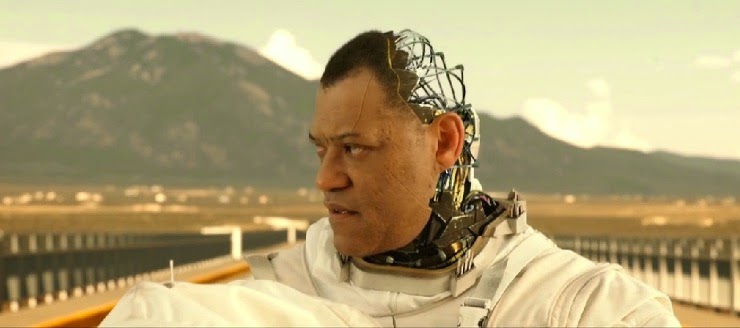
All of this feels like the film is unwinding and the filmmakers didn’t know what to do, so they opted for chase scenes and actions that made little sense.

Then the ending arrives. The film ends when Nic runs across a bridge and breaks through a glass wall. The camera pans back and we see that he is onboard a massive spaceship. The credits role. No attempt is made to explain anything. How did Nic get aboard the spaceship? Why did the aliens do the ruse at all? It makes no sense and doesn’t seem to have a purpose that they would tell Nic about themselves or that they would do it in this manner. And why give Nic the new legs, especially as they are powerful enough to let him escape the holodeck or whatever it is, and why make him feel like a prisoner who needs to escape after giving him the legs? What are the aliens thinking?
If the aliens are good, then why pretend to be bad and why make Nic go through the whole fake prisoner thing just to give him new legs. And if they are evil, why give him powerful new super legs? It makes no sense and they don’t even try to explain it. They just give you this fake ending that is meant to trick you into thinking that they revealed the final mystery that explains it all!

This pisses me off.

If you’re going to sell a film to the audience on the basis of a mystery, then the mystery needs to be answered or it needs to be presented in a coherent enough way to allow the audience to think they understand it. Otherwise, it feels like fraud. Why? Because when these clues are presented as part of the same story, there is an assumption in the human mind that these clues will fit together as part of the same story and together will tell us something deeper about the story. Unfortunately, Lost taught a generation of writers that it is enough to just toss out clues without ever tying them into anything. But that’s bunk. In effect, the writer is asking for credit based on work they never did: judge my mystery even though I never bothered to think one through. And discovering that the writer has cheated feels like one of those moments where someone asks you a riddle they don’t know the answer to, or tells you a story to which they don’t know the ending... deeply frustrating. And that is not how films should make you feel.

Look, you can leave unanswered questions, but you need to provide enough clues for the audience to feel like they can answer the mystery. This film doesn’t do that. To the contrary, this film leaves you feeling like the writers didn’t know how the story should finish and they hoped that by throwing up a big, though meaningless, reveal to end the film that the audience wouldn’t be smart enough to see their failing.

Grrr.

Thoughts?
[+] Read More...

Friday, July 27, 2012

Film Friday: Contagion (2011)

Contagion begins with one person passing a disease to another. They spread it to others. All these people die within the first couple minutes of the film. The next few minutes involve CDC members trying to track down where the disease began. From there, the film becomes the disjointed story of several individuals who really don’t do anything, nor are they interesting. Indeed, nothing about this film is interesting.

** spoiler alert **

Though critics fawn over him, Steven Soderbergh is hit or miss as a director. For every Sex, Lies and Videotape and Ocean’s Eleven there’s a Solaris and The Informant!. When he hits, he’s provocative and stylistic. When he misses, he’s predictable and boooring. Contagion is a “realistic” portrayal of a highly contagious and lethal virus spreading through the modern world. “Realistic” is in quotes because the film takes itself very seriously, but there’s no substance behind the air of realism. In this regard, Contagion is like Soderbergh’s Traffic: polished, serious, and intensely shallow.

Contagion acts like it’s presenting a scientific and non-fictiony view of virus-events, only it really isn’t. There’s almost no science presented and the serious tone masks the fact that the story is nothing more than a couple characters making uninteresting personal decisions. We do see the virus pass from person to person, but only for a minute or two -- Outbreak did this with much greater tension, as have most zombie films. They also try to track down the first person to get the disease, which could be interesting, except it gets resolved almost instantly and they don’t even tell us why it matters. At one point, they seal off Chicago, which could be interesting, except you don’t get to see it happen.
So what do we get instead? Instead, the film is about bureaucrats harassing Kate Winslet for no reason, Laurence Fishburne agonizing over bringing home one CDC employee when two million have already died and calling his fiancĂ© to tell her to leave Chicago, which briefly becomes a scandal that goes nowhere. We also see Matt Damon agonize that he can’t open the door to his house to let his daughter’s boyfriend in for a quickie, and Marion Cotillard makes an appearance as a doctor, though I honestly can’t tell you why. Elliot Gould appears too for some reason. Yawn.

The only thing this film really offers that’s somewhat original is Jude Law as Alan Krumwiede, an anti-government, conspiracy-theory blogger who sells his soul to a hedge fund and tells people they can cure this disease with snake oil. This is about as close as the film gets to an interesting storyline. Yet, while the film spends a lot of time on his character, you are never once shown any effect his actions have on anything. He just talks about getting a lot of page hits and the CDC people are upset at him. But it’s never even clear if he’s lying or what motivates him, nor do you ever see a single person get hurt following his advice.
So how could this film have been improved?

Well, for one thing, it needs focus. The Andromeda Strain created a compelling plot by focusing on whether or not the disease would escape the lab. Quarantine focused on a small group of people trapped with the infected as the government tried to bury the problem. The Crazies showed a group of uninfected trying to escape a town the government sealed off. Zombie movies, like Pontypool and Day of the Dead, thrive in portraying the early moments before the public is aware what is happening, and in showing the exponential math of infection. The Stand took another approach and built around the survivors, even as the virus was only starting. Twelve Monkeys showed mankind trying to rebuild afterwards. In each of these instances, the film followed characters whose survival was important. Their stories became the story of how the disease either spread or was stopped. As they learned information, you learned information, as they lost friends, you felt the loss. This pulled you in to the story.

Contagion isn’t like that. None of the characters in Contagion actually matter. If they all died in an industrial blender the moment the film began, not a single thing would change in the virus portion of the story. Even worse, these characters never learn anything they can pass on to the audience. Instead, the information is presented over radio broadcasts or it appears on the screen like an update. Thus, there’s no mystery and you have little actual connection to the virus story, it just seems to be going on in the background, even though these characters are presented as the most relevant characters to watch. That makes the film feel somewhat fraudulent bereft of drama.

Compare this film to Outbreak. Outbreak fell apart when it did the “crazed soldier” thing toward the end, but until that point the film was quite strong. Outbreak followed one character who had the ability to discover, diagnose and treat the virus, and it became the story of his race against the clock and the seemingly real hurdles he faced. Throughout the film, we knew little more than he did, and when we did it was used for dramatic effect. By comparison, in Contagion information gets handed out regularly and with little drama. For example, you will suddenly see the words, “2.3 million dead” written on the screen, which should be horrific except it’s just a number the way it gets presented. Moreover, in Outbreak, people close to the hero died, people we got to know. In Contagion, you almost never see anyone die and when you do, they are typically introduced as they are dying. So they’re all strangers.
This is why Contagion went wrong: it pretended it was a realistic portrayal of the spread of a deadly virus, but it gave us no realism, no science, no mystery, and no characters who mattered to the virus story. And the personal stories of the characters we were given just weren’t interesting, nor did they ultimately feel particularly relevant to anything. This was how Traffic felt. That was a film that seemed on the surface to be a serious exploration of the drug trade from Mexico to the United States, but there was no depth and nothing we hadn’t seen before. And the characters you did follow weren’t relevant to the larger point of the film, except that they were all anecdotally touched by the drug trade. It’s the same thing here. These characters don’t drive the story, they are passengers, people who kind-of-sort-of relate to the spreading of the virus.

Ultimately, a genuine story about the spread of a disease could be a fascinating film, but it needs to offer more than a glossy version of every other virus story. It needs to connect to the real people who make decisions so the audience can see how the important people would respond and the challenges they face, and it needs to connect us to the scale of death in a very personal way. Simply reading numbers of dead is not enough. Contagion does none of this.

[+] Read More...

Friday, May 4, 2012

Film Friday: The Black Hole (1979) v. Event Horizon (1997)

Disney’s The Black Hole and Paul Anderson’s Event Horizon don’t seem to have much in common. Black Hole is classic science fiction with robots and mad scientists and questions about the meaning of life. Event Horizon is a slasher film set in space. So why compare them? Because they’re actually the same movie.

** spoiler alert **

Black Hole has a fascinating history. It was the first Disney film not classified as suitable for all ages and it made $36 million at the box office and another $25 million in rentals on a $20 million budget. This success led Disney to experiment with more adult-oriented films, which led to the creation of Touchstone Pictures.

Black Hole is the story of the crew of the USS Palomino, whose mission is to search the universe for signs of life. In the process, they discover a derelict ship hovering on the edge of a black hole. This is the USS Cygnus, captained by Dr. Hans Reinhardt (Maximilian Schell). After boarding the ship, they discover that Reinhardt is still alive. He’s surrounded by robots -- drones, security troops and a sinister robot called Maximilian. Reinhardt claims the original human crew abandoned ship when the Cygnus was damaged. He stayed aboard hoping to save the ship and continue his research. In the twenty years since the ship went missing, he has perfected an anti-gravity drive and he now plans to use that to take the Cygnus into the black hole itself. Soon, Reinhardt’s story starts to unravel and the Palomino crew discover that the Cygnus crew never left, they have been turned into these drones. Reinhardt tries to kill them and a running battle ensues. During this battle, the Cygnus enters the black hole, which we learn is a gateway to both Heaven and Hell.

Despite surface differences, Event Horizon is rather similar. In Event Horizon, the crew of the Lewis and Clark are dispatched to investigate and rescue a derelict ship. That ship is the Event Horizon, which vanished seven years prior. It vanished because it was using a gravity drive which harnesses the power of a man-made black hole. When the original crew operated the gravity drive, that drive sucked them to Hell. It then returned the ship after the crew slaughtered each other in an orgy of blood. Like Black Hole, there is a mad scientist in the person of Sam Neill, who designed the Event Horizon and is a passenger on the Lewis and Clark. The return of the ship pushes him over the edge of sanity and he eventually tries to kill the crew of the Lewis and Clark, and that’s the whole plot. This film was a bust making only $26 million on a budget of $60 million.

So consider this: both stories involve derelict ships found by rescuers. They are derelict because of black holes, which become the cause of the plot. Both black holes lead to Hell. Both films involve killer mad scientists as the villains. Both films have someone on the rescue ship who lost a family member when the derelict disappeared. Both rescue ships get destroyed, as do the derelicts, and both crews escape in lifepods. That’s pretty similar. Yet, Event Horizon stunk whereas Black Hole is truly an under-appreciate gem. Here’s why.

Event Horizon is one of those films with lots of promise which never pays off, which is typical of Paul Anderson films because they lack substance. Look at the characters for example. Despite having a solid cast (Laurence Fishburne, Sam Neill and Jason Isaacs), you never care about the characters because they’re all the same. They all have the identical motivations and personalities. You could literally swap their names and jobs halfway through the film and no one could tell. Black Hole, by comparison, has inferior actors, but vastly superior characters. Each characters has their own strengths and weaknesses which make them relevant and memorable. Captain Holland is smart and cautious. Lt. Pizer is reckless and brave. Booth (Ernest Borgnine) is cowardly. Dr. Durant (Anthony Perkins) is easily awed and becomes torn between the crew and Reinhardt. Kate McCrae (Yvette Mimieux) has ESP, and VINCENT (Roddy McDowall) is the feisty, brave and motherly floating robot sidekick. The Black Hole crew are interesting and unique, with each guaranteed to have their good and bad moments in the story. The Event Horizon crew are just bodies to be fed into the special-effects grinder at regular intervals.

Now consider the villains. In Event Horizon the villain is ostensibly the ship, only the real villain is Sam Neill. And while I normally like Neill, here he just plays the standard “appears out of nowhere, says something evil, slaughters crew” type villain. You can’t remember a single line or moment. By comparison, Black Hole has three layers of villains, plus a surprise villain in Borgnine. The first layer is the security robots, who are easy to evade unless they appear in great numbers. Then you have Reinhardt who is crawling with complex motivations. He’s upset the world hasn’t recognized his genius and he’s obsessed with entering the black hole. He’s also gone mad living alone and fears Maximilian. Finally, you have Maximilian, who is a silent mechanical killing machine, like an early terminator, who becomes the personification of Satan. This affords the heroes in Black Hole a much greater and more interesting challenge.

Interestingly, Black Hole also becomes the more effective horror film, even though it’s not a horror film. And no, I’m not kidding. Black Hole means to be science fiction, not horror, but it has a tension which ratchets up repeatedly and leaves you with chilling psychological questions. The film begins with the discovery of the seeming ghost ship, the Cygnus. The ambiance is eerie because it is the kind of environment you can easily imagine where people once occupied the ship and now they are gone to some unexplained fate. It’s like being in an abandoned building where you know something evil happened, and it plays on our fear of being alone, fear of being hunted, and fear of the unknown. Then the Palomino crew discover that the drones are what is left of the original crew, who now live in a desiccated, zombie-like living-death existence. The terror of being imprisoned as the walking dead within your own body for the last twenty years suddenly hits the audience. Finally, the fight for survival begins.

Event Horizon offers no such mid-level tension, it just proceeds from creepy arrival to bloodbath. The ship is dark and ugly and unrealistic, and the plot is entirely watching these people get blown up and sliced apart in an orgy of blood. It’s all very gross and very generic. Yawn. The difference is this: Black Hole touches upon things that scare us and leaves you with several disturbing thoughts to consider when the film is over, Event Horizon leaves you with some ugly pictures you soon forget. Supplementing this, Black Hole has a masterful John Barry soundtrack which has a dizzying effect and supplements the emotional triggers of the film. Event Horizon has a forgettable heavy-metal soundtrack.

The endings are substantively different as well. Black Hole poses the interesting question of what lies beyond the event horizon of a black hole, and it answers that Heaven and Hell are there. It then suggests a view of both, with Hell involving fire, perpetual slavery, and loneliness. Event Horizon sets up the same premise that black holes are gateways to Hell, but it never really explains anything except to say that this somehow caused the crew to butcher each other. . . for some reason. That’s hardly contemplative.

Both Event Horizon and Black Hole have become cult classics, but there’s really no comparison. Black Hole is a well-designed movie which steps up the tension bit by bit, creates a solid eerie atmosphere, gives you lively and unique characters, and finishes with some memorable and thought-provoking ideas. Event Horizon is a bloodbath and nothing more. Its characters are carbon copies, its plot is minimal, it relies on cheap tricks to shock you rather than scare you, and it’s entirely forgettable.

It’s fascinating that two films with virtually identical premises can turn out so differently. I would love to see what a Ridley Scott could do with this concept.

[+] Read More...

Friday, May 27, 2011

Film Friday: Predators (2010)

I’ve been debating whether Predators deserves a full review. I try to review films only when I have some point to make about them, and I wasn’t sure I did with Predators. But the more I thought about it, the more I saw something worth discussing: Predators is a great action flick because it goes back to the old-school way action films were made, which is something we haven’t seen in years.

** spoiler alert **

Since the 1980s, action films have been made according to formulas. Their highs and lows are generically scripted and the details get filled in according to the type of action hero choosen: muscle men, martial artists, hot chicks or street-wise tough guys. Plots are little more than MacGuffins, and each story includes a standard set of required situations: the capture, the escape, the betrayal, the showdown and the fake first death. All the while, CGI explosions cover the screen to distract you from the crappy story. Predators disdains that formula and acts more like an old-school action film, where the actors have to pull you in, where the story is interesting in and of itself, and where the “action” derives from the actions of the characters rather than the CGI explosions.

Predators is a sequel of sorts to Predator and its progeny, though it barely mentions those. The story opens with Adrien Brody being parachuted into a jungle. In the jungle, he meets seven other people. They are all killers. For example, Alice Braga is an Israeli Defense Force sniper, Walter Goggins is a murderer on death row, and Louis Ozawa Changchien is a Yakuza enforcer. The only one out of place is Topher Grace, who is a doctor. It doesn’t take long for them to realize they are on an alien planet and they’ve been brought here to be hunted. The rest of the movie involves these characters struggling to defend themselves against the predators. There is even an excellent cameo.

Everything about this film works. But let me highlight four areas in particular:
1. Death to CGI! The scenery is excellent because it's real, i.e. it's not CGI. The monsters are excellent and real. The action feels authentic. At no point does this film wander off into CGI cartoon land. In fact, you leave the film wondering if they even used CGI. And the benefits of this are huge because it gives this film a solid connection to the real world.

2. The Plot. While I like films like Commando and The Transporter, the truth is they have no plots. They offer just enough conflict to justify the action and no more. Predators actually relies on its plot. In fact, there is surprisingly little action in the film and most of it comes later in the film -- it takes almost an hour before you even see the predators for the first time. In the meantime, the characters try to solve the mystery of where they are and why they are here. This is very reminiscent of old-school action films where the action was considered a climax to the plot rather than a plot-substitute. And even though the plot is largely obvious, it's still sufficiently unpredictable from moment to moment that it keeps your interest.

3. The Writing. Everything about this film feels authentic. It's entirely believable that this group of people would be chosen and it's entirely believable these people could put up a tough fight against the predators. They react as one would expect given who each of them is, e.g. they aren't all the bland modern self-sacrificing reluctant hero. The way they behave is believable. Their dialog not only suits them perfectly, but is tailored to each character, i.e. they talk like what they are. Even the humor is believable as there are no comic relief characters and the plot is never compromised to set up a joke -- the jokes derive from things you actually expect these characters to say and they are used to break the tension, but without becoming comedic. Moreover, it's so well written that it's full of lines that make you think "that's the best line in this film" over and over again.

4. Adrien Brody. Finally, the most impressive thing about this film is Adrien Brody. I could say "the acting" because they're all good, especially Grace and Goggins, but the guy who carries the film is Brody. Interestingly, while I’ve come to respect Brody’s acting ability in films like The Village and The Jacket, I had serious doubts he could pull off an action hero. But pull it off he does. He plays an American mercenary with a black ops background, and he plays the role perfectly. He speaks quietly and authoritatively and has a commanding presence. He moves smoothly and ruthlessly. He never acts stupidly or arrogantly and he never forgets his experience just to move the plot. All in all, watching him is like watching a special ops team on the Discovery Channel. I simply can’t say enough good things about the job he does.
This is why Predators succeeds so well and why it made $120 million. It’s smart, tense and it keeps your interest for reasons other than big shiny things blowing up. It’s the first action film in a long time where you don’t know who will live or what comes next. It also avoids all of the clichĂ©d scenes that now make action films so lame, i.e. there's no moment where we discover that our government is secretly behind this, no double cross by the hero’s lifelong buddy, and no scene where the hero surrenders to save a puppy. There is just a highly believable story with engaging characters. And that's a heck of a lot more than we get out of most action films these days.

[+] Read More...

Friday, March 18, 2011

Film Friday: The Matrix (1999)

By any measure, The Matrix is easily one of the greatest science fiction films ever made. It’s a thrilling action movie, which brought in half a billion dollars. It has a great story with jaw dropping twists and turns. It's presented with an incredible sense of style and innovative special effects. And, most importantly, it takes several science fiction themes to the next level, creating one of the philosophically deepest films on record.

** heavy spoiler alert **

Directed by Larry and Andy Wachowski (Bound), The Matrix is a mind-trip that takes place in a world where machines have enslaved the human race and the human race doesn’t know it. The film can be enjoyed either as a simple rousing action flick or as an intelligent science fiction film with almost limitless depth.
The Matrix As An Action Flick
The Matrix is the story of Thomas Anderson, aka Neo (Keanu Reeves), a computer hacker who feels that something is wrong with the world, something he can’t put his finger on. Through a series of seemingly impossible events, Neo is contacted by a shadowy man named Morpheus (Laurence Fishburne), who offers him a choice: go back to his life or see the real world. Neo chooses reality, and discovers that he’s been living his entire life in a computer simulation. He learns that in the real world, humans fought a war against an artificial intelligence they created, and lost. Now the remaining free humans hide in a city called Zion near the earth’s core, from which they continue to fight against the machines. The rest of humanity, the vast majority, live unaware in the virtual world created by the machines, as their bodies act as batteries for the machines. According to Morpheus, Neo is prophesized as “the One” who will end the war and free humanity.

The Matrix excels as an action flick. It’s stylishly shot with a strong techno soundtrack and totally hip costuming. The fight scenes are incredibly well choreographed, taking wire fighting to new highs, and it introduces “bullet time” effects, where the scene appears to freeze as the camera rotates around live action. The acting is solid, the dialog is almost-noir but packed with meaning, and there is significant character growth throughout the movie, but never at the expense of the pacing. And the story is clever and exciting. All of this combines in The Matrix to create some truly unique and iconic images, moments and characters. Thus, like most great films (like Star Wars and Close Encounters), The Matrix has inspired much (see, e.g. Inception), but it’s essentially been impossible to copy.

Based on this alone, The Matrix is well worth seeing. But this isn’t all it offers.
The Matrix As Ultra-Intelligent Science Fiction
Beyond the action, The Matrix becomes an extremely intelligent science fiction film. Most science fiction films address only one theme, and usually, the whole film revolves around revealing that theme, like a twist. The Matrix forswears that formula and instead mixes multiple themes, which it then approaches from new perspectives.

The main theme of the The Matrix is an old philosophical/religious question: free will versus predetermination. Free will is shown through Neo, who makes many choices. He must choose to see reality instead of the false reality he lives. He must choose to accept the role of savior. He must choose to stand and fight. And he must choose to believe reality will bend to his will. Even after he has made these choices, he still only has the power to free people if they choose to believe him, i.e. they have free will too. Indeed, the film ends with him telling the machines that he’s going to give humanity a choice.

But is free will an illusion? On the side of predetermination, the movie presents the Oracle and Morpheus (references to Ancient Greece), who see Neo as a prophesized “the One” who will end the war and free man from the machines. Neo objects to the idea of predetermined fates, but every move he makes seems foretold. Thus, it would seem The Matrix believes in predetermination. But wait, the Oracle herself casts doubt on this when she points out that he could be causing his own destiny simply by knowing it: “Would you really have knocked over that vase if I hadn’t mentioned it first?” Moreover, she manipulates Neo by lying to him to get him to act in predetermined ways. . . but then, he does act in predetermined ways.

While this battle rages, the film explores another common science fiction theme: man versus machine, but it does so in much greater depth than this issue normally gets. Science fiction often deals with machines turning on their creators, everything from intelligent computers, like Skynet and HAL, to killer robots in I, Robot. But beyond the shock of the machines rising up, there isn’t usually much more to these stories. The Matrix, by comparison, takes this as a mere starting point and then adds layers of depth from there. Thus, for example, in The Matrix, mankind doesn’t even know its been conquered, which is a rare take on this theme. Also, the machines are not as unified as they seem, as rogue programs like the Oracle help Neo and as the machines begin to lose control over Agent Smith, as he develops a blinding hate for humanity. Moreover, we’re told the machines aren’t all bad because they recognize they are dependent on humans, and they actually tried to make the matrix into a paradise. . . only, the humans wouldn’t accept the programming -- raising questions both of the nature of the human psych and whether a gilded cage is still a cage? These are all aspects that are rarely, if ever, seen in stories dealing with this theme.

What’s more, the man versus machine theme gets brought into the film’s other big theme: perception versus reality. This again is a common theme in science fiction and usually is enough to occupy an entire movie. Indeed, when this theme is used, typically the entire plot will center around the discovery near the end of the film that reality isn’t want it used to be. The Matrix goes deeper. It lets Neo in on the secret early in the film. Then it sets about asking questions that have almost never, if ever, been asked: (1) would you want to know about the real world if you were happy with your perceived world, (2) could you live happily knowing the world you perceive is fake, (3) at what point does perception become reality (if everyone thinks this is how chicken tastes, does that make it so), and (4) if our perceived reality is merely implanted in our minds, can we manipulate it?

The Matrix weaves these themes and questions together into one story, in which Neo must decide to break with the reality he knows so he can fulfill a prophecy and thereby set mankind free from a prison they don’t even know exists.

Adding even more depth and flavor to the exploration of these themes, The Matrix calls upon a treatise in philosophy and religion to inform its characters. For example, a large portion of The Matrix is a Christian allegory, complete with dozens of Biblical references, with Neo playing the role of Christ, as the savior of humanity if only mankind truly believes in him. At the same time, the film tosses in elements of a half dozen other religions like the Buddhist child bending the nonexistent spoon, plus philosophical concepts like Rene Descartes’ evil genius (a faulty argument for why God must exist), and more recognizable references to things like “Alice in Wonderland.” Indeed, this movie is exquisitely made with no single object, name, word or image appearing in the film by chance.

Finally, let me say a word on the ending. Roger Ebert (and others) criticized the movie because he viewed it as a “letdown” that a movie about “redefining the nature of reality” would end in a shootout. But he’s missing the point. The shootout is not the ending. The ending comes when Neo finally realizes that he need not obey the physical laws of reality. Thus, he need not dodge bullets, he can will them to stop. It is his triumph over perception that gives him his victory, not fancy shooting on his part. And thereby, Neo proves man’s superiority to the machines, as our minds can do something the machines cannot -- they cannot imagine outside the bounds of reality -- and he fulfills his destiny through the exercise of free will.

This is why The Matrix is a great film. Don’t let anyone tell you otherwise.

[+] Read More...