Showing posts with label Hobbit/LOTR. Show all posts

Tuesday, July 15, 2014

Summer of Films: The Hobbit (1977)

One of my favorite animated films is The Hobbit. This classic blows away the sluggish, misguided six-hour bore-a-thon in theaters today. This one had heart. It fit the book perfectly, both in terms of content and feel. It was so well done, in fact, that once you see it, it becomes impossible to separate from the book.

Adaptations of books are always difficult. Should you do a straight up adaptation or should you only use the book as a guide? And even if do you a straight up adaptation, how do you handle the things that work well in books but simply don’t translate to film? These are all common problems, but none of these affected The Hobbit. Indeed, The Hobbit did it all perfectly.
The Plot: Unlike the Jackson film(s), which use The Hobbit as a base to make a completely different film, the 1977 The Hobbit follows the story very closely. In many ways, watching this version is the same experience as reading the book, and that is a good thing. In fact, not only does this version follow the plot as written, but it even gives you a similar feel. To me, this is the most remarkable aspect of this adaptation. When you watch this film, you get the same sense of timing, of tension, and of adventure that you get reading the book. That is rare indeed. By comparison, the modern film is nothing like the book in any of these categories.
The Images: Interestingly, the images presented in The Hobbit fit the story so well that it becomes impossible to separate the movie images from the book after seeing them. What the animators have done which helps them in this regard is that they’ve taken the time to make each named character distinct, they’ve paid attention to how they are described in the book, and most importantly, they’ve avoided the urge to “be cool.” This is the problem with Jackson’s interpretation. Jackson wants everything in his films to seem cool, so he basically copies the style of other modern films and comic books. The Hobbit copied nothing. The result is unique characters who appear as imagined rather than unrecognizable characters meant to compete with other action and superhero flicks.
The Characters: The best thing about The Hobbit is that it maintained the character arcs throughout the film. Bilbo has a brave imagination, but lives as a cowardly ninny. As the story progresses, he must learn independence and how to endure discomfort and the unexpected. From there, he must find confidence, cunning, and finally bravery. None of this remains in the Jackson version, but it’s all here and it truly makes this Bilbo’s journey from what he was to what he becomes, which is the point to the books. Similarly, the dwarves are selfish blowhards who need to learn to be better people. Again, Jackson skips this and makes them all accomplished warriors. This film doesn’t. The end result is a movie with characters who actually grow before your eyes, rather than just move from scene to scene.
The Music: Interspersed throughout the film are several songs. Some are sung by the dwarves, some by the elves, and some by the goblins. The songs in the Jackson version are overproduced and uninteresting. But the songs in The Hobbit are amazingly memorable. Indeed, I can still sing parts of each even when I haven’t seen the movie in a decade. Not only that, but they add a feel to the film that the Jackson songs do not. When the goblins sing, it feels ominous. When the elves sing, it feels wistful. When the dwarves sing, it feels mischievous. And the reason is that these songs are simple but telling of the inner-character of the characters. Since Jackson’s characters have no inner-character, those songs are just entertainment.

The one downside I would say with The Hobbit is that the animation is a bit stark. It’s a lot like Charlie Brown where a couple squiggles pass for a battle. But ultimately, that’s not much of a flaw because the story is so strong and the rest of the animation is so spot on. If you haven’t seen this one, you absolutely should.
[+] Read More...

Friday, December 6, 2013

Film Friday: The Hobbit (2012)

The Hobbit is one of my favorite books. It is a great book. It’s also made to order to be turned into a movie because, unlike a lot of classics, this one reads like a film. It has very clearly described scenes and characters and lots of action, all of which will present a fun adventure. Even more importantly, it has great characters whose depth unfolds through their actions and the dialog. What could go wrong?

Peter Jackson.

When Jackson did The Lord of the Rings, I was excited to see it. The images they released looked amazing and he spoke about how closely he wanted to follow the books. Sounds great! Then the ominous signs started appearing. First, they added a love interest. There is no reason to do that in The Lord of the Rings, and someone who really was trying to be true to the books would know that. Then some of the actors started giving interviews and they mentioned that the script couldn’t just follow the books because The Lord of the Rings doesn’t really concern itself with character development.... because The Lord of the Rings doesn’t really concern itself with character development.

WHOOP!! WHOOP!! WHOOP!! Retard alert!
Yeah, that statement right there told me there would be problems, as indeed there were. As anyone who has read and understood The Lord of the Rings knows, the whole fricken book is character driven. It is about people who must push themselves much further than they ever imagined possible. Some must learn they cannot control events, some must come to peace with ancient enemies, some must deal with the betrayal of friends. There are characters of unswerving loyalty who find themselves accused of treachery, suicidal stands, and redemptions galore. There are friendships that get explored at their extremes. And for limited thinkers like Jackson, we’re even told what these people drink.

...because The Lord of the Rings doesn’t really concern itself with character.

//shudders

Sure enough, Jackson’s The Lord of the Rings was very pretty. And as generic fantasy stories go, it’s pretty good. It’s certainly better than Dungeons & Dragons and Eragon in that regard. But it’s an emotionally dead film. You don’t care about any of the characters because they are all generic... they are all Hollywood Reluctant Hero, Standard Grade™.

What’s really frustrating is that Jackson was handed a series of books with everything already in them. All he needed to do was put what he read on screen and he would automatically create a deeply, emotionally-satisfying film. But he stripped all of that out. If there is a moment where you learn something about the values, beliefs and worth of these characters, he took it away and replace it with Hollywood Reluctant Hero Anguish, Extra Strong™.
Then came The Hobbit. Once again, the warning signs were there. Jackson injected characters from The Lord of the Rings into the film because his marketing team said it would help. He stretched this simple story into three movies, because his marketing team said he could get richer that way. He once again swore to follow the book religiously (wink wink), because that’s good marketing too.

So I watched it. And you know what? Zzzzzzz.

The film opens with Jackson showing right away that he intends to make a dull film. Like a declaration of failure, Jackson opens the film with the story of Smaug. This is wrong. The Zen of The Hobbit, the book, is the way it grows. The story starts small. Gandalf is a bumbling old fool who seems to pick Bilbo at random to fulfill a contract... but he proves his worth little by little as the story grows. The dwarves are blowhards with no experience doing what they are about to do. They are quickly exposed, but little by little prove their worth as well... only to prove too stupid to know when they have won. Bilbo opens as a fussy wimp, a whiny, neurotic, defeatist homebody who is out of his element the moment he leaves his house. But as the story goes on, he find his inner strength. He learns the difference between confidence and arrogance. And he becomes a hero. Middle Earth too is like a puzzle, a puzzle you assemble bit by bit: you start in the safe shire. Then you are in the wild. You discover trolls. You meet the elves. You come to the Misty Mountains and you learn about Orcs and Goblins. Little by little, this amazing world reveals itself until you come to the climax of the story, the story of Smaug and the battle to take and keep the mountain.

Jackson skips to the end and hands you a cheat sheet at the opening. He thereby wipes out the growing wonder. It’s like leaving your Christmas presents unwrapped.
After the bad start, it gets worse. First, we meet the dwarves. As with Snow White’s dwarves, each of the dwarves in the book has his own personality. Some are foolish, some are arrogant, some are cowardly and most are ungrateful. Some are mischievous, some are childish. And together they form an interesting party who are much more than Bilbo can handle in the way of visitors. For his part, Bilbo is neurotic. He spends the opening of the book worrying about the mess the dwarves are making, worrying that he will be seen as a bad host if he does not let them eat him out of house and home, and generally panicking. These things are vital to the book because they define who these characters are by their negative traits and they tell the audience what the characters must overcome to succeed. It is their journey to become better people which will give the book its strength. Indeed, seeing Bilbo go from whiny coward to standing boldly before his enemies is what makes the book so inspiring.

Jackson tosses all of that out. His dwarves are all Hollywood Badass, Generic Grade™, meaning they are tough and competent and their only flaw will be overconfidence... they are all the same. Bilbo is Hollywood Reluctant Hero, Standard Grade™, meaning his only flaw is that he’s not willing to admit yet that he’s a hero (look at the determined look on his face in the images... is that anything but a hero?). There will be no growth here, as each of these characters are already fully complete. In fact, the only moment of growth will be when the dwarves decide to honor Bilbo by telling him he has earned their respect. Yawn.
Having gotten Bilbo and the dwarves together, the story continues in the same order as the events in the book, though none of the scenes are all that close to what you see in the book. It stops with them being rescued by the eagles. Nothing interesting happens in between, or maybe I passed out for two hours... not sure.

Put simply, the film bored me to tears.

Now let me be clear. I am not saying that this film stinks because it wasn’t the book. I knew it wouldn’t be the book and I’m fine with that. What I’m saying is that it stinks because it was a lifeless, dull movie. And the reason it was lifeless and dull is because you just can’t care about the characters. And the reason you can’t care about the characters is because Jackson doesn’t give them any chance to grow, to become better, to give us anything interesting. They are machines, traveling from point A to point B executing the plot.

Seriously, think about this. Do we really care that Bilbo played a rather lame riddle game with some frog-creature? Does that make a good film? Hardly. Imagine Superman and Batman doing that in their next movie. What made that scene with Bilbo and Gollum so great was that it showed Bilbo shedding his fear, gaining confidence, and pushing things too far to arrogance. It is something we can relate to. Jackson’s Bilbo doesn’t do that. He’s just going through the motions. Zzzzzz.

Thoughts?
[+] Read More...

Wednesday, April 17, 2013

American Mythology

Unfortunately, genuine analysis is becoming a lost art. Indeed, in the modern world, most analysis takes the form of uninformed opinion followed by the cherry picking of facts to fit the conclusion. This is probably because it’s easier to be right when you pick your own facts. In any event, I ran into just such an article the other day and I think it’s worth discussing.

This article was on Yahoo, a wretched hive of scum and idiocy. And what drew my attention was the assertion in the headline that Americans can’t do fantasy stories: “Where are all the American fantasy characters?” Well, this struck me as rather stupid because America wasn’t around in the time of knights and dragons, so naturally there won’t be any American fantasy characters. But it turns out this wasn’t what the writer meant. What he eventually got around to saying was that “our mythology” is based on fantasy books and Americans simply don’t write fantasy books. See, the big three fantasy books (Narnia, The Lord of the Rings, and Harry Potter) are all British and “talk about British values.” Thus, spoke the moron,
“Yet if Fantasy books make up much of our mythology, and I think strongly that that is true, then I also think that we, in America, have a problem. The problem is that most of our Fantasy isn't written by Americans about American culture and values.

* * *

English values are similar to ours, but they're still not American. And if mythology is supposed to teach a culture how to act and behave, what type of person you should strive to be, then we have a serious problem, because all our mythology is teaching us how to be good Brits, not good Americans.”
Oh boy.

Let’s take this idiot down, shall we?

First, in the article itself, he notes that it was the start of the third season of Game of Thrones which made him ask this question. Game of Thrones was written by an American. So his own article contradicts the point he was pondering. He also seems to have ignored other American fantasy writers like Terry Brooks to reach this point.

Secondly, I don’t for a minute buy his conclusion that “fantasy” is our mythology. American mythology is much more real-life, focusing on the Founders, on the Civil War, on the American West and gangsters and astronauts. American kids don’t say, “I want to be Frodo Baggins or Harry Potter when I grow up,” they say, “I want to be a cowboy... an astronaut... a gangster.”

Actually, if you really want to know what forms our mythology, it’s not wizards and dragons at all. Sure, we like dragons, but out mythology is a combination of many things: some dragons/wizards, some Ancient Greece, some Rome, some Samurai and Ninjas, lots of cowboys, lots of science fiction and some horror. And what does all of this add up to? Superman. Batman. James T. Kirk. American kids don’t get their understanding of our culture from Harry Potter, they get it from superheroes who lay out truth, justice, and the American way.

Finally, even if you look at Narnia and Harry Potter as something which resonates with kids, it’s rather selective to just pick those but ignore Twilight and The Hunger Games, both of which are American. Walt Disney’s effect on our culture is a million times that of Harry Potter. So is Luke Skywalker’s effect. So is Stephen King’s.

This is one of those theories that has some appeal for the brief moment the idea enters your head until you realize that you just picked some random stuff and invented a pattern rather than finding a genuine pattern. Sadly, in the modern age, there is no longer a filter that requires people to think before they voice their opinions authoritatively. Welcome to the net.

Anyway, what do you think makes up our mythology?
[+] Read More...

Friday, June 3, 2011

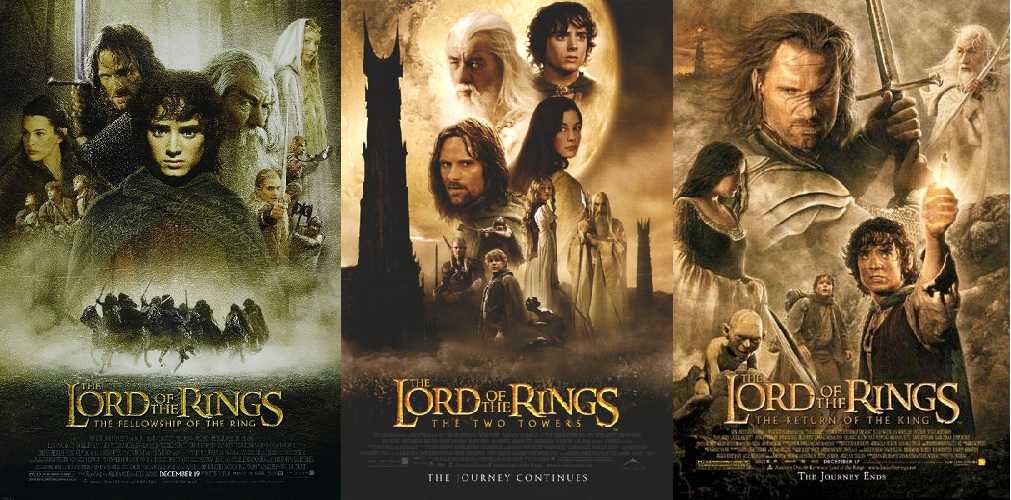
Film Friday: The Lord of the Rings (2001, 2002, 2003)

The Lord of the Rings trilogy is a top-notch fantasy action/ adventure and I absolutely and unequivocally recommend it. I own each film and have seen them many times. So if you love these films, let's stop there, mehl-on (that’s Elvish for “friend”). But if you want to see what’s wrong with these lifeless, shallow films and why they never came anywhere near their potential, then read on.

** spoiler alert **

Let me start by saying my criticism IS NOT that the films aren’t identical to the books. The Lord of the Rings trilogy are my favorite books, but I understand that books need changes to become effective films. My criticism IS that Peter Jackson made too many of the wrong kinds of changes, and thereby turned a nuanced, meaningful story with characters we care about deeply into an emotionless plot-driven film that's hard to care about.

Characters Lost: The first clue that something was going wrong with the characters occurred even before the film was released. One of the actresses gave an interview in which she repeated the marketing line that they were staying 100% faithful to the book, except where they absolutely had to make changes -- which is, of course, a lie. She then ominously said they had to change the characters because “the book doesn’t really have a lot of characterization.” This was a sign Jackson didn't understand the books and was about to strip the characters of their character to "Hollywood" them up. Consider these:
Frodo: In the book, Frodo resists leaving the shire. He’s not mentally or emotionally strong and he’s certainly not ready for an adventure, nor is he particularly mature. This makes his journey all the more impressive, as he must grow into the role thrust upon him. This is also why his decision to leave the group after Gandalf’s death is such a strong moment. He realizes he is endangering his friends and he chooses to leave them to save them. This is THE moment Frodo finally accepts his responsibilities, but we’re not sure he’s up the task.

Jackson tosses this away and turns Frodo into the modern fake-reluctant hero. While Frodo professes not to want to the responsibility, he is shown to be mature, competent and ready for the challenge, and he volunteers easily. Thus, there is no moment where Frodo grows up. There is never any doubt he would continue the journey with the ring after Rivendell. There is almost no motive for him leaving the group after Gandalf’s death, except that Boromir made him think his friends were becoming dangerous to him. Even the Nazgûl chasing him don’t seem all that dangerous because the film leads us to believe that he’s a competent adventurer ready to meet the challenge.

These are dramatic changes that rob the character of growth, the story of uncertainty, and the scenes of emotion. One of the key points in the book is that the least likely people can play vital roles in saving mankind. This is lost in the film because Frodo is set apart from the very beginning as a special character who is up to the task and only needs to be shown the direction to march. This cheapens his victories and lessens the drama of his choices.

Gimli/Legolas: Friendship Devalued: What Jackson does to Gimli is an atrocity. Book Gimli is a headstrong, excellent warrior who butts heads with the other companions. Moreover, as a Dwarf, Gimli dislikes and distrusts Elves, because of conflicts between the two races that go way back. This matters because it establishes the relationship between Gimli and Legolas, and sets up the group dynamic. Indeed, the ring companions don’t trust each other. They all have different motives and ancient grievances and this makes it hard for them to work together. But as they prove themselves to each other, they slowly earn each others’ trust and respect. Nothing shows this change more than the growing friendship between Gimli and Legolas, the most unlikely friendship in the group -- they don’t actually become friends in the book until Gimli greets Galadriel kindly, something he doesn't do in the film. Jackson throws this away and makes Gimli into pure comic relief. He also makes Gimli and Legolas into almost-instant friends.


Spot the dwarf. (click to enlarge)


This has several nasty consequences. First, it sucks out the very characterization Jackson claims is missing in the books because it denies Legolas and Gimli the chance to grow. Secondly, it eliminates an important dynamic within the group -- the need to come together. Third, it trivializes what they are doing. The world is facing its end as Sauron's rise is at hand. These people are fighting for their lives and the lives of all the other members of their various races. But Jackson’s decision to turn Gimli into comic relief turns this whole thing into a joke. Indeed, Jackson even has them engage in a counting game throughout the battle scenes, which makes their actions seem like a light-hearted videogame rather than the murderous struggle against desperate odds that it is.

Gandalf: When Gandalf dies in the book, it’s a shocking, weepy moment. In the film, not so much. Why? Because Jackson fails to connect us to his character. One reason is that his importance to the group isn’t obvious in the film because the group are already friends. Thus, nothing will change after his death. In fact, the group doesn’t even stop to mourn except that Boromir thinks the Hobbits need a break. The message: Gandalf is just an expendable member of the group. By comparison, in the book, Gandalf holds the group together and there's a real chance the group will fall apart after his death.

Also, the film never addresses what Gandalf means to the others personally. For all his skill, Aragorn is a lost soul. He literally roams the wilderness afraid to face his responsibilities, i.e. returning to Gondor and claiming the throne. Gandalf is the conscience trying to get him to face his responsibilities. Frodo has been manipulated into this quest by Gandalf with the assurance that Gandalf would always protect him. When he dies, Frodo must fend for himself and his will comes close to breaking. None of this makes it into the film. Aragorn is presented as a single-minded, determined hero, and his issue with reclaiming the throne is given short shrift in one quick scene with Liv Tyler. Frodo is the volunteer who is ready to take on the world. Because Gandalf’s importance to these people is lost, his death has little personal meaning. His death is no longer the death of a friend, a mentor, and the guiding hand that held them all together, he's just another member of the group. . . and one you don't even see that often.

Since he now means so little, his death means little to us. Since his death means so little, his resurrection means just as little. In fact, his resurrection isn’t even a resurrection in the film, it’s more of a reappearance. In the book, it’s clear Gandalf died and was reborn as Gandalf the White. In the film, he just sort of shows up again. Thus, the significance of his self-less act is cheapened, i.e. he goes from sacrificing himself for the group to just getting into a very hard fight.
CGI Stupidity: This is one of the most visually beautiful films of all time. They found incredible natural scenery in New Zealand, used fantastic costumes, and had stellar effects. Things like the city of Minas Tirith were flawless and amazing. But like children who can’t help themselves, they had to abuse the CGI:
Significance Diluted: Part of what makes the humans in LOTR The Book so heroic are the dire odds they face. The fact they stand their ground against these odds demonstrates their courage. Moreover, because of the small number of defenders, each death is tragic and costly. The film throws that away because Hollywood can’t stop itself from filling every millimeter of screen. Instead of the 2,000 defenders in Helms Deep mentioned in the book (including Jackson's gay hairdresser Elves) compared to Saruman’s 10,000 Orcs, or the 9,000 defenders at Gondor against Sauron’s 250,000 Orcs, the film creates a battle of millions on each side. Suddenly, the importance of any particular defender disappears. In other words, gone is an army of precious individuals and in its place the audience gets two giant CGI blobs slamming into each other. How can you feel any sense of loss for that? Not to mention, this makes some of the dialog pretty silly, like when King Théoden says, “so few came.” Really? There's no room for more on the field!

Not to mention this kills the realism. No battle in history, not Waterloo, Verdun or anything in World War II had anywhere near the number of troops shown on the field. This is probably more people than were alive in all of Medieval Europe. Thus, by trying too hard, they not only reduce the significance of each defender, but they create a battle that just doesn’t look real.

Moreover, even beyond the numbers, the CGI is downright stupid. Why does the movie begin with a line of Elves all the way to the horizon doing what appears to be a Dallas Cowboy Cheerleader linekick in perfect formation? Why is everyone wearing identical uniforms? And why are all the humans’ uniforms freshly laundered and their armor undented and shiny? Why are Orcs, an undisciplined army of thugs, standing in perfect Napoleonic squares? Why? Because everyone in Hollywood apparently suffers from Obsessive Compulsive Disorder combined with a uniform fetish. This is stupid and it sucks the realism right out of these battle scenes. Can I overlook it? Sure, just like I could overlook a cartoon rabbit defecating in the background of each scene, but that doesn’t excuse its inclusion in the film.

Realism Denied: Finally, even in up-close battles, the CGI people still go too far. Legolas in particular is subject to this. As he’s fighting the Orc Warg (wolf) riders in Rohan, he looks more like Rubberband Man than anything solid as he slides around the wolves and jumps from one to another to kill them off. Why are the war elephants at Pelennor Field 50 feet tall? It doesn’t make any sense or add anything. . . except that it lets the CGI people have Legolas swing from elephant to elephant like digital Tarzan, which they no doubt thought would be cool -- but just looks bizarrely unrealistic. These things detract from the realism the film otherwise works so hard to achieve. It’s literally like adding Roger Rabbit to Saving Private Ryan. And why include a fake-looking, comic-y “cave troll” in Moria in the middle of one of the most serious battles in the book? Because they couldn't stop themselves.
So let me finish with this point: my complaint is not that the movie is not the book (though I am offended they kept proclaiming they followed the book). My complaint is that the characters are lifeless and the story lacks any sort of emotion because every decision Jackson made reduced our emotional investment in the characters, reduced the reality of the film, and reduced the stakes for which they were fighting.

These things may not have interfered with your enjoyment, but you’ve got to admit that if Jackson had kept with what I say, this would have been a much stronger film.

[+] Read More...