Showing posts with label Star Trek. Show all posts

Thursday, June 5, 2014

Let's Call It A Star Wars Preview... Of Sorts

So I finally saw J.J. Abram's Star Trek: Rot in Darkness and I'm trying to figure out if there is enough profanity in our language to let me describe that movie properly in a review. In the meantime, I realized last night that the same pathetic piece of sh*t who royally f*cked up Star Trek will now get the chance to do... the... exact... same... thing... to... Star Wars. Let's see what Star Trek tells us to expect.

Jedi Babies: Abrams has Muppet Baby Syndrome. He's a firm believer in replacing competent actors with young hotties. The average age will be 16 and they will all look like the misshapen creatures in fashion magazines.

F*ck Your History: Abrams derives a sexual pleasure from mocking the history and mythos of the original films.

Soak The Suckers: Since Abrams hasn't yet figured out how to require in-movie micropurchases, as they do in games now, he will instead find other ways to try to drain your wallet dry to see this film. Frankly, product placements are likely.

He Will Insult Your Intelligence: I wish I could say that Abrams tries to stay at the level of the lowest common denominator when he makes films, but he doesn't... he stays well below that. His dialog is mind-numbing, his action sequences are patently fake, and his plots make most summer blockbusters look like Shakespeare.

Unmitigated Gall: Abrams has no shame. He doesn't mind repeating iconic scenes without adding a hint of anything original... or even a competent retelling. Watch for Star Wars to essentially be a meandering remake of the best parts of the first six movies all thrown together with limited connective tissue.

Leftist Shit: Finally, Abrams has proven to be a far-left jerk off. Look for anti-conservative and anti-American statements throughout.

Frankly, I think I may skip it. I should have skipped his rape of Star Trek. Now my mind hurts from remembering it.
[+] Read More...

Tuesday, October 30, 2012

Questionable Trek vol. 31

We asked about the funniest moment in the films, and there were many. But what about the series? Was there anything funny in the series?

Question: "What was the funniest moment in any Star Trek series?"

Scott's Answer: "The Trouble with Tribbles" is probably Trek at its funniest, but it's also just an extremely well-written episode. Memorable dialogue, fun character moments (I love Kirk's "Storage compartments? Storage compartments?!"), and everyone gets a moment to shine, including the entire cast - sans George Takei who was shooting a movie - and a half-dozen guest stars. Not bad for 23-year old David Gerrold - this was his first script sale! TNG had many funny moments, including Riker giving a Ferengi some purposely-confusing technobabble, the various misadventures of Lt. Barclay, Q posing as a delivery man asking for "a Jean Luck Pickerd," and a bizarre dinner party with Troi's mother in which Data utters the immortal line, "Could you please continue the petty bickering?"

Andrew's Answer: I had a real problem with the humor in The Next Generation. It all felt faked to me and I never found it funny. I did laugh a good deal at the humor in the original series however. I suppose "The Trouble With Tribbles" is the Holy Grail on that. And I think the funniest moment was when Scotty emphatically said he didn't start the fight with the Klingons because they insulted Kirk, but he did start swinging when they called the Enterprise a "garbage scow." Kirk has this hilarious look on his face which just makes you laugh.

[+] Read More...

Thursday, October 25, 2012

The Politics of Star Trek vol. 1

Rather than doing a typical Star Trek article this week, I'm instead going to announce the release of the first edition of The Politics of Star Trek volume one.

This is the first in what I expect to be seven books that will cover the entire original series. The format is similar to the series we've done here at the site, though each episode is covered in a little more depth. Volume one also has an introduction which talks about the nature of Star Trek and how it came to be conservative. So this is a bit more than you'll get at the blog if you're interested.

The image above is the cover, which was done by our own tryanmax. He also provided eight more illustrations for the book.

Here are the episodes that are covered in volume one:
Episode 3: “Where No Man Has Gone Before”
Episode 50: “Patterns of Force”
Episode 14: “Balance of Terror”
Episode 48: “A Private Little War”
Episode 28: “The City on the Edge of Forever”
Episode 13: “The Conscience of the King”
Episode 75: “The Way To Eden”
Episode 24: “This Side of Paradise”
Episode 5: “The Enemy Within”
Episode 23: “A Taste of Armageddon”
I'm hoping to get future additions out every couple of months.

If you're interested in the book or if you know someone who would be, you can find it at Amazon (LINK). Please leave a review!

And hopefully, the Conservative Guide to Films will be ready within a couple weeks as well.

So tell me, what is your favorite conservative moment from Star Trek?
[+] Read More...

Tuesday, October 23, 2012

Questionable Trek vol. 30

A couple weeks ago we asked about Captain Kirk's best qualities, but no man is perfect... except maybe me. :) So maybe we should flip that around?

Question: "What is Capt. James T. Kirk's worst quality as a leader?"

Scott's Answer: I struggled with this one. I really did. An exhaustive Google search came up with all sorts of articles with titles like "Captain Kirk's Best Qualities" but with no mention of his flaws. At the end of the day, I'd say that he could come across as arrogant now and then. Not all the time, mind you, but it was there. On one hand, I suppose a touch of arrogance is required to attain a position like his. On the other hand, sometimes you just want to say, "Dude, you don't know everything!" [smile]

Andrew's Answer: Kirk has flaws? Who knew? Actually, I don't think he does, at least not in the series. In the films, sure, but that's not the real Kirk. So I'm going to go a little philosophical on this one. I think Kirk's biggest problem is that he makes no room in his life for a family. Kirk focuses so excessively on his duty that he's become rather one-dimensional and I that while this makes him an incredible leader, it also will deprive him of the things that are most important in life. It makes me feel sad for him.

[+] Read More...

Tuesday, October 16, 2012

Questionable Trek vol. 29

A Vulcan, an android and a Romulan walk into a bar owned by a talking parrot. Stay with me here. . .

Question: "What was the funniest moment in the Star Trek films?"


Scott's Answer: If you had asked me this question when I was 11 years old, I might've said Data's various emotion chip scenes in Star Trek Generations . His first drink, the "lifeforms" song, and even his brief use of profanity... but today, I find those moments more cloying than anything else. Having said that, I love the scene in Star Trek IV in Gillian's truck, which includes the famous "Yes"/"No" exchange between Kirk and Spock regarding their love of Italian food, along with one of my favorite bits, when Kirk says to Gillian, "You're not exactly catching us at our best" to which Spock interjects "That much is certain." I also love this exchange between Bones and Spock in The Motion Picture: "Spock, you haven't changed a bit. You're just as warm and sociable as ever." "Nor have you, Doctor, as your continued predilection for irrelevancy demonstrates."

Andrew's Answer: Good question! The films had a lot of hilarious moments. Spock not knowing how to swear in Star Trek IV, Kirk and his "double-dumbass on you." Then there's the "Earth, Hilter, 1938" moment in The Undiscovered Country. From First Contact you've got, "You didn't tell him about the statue?" But my favorite moment is actually in Star Trek III, when McCoy says of Spock putting his consciousness inside McCoy, "This is his revenge for all those arguments he lost!" LOL!

[+] Read More...

Tuesday, October 9, 2012

Questionable Trek vol. 28

When it comes to leadership, there's nobody like Captain James T. Kirk. He's the best. . . unless you happen to be wearing a red shirt.

Question: "What is Capt. James T. Kirk's best quality as a leader?"


Andrew's Answer: Kirk does the one thing all great leaders do. . . the one thing poor leaders are incapable of doing: he constantly re-assesses his beliefs. When confronted with a problem, most people dig through their existing beliefs, look for the solution that they settled upon long ago, and run with it. If it works, great. If not, they double down. Not Kirk. Kirk does what real leaders do, he constantly questions and tests his beliefs and if he finds that he is wrong, he's got the fortitude to change his beliefs. That makes him the ultimate decision maker because he is devoid of prejudice. That's impressive.

Scott's Answer: Kirk does something that I wish more people (cough, politicians) would do: he surrounds himself with people of different worldviews and didn't hesitate to consult with them, despite their often diametrically-opposed opinions. Allow me to quote Alex Knapp of Forbes: "Weak leaders surround themselves with yes men who are afraid to argue with them. That fosters an organizational culture that stifles creativity and innovation, and leaves members of the organization afraid to speak up. [...] Historically, this has led to some serious disasters, such as The Phantom Menace. Organizations that allow for differences of opinion are better at developing innovation, better at solving problems, and better at avoiding groupthink."

[+] Read More...

Tuesday, October 2, 2012

Linkable Trek

Scott roams the internet far and wide to ply his trade as a link dealer. Fortunately, Scott provides links free to us. Today, he's specializing in Trek links you might like. Share your thoughts and add anything we missed!

Celebrating 25 years of Star Trek: The Next Generation

Star Trek: The Next Generation premiered 25 years ago last week and its influence on pop culture and genre television cannot be underestimated. Looking back on it now, it's amazing to see how successful it was, sometimes beating even Monday Night Football in the ratings. And of course, it's influence on my life has been... immeasurable. This is my 20th year of being a fan and [raises glass] here's to 20 more!

Walter Koenig gets a star on the Walk of Fame

I don't know how much this stuff means to people but it's always a nice gesture and fans love taking photos of their favorite stars', uh, stars. (I may or may not have a picture of Pee-Wee Herman's star!) Anyway, the surviving cast members (sans Shatner) turned out to show their love and support for Walter Koenig who finally received his star. (I'm still getting used to seeing Koenig without his toupee.)

Leonard Nimoy greets the space shuttle Enterprise

Sadly, the space shuttle fleet was retired last year. The space shuttle Enterprise was actually a test orbiter and never made it into space. However, that hasn't stopped NASA from celebrating its accomplishments as she finds a new home at the (awesome) Intrepid Sea, Air & Space Museum in New York City. Leonard Nimoy was on hand to welcome it as only a Vulcan could.

Could we build the Starship Enterprise?

With the aforementioned shuttle retirement, many Americans are asking, "Why can't we dream big anymore?" Well, one guy has a dream: he wants to build the Enterprise... for real: "Built in space, the ship would never visit the surface of any moon or planet, and so would never need to reach the high speeds necessary to escape surface gravity. The engines would be powered by nuclear reactors onboard the ship, and use argon rather than xenon for propellant, saving a few hundred billion dollars in cost."

Remembering William Windom and "The Doomsday Machine"

Character actor William Windom passed away last month and, among many other things, he played Commodore Decker in "The Doomsday Machine." This article pays tribute to both him and the episode, which is constantly ranked as one of Star Trek's best. "They say there's no devil, Jim, but there is. Right out of Hell, I saw it!"

Malcolm McDowell (Dr. Soran) regrets Captain Kirk's death

At this point, I think everyone involved with Star Trek Generations wishes they hadn't killed Captain Kirk - it would've saved them a lot of trouble and fan whining in subsequent years! The always-entertaining Malcolm McDowell speaks for many when he says Kirk deserved a better sendoff.

10 things you probably didn't know about Deep Space Nine

While TNG was my first, DS9 was probably the best of the modern day Treks. This piece points out some interesting trivia, including the fact that the original concept for the show had it take place on a planet... sort of a Fort Laramie in the future. Only later did the creators shift gears and set it in space.

Aircraft carriers in space

This fascinating article looks at how sci-fi (specifically Trek and Battlestar Galactica) has portrayed various elements of naval warfare. "Interestingly, the sci-fi authors of the 1950s were better at thinking it though. It was a time when everyone was talking about how a hydroponics section would be needed to provide food on a starship. Maybe nowadays you can say you have a magic power source, or nanotech to produce the materials you need."

[+] Read More...

Tuesday, September 25, 2012

Questionable Trek vol. 27

Space.... is alive.... with the sound of music.

Question: "What is the best piece of music from the Trek universe?"

Scott's Answer: Gee, pick a hard one! Star Trek is what got me into film music. The one piece I can listen to over and over again is James Horner's "Stealing the Enterprise" from Star Trek III. It plays during the sequence in which Kirk and Co. hijack the Enterprise in order to find Spock while Starfleet sends the ill-fated Excelsior after them. It's exciting stuff, even if Horner liberally quotes from Prokofiev at the beginning.

Some honorable mentions (who am I kidding - they're all great!) include Jerry Goldsmith's "The Enterprise" from Star Trek: The Motion Picture, Jay Chattaway's theme from "The Inner Light", Gerald Fried's famous fight music from "Amok Time", and Cliff Eidelman's "End Credits Suite" from Star Trek VI.

Andrew's Answer: Hands down, no contest whatsoever, the theme music to Voyager (by Jerry Goldsmith). Man, that's an incredible piece. I love the opening with the horns, the drums, and then the slow build. That is utterly fantastic! ENJOY!

[+] Read More...

Tuesday, September 18, 2012

Politics of Trek: “Space Seed”

Let’s continue the Politics of Trek series with the issue of eugenics. Eugenics is the applied science of using various practices to improve the genetic composition of a population. Although widely popular and widely practiced in the 20th Century, Eugenics fell into disrepute when it became associated with the Nazis. Star Trek reflected this moral opposition in Episode No. 22: “Space Seed.” Khaaaaaaan!
The Plot
As our episode begins, the Enterprise comes upon an ancient spaceship slowly making its way through space. This is the Botany Bay, which was launched from Earth in the 1990s, the era of the Eugenics Wars. The Eugenics Wars occurred because a group of scientists tried to breed the perfect soldiers by making them faster, stronger and smarter than ordinary people. But these “supermen” were arrogant and egomaniacal, and they rose up and conquered one-third of the Earth, over forty nations. It took a world war for the rest of humanity to defeat them.

The most power of these genetic supermen was Khan Noonien Singh. And when his empire was about to fall, he and 84 of his fellow supermen fled the Earth aboard the Botany Bay cryogenically frozen in stasis. Kirk does not know who is aboard the Botany Bay, however, because historical records from the relevant period are fragmented and incomplete. But Kirk soon learns who Khan is after Khan awakes out of stasis. Unfortunately, before Kirk decides what to do about Khan, Khan awakens the rest of his followers and they seize the Enterprise. After a struggle, Kirk defeats Khan and decides to banish Khan and his followers to a harsh but habitable planet, Ceti Alpha V, where they can build their own world, just as the British convicts at Botany Bay tamed a continent. As the episode ends, Khan quotes Satan from Milton’s “Paradise Lost”: “It is better to rule in Hell than serve in Heaven.”
Why It’s Conservative
As with most Star Trek episodes, there are many small philosophical and ideological moments. For example, Khan compares Kirk to the people of his era and in the process makes the point that humanity hasn’t changed:
Khan: Captain, although your abilities intrigue me, you are quite honestly inferior. Mentally, physically. In fact, I am surprised how little improvement there has been in human evolution. Oh, there has been technical advancement, but, how little man himself has changed.
This is consistent with the conservative belief that human nature is fundamentally fixed. The fact Kirk still manages to defeat Khan adds the conservative idea that despite human nature being fixed, human nature does not equate to destiny, i.e. we can overcome our genes, our instincts, and our poor starts in life to excel.

There is also a fascinating debate between Khan and Spock, where Khan tries to defend dictatorship on the basis that dictators bring the world order. Spock rejects this.
Khan: There was little else left on Earth.
Spock: There was the war to end tyranny. Many considered that a noble effort.
Khan: Tyranny, sir? Or an attempt to unify humanity?
Spock: Unify, sir? Like a team of animals under one whip?
Khan: I know something of those years. Remember, it was a time of great dreams, of great aspiration.
Spock: Under dozens of petty dictatorships.
Khan: One man would have ruled eventually. As Rome under Caesar. Think of its accomplishments. . . We offered the world order!
Notice that Spock rejects the idea that order is superior to freedom, and he equates living under a dictatorship with being part of a team of animals. This idea is reinforced when Kirk and Scotty try to explain to Spock why Khan was the best of the tyrants:
Scott: I must confess, gentlemen. I've always held a sneaking admiration for this one.
Kirk: He was the best of the tyrants and the most dangerous. They were supermen, in a sense. Stronger, braver, certainly more ambitious, more daring.
Spock: Gentlemen, this romanticism about a ruthless dictator is—
Kirk: Mister Spock, we humans have a streak of barbarism in us. Appalling, but there, nevertheless.
Scott: There were no massacres under his rule.
Spock: And as little freedom.
McCoy: No wars until he was attacked.
Spock: Gentlemen!
Kirk: Mister Spock, you misunderstand us. We can be against him and admire him all at the same time.
Spock: Illogical.
Spock is appalled that the others could even consider the simple lack of massacres or aggressive wars as positive justifications for dictatorship. To him, the lack of freedom is the defining criteria of right and wrong, and it cannot be legitimately traded for order. This is the classical liberal belief in the moral superiority of the individual and individual freedom. And as we’ve noted before, classical liberalism is the foundation of modern conservatism. Unfortunately, modern conservatives have in recent years failed to maintain this principle in light of rising crime rates and Islamic terror, nevertheless it does remain a fundamentally conservative principle and the growing influence of libertarian conservatism suggests a return by conservatives to this principle. As for modern liberals, they invoke this principle only as situational rhetoric. Hence, things like liberal opposition to Guantanamo Bay under George Bush evaporated under Obama.

In any event, the main purpose of this episode is to criticize eugenics. The word eugenics remains in disgrace today because of its association with the Nazis, who practiced forced sterilization and mass murder all in the name of achieving racial purity. But its history is worldwide. The term eugenics was actually coined by Britain’s Sir Francis Galton in 1883, where it was advocated as a means of stopping “undesirables” in the lower classes from bearing offspring because they were viewed as lacking genetic worth. Eugenics was particularly popular among socialists and the labor party. In 1913, Britain under a Liberal government passed the Mental Deficiency Act, which proposed segregation of the “feeble minded” from the rest of society. Forced sterilization was proposed, but not implemented.

In the United States, the eugenics movement got laws passed in many states to prohibit the marriage of undesirables, such as people with epilepsy and “the feeble-minded”, and allowing the states to forcibly sterilize the mentally ill to prevent them from passing on mental illness. These laws were upheld by the Supreme Court in 1927 in the Buck v. Bell decision, wherein Justice Oliver Wendell Holmes famous said, “Three generations of imbeciles are enough.” Holmes, by the way, was a favorite of progressives, particularly for his recognition of union rights, and his decisions are credited with creating the judicial support for the economic regulation imposed by the New Deal. According to the Buck Court, the forced sterilization of the mentally retarded “for the protection and health of the state” did not violate the individual’s due process rights. Between 1907 and 1963, more than 64,000 people were forcibly sterilized in the United States.

Following the defeat of the Nazis, the idea of eugenics fell into disfavor around the world as the word eugenics came to be associated with mass murder and attempts to perpetuate racial purity. This was the period during which “Space Seed” was written, and throughout this episode, Kirk and Spock and McCoy make it clear in their tones that they find the idea of eugenics morally repugnant, although the episode does not address this in the dialog. Instead, the episode makes the point that eugenics is a bad idea. First, Kirk disputes the assertion that supermen can actually be created through eugenics.
Kirk: Would you estimate him to be a product of selective breeding?
Spock: There is that possibility, Captain. His age would be correct. In 1993, a group of these young supermen did seize power simultaneously in over forty nations.
Kirk: Well, they were hardly supermen. They were aggressive, arrogant. They began to battle among themselves.
Notice that Kirk rejects the label “supermen.” He points out that these individuals were aggressive, arrogant and began to battle among themselves. These are hardly the actions of advanced human beings. They are instead the actions of psychopaths. And what Kirk is saying is that he doubts it’s even possible to improve human beings because these so-called supermen turned out to be anything but actual supermen. This is an attack on the very idea of eugenics, which is premised on the belief that humans can be improved. And the fact that Kirk ultimately defeats these supermen suggests that the writers too rejected the notion that these were actual supermen.

Spock then adds that the problem was that the eugenics scientists failed to understand that giving these individuals superior abilities would also give them superior ambition, and that this is what made them arrogant and aggressive.
Kirk: Well, they were hardly supermen. They were aggressive, arrogant. They began to battle among themselves.
Spock: Because the scientists overlooked one fact. Superior ability breeds superior ambition.
Kirk: Interesting, if true. They created a group of Alexanders, Napoleons.
This is an interesting point by Spock, but Kirk does not discuss it. Instead, he dismisses it as “interesting, if true.” The reason Kirk says this is to let the audience know that the specific reason for the failure of these scientists is not relevant. What is relevant is that the scientists were unable to predict the result of their genetic manipulation. This is the same point already made in Episode 8: “Miri,” where attempts to make humans resistant to disease wiped out all the adults on the planet. The message here is that attempting eugenics is simply a bad idea because it’s impossible to foresee the consequences of such an attempt, and the consequences can be such that all of the human race will pay the price. Here a group of scientists created super soldiers who tried to enslave humanity and caused a world war. In “Miri,” they wiped out the population with a super virus. The consistent message is that mankind is not smart enough to tamper with nature.

Unfortunately, modern liberalism has slowly returned to the ideas of eugenics, if not the word. Modern liberals support abortion, which is being used to eliminate children with bad genes or medical conditions, and now has a several decade history of leading to sex-selection. They support genetic tampering, which many speculate will lead to the creation of two classes of humans – those who can afford to give their children superior traits and skills and those who can’t. They also support cloning, euthanasia, and population control. Each of these are ideas originally encompassed by eugenics. Star Trek would warn against each of these on the basis mentioned above, that humans simply aren’t capable of foreseeing the negative effects of such tampering. And in that, Star Trek remains conservative.

[+] Read More...

Tuesday, September 11, 2012

Questionable Trek vol. 26

Some leaders are born, others are made. Some are just written into the script. Capt. Jean-Luc Picard is one of these options. :)

Question: "What is Capt. Jean-Luc Picard's best quality as a leader?"


Andrew's Answer: I'm not a big fan of Picard's leadership. He is often ineffective and makes wrong decisions, and if it weren't for the fact he's the hero, his crew would be dead many times over. But he does display two things I really like. He's not afraid to get input from his staff, which too many self-described leaders don't do, and more importantly, he's patient. Patience is the true key to leadership. Never jump to conclusions. Don't act rashly before you know the real score. Don't act on rumor or emotion. He's patient and that's a great quality any solid leader needs.

Scott's Answer: I answer this question knowing that: a.) Captain Picard isn't the most popular guy 'round these parts, and b.) TNG was my original gateway into Star Trek. Having said that, I for one like Picard's skill with diplomacy and rhetoric, using force only when needed. There's a place for cowboy diplomacy but there's also a place for reasonable discussion. I must also point out that Kirk was Kirk from the very beginning, as if spawned fully-formed from the head of Zeus. Picard, on the other hand, grew over time. Not a lot, mind you, but it's noticeable. (He doesn't speechify nearly as much in later seasons.) I don't know if this was because of new writers constantly coming in, or Gene Roddenberry's declining influence, or Patrick Stewart's request for more fun and action for his character... but the answer probably involves all three.

[+] Read More...

Tuesday, September 4, 2012

Questionable Trek vol. 25

Everybody love the headliners -- Kirk, Spock, McCoy, Picard, Riker and Data. Why? Because they get top billing. They get the cash, the chicks and the best quarters too. But sometimes the little guys need love too.

Question: "What secondary character would you most want to have dinner with and what would you discuss?"

Andrew's Answer: All right, you're not going to believe this one, but I'd like to meet Guinan (Whoopie Goldberg). I thought her character was all around pretty neat. She clearly had an interesting history. She had great stories. She was very insightful. And she proved several times to be an excellent dinner companion. In terms of what I'd want to discuss, it would probably just be the history of the galaxy as she knows it.

Scott's Answer: Of all the people in the 23rd and 24th centuries, my answer most closely resembles a person from the 21st century: Lt. Reginald Barclay (Dwight Schultz). He appeared in several episodes of TNG and Voyager. He was one of the few "ordinary" people we saw in the so-called "enlightened" 24th century. He had bad habits and obsessions and nervous tics and he was bad with women... but at the end of the day, he just needed someone to talk to. I think it would be interesting to have a conversation with him, not to mention I'd get to ask him, "So, what was it like being a genius for a day?"

[+] Read More...

Tuesday, August 28, 2012

Questionable Trek vol. 24

Not everyone can afford the best locations and the best sets like George Lucas can. Sometimes, you just gotta turn that spot behind the dumpster into an exotic world.

Question: "What was Star Trek's cheapest moment?"


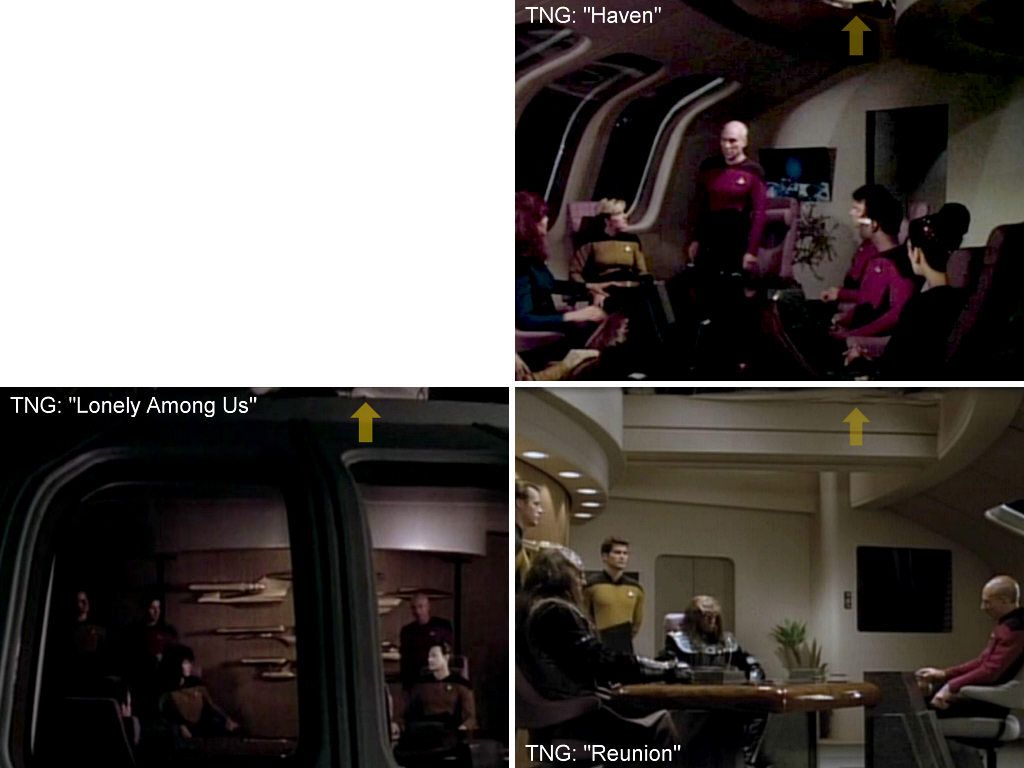
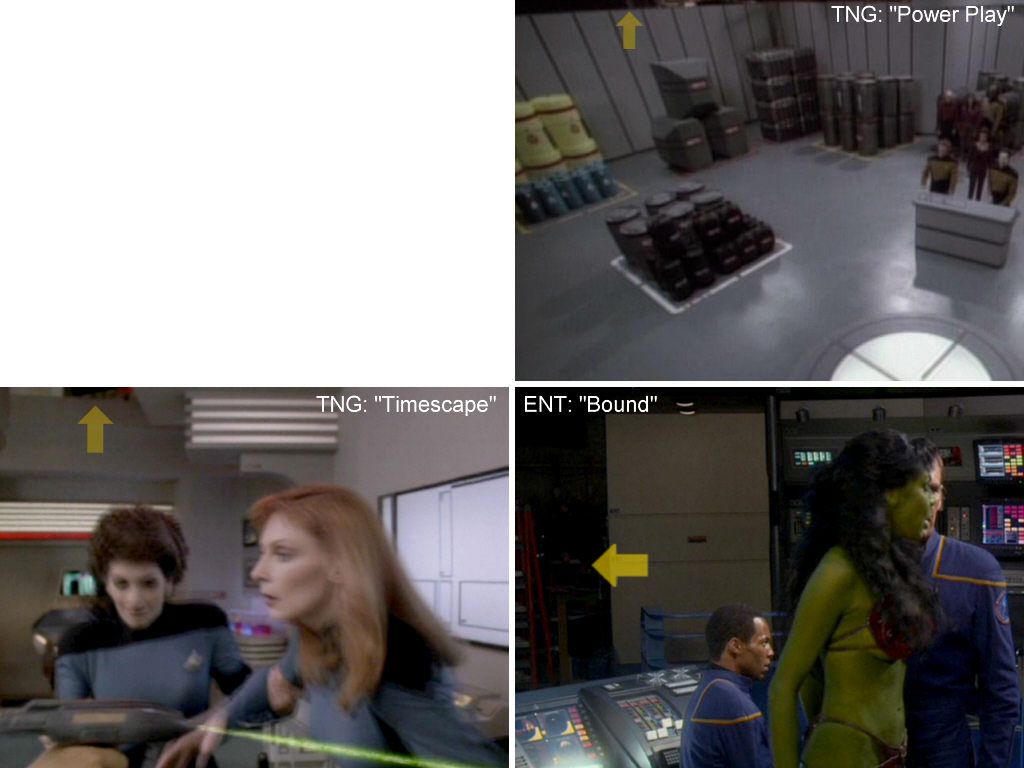
Scott's Answer: Given the realities of TV production, it's inevitable that some things will fall through the cracks. The one thing the creators never managed to do well was painted backdrops. You've seen them before: a set can only be so big so they use fake backdrops to fill in the rest. But look at this! I mean, who were they trying to fool? Even Star Trek: Nemesis which, was, in theory, a big budget movie, had the same problem!

Andrew's Answer: Oh, there are so many! So many cheesy sets, so many reused uniforms, so many reused effects, so much cheapness. But the thing which stands out to me the most is actually an entire movie: Star Trek V. The opening scene at Yosemite is great. You've got great scenery, excellent effects and they clearly dropped some coin on getting that done. But then they board the Enterprise and everything changes. It felt like this was the moment they ran out of money, so they created three or four very small, dirt cheap sets and everybody acted like this was a real starship. I think the original Enterprise interiors from the series were more convincing frankly.

[+] Read More...

Tuesday, August 21, 2012

Questionable Trek vol. 23

Sometimes you just gotta geek out when you start talking Star Trek! And there's nothing more geeky than comparing starships!


Question: What is the coolest ship other than the Enterprise?

Scott's Answer: To the franchise's credit, there have been so many cool-looking ships over the years but, for me, I think the Borg cube represents sheer elegance in its simplicity. I know I've said it before but, all too often, designers look at the "evil" villain and decide that their ship must look "evil," too, even though this makes absolutely no sense. The eeriness of the Borg cube comes from its geometric perfection.

Andrew's Answer: Arg! Did we really ask this? Apparently, we did. I suppose I can't just pick another version of the Enterprise? No, that would be cheating. So I'm going with the Klingon battle cruiser from Star Trek: The Motion(less) Picture! Sleek, impressive and sporty, this improved version from the original series will go from standing still to Warp 7.9 quicker than gagh will give you worms!

[+] Read More...

Tuesday, August 14, 2012

Politics of Trek: “Where No Man Has Gone Before”

Lord Acton famously said that power corrupts and absolute power corrupts absolutely. That is the point behind the second pilot created for Star Trek the original series, which was shown as Episode 3: “Where No Man Has Gone Before.” It is also a deeply conservative point and it sets the tone for the whole series.
The Plot
As the episode begins, the Enterprise is planning to pass through the barrier that rings the galaxy to see if this is possible. As they approach the barrier, they find an old-style ship recorder from the SS Valiant, a ship no one knew had been out this far. The recorder reveals that the Valiant tried to pass through the barrier and was damaged. The captain then began a frantic search related to ESP, extra-sensory perception, in the ship’s library. Soon afterward, he gave the command to destroy the ship. Despite this, Kirk gives the order to enter the barrier. The Enterprise is severely damaged and loses its warp engines. Several crew members are injured, including Kirk’s friend Gary Mitchell and the ship’s psychiatrist, Dr. Elizabeth Dehner. Mitchell soon begins to show growing psychic powers. As the ship limps to Delta Vega, an unmanned lithium-cracking facility where Kirk hopes to repair the Enterprise, Kirk struggles with what to do about Mitchell and his growing mental powers.
Why It’s Conservative
This episode tackles the conservative belief that absolute power corrupts absolutely. Conservatives understand that human nature is flawed and that human beings simply cannot be trusted with unchecked power. That is why conservatives advocate limited government, rule of law, and limited discretion. Liberals, on the other hand, advocate powerful government with the belief that if the right people are put in charge, they will use that power for the good of all. Conservatives reject this because they don’t believe the right people exist. Star Trek also rejects this for the same reason. Indeed, not only does Kirk come straight out and quote Lord Acton in this episode, but we are shown that someone as unassuming and carefree as Kirk’s best friend Gary Mitchell will be corrupted by power. Here is Kirk trying to convince Dr. Dehner to help him defeat Mitchell:
MITCHELL: I've been contemplating the death of an old friend. . .
DEHNER: Stop it, Gary.
MITCHELL: Morals are for men, not gods.
KIRK: A god, but still driven by human frailty. Do you like what you see?
MITCHELL: Time to pray, Captain. Pray to me.
KIRK: To you? Not to both of you?
MITCHELL: Pray that you die easily.
KIRK: There'll only be one of you in the end. One jealous god. If all this makes a god, or is it making you something else?
MITCHELL: Your last chance, Kirk.
KIRK: Do you like what you see? Absolute power corrupting absolutely.
By this point, Mitchell has fully come to believe that he is a god. But the episode showed this transition from unassuming crewman to faux god quite gradually, and each step made sense given his newfound powers. First, Mitchell became bored with the rest of the crew because his intellect grew far beyond their level. Thus, he lost his desire to be among them. Then he became angry and looked down upon his friend Lt. Lee Kelso because Kelso had failed to spot something which was obvious to Mitchell. Soon, Mitchell began giving orders and countermanding orders he didn’t like. Then he started calling himself a god and likened the crew to insects: "You fools! Soon I'll squash you like insects." Finally, he began killing people who got in his way, even though he clearly had the power to use less violent means to achieve his ends. Their lives simply didn’t matter to him.

And why does this happen? As Kirk explains it, it is because humans are flawed:
KIRK: Did you hear him joke about compassion? Above all else, a god needs compassion.
DEHNER: What do you know about gods?
KIRK: Then let's talk about humans, about our frailties. As powerful as he gets, he'll have all that inside him. . . . You were a psychiatrist once. You know the ugly, savage things we all keep buried, that none of us dare expose. But he'll dare. Who's to stop him? He doesn't need to care. Be a psychiatrist for one minute longer. What do you see happening to him? What's your prognosis, Doctor?
“He doesn’t need to care,” is the very heart of the problem with absolute power and Kirk puts his finger right on it. Moreover, notice that this is an indictment of all humanity, not just Mitchell, and that Kirk is saying that humans simply can’t be trusted with immense power because it is in our nature to abuse it. This is a conservative point. Had Kirk been a liberal, he would have tried to convince Mitchell to use his power for good because liberals believe that absolute power used benignly can achieve wonders. A liberal Kirk never would have suggested that it is simply beyond humans to use absolute power wisely, he would have tried to ensure that Mitchell was the right person to wield it or to convince Mitchell to use it wisely. But Kirk is no liberal and he makes no attempt to change Mitchell’s heart because he knows this isn’t possible. Instead, he tries to prevent Mitchell from being able to use the power.

Kirk’s understanding is the conservative understanding of human nature and of power. This is why conservatives are wary of liberal attempts to hand massive, unchecked power to governments or persons. . . because there is no human who would not misuse it eventually. That is the point of this episode and it will become a recurring theme throughout the series, and that will keep Star Trek on the conservative side.

[+] Read More...

Tuesday, August 7, 2012

Questionable Trek vol. 22

Last week, we tried to recast Jean Luc Picard. This week we're headed straight into the land of sacrilege.

Question: Who would you cast as James T. Kirk other than William Shatner?


Andrew's Answer: Adam West. Just kidding. To me, this is WAY harder than last week because William Shatner made James T. Kirk into a true icon. But do this we must. I considered three choices originally, but only one of them ultimately worked. My first thought was William Holden, who is just all kinds of tough-guy awesome. But Holden’s kind of a loner, so he doesn’t work. My next thought was Jeffrey Hunter, who was excellent as Capt. Christopher Pike. But I think he’s too angry for a full series. Then it hit me. In the second pilot, “Where No Man Has Gone Before,” Kirk ends up killing best friend Gary Mitchell, played by Gary Lockwood, who has the distinction of being killed by two icons: Kirk and HAL in 2001! He’s got the right mix of strength, compassion, brains and seat-of-the-pants leadership. He’s not a sexy choice, but he’d be a good one.

Scott's Answer: This might sound like a bit of a cheat and I'll explain why but I would have to say Leslie Nielsen. Originally, I had considered Nielsen's Airplane! co-star Lloyd Bridges but he was a decade too old. Before Nielsen became a comedy icon, he was actually a serious actor and the reason this answer could be considered a cheat is because Nielsen had already played a Kirk-esque spaceship commander in the science fiction classic Forbidden Planet, which was one of Gene Roddenberry's inspirations for Star Trek. But he was a handsome leading man, with an air of authority, whom you could see leading a crew into battle. And whenever they encountered a weird space anomaly, he could say, "I haven't seen anything like this since the Anita Bryant concert." (That was an Airplane! reference.)

[+] Read More...

Tuesday, July 31, 2012

Questionable Trek vol. 21

Ok, Patrick Stewart, aka Gurney Halleck, was a solid choice for Capt. Jean Luc Picard. But what if he wasn't available? I understand he didn't even particularly want the role.

Question: Who would you cast as Jean Luc Picard other than Patrick Stewart?


Scott's Answer: This was a tough one for me but after doing a little thinking and digging, I came across Patrick Bauchau, a Belgian actor best known in this country for his work on The Pretender and Carnivàle. He's one of those guys who's not a Movie Star, but an actual Actor. I've seen him many times (Panic Room, A View to a Kill, etc.) but I just didn't know it was him. Ironically, a cursory glance at his IMDb page reveals that he played a character with the last name "Picard" in the awful movie 2012. Small world!

Andrew's Answer: I'm going to go with an actual Frenchman for the role of our French captain, and a personal favorite of mine, Tchéky Karyo. Karyo was excellent in the otherwise silly The Core and in the excellent Luc Besson film La Femme Nikita. And my favorite role for him, oddly, was in Wing Commander. He's French, which is a plus when playing a Frenchman, he's got solid screen presence, and I think he would have brought the right combination of Earthiness, likeability, and sophistication.

[+] Read More...

Tuesday, July 24, 2012

Questionable Trek vol. 20

In honor of the release of the Blu-Ray version of Star Trek: The Next Generation, we decided to come up with a list of George Lucas like changes that could be made to the series to make it the way the creators always envisioned it. Please add anything we missed.

Andrew's Answer:

1. Short answer, Picard shoots first.

2. All phasers replaced with foam pointer fingers.

3. They really do need a conference table on the bridge.

4. Wesley replaced by Jar Jar Binks.

5. Worf digitally moved to the left three paces in all scenes for no reason whatsoever.

Scott's Answer: Since you mentioned it, the Blu-Rays won't have any George Lucas-style changes. The show has been reconstructed from scratch using - get this - the original effects shots, using CGI only when the original elements are MIA. (Paging Mr. Lucas...) The company line is that they are being faithful to the original broadcasts, but I do have a few items on my geek wish list:

1. Please replace this oft-used matte painting!

2. Paint out the guy with the glasses.

3. Extend these sets so we don't see the soundstages: click here and here.

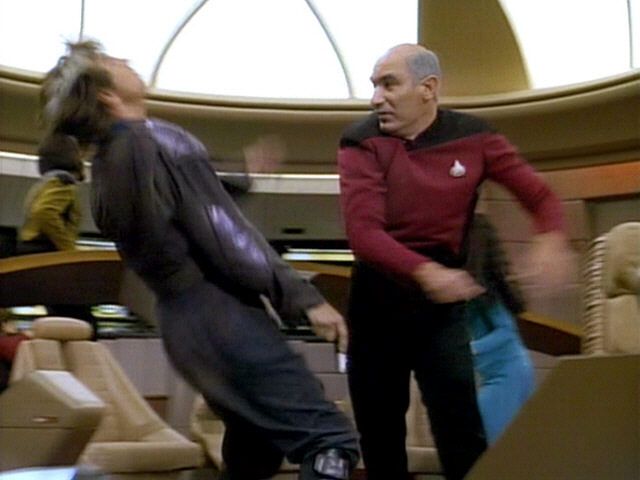
4. Yeah, this is obviously not Patrick Stewart - it's his stunt double. They can fix this now!

5. I know this sounds totally fanboyish but it would be nice to see some new ships. Due to the exigencies of TV production, they often reused the same models but now they can create a few new ones.

(Special thanks to Ex Astris Scientia for the background info and stills.)

Thoughts?

[+] Read More...

Tuesday, July 17, 2012

The Best Father in Star Trek

By Big Mo
One of the best parts of the entire Star Trek franchise is its portrayal of fathers and fatherhood. Whether by accident or design, the mixture of good, strong, weak, so-so, bad, clueless, stupid or tyrannical dads was well done, both among main characters and the “alien of the week” episodes. There are many fathers worthy of discussion in the Star Trek series (Sarek, Rom, Kirk, Mogh (the long-dead father of Worf and Kurn), and even Gul Dukat) and perhaps they can be the subject of another essay. But I want to focus on the man I consider Trek’s best father, DS9’s Benjamin Sisko (the superb Avery Brooks).

Even though I was still in college and years away from marriage and even further away from having kids, I was immediately drawn to the character of Benjamin Sisko when DS9 premiered. In “The Emissary” — the best pilot episode of all Trek shows — he loses his wife, reluctantly takes command of a battered space station, even more reluctantly assumes the unwelcome role of “emissary” for the recently liberated Bajorans, considers resigning from Starfleet, and carries a huge chip on his shoulder against Captain Picard because of Jennifer Sisko’s death.

Yet Sisko never displays any of this to his son, Jake (Cirroc Lofton). Sisko remains Jake’s father. He never uses his son as an easy, convenient target for his frustrations and anger. He does his absolute best to make a new home for his son on a decrepit, cold and foreboding space station at some far-off world that’s a long way from Earth and the rest of the wider Sisko family.

Now, the children on Picard’s Enterprise generally were an irritating bunch, especially Wesley in Seasons 1 and 2 (though he is quite good in the Season 5 “The First Duty”); Worf’s son, Alexander; and the annoying episode where Picard and other officers are turned into children. (Exceptions are the episodes “Family,” with Picard’s nephew Rene, and “Disaster,” in which Picard led three kids to safety up an elevator shaft.) But Jake Sisko was different. It became clear early on that he was his father’s son. Essentially, Sisko raised Jake to show proper respect to adults, elders and other authority figures, and to learn from their experiences instead of being the typical punk-ass kid who acts like he knows far more than his father — or any adult — ever possibly could. (As I did in my early college years; thinking you know far more than your parents must be some sort of unwritten right of transition to adulthood.) The only Trek equivalent I can think of is Spock’s relationship with Sarek.

Sure, Jake is aware of how unhappy his father is, but throughout the rest of DS9’s Season 1 and into Season 2 he does his best (not always successfully) to avoid becoming a burden to Sisko. He often gets into trouble with Quark’s nephew, Nog, but that’s more out of boredom than disobedience or rebelliousness. And even though Jake doesn’t follow Sisko’s Starfleet path and instead becomes a writer/journalist, he continues to learn from his dad, take advantage of the unique opportunities he has and make the absolute best life he can on the station.
Several episodes contain scenes that highlight the fatherhood — the truly manliness — of Ben Sisko that he imparted to his son, including “Explorers” from Season 3 and “The Visitor” from Season 4.

The one that stands out most to me is “Homefront” (part 1) from Season 4. In this episode, we finally meet the man who instilled such strong values in Sisko, especially 1) respect and honor for parents, and 2) respect for civilian and military authority — both in following the law and challenging boneheaded decisions.

The primary story of “Homefront” involves the shape-shifting Founders of the Dominion infiltrating Starfleet Command. Sisko and Odo, with Jake in tow, travel to Earth to help Admiral Layton and his team deal with the situation. At this point, the only way to uncover a shape-shifter in disguise, other than seeing him change, is to do a blood test to see if the blood changes form. I could do a magazine-length essay on how the blood tests relate to TSA, but that’s a whole other issue.

The back story – the best part of an already strong episode – revolves around Sisko and his father, Joseph Sisko (played by Trek veteran Brock Peters (ST IV and VI), otherwise best known as Tom Robinson in To Kill a Mockingbird). Joseph is a stubborn man quite set in his ways. He’s the owner/operator of the finest Creole restaurant serving non-replicated food in New Orleans. (It’s a place I’d love to patronize — mmm...) He welcomes his son and grandson for their stay, with Jake helping in the restaurant. But Joseph refuses to slow down, see his doctor or even take his medication, which of course greatly concerns Sisko. But like Sisko does with Jake, Joseph does not lay his problems on his son’s shoulders. However, like Jake, Sisko feels the burden anyway.

Now comes the powerful scene, which provides one of the finest moments in all Trek (and also one of the franchise’s best explorations of the price of freedom, but that’s a whole other story). (CLICK) Joseph refuses to cooperate with the mandatory blood screenings for all Starfleet personnel and their families. “It’s the most ridiculous thing I’ve ever heard,” Joseph says. “Do you believe that?” Sisko says he gave the order himself, and the incredulous Joseph rebukes his son: “Now why would you go and do a stupid thing like that?” he says.

He soon turns to Jake, “Do you think I’m a shape-shifter?” Uncomfortable, Jake protests, “Come on, Grandpa ...” And Joseph says sternly, “Answer the question!” Which Jake does immediately—and respectfully.

Sisko unsuccessfully tries to reason with Joseph, and even threatens to get a warrant. The scene climaxes when Joseph cuts a finger while chopping vegetables. He goes to wash the finger, telling Jake to get a medical kit, then turns around to see Sisko looking warily at the discarded knife to see if the blood changes. Truly shocked, Joseph angrily lays into his son: “Benjamin Lafayette Sisko. What the hell has gotten into your head?! You actually thought I was one of them, didn't you!”

Suddenly unsure of himself and unsettled that he could think his father was a shapeshifter, Sisko says weakly, “I don’t know ... I wasn’t sure...” And the strong and powerful man that is Benjamin Sisko crumbles before his father.

The scene ends suddenly when the elder Sisko suffers a mild heart attack. At the beginning of part 2, Joseph is back on his feet and has taken a blood test because of events at the end of part 1. I think Joseph acquiesced too quickly — the only unsatisfying portion of this otherwise stellar episode.

Think about this, though: Could anyone else have told Sisko that something he did was “stupid”? Could anyone in his command or with a lower rank defy him like that? Probably not — at least not without repercussions. You can’t buy the kind of deference and loving respect that Jake and Sisko give to their respective fathers. Sons must be raised in such a way that fosters that respect through childhood, the teen years and into young adulthood. And if you engender that respect in your sons based on your love and authority, they will reflect your values when they’re on their own. Such is the case with the second episode I’m highlighting here.

At the same time, both Jake and Joseph show proper deference to authorities—which includes Joseph’s challenge. It’s clear he’s willing to accept the consequences of his refusal, and has the presence of mind to not just challenge his son, but also something he firmly believes to be wrong in a free and open society.
Another standout episode is “Valiant” from Season 6.

I look on this episode as the ultimate payoff where the son reflects the father’s imparted lessons and wisdom. Sisko barely appears in person in this episode, but we feel his presence through his son.

Jake and Nog stumble across the Valiant, a Defiant-class ship crewed by cadets of the elite Nova Squadron (last seen in Homefront). The ship’s regular officers are all dead, and the highest-ranking cadet, Watters, is acting as captain. Nog is thrilled to be among Nova Squadron and eagerly joins the crew. But Jake is uneasy. He begins to think Watters is unstable and foolish, especially when Watters announces that they will attack a huge and powerful Dominion battleship by themselves. The battleship easily outclasses and outguns their tiny vessel — kind of like an elephant vs. a flea. Jake thinks that the Valiant should take the intelligence about the battleship back to Starfleet, but Watters is full of himself and completely delusional about the abilities of the still wet-behind-the-ears cadet crew.

Watters announces his intentions before the assembled crew. Having had enough of Watters’ rah-rah talk, Jake attempts to appeal to the common sense of the crew and convince them to leave the area with the new information. He draws upon what he has learned from his father and everything that has happened in the previous five years. Trusting in his assessment of his truly heroic and brave-beyond-brave father, Jake goes for broke:

“You probably all know who my father is: Benjamin Sisko. So you know I'm not exaggerating when I say that he's considered to be one of the best combat officers in the fleet,” Jake says. “And I'm telling you right now that even with the entire crew of the Defiant with him... My father would never try to pull off something like this. And if he can't do it... it can't be done.”

Unmoved, Watters claims, “We're Red Squad! We can do anything!” He soon throws Jake in the brig. And the cadets cheer Watters — right up until the moment that the enemy battleship kicks their asses and kills them all except Jake, Nog and one cadet.

Look at that scene this way: My USMC step-dad considers Chesty Puller as the Marine of all Marines, and if Chesty Puller’s son (himself a Marine) had said that his father wouldn’t do something, that’s pretty much gospel.

So, in the first example, we see deference and respect at play — earned respect for familial authority and deference to public authority, which includes standing on principle and being willing to accept the consequences. In the second, we see Jake Sisko assessing how his father would handle a dangerous situation and then being unafraid to stand before a bunch of peers and tell them that their foolishness and bravado will get them all killed.

[+] Read More...

Monday, July 9, 2012

Politics of Trek: “The Enemy Within”

Liberalism and conservatism fundamentally disagree about human nature. Conservatives believe human nature is fixed and cannot be changed, though it can be controlled by the individual. Liberals believe human nature is malleable and can be changed to eliminate negative traits. Star Trek comes down on the conservative side in Episode 5: “The Enemy Within.”
The Plot
As our episode begins, the Enterprise is orbiting Alpha 177, conducting geological experiments. When an injured crewman is beamed up covered in magnetic dust, the transporter begins to malfunction, but this is not discovered before Kirk beams up. This malfunction splits Kirk into two separate people, one containing only Kirk’s good side and one containing his evil side. Separated from each other, the good Kirk become indecisive and the evil Kirk becomes purely impulse driven and maniacal. Eventually, the two begin to die without each other and they need to be sent back through the transporter to be spliced back together.
Why It’s Conservative
“The Enemy Within” is about the duality of man. Each of us has two halves, a good half which strives to behave nobly and a darker half dominated by rotten and unhealthy desires. It is the combination of these two sides which make us who we are, and both sides are necessary. That is the point to this episode and it’s ultimately a very conservative point.

When Kirk is split into two parts, we quickly see that neither part can function without the other. The evil part lacks self-control and acts in irrational, destructive and even criminal ways. He is incapable of living among others because he has no ability to respect their rights or to treat them in a manner which would allow society to foster. Nor is he capable of choosing his own long-term good over immediate gratification. This isn’t really all that surprising as both liberals and conservatives would agree that a person who acts purely on their base instincts would end up like this.

Where the episode takes a surprising turn, however, is that the good half fails too. That half of Kirk proves to be indecisive and incapable of making decisions. Specifically, he’s incapable of making the command decisions needed to guide the ship because he’s afraid those decisions might be the wrong decisions and because he no longer has the strength to send people to their possible deaths. Here Spock makes this very point, that both halves of our personalities are needed to be fully functional:
SPOCK: Judging from my observations, Captain, you're rapidly losing the power of decision.
MCCOY: You have a point, Spock?
SPOCK: Yes, always, Doctor. We have here an unusual opportunity to appraise the human mind, or to examine, in Earth terms, the roles of good and evil in a man. His negative side, which you call hostility, lust, violence, and his positive side, which Earth people express as compassion, love, tenderness.
MCCOY: It's the Captain's guts you're analyzing. Are you aware of that, Spock?
SPOCK: Yes, and what is it that makes one man an exceptional leader? We see indications that it's his negative side which makes him strong, that his evil side, if you will, properly controlled and disciplined, is vital to his strength. Your negative side removed from you, the power of command begins to elude you.
Notice Spock’s point that it takes both sides to make a person complete. The good side makes the person wise. The bad side gives the person strength, i.e. the power to be decisive and make hard decisions. Spock also observes that the evil side must be tamed and control: “his evil side. . . properly controlled and disciplined, is vital to his strength.” This is a key conservative point.

Conservatives believe that all humans have a good side and a bad side, and that it is impossible to eliminate either from our natures. In other words, human nature is fixed and cannot be changed. Yet, they also believe the individual is capable of taming their bad side and keeping it under control. This is why conservatives do not accept policies which are intended to change people, but they instead advocate policies which are intended to give people an incentive to control their bad sides and to punish those who fail. This is exactly the point Spock is making. He notes that not only do we have these two halves, but that it requires both sides for us to be fully functioning, and even more importantly, we must control our evil side to harness the benefits it provides.

Liberals disagree with both points. Liberals believe that humans are malleable and that human nature can be changed with education or through peer pressure. This is why socialist states sent people to camps for re-education. This is why liberals seek to criminalize “hate” rather than the actions resulting from that hate. This is the premise of political correctness, that the negative parts of human nature will simply vanish if no one is willing to admit they exist. This is the theory of thoughtcrime and newspeak.

Liberals also, paradoxically, believe that it is beyond the ability of an individual to control their dark side. They believe that our instincts are taught to us by our experiences and, once learned, they overwhelm us and force us to act. That’s why they excuse crimes as being the result of cycles of violence or being the result of root causes, because they think it is simply beyond the power of the individual to overcome what they’ve been taught.

Thus, a liberal Spock would have held up the good Kirk as the model of what liberals hope to achieve for all of mankind and he would have spoken of rehabilitating the evil Kirk. He would have been aghast at the idea of returning the evil portions to the good Kirk, because that is exactly what liberals hope to achieve with humanity. And he certainly wouldn’t have suggested that Kirk could control his evil side.
Interestingly, to show you how much liberalism has changed since 1966, even the show’s liberal voice McCoy agrees with Spock this time, noting that: “We all have our darker side. We need it! It's half of what we are.” He doesn’t seem as convinced that the darker half is necessary for all of us, but he accepts that it is what makes us who we are and he notes that Kirk at least needs it to command a starship:
MCCOY: Yes, human. A lot of what he is makes you the man you are. God forbid I should have to agree with Spock, but he was right. Without the negative side, you wouldn't be the Captain. You couldn't be, and you know it. Your strength of command lies mostly in him.
I can’t help but wonder if a modern McCoy would be so ready to agree with Spock?

[+] Read More...

Tuesday, June 26, 2012

Questionable Trek vol. 19

Life is full of accidents, and Star Trek is no different. And sometimes, accidents mean everybody else steps up in rank! :) Let’s suppose that Kirk and/or Picard met with such an untimely terminal incident.

Question: "Who would have made the better replacement: Spock, Riker, Data or McCoy?"


Andrew's Answer: Interestingly, we’ve seen three of these four in action at one point already, with the odd man out being McCoy, who should NEVER be given command of anything. Spock and Data both had trouble relating to their crews and found themselves assaulted. Riker had trouble making big decisions. Riker would probably be a fun commander, the guy you want to work for, but I think he would get you killed eventually. Between Data and Spock, I think the easy choice is Spock because while he is logical and tends to play the odds, he also grasps the need for intuition and the occasional desperate move. Data doesn’t. So I would choose Spock.

Scott's Answer: I suppose I will have to go with Riker. He usually came across as a natural leader, knew when to talk, knew when to fight, and inspired loyalty among the crew. On the other hand, I might be a little biased because the writers regularly hinted at Riker getting a command of his own one day, possibly as early as the first season. It's clear this was always on their mind, in case Patrick Stewart decided to leave the show. As far as getting people killed, every Starfleet officer seemed to have that problem! Having said that, if the choice were between Spock and Data, I agree with Andrew: Spock is the logical answer.

Thoughts? Anyone you think would be better?
[+] Read More...