You would think I wouldn’t like
The Shining. Why? Because I don’t like Stephen King. His work is formulaic and stolen. Also, I respect Stanley Kubrick much more than I like his films. So I should hate
The Shining, right? Well, no. At one point, King was a talented writer and
The Shining was his high-water mark. And while I find Kubrick’s work lifeless, his casting of Jack Nicholson made this film
great. Plus, there’s a lot more to this film than at first appears.
** spoiler alert **
You all know the story. Jack Torrance (Jack Nicholson) gets a job as the caretaker of the Overlook Hotel, where he and his family will be snowbound during the winter. He plans to use the time to finish his book. But things don’t go as planned as he and his son Danny start seeing ghosts. One thing leads to another and Jack goes insane and tries to kill his family. That sounds pretty straight forward. . . but is it?
Jack!
 Before we get into the story itself, let me point out that the single most important element in this film is Jack Nicholson. Without him, this film would be a dud, and I mean that. As I’ve said before, Kubrick’s style is sterile and his characters are lifeless. They are not people you can care about. . . they are merely cardboard images that work the plot. But Nicholson is anything but cardboard. Nicholson is like a live grenade packed with the most excitable of human emotions. He is the kind of man who puts you on edge constantly. Even when he’s being nice, you watch him out of the corner of your eye for fear he may explode. He is the definition of “volatile.”
And that is exactly what the role of Jack Torrance needed. Torrance is an ex-alcoholic who seems to be falling into a “dry high.” As he falls, he gets increasingly paranoid and volatile. His paranoia is fed by the idea his wife and child are conspiring against him to blame him for being a failure as a father. This is the result of prior incidents where Jack lost his job for injuring a student and then injured Danny while he was drunk. Jack thinks his wife Wendy has never forgiven him for this and is poisoning their son’s mind. However, as written and filmed the role simply doesn’t have enough dialog to provide this information and its impact to the audience. That’s where the inner turmoil of Jack Nicholson comes in. He manages to convey all the instability, the paranoia, the repressed rage and the panicky instant-regret to tell you what you need to know about Torrance, even if the script doesn’t. Without Nicholson, Jack Torrance would be a boring man who inexplicably turns murderous.
Let me also add that Shelley Duvall is brilliant as the “abused wife” (Wendy). She is truly believable as she walks on eggshells around the explosive Jack and then shows genuine terror as he worsens.
Who Is Jack Torrance?
So, aside from Torrance’s inner nature, what isn’t so straight forward in this film? Well, let’s start with the ghosts. Are they real? If you read the novel, you might be surprised to discover that it’s very likely the ghosts aren’t real. Torrance is suffering the hallucinatory effects of a dry high and there is no evidence the ghosts exist. Even the injuries Danny sustains are likely caused by Torrance himself (interestingly, Wendy never does see the ghosts, only Jack, who is high, and Danny, who is abused). In the film, it’s more clear that the ghosts are real. In fact, in one instance, they actually help him in the physical world by unlocking a food locker and letting him out. So that kind of kills the mystery, right?
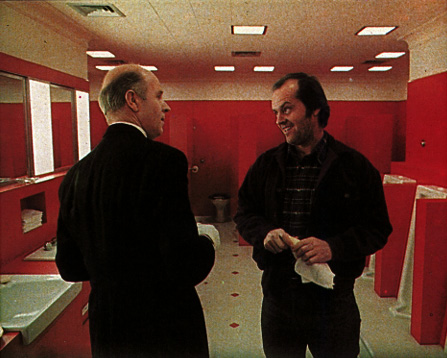
 Yes and no. In its place you are given something much larger to consider. Who are these ghosts and what is their connection to Torrance? Obviously, they are haunting the Overlook and with Torrance being the caretaker, they have set their sights on him, right? Well, not so fast. In the scene in the bathroom between Jack and Grady, Jack identifies Grady the butler as the caretaker who killed his kids. But Grady denies this and responds, “You’re the caretaker, sir. You’ve always been the caretaker.” What does this mean? It could just be the ghost trying to trick Torrance, but there is one more piece of evidence to consider. At the end of the film, after Torrance dies, the camera pans in on a photo of a July 4th party at the Overlook in 1921. There, right in front, is Jack Torrance (see below). So how do we interpret this?
It’s possible the Overlook simply sucked him into its history and this is where it deposited him. But that’s unsatisfying as nothing else in the plot hints at people turning into photos. Where, for example, is the "new" picture of Dick Hallorann (Scatman Crothers)?
Could Jack be THE caretaker as Grady claims? It’s possible that Jack has reincarnated repeatedly and each time comes back as someone whose destiny is to become the caretaker and murder his family. This would be consistent with Grady’s statement that Jack has “always been the caretaker.” Interestingly, it would also be consistent with another piece of evidence. We are inclined to dismiss this idea because Jack points out that the butler is Charles Grady, the prior caretaker who killed his family. But the butler denies any knowledge of this and actually identifies himself as Delbert Grady. So it’s possible this man is not the Grady who was the caretaker. Does that make it Jack?
 Maybe, except there’s a problem with the reincarnation theory. Charles Grady was the caretaker the year prior. That means Charles Grady and Jack Torrance were both alive at the same time. Thus, Jack could not be the reincarnation of Charles. It could be that both Jack and Grady are trapped in some sort of reincarnation circle, one after the other, but that would be kind of a new theory on reincarnation and there’s no evidence for it in the film. Thus, it’s unlikely this is what was meant. It could also be that Grady is simply lying, trying to manipulate Jack into following his lead. But then, how do we explain the 1921 picture?
We can’t discount the possibility that Kubrick simply threw in clues that make no sense, this wouldn’t be the first time (see the second black obelisk in 2001). But what about this: what if Jack isn’t really ever alive? What if Jack is a ghost. What if Jack did something in 1921 that trapped his soul at the Overlook, just like all the other ghosts, and now he’s destined to live out this nightmare of going insane and killing his family over and over and over again. One of the many views of hell or purgatory involves the person being forced to live their crimes/sins over and over forever. Maybe that’s what’s going on here? That would explain why he supposedly goes insane slowly over time, yet he started writing "all work and no play" instead of his book the moment he arrived at the hotel.
Sadly, there isn’t enough evidence to piece this together. But maybe that was intentional? Maybe the inexplicable aspect of this film adds to its terror? We honestly don’t know what is going on with Jack or why the ghosts have targeted him or why he’s so open to them. We don’t know what’s real and what isn’t. Who is Delbert Grady? Who is Jack? We see a wall of blood coming down the elevator, dead girls in the hallway and a woman turn into a rotting corpse, but is any of it real? We just don’t know. But maybe not knowing is more terrifying than knowing for sure -- it’s the fear of the danger yet to come as compared to knowing the extent of your trouble.
Also, maybe this is part of Kubrick’s plan to disorient us. He does this masterfully throughout the film. For example, he constantly switches back and forth between huge cavernous rooms that make us feel insecure, unprotected and exposed, and the cramped family quarters and narrow curvy hallways that make us feel claustrophobic. He gives us the promise of help, only to take it away the moment it arrives. He makes the ghosts unreal, only to let them do something in the real world (yet Wendy still never sees them, so are they really real?). He tells us Jack is slowly going insane, yet he started writing “all work and no play” in his book from the moment he arrived at the Overlook. Doesn't that mean he was insane before he got here? None of this adds up and as a consequence, we can never get a single point of reality onto which we can grasp. We are thus disoriented from the start, and we can never get our bearings. So maybe the fact that we can’t explain exactly what Jack is just adds to the terror because maybe he’s a real guy being haunted, or maybe he's just going insane, or maybe he’s something much worse that we can’t quite understand.
Interesting isn’t it?
[-] Collapse Post...