Showing posts with label Blockbusters. Show all posts

Friday, August 23, 2013

Film Friday: Men in Black (1997)

Men in Black is an excellent film. It was such an excellent film that it made a fortune, spawned a franchise, and has proved to have very strong staying power. What’s interesting about this film though, is that it is the perfect marriage of a tent-pole film with a cult film. Seriously.
The Plot
Although it appears to have a complex story, Men in Black is really just a superhero origin-story centered around Agent J (Will Smith). Smith is a New York City cop who gets recruited by Agent K (Tommy Lee Jones) to work for a shadow organization known as M.I.B. (Men In Black). Located in New York City, M.I.B. polices all the extraterrestrials who live secretly among the human population of the Earth. Their job is to make sure that the aliens behave and that the humans never discover the aliens. They also protect the Earth from various threats.
J’s first case involves tracking down a bug (Vincent D’Onofrio), who has come to Earth to kill an Arquillian prince. The prince lives in Brooklyn and his people are at war with the bugs. As J and K track down the bug, they are given an ultimatum from an Arquillian battle cruiser, which threatens to destroy the planet unless something stolen from the prince (“the galaxy”) is returned within a few hours. Simple.
What Makes This Movie Work
So what makes this film work? Well, in a sense, everything. The actors have a strong screen presence and excellent chemistry. Will Smith was a rising, bankable star at this point, having just come off of Independence Day. His presence in what appears to be a lighthearted summer film all but guaranteed success. Adding to that, Smith gets teamed with the cranky, quasi-redneck Tommy Lee Jones, also a bankable star at the time, which evokes memories of prior successful opposites-attract buddy-cop films like Lethal Weapon. Barry Sonnenfeld had cache as a direct as well, having just directed Get Shorty and the Addams Family films. Sonnenfeld did a great job too: solid pacing, clean visuals, memorable scenes and great effects. The film also had the right feel. It came across as lighthearted, funny, and easy to enjoy.

Those are the perfect tent-pole traits and are guaranteed to put butts into seats.
What kept them there, however, and what has kept people enjoying this film so many years later, is the thing almost all tent-pole films lack: intelligence. In fact, at its core, this is one heck of a smart film. That intelligence, however, was hidden within a ton of ambiguity, just like a cult film.

As I’ve said before, what makes a film into a cult film seems to be that the film is highly intelligent, but lacks the clarity most general audience require. Thus, the film finds an audience because of its intelligence, but it is a limited audience because of its ambiguity. You would think Men in Black would suffer the same fate because of its ambiguity, but it doesn’t. Consider this:

Unexplained Jokes: This film is crawling with jokes general audience will never get on their own. I saw this film in the theaters and it was fascinating to watch the audience. When Will Smith calls K’s car a “Ford POS,” about ten people laughed. The rest waited for the joke. When Z tells the smug guys who just brutally bombed the test to become members of M.I.B., “You’re everything we’ve come to expect from years of government training,” the same ten people burst out laughing. The rest didn’t see the joke. Oh, they laughed a moment later when Will Smith said, “Yo, yo, with the thing,” but they didn’t see the joke about government training leading to hopelessly rigid thinking.
Throughout this film, there are jokes that don’t pay off until a scene or two down the line. There are jokes that require you to grasp that what the characters say isn’t what they mean. There are jokes that require you to have some understanding of the outside world to get the joke. The general audience I sat with didn’t get those. Those other ten people got each one. Fortunately, there were enough other simple jokes that the general audience didn’t miss them. In effect, both groups laughed, they just laughed at different things.

Unexplained Background: So who are the M.I.B.? You never really find out. You get a lot of words thrown at you, but in the end there’s little in the way of clarity. In fact, it’s a running joke that Tommy Lee Jones avoids answering those questions. Then they toss out ideas like the nature of “the galaxy,” but they never clearly answer it, unless you are smart enough to connect the ending of the film to that answer -- it turns out the Earth is in a “galaxy” of its own, which is in a bus station locker, which is itself in a marble being played with by some kids.

Throughout this film, we are introduced to characters whose fates we never learn. We run into subplots that go nowhere. We get no answers to basic questions. This is the sort of stuff that excites cult-film fans because it leaves it up to the viewer to debate the answers and fill in the movie... this is the stuff a thousand web pages are made of. But general audiences don’t normally like this. So why did they like it here? The reason is that every time something ambiguous happens, the scene finishes with Will Smith distracting the audience... “Look, shiny!” That way, both audiences get what they want.
Hidden Depth: The film is crawling with hidden depth too. A good chunk of the jokes involve scientific principles or theories. The film constantly makes hilarious analogies, always without telling you. For example, the film starts with border patrol agents rounding up illegal aliens. That is exactly what M.I.B. are, which makes that scene rich with irony. But no one points this out. The bug is driving around in a truck belonging to an exterminator. The fact that “superior” aliens view coffee and cigarettes as our highest achievement is hilarious too.

Then there’s philosophical depth. Throughout the film, you are constantly being bombarded with ethical, moral and philosophical questions. Is it immoral to change someone’s memories? Does it make it less immoral to give them a happy memory? Would you want to be able to block out memories? What is the nature of the human race? One of the most insightful comments ever in film was this:
J: “People are smart. They can handle it.”
K: “A person is smart. People are dumb, panicky dangerous animals and you know it.”
There was also this: “The only way these people get on with their lives is they don’t know the truth.” That’s very true of humans. Do our prejudices blind us to truth:
“Fifteen hundred years ago everybody knew the Earth was the center of the universe. Five hundred years ago, everybody knew the Earth was flat, and fifteen minutes ago, you knew that humans were alone on this planet. Imagine what you'll know tomorrow.”
These are not only intensely complex questions, but the film frames them in amazingly clever ways to allow those who “get it” to think about it and to allow those who don’t to just see dialog.
So what does all this mean? Well, on the one hand, I think the intelligence is what has given this film its longevity. Tent-pole audiences are remarkably fickle, but cult-fans tend to be the ones who watch movies over and over. It also tells us that you can make a film that appeals to both audience. This film provides a guidepost on how.

Think about this. Here is a film that actually satisfies both groups, groups who rarely see eye to eye: “It was mindless and stupid” v. “It was confusing and stupid.” The reason it did was that it let each audience see what they wanted. People who are looking for smarter films got deep, philosophical points, jokes that trusted the audience, and rich depth throughout. Then people who are looking for something mindless got The Big Shiny from Will Smith to punctuate each joke or close out each philosophical moment.

I would call this a model for successful filmmaking.
[+] Read More...

Wednesday, April 3, 2013

Guest Review: Battleship (2012)

by ScottDS

When the first trailer for Peter Berg’s Battleship hit the Internet, that sound you heard was a collective groan: “Really? A movie based on a board game*?!” It financially underperformed in the U.S. and most likely put an end to Taylor Kitsch’s sci-fi movie career (he of John Carter infamy). However, I’m pleased – no, surprised! – to say that the movie isn’t terrible. Dumb, loud, clichéd, stupid… yes. But not terrible, and infinitely better than the last two Transformers movies.

** spoiler alert **

NASA discovers an Earth-like planet in another star system and transmits a powerful signal from their array in Hawaii. Meanwhile, Commander Stone Hopper (Alexander Skarsgård, dreamy as usual) has a problem, and his name is Alex Hopper (Kitsch), Stone’s younger slacker brother, who gets into trouble while trying to impress Samantha Shane (Brooklyn Decker), who just happens to be the daughter of Pacific Fleet commander Admiral Terrance Shane (Liam Neeson). Stone forces Alex to join the Navy and we cut to the present where Alex is a trouble-making lieutenant aboard the USS John Paul Jones (JPJ), an Arleigh Burke-class destroyer. Stone is the commanding officer of her sister ship, the USS Sampson. Their ships are engaged in RIMPAC – Rim of the Pacific Exercise – in Hawaii.
Five alien ships arrive in response to NASA’s signal. Four land in the ocean off Hawaii and erect a force field, trapping the Sampson, JPJ, and the JMSDF Kongō-class destroyer Myōkō. A fifth ship crashes in Hong Kong. The Sampson and the Myōkō are destroyed and the JPJ is damaged, forcing Alex to assume command since he’s now the senior officer. They’re unable to communicate with anyone outside the force field and the radar is on the fritz, but Myōkō’s captain, Nagata (Tadanobu Asano), who had been rescued after the initial melee, comes up with an idea involving tsunami warning buoys (to detect water displacement). The JPJ sinks two alien ships but is ultimately destroyed herself. Upon returning to the mainland, Hopper and Co. assume command of the battleship-turned-museum ship USS Missouri. They destroy the communications array on the island – which the aliens had been using to contact their comrades – and with the force field down, jet fighters swoop in to destroy the last remaining alien vessel. Alex is promoted to Lieutenant Commander and asks Admiral Shane for his daughter’s hand in marriage. Shane rejects him but the two head off to lunch, presumably to discuss the situation.

This is a dumb movie... but there are different kinds of dumb. Whereas 2012 and the Transformers sequels are offensively dumb, this movie is likably dumb. It doesn’t set its sights too high, its intentions are (kinda) good, and while there are a handful of cheesy moments, there are no cringe-worthy ones. I won’t go so far as to say it’s self-aware, but I did laugh when one tough character tells a geeky character, “Let's see if we can buy the world another day!” and the geek replies, “Who talks like that?” Is Peter Berg winking at the audience? I doubt it, but it was an appreciated moment. One wishes the characters in Transformers knew how ridiculous they were sometimes. The rest of the script – if you can call it that – doesn’t do any favors. It cobbles together scraps from Armageddon, Pearl Harbor, Transformers, Star Trek: First Contact, Battle: Los Angeles, Top Gun, and even Space Cowboys. Thankfully, we don’t get any annoying parents, or robot testicles, or robots pissing on people... oh God, has the bar been lowered that much? Are we now supposed to be an impressed when a summer blockbuster doesn’t have those things? [smile]

When I speak of the film’s intentions, I’m referring to Peter Berg who is obviously a fan of the U.S. Navy, so much so that many people have referred to this film as “Navy porn.” Contrast that with Michael Bay: he may have had good intentions with Armageddon (the space program) and Pearl Harbor (our veterans) but with the Transformers films, any good intentions he might have had (selling cars?) are undone by excess. To be fair, Battleship has plenty of that but it also has shots that last longer than 12 frames and action that isn’t blurred by shaky-cam. How novel! And it’s nice to see a third act involving actual human beings working on plans to defeat an enemy, as opposed to CGI robots duking it out, and we can’t even tell which one is which. Battleship might be clichéd and simplistic, but it’s not convoluted and it doesn’t overstay its welcome. Okay, maybe it does but only by 10 minutes or so.
Taylor Kitsch isn’t bad as Alex Hopper – not bad for this movie, anyway – and his character arc can be seen a mile away, but he’s a little more comfortable here than he was in John Carter. Skarsgård (of True Blood fame) is good, but he doesn’t last long. Neeson brings his usual gravity to the role but it’s a thankless one that could’ve been played by any actor over 50. Speaking of actors, this film includes a few whose stock in trade ain’t acting. Samantha is played by model turned actress Brooklyn Decker. She’s... okay. Could a classically-trained actress have done better with the role? Maybe, but Decker is inoffensive and when she first walks in, all I could think was, “Boobs!” [smile] The JPJ’s weapons specialist is played by R&B singer Rihanna. All her dialogue is available here. I’m wondering why she chose this movie to make her big-screen debut. It’s a nothing role – one of those characters who makes sarcastic remarks and barks orders, but maybe it worked because if the character wasn’t played by a recognizable performer, no one would care. Tadanobu Asano is very good as Nagata (and even better as a marketing hook for the Asian market), who starts off as Alex’ RIMPAC rival but ends up an ally and Jesse Plemons plays a schlub Seaman who helps figure out the aliens’ weakness.

This brings up a problem. Remember Signs? The aliens in that film arrive on Earth, a planet consisting of 75% water, yet are allergic to water. The entire crux of Battleship’s “plot” involves a NASA mission to locate an Earth-like planet that is approximately the same distance to a star as Earth is to the Sun and is capable of supporting life. So what is the aliens’ weakness in this film? Direct sunlight! How did such a race manage to evolve on a planet like ours, let alone develop space travel? Sure, they wear visors but imagine if we all had to wear visors during the day, lest we become paralyzed. The aliens are also like Star Trek’s Borg, in that they only harm people that are considered a threat. To paraphrase one of the Trek DVD commentaries, “Well, gee, if only the aliens didn’t have that particular bit of programming, they could’ve conquered the galaxy by now!” They cause plenty of destruction, both on land and at sea, but people seem to be spared because it’s convenient to the plot, or because they’re played by recognizable actors!
I want to mention a couple of things this movie has, one cornier than the other. Samantha is a physical therapist and spends most of the movie with Lt. Col. Mick Canales, an Army veteran and double amputee. Canales is played by Gregory Gadson, a U.S. Army Colonel who just happens to be a “bilateral above-the-knee” amputee. No one will mistake him for Olivier or Brando, but again, this was something that could be appreciated. If this were a Michael Bay movie, Samantha would be a stuck-up model and she’d find a way to get aboard one of the ships, even though such a thing would be quite improbable. Now for cheese... the USS Missouri is a museum ship docked at Pearl Harbor. Assisting Hopper and Co. in reactivating her are several retired veterans... who just happen to be there... and who approach the camera in slow motion. Is the actual ship maintained 24/7 by veteran officers who served as far back as WWII? Maybe... I have no idea. I’d love to visit it one day, but man oh man, was this schmaltz with a capital “S-C-H”!
Like 99% of summer blockbusters, tech stuff is top-notch. The sound design is excellent and I envy those with a state-of-the-art sound system. ILM knocked it out of the park with the visual effects and the projectiles fired by the alien ships somewhat resemble the pegs used in the original Battleship board game. By the way, the aforementioned warning buoy scene is the one scene that gives the film its title, where the characters are able to detect the ships on a grid with a letter/number system. It’s quick and obvious but also pretty neat, though I doubt there are that many buoys and I doubt they’re arranged in the ocean on a perfect square grid! There are several different alien ship designs, including a spherical “buzz saw” weapon that wreaks havoc on land – again, excellent work by ILM and a variety of vendors. Considering the state of visual effects today, these people no doubt burned the midnight oil to get the work done on time.

I can’t help but recommend this movie – it’s not high art, or even low art… or even art. But it’s harmless and inoffensive. It’s PG-13 for generic “mayhem.” Two characters say the F-word but are cut off in comically awkward fashion. Why do I mention the rating? Because if you have young boys in your family, they’re gonna love it!

“They ain't gonna sink this battleship, no way!”

*Movies based on board games don’t have to be bad. Clue is a cult classic, and maybe it was just ahead of its time.
[+] Read More...

Friday, March 22, 2013

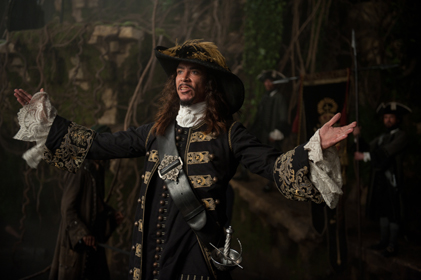
Film Friday: Pirates of the Caribbean: On Stranger Tides (2011)

Ok, so why am I reviewing this film? Am I going to tell you that this film is actually a hidden gem? Hardly. Have I found some moment of deep meaning within it? Nope. What I have found, however, is a film with some really interesting elements that just get horribly misused because the film lacks focus. That makes this film worth discussing.

Pirates of the Caribbean. Hmm. What can we say about Disney’s Pirates of the Caribbean franchise? Well, the first film was actually quite brilliant. What appeared to be nothing more than another lazy summer blockbuster provided one of the tightest and most original stories in years. It included amazing effects, great sets, tremendous writing with moments of intense cleverness, and fantastic acting. It was such a strong movie that it spawned a franchise that has run much longer than the sequels deserve.

Then came Pirates of the Caribbean II: Dead Man’s Chest. Nothing about this film worked and it proved irredeemable except as a gateway to the third film, Pirates of the Caribbean III: At World’s End, which came close to recapturing the glory of the first film except for one giant caveat: At World’s End’s story was tight and interesting and original, the acting was good, and the visuals were fantastic, but every single scene in that film ran one line of dialog too long. For whatever reason, the filmmakers tried to throw a moment of comedy at the end of each scene, like Lucas did with Anakin in Phantom Menace ("oopsies"), and in the process turned brilliant scenes stupid. Moreover, they stupidly handed over the last forty minutes to the special effects nerds and told them to bore people to death. Lop off the CGI ending and the pointless attempts at humor, and this would have been a truly inspired film. In fact, I’m so sure of this that I keep meaning to one day edit the movie myself to achieve this.
With that backdrop, we now come to Pirates of the Caribbean: On Stranger Tides. Based on the strength of I and III, I wanted to like this film, but that really wasn’t possible. Indeed, the first time through, the film simply makes no sense. The characters go from one location to another for no apparent reason except to give the appearance of motion before meeting for the ending. Elements gets tossed into the film in ways which seem meaningless. For example, the Spanish get introduced seemingly out of the blue and then they vanish. They do reappear near the end, but they don’t really add anything to the plot before they disappear again. Geoffrey Rush is brought back as Barbossa (a huge plus as he makes these films) but then he gets sequestered from the plot. And so on.

The dialog too felt like nonsense. It felt formless and like the actors were reading to the scene rather than speaking from their characters. The only character who had any consistent definition was Blackbeard (Ian McShane). The sets felt unoriginal as well, and the stirring visuals were missing this time. Also, there just didn’t seem to be much originality in the story.
Upon further viewing, I began to notice something interesting. Within the film, there are all the elements for a great film. You have Barbossa, who is just a joy to watch. You have the confrontational relationship between the missionary and Blackbeard, which is quite deep, quite philosophical and quite interesting. They also have theological debates wrapped up tightly in single lines of dialog. The relationship between the missionary and the mermaid is interesting too on many levels, as is the relationship between Penelope Cruz and her father Blackbeard, which is complex and nuanced and ultimately comes down to an impossible choice of whether a daughter should sacrifice herself to save the life of her father, even if he is evil. The Spanish are interesting too. They were the world’s superpower of the era and seeing them interact (or not interact) with the other characters provides a fascinating perspective. It’s a bit like watching characters fight with each other as the US Army does its thing in the background.

So that all sounds pretty good, but then there’s the catch. Despite the presence of some smart elements, the film fails to employ them properly. Indeed, the film doesn’t seem to have any idea how to use them at all. It’s like this film was created by asking five or six very bright writers to come up with plots, and then a moron was asked to condense their plots and form them into one film. And in the end, you could literally toss out 90% of the film without changing the plot. That’s horrible writing. Consider this:
The film never bothers to explain the nature of the relationship between the missionary and Blackbeard or why Blackbeard tolerates him. Why should Blackbeard even keep this disrespectful man alive, much less let him roam freely? The film doesn’t tell us, nor does it really present this as something to consider. What is the point to Barbossa? He could have been removed entirely from the film without anyone noticing as all he really does is travel to the end of the film and then give Blackbeard a wound he could have gotten from anyone (or even touching a poisonous plant). Why are the Spanish in this film? Yes, they are presented as the reason the British enter the race to find the fountain of youth, but why even bother with this plot contrivance? It would have made more sense to race Barbossa against Depp or perhaps Barbossa and Depp against the Spanish or Blackbeard. Tossing in the British added nothing and made the Spanish seem pointless, especially as they serve no purpose in the film – even at the ending, when they destroy the fountain of youth, they fail to do so, which makes them meaningless to the plot as the other characters could have taken their time getting there. In effect, the way the Spanish are treated in this film would be like making a bar fight movie where the US Marine Corps swoops into the bar, searches it and leaves again. That may make for an interesting moment in the film, but it adds nothing to the story itself.
The only bit of intelligence which does develop meaning on screen is the relationship between Cruz and Blackbeard, but therein lie several problems. First, this means that the main emotional impact of the film is between characters who are new to the story. This devalues Barbossa and Depp, who are the main characters. Secondly, the film is so obsessed with making sure that Depp gets to ham it up in each scene that the emotional impact is constantly being undermined by the juggling clown dancing across the screen. Third, this subplot has no relationship to most of the film. Indeed, the need for Cruz to save her father doesn’t even arise until the final minutes of the film and little before that hinted that this would be the point to the film.

In effect, what you get in On Stranger Tides is a film that includes many excellent elements, but none of which get fleshed out, none of which get tied into the film and none of which are necessary for the plot. Even the title is meaningless as it gives no sense of what the movie is about. Compare this to the prior films, which were driven by very specific storylines that arose quickly, motivated each of the characters toward confrontation, and drove the film relentlessly toward a conclusion. Nothing like that can be found here – this is just some stuff that happens until it ends.

It fascinates me that in an age of manufactured films where art gives way to formula that someone could have gotten the formula so wrong in this instance. It makes me wonder what they were thinking?
[+] Read More...