By ScottDS
Chapter eight of David Hughes’ book The Greatest Sci-Fi Movies Never Made is titled “Alienated.” It charts the hellish development of the film that became Alien3. The final version that appeared in theaters in the summer of 1992 was a compromised product that its director has since disowned. In 2003, fans were treated to the “Assembly Cut” which best approximated the director’s original vision. While I think the theatrical version is merely okay, I love the Assembly Cut. It’s flawed but brilliant in its own way.
An escape pod is launched from the Colonial Marine spaceship Sulaco after it experiences an onboard fire. Aboard the pod are the cryotubes housing Ripley (Sigourney Weaver), Hicks, Newt and the damaged android Bishop, all in stasis. The pod crash lands on Fiorina “Fury” 161, a “double-Y chromosome” prison colony inhabited by the scum of the universe. Ripley is the sole survivor of the crash and superintendent Andrews has sent for a rescue team to evacuate her. A heartbroken Ripley, with the assistance of sympathetic doctor Clemens (Charles Dance), examines Newt’s corpse for signs of alien infection. Andrews and the inmates – all of whom embrace an apocalyptic millenarian religion – participate in a funeral for Hicks and Newt. Meanwhile, an alien bursts out of a dog owned by one of the prisoners (a cow in the Assembly Cut) and starts attacking people one by one.
Ripley hooks up Bishop’s (Lance Henriksen) remains and we find out that there was indeed an alien aboard the ship. After scanning herself, she finds out that she’s pregnant with a queen alien. Ripley asks Dillon (Charles Dutton), the leader of the prisoners, to kill her. After all, the alien won’t kill Ripley as long as she has an embryo inside her. Dillon promises to do so after she helps them kill the alien. After a prolonged bait and chase, they lure the alien into the foundry where the molten metal causes the alien to literally burst. The Company arrives and, wary of their intentions, Ripley sacrifices herself by jumping into the furnace. The facility is quickly closed down and the film ends with Ripley’s “last surviving member” log entry from the end of the first film.
If you look up the phrase “development hell” on Wikipedia, you will find this definition: “...a period during which a film or other project is ‘trapped’…” You might as well find the poster for Alien3 right next to it. This film went through draft after draft over a period of many years. Some versions featured Ripley and no Hicks or Newt, while others featured Hicks and Newt but no Ripley. Cyberpunk author William Gibson penned a version featuring the Weyland-Yutani Corporation pitted against a rival Socialist culture who encounter the alien. Near Dark writer Eric Red and future Pitch Black creator David Twohy also wrote drafts. At one point, future Die Hard 2 director Renny Harlin was attached to the film but later walked.
Eventually, producers David Giler, Walter Hill, and Gordon Carroll sought out Australian director Vincent Ward. Ward’s idea remains one of the great unfilmed stories. It took place on a wooden planet (literally) populated by an order of Luddite monks. They believe the alien to be the devil, and Ripley’s presence a threat to their celibacy. This story was somewhat more introspective, with Ripley reflecting on her life (or lack thereof). “The Name of the Rose in outer space,” as one critic put it. Needless to say, Ward eventually left after seeing his vision slowly wither away due to money and studio politics. Giler and Hill, at the request of Sigourney Weaver, decided to write the final draft themselves.
Hired to direct was a young music video and commercial wunderkind named David Fincher. Fincher had little time to prepare and had to film on sets that had been constructed for Vincent Ward’s version. He had to supervise re-writes, assist with creature designs, and basically act as his own producer. Remember, this was his first movie – he wasn’t even 30 years old yet! He faced opposition – much of it quite arbitrary – from the studio at nearly every turn. In 2003, DVD producer Charles de Lauzirika supervised the construction of an “Assembly Cut.” (Fincher refused to be involved, hence the lack of “Director’s Cut” title.) This version best approximates the last cut Fincher supervised. It’s 30 minutes longer than the version people saw in theaters 11 years earlier.
This is where I come in. I saw this version before I ever saw the theatrical version… and I LOVED IT! It was dark, it was disturbing, it was beautiful to look at – one of those movies you could frame on your wall. There were one or two dramatic visuals that, when combined with the music, kept me up at night. It’s the best acted of all the Alien films. The tone is pure melancholy. Too many movies aren’t as enjoyable as they could be because the tone is inconsistent. (That’s not to say a dark tone always = enjoyment!) Fincher let’s you know exactly 15 seconds in that you’re f---ed. Why 15 seconds? Because that’s when composer Elliot Goldenthal takes the familiar Fox fanfare and corrupts it, ending it on an unresolved note.
To be fair, the film is conceptually flawed and no amount of re-cutting can fix it. Its tone is perhaps too melancholy, especially after the happy ending of Aliens. And unlike the superior firepower of that film, this film features no firearms at all, thus forcing the inmates to “improvise.” The bleak opening title sequence no doubt alienated many people who couldn’t believe that Hicks and Newt were killed off, thus rendering the previous film completely pointless and inspiring no confidence in this film whatsoever. Most of the characters are interchangeable – 99% of the cast consists of bald British guys with thick accents! Oh, and asking us to sympathize with a bunch of rapists and murders… probably not a good idea. And I still have no idea how the alien got aboard the Sulaco. Also, for a horror film, Alien3 isn’t really scary, but you know what? As someone who hates “Gotcha!” scares, that works for me. The mood is scary enough!
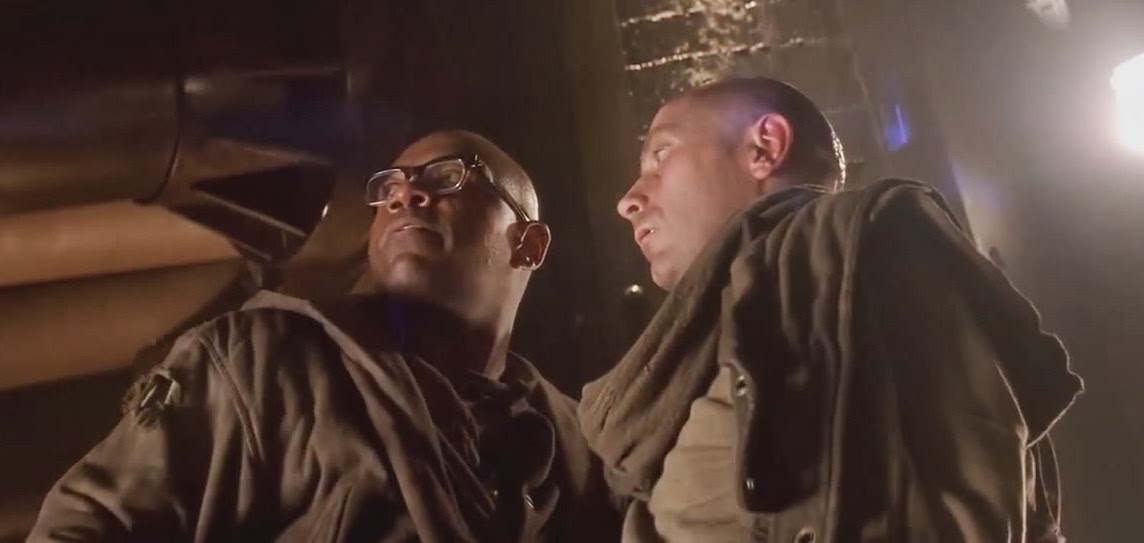
But I still enjoy it. The movie is Alien3, not Aliens 2. The religious element gives this film an extra dimension that the other films lack. Some people felt it was all a bit too nihilist, though I think fatalist might be more appropriate. Still, Fincher gets points for trying to make something bigger and meaningful and not just a generic sequel. As I said above, the acting is excellent. Charles Dance and Charles Dutton play Clemens and Dillon, respectively. Clemens is understated while Dutton goes big. Clemens is the prison doctor and provides some necessary exposition, as well as a temporary love interest. Unfortunately, he’s killed off much too soon. Dillon makes for a charismatic leader and, in the Assembly Cut, is introduced in group prayer. His Malcolm X glasses are a nice touch, too.
The late Brian Glover plays Superintendent Andrews and he just commands the screen. He has the tired look of someone who’s been at this job too long. His factotum Aaron is played by Ralph Brown. This character suffers somewhat from conceptual problems. Fincher saw him as a working-class hero while Giler and Hill saw him as the comic relief. The prisoners refer to him as “85” (his IQ) but this doesn’t gel with anything else. The one character that benefits the most from the Assembly Cut is Golic, played by Paul McGann. (McGann was the Eighth Doctor and played Lt. Bush in the Horatio Hornblower TV movies.) Golic is crazy and sees the alien as a fiery angel of death.
At least that’s how it was supposed to be. In the theatrical version, Golic sees his friends killed and is confined to the sickbay. We never see him again and at the end of the film, we’re left wondering what happened to him. In the Assembly Cut, Golic escapes from the sickbay. Ripley and the others have managed to secure the alien in a storage facility… only for Golic to come along later and free it, asking “What do you want me to do next?” He’s quickly killed by the alien, who then escapes. The studio brass felt that capturing the alien diminished its power, but Fincher and editor Terry Rawlings (who also edited the first film) felt this only hardened the suspense – it’s only a matter of time before the alien wreaks havoc again. They were overruled. The chase scenes are exciting, to a point – unfortunately, things get a bit repetitive and I can only assume that Fincher would’ve made some trims had he decide to participate in the new cut. And most of the time you can’t tell who’s who and you don’t really care for any of these people anyway.
Elliot Goldenthal’s longing score is certainly the most avant-garde in the Alien canon. Some parts are more, uh, conceptual and not as pleasant to listen to apart from the film, while others sound more religious in nature. (The title track uses text from Agnus Dei.) The cinematography is beautiful. Fincher has one of the best eyes in Hollywood and he’s ably assisted by the late Alex Thomson B.S.C., who had to step in for the late Jordan Cronenweth A.S.C. whose Parkinson’s Disease rendered him unable to complete the job. The live-action creature effects are great, but the visual effects are a mixed bag. The model work is fine… but there are wide shots featuring the alien in toto. In actuality, this was a rod puppet photographed in front of a bluescreen and composited into the shots. None of these shots have aged well – the alien sticks out like a sore thumb, obviously pasted in after the fact.
Today, it’s sequels, prequels, reboots, oh my! But the template, for the most part, remains the same. I give Fincher and Co. credit for going somewhere different with this universe. Yes, it would’ve been more entertaining had they continued with James Cameron’s action-oriented style. Instead they made a more contemplative and thoughtful movie. Flawed? God yes! But it’s interesting and also serves as a cautionary tale: have a script!
David Fincher, by the way, has since redeemed himself as well. While he gets acclaim and awards for Benjamin Button and The Social Network, personally I think 2007’s Zodiac might be his masterpiece.
“Nobody ever gave me nothing! So I say f--- that thing! Let's fight it!”
[+] Read More...
Chapter eight of David Hughes’ book The Greatest Sci-Fi Movies Never Made is titled “Alienated.” It charts the hellish development of the film that became Alien3. The final version that appeared in theaters in the summer of 1992 was a compromised product that its director has since disowned. In 2003, fans were treated to the “Assembly Cut” which best approximated the director’s original vision. While I think the theatrical version is merely okay, I love the Assembly Cut. It’s flawed but brilliant in its own way.
An escape pod is launched from the Colonial Marine spaceship Sulaco after it experiences an onboard fire. Aboard the pod are the cryotubes housing Ripley (Sigourney Weaver), Hicks, Newt and the damaged android Bishop, all in stasis. The pod crash lands on Fiorina “Fury” 161, a “double-Y chromosome” prison colony inhabited by the scum of the universe. Ripley is the sole survivor of the crash and superintendent Andrews has sent for a rescue team to evacuate her. A heartbroken Ripley, with the assistance of sympathetic doctor Clemens (Charles Dance), examines Newt’s corpse for signs of alien infection. Andrews and the inmates – all of whom embrace an apocalyptic millenarian religion – participate in a funeral for Hicks and Newt. Meanwhile, an alien bursts out of a dog owned by one of the prisoners (a cow in the Assembly Cut) and starts attacking people one by one.
Ripley hooks up Bishop’s (Lance Henriksen) remains and we find out that there was indeed an alien aboard the ship. After scanning herself, she finds out that she’s pregnant with a queen alien. Ripley asks Dillon (Charles Dutton), the leader of the prisoners, to kill her. After all, the alien won’t kill Ripley as long as she has an embryo inside her. Dillon promises to do so after she helps them kill the alien. After a prolonged bait and chase, they lure the alien into the foundry where the molten metal causes the alien to literally burst. The Company arrives and, wary of their intentions, Ripley sacrifices herself by jumping into the furnace. The facility is quickly closed down and the film ends with Ripley’s “last surviving member” log entry from the end of the first film.
If you look up the phrase “development hell” on Wikipedia, you will find this definition: “...a period during which a film or other project is ‘trapped’…” You might as well find the poster for Alien3 right next to it. This film went through draft after draft over a period of many years. Some versions featured Ripley and no Hicks or Newt, while others featured Hicks and Newt but no Ripley. Cyberpunk author William Gibson penned a version featuring the Weyland-Yutani Corporation pitted against a rival Socialist culture who encounter the alien. Near Dark writer Eric Red and future Pitch Black creator David Twohy also wrote drafts. At one point, future Die Hard 2 director Renny Harlin was attached to the film but later walked.
Eventually, producers David Giler, Walter Hill, and Gordon Carroll sought out Australian director Vincent Ward. Ward’s idea remains one of the great unfilmed stories. It took place on a wooden planet (literally) populated by an order of Luddite monks. They believe the alien to be the devil, and Ripley’s presence a threat to their celibacy. This story was somewhat more introspective, with Ripley reflecting on her life (or lack thereof). “The Name of the Rose in outer space,” as one critic put it. Needless to say, Ward eventually left after seeing his vision slowly wither away due to money and studio politics. Giler and Hill, at the request of Sigourney Weaver, decided to write the final draft themselves.
Hired to direct was a young music video and commercial wunderkind named David Fincher. Fincher had little time to prepare and had to film on sets that had been constructed for Vincent Ward’s version. He had to supervise re-writes, assist with creature designs, and basically act as his own producer. Remember, this was his first movie – he wasn’t even 30 years old yet! He faced opposition – much of it quite arbitrary – from the studio at nearly every turn. In 2003, DVD producer Charles de Lauzirika supervised the construction of an “Assembly Cut.” (Fincher refused to be involved, hence the lack of “Director’s Cut” title.) This version best approximates the last cut Fincher supervised. It’s 30 minutes longer than the version people saw in theaters 11 years earlier.
This is where I come in. I saw this version before I ever saw the theatrical version… and I LOVED IT! It was dark, it was disturbing, it was beautiful to look at – one of those movies you could frame on your wall. There were one or two dramatic visuals that, when combined with the music, kept me up at night. It’s the best acted of all the Alien films. The tone is pure melancholy. Too many movies aren’t as enjoyable as they could be because the tone is inconsistent. (That’s not to say a dark tone always = enjoyment!) Fincher let’s you know exactly 15 seconds in that you’re f---ed. Why 15 seconds? Because that’s when composer Elliot Goldenthal takes the familiar Fox fanfare and corrupts it, ending it on an unresolved note.
To be fair, the film is conceptually flawed and no amount of re-cutting can fix it. Its tone is perhaps too melancholy, especially after the happy ending of Aliens. And unlike the superior firepower of that film, this film features no firearms at all, thus forcing the inmates to “improvise.” The bleak opening title sequence no doubt alienated many people who couldn’t believe that Hicks and Newt were killed off, thus rendering the previous film completely pointless and inspiring no confidence in this film whatsoever. Most of the characters are interchangeable – 99% of the cast consists of bald British guys with thick accents! Oh, and asking us to sympathize with a bunch of rapists and murders… probably not a good idea. And I still have no idea how the alien got aboard the Sulaco. Also, for a horror film, Alien3 isn’t really scary, but you know what? As someone who hates “Gotcha!” scares, that works for me. The mood is scary enough!
But I still enjoy it. The movie is Alien3, not Aliens 2. The religious element gives this film an extra dimension that the other films lack. Some people felt it was all a bit too nihilist, though I think fatalist might be more appropriate. Still, Fincher gets points for trying to make something bigger and meaningful and not just a generic sequel. As I said above, the acting is excellent. Charles Dance and Charles Dutton play Clemens and Dillon, respectively. Clemens is understated while Dutton goes big. Clemens is the prison doctor and provides some necessary exposition, as well as a temporary love interest. Unfortunately, he’s killed off much too soon. Dillon makes for a charismatic leader and, in the Assembly Cut, is introduced in group prayer. His Malcolm X glasses are a nice touch, too.
The late Brian Glover plays Superintendent Andrews and he just commands the screen. He has the tired look of someone who’s been at this job too long. His factotum Aaron is played by Ralph Brown. This character suffers somewhat from conceptual problems. Fincher saw him as a working-class hero while Giler and Hill saw him as the comic relief. The prisoners refer to him as “85” (his IQ) but this doesn’t gel with anything else. The one character that benefits the most from the Assembly Cut is Golic, played by Paul McGann. (McGann was the Eighth Doctor and played Lt. Bush in the Horatio Hornblower TV movies.) Golic is crazy and sees the alien as a fiery angel of death.
At least that’s how it was supposed to be. In the theatrical version, Golic sees his friends killed and is confined to the sickbay. We never see him again and at the end of the film, we’re left wondering what happened to him. In the Assembly Cut, Golic escapes from the sickbay. Ripley and the others have managed to secure the alien in a storage facility… only for Golic to come along later and free it, asking “What do you want me to do next?” He’s quickly killed by the alien, who then escapes. The studio brass felt that capturing the alien diminished its power, but Fincher and editor Terry Rawlings (who also edited the first film) felt this only hardened the suspense – it’s only a matter of time before the alien wreaks havoc again. They were overruled. The chase scenes are exciting, to a point – unfortunately, things get a bit repetitive and I can only assume that Fincher would’ve made some trims had he decide to participate in the new cut. And most of the time you can’t tell who’s who and you don’t really care for any of these people anyway.
Elliot Goldenthal’s longing score is certainly the most avant-garde in the Alien canon. Some parts are more, uh, conceptual and not as pleasant to listen to apart from the film, while others sound more religious in nature. (The title track uses text from Agnus Dei.) The cinematography is beautiful. Fincher has one of the best eyes in Hollywood and he’s ably assisted by the late Alex Thomson B.S.C., who had to step in for the late Jordan Cronenweth A.S.C. whose Parkinson’s Disease rendered him unable to complete the job. The live-action creature effects are great, but the visual effects are a mixed bag. The model work is fine… but there are wide shots featuring the alien in toto. In actuality, this was a rod puppet photographed in front of a bluescreen and composited into the shots. None of these shots have aged well – the alien sticks out like a sore thumb, obviously pasted in after the fact.
Today, it’s sequels, prequels, reboots, oh my! But the template, for the most part, remains the same. I give Fincher and Co. credit for going somewhere different with this universe. Yes, it would’ve been more entertaining had they continued with James Cameron’s action-oriented style. Instead they made a more contemplative and thoughtful movie. Flawed? God yes! But it’s interesting and also serves as a cautionary tale: have a script!
David Fincher, by the way, has since redeemed himself as well. While he gets acclaim and awards for Benjamin Button and The Social Network, personally I think 2007’s Zodiac might be his masterpiece.
“Nobody ever gave me nothing! So I say f--- that thing! Let's fight it!”


