Showing posts with label Science Fiction. Show all posts

Friday, March 2, 2018

Guest Review: The Osiris Child (2016)

by tryanmax

This is less of a review than it is a recommendation. The Osiris Child (a.k.a. Science Fiction Volume One) is the rare indie sci-fi project that can stand among the special effects blockbusters but still delivers on the human-level drama of a low-budget flick.

The story pulls together a lot of common tropes: a planet on the verge of destruction, a mega corporation with a hidden agenda, an officer who goes rogue to save his child, a team up with an escaped convict, a stop-off at a wretched hive of scum and villainy, and everyone has a complicated past. None of this undercuts the movie’s appeal.

To be sure, Osiris has some rough edges, but the pacing is brisk, so you never get to dwell on it. Some intense stuff happens out of frame (which may be good or bad, depending on your tastes) but there is still plenty of on-screen action including a couple great chase sequences and a prison riot.
The narrative unfolds in a very non-linear fashion. In a few places, this is frustrating, but overall, it’s a smart choice that both creates and solves mystery and propels the story. Chapter title cards help keep things clear while adding a bit of a graphic novel feel.

But the best part from a sci-fi perspective is how convincingly futuristic this film is. As in other films, the Australian Outback stands in for a sparse alien world. Special effects are used sparingly, so the ones they have are done well. Holographic displays may be ubiquitous even on cheap TV shows nowadays, along with spaceships and cityscapes, but those in Osiris are high-quality.
There are all sorts of little touches that sell the idea of being in the future. Everyone has a little device that they bump to transfer money, much like photo sharing on cell phones. A coffeemaker adds cream and sugar by voice command while an AI researches the main character’s ex-wife’s new boyfriend. Smart, subtle aesthetic choices hold the sci-fi feel without needing to have a hovercraft float by every few minutes. Fans of practical effects will be pleased, too, by the film’s creatures. (There are creatures!)

From a scripting perspective, the thing that really sets Osiris apart is how cooperative most everyone is. Unlike other action films that try to increase the tension through pointless bickering, everyone in Osiris seems to appreciate the larger stakes. Characters may start out suspicious of one another, but once motives are sussed out and found to reasonably align, everyone comes together rather easily. Even the meth-head gun dealers are basically decent fellas.
The Osiris Child is geared solidly at genre-lovers. Fans of Riddick, Mad Max, and Ridley Scott will definitely get the most out of this, but anyone who loves sci-fi action will warm to this. By the way, the ending is one of the best surprises I’ve encountered in a while.
[+] Read More...

Thursday, October 27, 2016

Guest Review: Independence Day: Resurgence (2016)

by Jason

Roland Emmerich, just give it up. You’re done. D-O-N-E. You’ve strip-mined disaster movies of everything they’ve got. You literally have nowhere else to go unless you blow up a whole galaxy. Then again, that might have been a better idea for a film than what we ultimately ended up with.

The Plot

It’s Independence Day all over again. Another alien ship shows up, lots of cities go boom, we fight back but our military is no match for them, we go to Area 51, we hatch a plan to get through the aliens’ defenses, an important character sacrifices himself to help beat the aliens, we win, main characters gather in the desert to celebrate the victory, roll credits. Now imagine all that done half-assed, and you have Independence Day: Resurgence.
The Good

Okay, snark aside, there are some good ideas in this movie. The film’s first act reveals that the war against the aliens started in the first film actually continued for a while in certain areas such as Africa, with a warlord who waged a guerilla war against some of them for a long time. We also learn that David Levinson (Jeff Goldblum) has been working with the world’s governments to use alien technology captured from the first invasion to help strengthen the planet’s defenses to the point where they can build a functioning moonbase and fighter planes that can fly in space. Meanwhile, former President Whitmore (Bill Pullman), long bearded and apparently ailing, senses a new ship of aliens is approaching as a side effect of having telepathically linked to them in the first movie. The telepathic warning also reaches a comatose Dr. Okun (Brent Spiner), who wakes up from twenty years after his encounter with the alien in the Area 51 lab and starts writing weird alien symbols all over the wall.
The Bad

Unfortunately, Emmerich doesn’t develop these ideas into anything compelling, mostly because the movie gets swallowed up in rehashing the first movie, only Resurgence doesn’t even do that well. In the first film, we got treated to big city-sized flying saucers shooting down beams that blow away whole cities. Here, we just get another mothership that only wrecks havoc because it’s surrounded by a gravity field that lifts up whole cities as it descends to the planet and then drops them back across the planet. I couldn’t tell whether the aliens were doing this on purpose or if it was just a byproduct of their ship’s arrival. And humanity’s air counterattack against the aliens? Boring and a mess. It’s like Emmerich forgot how to shoot an aerial dogfight scene. I could follow the air battles in the first movie much better.

The movie does introduce some new characters plus new actors that play grown-up roles of two kids from the first movie, but with the exception of Whitmore’s daughter, they’re all bores. Most of the original cast does return, even an ailing Robert Loggia (R.I.P.) who gets a quick cameo at a presidential ceremony in his old role as General Grey, and they pretty much outshine the newbies. There’s a female president played by Sela Ward who makes one big dumb mistake in the course of the film and is later killed by the aliens. That’s pretty much her contribution. Jeff Goldblum is still Jeff Goldblum, just a little older and grayer. If you’ve seen the trailer, you’ve seen all the “Goldblumisms” that are worth seeing. Meanwhile, Judd Hirsch as Goldblum’s dad is back and he ends up with a subplot so irrelevant it’s shocking that it got past Emmerich. After he survives a tidal wave brought on by the alien ship’s arrival, he dusts himself off, escorts a bus of children through the aftermath of the alien invasion to Area 51…and that’s it! On the other hand, this movie loves Brent Spiner’s Dr. Okun, so if you liked his short role in the first flick, be prepared to have lots more Okun served up in the sequel!

As an aside, the movie dumped Margaret Colin’s Constance Spano (David Levinson’s ex) even though the actress is still very much active and seemed from what I can tell ready to reprise the role. Why? Let’s see. Colin is currently 58 years old, while the actress that plays the new female character that partners with David is 45. Yeah, I think we can draw the expected conclusion here and move on.
How the Aliens Lose

I have to reserve some special scorn for how the human race fights the aliens in this movie. In the first, Goldblum and Smith fly up to the mothership and upload a virus that shuts down the deflector shields on the alien craft and allow the military to take them down. Simple, easy to follow, even if the fact that Goldblum’s laptop can successfully interface with an alien computer left more than a few moviegoers rolling their eyes.

In Resurgence, the strategy is to lure the aliens’ queen out of the mothership so they can kill it, and without the queen, the mothership will stop its attack on Earth and just leave. That’s it. The climax is basically a battle between a giant alien queen who’s the size of a Transformer plus some of her escort fighters. Once she’s dead, the aliens suddenly stop as if they get a mental blue screen of death, pick up, and go. Never mind that their mothership is still fully functional, they just can’t do the job any more. Queen dead, they go bye-bye. I don’t know if I have the words to communicate how both stupid and underwhelming this is.
Time to Hang It Up, Roland

Whatever filmmaking talent Roland Emmerich still possesses ought to go to other kinds of films, because this movie shows he’s completely out of gas when it comes to disaster and mayhem. Actually, I’d say this movie’s failure is a greater symptom of audience fatigue for these kinds of movies as a whole.

When the first Independence Day came out, movie audiences of the time had not seen special effects movies that depicted mass destruction of landmarks and cities, certainly not so realistically. You’d have to go back decades to flicks like War of the Worlds and Earth Versus the Flying Saucers. Usually, mass destruction was a threat that movie heroes could stop in the nick of the time. So when Independence Day depicted an epic war between humanity and an invading alien race, it wasn’t a shock that people flocked to see it.

Now Emmerich has essentially given us the same movie twenty years later and it’s a snoozer. Why? Because mass destruction has been done to death. The Transformers movies have done it. The Marvel movies have done it. The DC movies have done it. Emmerich himself has done it twice, in The Day After Tomorrow and 2012. There’s only so many ways you blow up city streets, buildings and skyscrapers. I’d be shocked if by now Industrial Light and Magic doesn’t have a “blow up a city” computer program to click on demand.

Final Verdict

The first Independence Day was lightning in a bottle. It was a huge success because of its basic alien invasion plot, effects that (largely) still hold up, and a cast that included a few ab-libbers to add some chuckles to the film (notably Hirsch, Smith and Goldblum). But it’s clear all the inspiration was used up for the first film. It’s like in that 20 year gap between films, Emmerich forgot how to put together a cohesive story, so he just rehashed the first one but made it less fun, less understandable and much more underwhelming. If Emmerich truly wanted to make a sequel, he should have done it years ago, and if the sequel hook from this film suggests the kind of film he wanted to build up to, a “let’s go into space and take the fight to the aliens,” thing, there was no reason he couldn’t have done that story then or even now.

Celebrate your Independence Day from this film!
[+] Read More...

Monday, June 27, 2016

Guest Review: Intersellar (2014)

by Koshcat

I am of two minds when it comes to Interstellar the science fiction drama directed by Christopher Nolan: I liked it but the forced tensions bug me.

Overall the basic plot is simple. Crop blight is slowly destroying Earth’s crops and threatening humanity with starvation and lack of oxygen. Joseph Cooper (Matthew McConaughey) is a former NASA pilot, now widower farmer trying to raise two kids. A message from a “ghost” to his daughter leads him to a secret program to find a new planet for colonization.

A wormhole mysteriously appears near Saturn that allows passage to a distant galaxy where Professor Brand (Michael Caine) has sent 12 volunteers to find a suitable planet. They have transmitted that there are three promising sites near a black hole. There are two plans for colonization: A) move everyone from Earth to the new planet and B) repopulate the new planet with frozen embryos. Professor Brand is trying to work out plan A but the math doesn’t compute.

Cooper’s daughter, Murphy, joins Professor Brand in hopes of deriving the right formula but she needs the information hidden inside a black hole. Mr. Cooper agrees to pilot the spaceship with hopes of quickly finding the right planet and then returning to his family. Due to relativity, what takes Cooper months turns into decades back home. The first two planets turn out to be duds and Cooper sacrifices his life to push his crew mate Amelia Brand (Anne Hathaway), who is Professor Brand’s daughter, to the third and eventually suitable planet. His sacrifice is to fall into the blackhole where he is able to learn the secret formula and transmit it to his daughter as the “ghost” allowing the rest of humanity to be saved.
SPOILER ALERT

Why I liked this film, despite the gargantuan plot holes, is it focused more on the story and characters rather than the CGI to move the plot. The characters have fear and despair but other still have hope. Nobody is evil for evil’s sake. The closest “bad guys” might either be Professor Brand or Dr. Mann (Matt Damon), one of the first 12 astronauts. Professor Brand has faked the calculations for years because he has decided it is physically impossible to implement plan A. Plan B was the plan all along but lied to Cooper so he would leave his family in hopes of finding a new place for them. This isn’t from a place of evil but a decision out of despair and rationality. Dr. Mann is trapped on an inhospitable planet to die alone and has been transmitting false data. He is afraid, weak, and a coward and tries to kill Cooper to get off the planet. His decision is based on irrationality not evil intent. There is no greedy politician trying to control the Earth or multinational company trying to get rich. And any movie that makes Matt Damon look like a dick is ok with me.

The CGI is beautiful and acts as a backdrop rather than the central plot. The story behind the development of the black hole is fascinating as the most up to date theoretical equations where entered into the rendering software which then developed the visual effect (LINK). Finally, how many movies can discuss and show the theory of relativity and still keep people in their seats? This is what true Sci-Fi should look like.
What distracts me from the movie is the unnecessary and forced conflicts. Let’s start with the blight. Anyone with a rudimentary understanding of biology knows that a disease that attacks completely different species is extremely rare to the point of impossibility. For the billions spent on building spaceships and sending people through wormholes, couldn’t they have built self-contained cities? It is also unlikely a blight would effect the plants underwater, wouldn’t it be easier to live there? How about just developing plants immune to the blight? Maybe they shouldn’t be so anti-GMO.

The next is the lying by Professor Brand. Why does he need to lie? Why can’t he just say that he can’t complete the formula without more information? Another is Murphy being so pissed at her dad for leaving that she won’t speak to him for decades and then accuses him of lying to her about the possibility of his never returning. I understand being angry and sad that her dad left, but couldn’t that emotion be better served to get him back? Eventually it does but her resentments simmers for years and seems like wasted energy. There is also tension between Murphy and her brother, Tom (Casey Affleck), that doesn’t seem to make any sense. Why did Tom punch her boyfriend who only wanted to help his family? If Tom had given up on life, why was he still farming? Why does Casey, a much better actor, get less attention than Ben?
Another issue is why do the robots have a sense of humor level? An honesty level? I would want my robot helpers to be boring and brutally honest. Having the potential planets around a blackhole leads to interesting scientific dilemmas, but seems like a terrible place to find a new home. Dr. Mann lying about the planet so he wouldn’t die alone makes sense to me, but killing the other astronauts doesn’t. It leads to a great scene where Cooper has to stabilize the ship, but I guess a simple malfunction or stray asteroid wouldn’t have provided enough tension. Finally, the whole scene inside the blackhole is all dues ex machina and Cooper’s return was, frankly, lame.

I watched it a second time with my wife and kids. My wife and daughter where crying through the whole movie and were irritated at the end despite the happy ending. I found this to be interesting. This movie touches and pulls on a lot of emotional strings, which a good movie should, but perhaps it was too much? I like the movie more than I disliked it because Nolan at least seems to understand that a good movie is dependent on story and characters and not how many spaceships are moving behind Yoda.

Thoughts?
[+] Read More...

Thursday, April 21, 2016

Film Friday: CHAPPiE (2015)

Though I doubt Director Neill Blomkamp would admit this, but his latest film CHAPPiE is Robocop 2. Robocop 2 was a fun, though flawed movie. CHAPPiE, on the other hand, sucked. In fact, they should have called it CRAPPiE. Skip this one.

The Plot

Robocop 2 is the story of a man who has been turned into a robot and now works as a police officer in Detroit. The evil corporation that built him decides they need to destabilize Detroit so they can sell their new combat robot the ED-209. They want to give the ED-209 a chance to show what it can do in terms of restoring order. To do this, they corrupt Robocop’s programming and make him useless, letting crime run rampant. Eventually, Robocop frees himself from the programming and he takes on the evil ED-209 robot built by the evil corporation and destroys it.

Now tell me if this sounds familiar.
CHAPPiE is the story of a robot who works as a police officer in Johannesburg, South Africa who gets turned into a man, or at least becomes sentient. A key employee (Hugh Jackman) at the evil corporation that built him decides he needs to destabilize Johannesburg so he can sell his new combat robot (let's call it, hmm, how about the ED-209a?). He wants to give the ED-209a a chance to show what it can do in terms of restoring order. To do this, he corrupts all the police robots and shuts them down, letting crime run rampant. Eventually, CHAPPiE’s friends teach him morality (or at least a sense of revenge) and then he takes on the evil ED-209a robot built by the evil employee and destroys it.
There is a twist at the very end which is meant to "elevate" the film, but honestly you won’t care. Basically, CHAPPiE is a police robot which gets destroyed by the evil gang from The Road Warrior. Rather than scrap him, the Indian scientist from Short Circuit realizes that in death, CHAPPiE has become alive. Don’t ask the film to explain it though, because it won't. Dr. Short Circuit tries to take CHAPPiE home to work on him, but he gets kidnapped by the Road Warrior gang who want their own police robot. Dr. Short Circuit gives them the robot and they name him and feed him and teaching him how to be white trash. Soon, he’s garbling his lines in ghetto South African, he’s wearing rapper gear, and he’s jacking cars. Isn’t that cute? Anyways, at the end, CHAPPiE figures out how to transfer his consciousness into another robot. He does the same for the dying Dr. Short Circuit and for the dead white trash chick who taught him nothing redeeming. Gee.
Oh, and he brutally beats Hugh Jackman to near death after Jackman kills the Road Warrior gang, including the white trash chick, and Dr. Short Circuit.

This Film Sucked

I’ve said for a long time that Neill Blomkamp is a leftist. Even as other conservatives bizarrely thought that District 9 was somehow conservative, I noted the standard leftist anti-white, anti-male, anti-police, anti-military, anti-corporate, and anti-capitalism themes and undertones. Then came Elysium with its nonsense anti-white, anti-police, anti-corporate, anti-capitalism, and pro-universal healthcare themes. Now we have this. This time, you have evil white capitalist ex-military types who want to destroy a sentient robot who is so gosh darn ghetto cute. The evil Road Warrior gang is entirely white, of course.
Still, I could overlook his politics if his films didn’t suck. District 9 was sloppy and uncreative without any appealing characters. It also felt a LOT like the miniseries V. Elysium was derivative nonsense that substituted propaganda for plot. None of its characters were appealing either. This one... this one is a poor rip-off of Robocop 2. This gives the film an uncomfortable “I’ve seen this story before” feeling. Add in all the not-credible moments that go unexplained – like how CHAPPiE comes alive, why he would have no programming when he did but would quickly get all the programming he needs, why Dr. Short Circuit randomly visits the robot but the Road Warrior gang don’t kill him, etc. – and what you get is a movie that feels like nonsense. And finally, add in the utter lack of appealing characters once again.
Seriously, these characters are impossible to like. Obviously, you’re not supposed to like Jackman or the Road Warrior gang or the corporate president (Sigourney Weaver). The people you are supposed to like are Dr. Short Circuit, the white trash couple, and CHAPPiE himself. But Dr. Short Circuit is a random character whose motives are unclear and who feels like a plot convenience. When he dies at the end it’s hard to remember that he was even in the film anymore. White trash chick ostensibly wants to raise CHAPPiE as if he were a child, but she’s white trash with an ugly accent and the values of a gang banger. Listening to her “mother” a robot with the Religion for Dummies take on a human soul is hard to take. Then her boyfriend trains CHAPPiE to use the same pigeon English they do, to carry himself like a drug dealer, to carjack people, and to hurt people (but it’s funny because they’re rich!!). That makes them and CHAPPiE super hard to like.
In fact, by the time Jackman shows up with his evil capitalist military ED-209a robot, it seems pretty clear that killing off all the characters would be best for society... and probably for them too. It’s hard to like a movie like that, especially when the director doesn’t seem to realize that the characters he offers as the good, likable heroes are all rotten sh*ts who need a delousing and a serious prison-yard beating.

Honestly, this movie felt like an insult. Blomkamp insulted my intelligence by trying to do a hidden remake of Robocop 2, and playing the robot as childlike. He insulted my political and moral beliefs with his themes. He insulted my cultural sensitivities by trying to shove this gang banger culture in my face. And he insulted my time by not doing anything interesting or original at any point during the movie.

I’m glad I didn’t pay to see this turd.
[+] Read More...

Thursday, March 31, 2016

Film Friday: Pixels (2015)

Pixels is an Adam Sandler film. Enough said. No? Ok, I’ll say more. First, let me say that the film isn’t nearly as bad as ALL the critics said. This thing literally had 100% negative ratings. It’s not that bad. But it’s not good either. What it is, is an excellent idea mis-executed in typical Adam Sandler fashion, and all the negatives that entails. What’s funny, is that I can’t tell you how to fix it. Why? Read on.

Plot

Imagine if we sent a radio signal into space and an advanced alien world saw it. Imagine if they mistook the images we sent them as a declaration of war or hostility and they decided to come wipe us out before we did something to them. Sounds like good but somewhat-clichéd science fiction, doesn’t it? But wait, there’s more...

Imagine if the images we sent were actually from our videogames in the 1980’s and early 1990’s. That’s a little more interesting, isn’t it? And what if the aliens use those videogames as a guideline for the rules of war, and what if the aliens have chosen to send electronically-made warriors who resemble the “warriors” in the games we sent and generally follow the same rules from the game. That sounds like it could make for a heck of an interesting and original comedy, doesn’t it? But wait, there’s more...
What if this film also starred Adam Sandler and was basically an Adam Sandler film with Adam Sandler-style jokes about getting hit in the balls, fat guys obsessed with hot girls, flummoxed authority figures, and lots of lazy sight gags? Doesn’t that sound great? Yeah, I had the same thought.

Anyways, the plot is this: aliens are coming to kill us because we sent them images of our videogames, which they mistook as a declaration of war. They have created a set of rules using those videogames. Paul Blart Mall Cop is the President and he brings his friends, Adam Sandler, some fat guy, Peter Dinklage and some hot chick to fight the aliens. They win.
Why I Can’t Fix This Film

Before I talk about this film in any detail, let me say that the film wasn’t as bad as the critics said. It was good-natured. It had some decent laughs now and then too. Basically, it was an entertaining enough waste of time. My kids actually liked it a lot.

That said...

As a general rule, I’ve found space-based comedies to be on the dull side. More often than not, these films have a lot of promise at the outset, having picked creative setups in a rarely-touched field, but then they just seem to fall apart. It strikes me that where they typically fail is in a lack of sufficient affinity for science fiction that they can derive their humor from the science fiction premise.
To give an example, while I found Spaceballs to be funny generally, it still felt flat to me because it was all about non-science fiction jokes. It’s humor was Jewish or Joan Rivers or about black people’s hair. Sometimes it poked fun at Darth Vader, but not in any way that acted as a genuine parody of Star Wars. Worse though, I can’t recall a single bit of humor that would work for a science-fiction comedy. Essentially, this was a Mel Brooks film set against a Star Wars/Princess Bride veneer.

An even better example comes from Mars Attacks. This film is nothing but one running sight-gag. Basically, you’re supposed to laugh at the way the aliens look and the images of what they do – like a head swap between two characters. But there’s little humor in that film that derives from the actual premise of an alien invasion. Essentially, this film is a comedy about infidelity, a crazy president, and just some nonsense characters acting strangely. The aliens are a McGuffin to give these characters some justification for acting strangely. In fact, you could have replaced the aliens with Russians or zombies or even just a rumor of an invasion and almost nothing would have needed to change in the story.
That brings me to Pixels. Pixels has such potential. Think of its potential as an adult version of Wreck-It Ralph. If you saw Wreck-It Ralph, then you saw the amazing potential that a comedy like this has. And what made Wreck-It Ralph work was a combination of a world that was packed with wonderful nostalgic references, a character whose worldview, whose personality and whose limitations derived from that world and who needed to grow beyond those limitation, and a plot that truly felt like something that would happen in this videogame world. Pixels has none of that.

Pixels is an Adam Sandler film. It’s about Adam Sandler and his friends walking though a film ogling women and showing everybody up. You have “loveable loser” Sandler who has a unique talent – playing video games. You have the President of the United States, who is a personal friend of Sandler’s and is so incompetent that there’s no way he could ever be elected. This is Kevin James reprising his role as Paul Blart Mall Cop. You’ve got the fat guy who pines for any woman with big breasts. You’ve got the super hot chick who once dated Sandler and will want him back again once he becomes a hero. Only the Peter Dinklage character feels fresh and interesting, and he gets tossed aside except for two jokes.
The plot involves Paul Blart doing asinine things as other dignitaries stand around looking shocked at what he’s done to the presidency. It involves Sandler showing off to the military, to the media, and ultimately to the world. It involves the fat guy doing stupid things every time he sees a hot chick. Oh, and there are aliens.

Now, at times, the film does make good jokes about the aliens, and those are pretty funny. But again, they are basically sight gags – a cute electronic dog, seeing PacMan on a New York City street, a pretty funny joke involving Cubert, and seeing Cubert wet himself. In terms of the premise itself, however, there’s almost nothing about it that becomes part of the humor. The one exception that comes to mind is when Dinklage somehow manages to use cheat codes in real life. Beyond that though, you could have swapped out the aliens for alligators and nothing would have changed.

As a result of this, Pixels feels like an average Adam Sandler film, but a nothing compared to its potential or Wreck-It Ralph. Unfortunately, this seems to be typical for science fiction-based humor.
So why can’t I tell you how to fix this film? Usually, I can come up with a couple changes that would have helped. This time I can’t. To explain this, a quote from The Matrix comes to mind. Neo asks if they made a mistake because something they expected to happen didn’t happen. Morpheus says, “No. What happened happened and couldn’t have happened any other way.” The same thing is true here. The moment this thing started as an Adam Sandler film, it could follow no other path... it couldn’t have happened any other way. Indeed, by choosing this mix of characters and requiring that Sandler go through the process of being the lovable-loser-turned-winner, it became impossible to have this film to do anything other than what it did. In other words, the structure is so restricting that it cannot be fixed.

Thoughts?
[+] Read More...

Thursday, June 25, 2015

Film Friday: Close Encounters of the Third Kind (1977)

Close Encounters of the Third Kind is an amazing and fascinating film. Normally, I don’t review films that have been written about this much, but this time I think it’s worth it. Close Encounters is the film I think of when people talk about the 1970’s film renaissance, when I think of Spielberg’s real talent, and when I think of films done right. This is a film you should see and appreciate.

Plot

Close Encounters involves the convergence of two separate but related stories. The first story unfolds in small vignettes that take their time to explain what is going on. In the first vignettes, a group of men race through the desert to find a collection of World War II era fighter craft, Grumman Avengers, in pristine condition. We don’t know this yet but these are the planes belonging to the doomed Flight 19 which vanished without a trace off of Florida. In the second, the same men find a ship, the SS Cotopaxi (which sank on her way to Cuba), in the sand dunes of the Gobi desert. In the third, an air traffic controller hears two planes report seeing UFOs flying near them. In the forth, the men are in India, where they seek villagers who claim to have seen something in the sky. These villagers provide the men with a series of musical tones which the men conclude are a form of communication.
Each of these vignettes builds the puzzle and brings us to the conclusion that aliens are seeking to communicate with the human race and they have chosen Devil’s Tower, Wyoming as their place of contact.

The second story, which is interspersed between these vignettes, involves Richard Dreyfuss as Roy Neary, an electrical lineman from Indiana. Roy is out looking to fix a downed wire when he has a close encounter which sunburns half his face. This piques his interest and he starts to investigate UFOs. In the process, he meets a single mother named Jillian, who also has had a close encounter. Her son will be kidnapped by the aliens while she is in the house.
As Roy investigates, he becomes increasingly erratic in his behavior. This causes his wife to take their three children and leave him. The specific event that causes her to leave is when Roy starts dumping garbage in their living room so he can build a life-size model of Devil’s Tower. He feels compelled to do this even though he doesn’t even know that it’s Devil’s Tower until he sees a report on the news that the military is evacuating the Devil’s Tower area because of a supposed nerve gas spill. Roy is drawn to the area and, believing the military story to be false, he makes his way there.
At the foot of Devil’s Tower, the two stories converge as Roy is picked up trying to sneak into the area. There the men from the vignettes question him and try to send him away. But Roy escapes and reunites with Jillian, who also has been drawn here. They make their way up the mountain until they find the secret landing base the government constructed. Soon enough, the aliens arrive.

What Makes This Film So Awesome

Close Encounters is an awesome movie. It’s beautiful shot. It’s incredible well written. You really care about these characters. The plot is engaging. The mystery of what is going on is fascinating the first time through and still engaging even when you know how it will turn out. The movie has iconic music and sounds. It has amazing special effects too, blowing away those of today.
The movie is historically interesting too. For one thing, this film allowed science fiction to grow up. Before this, science fiction was about spaceships and laser guns and battling aliens. This was the first film that foreswore that and said that science fiction could be a character drama about how we finally make contact with an alien race. Indeed, the film’s view of realistic aliens as peaceful is essentially groundbreaking.

It’s also historically interesting because of the way it influenced UFO believers. Before this film, UFO abductees all over the world reported seeing very different aliens. But after this film, they all saw the small gray eunuchs with large heads and large eyes. So in a way, this film unified the UFO story, which has made the industry stronger... even though it should be discrediting.

Anyway, what makes this film so fantastic is the way Spielberg handled it. This was probably the film that cemented Spielberg’s empire, coming on the heels of Jaws and being a world wide mega-hit, and the reason why is that Spielberg was at the top of his game. This was Spielberg before he succumbed to commercialism and before he started using shortcuts to generate emotion. This was Spielberg when he took his time and told the story as it should be told.
What Spielberg did so well can be seen in the characters. First, and most importantly, he takes his time. Spielberg never rushes. This is so rare in modern cinema, where every second that can be removed from a film is for various reasons. Secondly, there are no villains. Some want to see the military as villains, but they aren’t. The military chases everyone out of Wyoming and tries to keep Roy and Jillian from getting up the mountain because they want to avoid a chaotic first contact. Notice that they never use violence to stop these people, and there are no armed soldiers or weapons at the landing site. Doing a film without a villain is a rare achievement in modern cinema because it is harder to write conflict without a villain.

The real key, however, is in the wide array of characters who get solid screen time. Roy is the everyman skilled laborer. His wife (Terri Garr) is the frustrated wife. Jillian is the overwhelmed single mom. David Laughlin (Bob Balaban) is a cartographer who is enlisted in the search for clues because he can translate French into English. Claude Lacombe (Francois Truffaut) is a French scientist and specialist in UFOs who leads the search for clues. Other prominent characters include an Air Force officer assigned to Project Blue Book, the Army commander in charge of clearing out Wyoming, air traffic controllers and the pilots to whom they speak, police, co-workers of Roy, Roy’s kids, a UFO crank, the men in charge of communicating with the aliens, and so on. Each of these characters feels real to us because we learn tons about them. In fact, we know more about them than we know about the lead characters in most modern films, and that makes the film feel real.
What's more, Spielberg gives us this wealth of information in only a few clever moments or lines of dialog. Consider Roy’s wife Ronnie. She seems like a loving wife on the surface, but we quickly see that she’s rather lazy, from her wardrobe, and she’s more concerned with appearances than with Roy’s problems as she tries to hide his sunburn and get him to stop talking about it. And, most tellingly, she blows up at Roy at the very moment where he asks her for emotional help. This tells us so much about her and it explains why Roy acts so erratically. As an aside, she would not exist in a modern remake except as an off-screen ex-wife.

Now take Laughlin, who is a sort of narrator for the vignettes. He never tells us anything about his life, except that he was a cartographer who also speaks French. But we soon learn that he’s rather meek, that he’s amazed by what he’s seeing and wants to believe, that he’s a kind man, that he never once worries that the aliens might be a danger, and that he’s rather bright. We learn this in an intensely clever scene where he solves the key mystery. In this scene, Laughlin realizes that the signals sent by the aliens represent coordinates on a map. In most movies, he would blurt this out and the scene would end. But Spielberg doesn’t do this.
Instead, we see Laughlin figure it out. He takes a moment to be sure of what he thinks he’s found. Then, rather than slamming this in the faces of the supposed geniuses who are debating all around him, he politely turns and says, “excuse me.” Then he humbly explains his conclusion. And then, having solved the key mystery, he goes right back to being a simple interpreter. This tells us so much about his character. And again, this is exactly the kind of character films no longer use because they want the main character to handle everything and they don’t care about letting you get to know the minor characters.

In fact, while we are talking about that scene, I think the brilliance of that entire scene deserves mention, as Spielberg converts a scene involving men talking into an action scene. He does this by having all the characters talking over each other and moving their arms around, which gives the impression of motion. Then, rather than grabbing a map, they find an enormous globe, which they free from its holder rather than carry back to their room and they let it roll toward the camera as they chase it. Again, this gives a sense of motion and urgency, and strangely it makes the audience tense as they wait to see if the men can catch the globe, just as it's tense waiting to see if Laughlin can interrupt them to be heard - in a similar moment, Roy is distracted by his wife as the television shows Devil's Tower in the background and it feels very tense as you wait to see if he will turn around in time to see it. Finally, rather than just finding the spot on the map, we watch two fingers trace the longitude and latitude lines until they connect, giving the audience a feeling of a race and a treasure being found, and then suddenly the room explodes in voices again.

The end result is that a scene which essentially only involves some men pondering the meaning of some numbers and looking it up on the map, turns into an action scene with a dramatic punch. Spielberg does this throughout the movie. This is what Spielberg used to do so well and which so few others ever managed to copy - make boring moments into heart-pounding scenes filled with real characters. Sadly, no one does this today. This is why this film is so amazing.

Thoughts?

As an aside, notice that the rolling globe and the tracing of lines will appear again in Raiders of the Lost Ark.
[+] Read More...

Friday, May 8, 2015

Film Friday: 2010 (1984)

With us touching upon the unique career of Roy Scheider, I thought it was appropriate to finally finish the Peter Hyams sci-fi trilogy: Capricorn One, Outland and now 2010. I view Outland as a masterpiece. Capricorn One is a good but not great and has been unfairly forgotten, especially against today’s dearth of worthwhile films. Then there is 2010. 2010 is simultaneously a strong, entertaining film and a complete and utter disappointment. Let’s discuss.

Plot

Here’s the background: 2010 is the supposed continuation of 2001. After killing his crew, the HAL 9000 brought the Discovery One into orbit around Jupiter. The US is planning to eventually go get it and find out why HAL went rogue.

As the story opens, Dr. Heywood Floyd (Roy Scheider) is approached by a Russian agent. The man advises Floyd that the Discovery’s orbit is decaying faster than expected and that HAL will be destroyed in a crash with Jupiter’s moon Io before the Americans can get there. He also tells Floyd that the Soviets are preparing to launch a flight to get to HAL first. The problem is that the Soviets lack the ability to restart the Discovery and get information out of HAL. That is why the agent has approached Floyd, because the Russians want Floyd to go with them.
Of course the trip almost doesn’t happen because tensions between the Soviets and the Americans are so high that war seems inevitable and no one wants to help the Soviets get to HAL. Ultimately, however, an agreement is reached and Floyd and two other Americans ride along on the Soviet ship, the Leonov.

As they approach Jupiter, Floyd is awoken early by the Russian crew. Telemetry from Jupiter’s moon Europa shows something incredible: the possibility of life. Unfortunately, tensions are running even higher at home and the Russians have been ordered not to cooperate with Floyd. They try to land a probe on Europa, but it gets destroyed.
Soon enough, the Leonov comes to the Discovery. The Americans board the Discovery and restart HAL. At that point, they start getting messages from Dave Bowman, the former pilot of the Discovery who vanished at the end of 2001, that they need to leave the area within a certain number of days. To do this, they will need to sacrifice the Discovery, using it as a booster rocket to get the Leonov into the right position to return to Earth. But can they trust HAL to sacrifice himself?

In the end, they get a message from God basically telling them, “Stay off my lawn.”

Entertaining Movie, but Major Disappointment

As a movie goes, 2010 is quite entertaining. You’ve got a good plotline, with the need to get to the Discovery before its orbit decays. They set up good tension between the two crews and do a good job of overcoming that tension. They add excellent additional tension with the question of whether or not they can trust HAL. The effects are well done and the space scenes are smart and heart stopping. They feel more honest to me than Gravity. The solution to the film is clever and the bit about God at the end makes for a nice ribbon on the film.
I do question why the Russians would agree to this on the terms they do, which let the Americans claim the Discovery and keep the Russians out at their whim, but it doesn’t really detract from the film. All in all, this is a good science fiction adventure and, while it’s certainly not Top 10 material, it is much better than most of what the studios turn out today.

Where the film goes wrong is as a sequel to 2001. It’s interesting. If this hadn’t been a sequel to 2001, I suspect the film would have been ignored. Without the mystery of HAL sitting at the center of this film, it just doesn’t feel like enough to draw people in. Yet, the film craps all over the legacy of 2001.
2001 had a futuristic aesthetic. It took place at a time when humanity seemed more robotic and sterile. Fashions were futuristic. Their technology, while feeling dated to us today, felt futuristic and advanced when the film was made. Their technology was obviously superior to ours. The Earth was different too and there was little sense of dueling superpowers. To the contrary, the film seemed to suggest that humanity had moved beyond our conflicted world today and was ready for the next step in their evolution. 2010 was none of these things. 2010 takes place in a world that is virtually identical to the 1980’s in every way. From a technological, aesthetic and human evolution perspective, 2010 is an entirely different world than 2001, it is a world that feels a hundred years less advanced.

What’s more, the feel of the two movies is entirely different. 2001 was a contemplative, science fiction film that took its time to raise questions about the nature of humanity and where we were going as a species. It also suggested some higher guidance, but stopped well short of declaring a deity. To the contrary, it left you guessing as to who or what the obelisks were and who placed them where they were and what they really meant.

2010 is just a low-key action film. It mentions a couple of philosophical questions, but it never even bothers asking the questions those mentions imply, nor does it spend time developing those issues. It is the difference between being asked to contemplate the nature of silence and being told, “Gee, it’s quiet around here.” At no point does 2010 address human evolution, the nature of life, or really the afterlife. All it does in that regard is have God send a warning through a dead guy and then send a text message to Earth... “Stay off Europa beeeatches.”
To me, this is the real failure. I enjoy 2010 as an action adventure, but I wanted more. Being a sequel to one of the most contemplative films ever, you kind of expected either that the film would provide some answers or would ask a new set of questions. This one doesn’t. And the one answer it does provide, why HAL went all Hannibal Lecter on the crew just isn’t satisfying or even up to the level of what it was implied in 2001.

In 2001, we are given clues to HAL’s behavior, but no real answers. We see that HAL is arrogant, despite seeming emotionless. He notes that he cannot make mistakes... only humans make mistakes. He is cold-blooded and doesn’t think twice about murdering the crew. He doesn’t even give them a chance by killing half of them in their sleep. He seems to be a liar or lacks self-awareness or is perhaps insane at the end when he’s trying to tell Bowman that he’s “all right now.” He seems to cling to life, even though it shouldn’t matter to him one way or the other.
What does this all mean? I think it suggests that HAL has attained a level of sophistication in his programming where he has developed human flaws. Why? Well, that’s the interesting question. That is what 2010 needed to answer. But all 2010 offers by way of explanation is that HAL was given conflicting orders with the suggestion being that evil scientists programmed him to somethingsomething Ronald Reagan is evil mumblemumble somethingsomething. So when his orders to protect the crew and to complete the mission came into conflict, because he saw the crew as standing in the way of that (why he thought this is another key unexplained point), HAL resolved the conflict by murdering the crew. HAL is, in fact, the victim! Root causes root causes!!
Up yours. This is utter crap. First, the two key points to this explanation aren’t even explained. They are just glossed over: the evil military scientists did SOMETHING and HAL freaked because of SOMETHING! Secondly, and even worse, this explanation completely undoes the setup. This explanation turns all of HAL’s surprising and fascinating behavior into “the military programmed him to do that.” There is no longer any question about HAL evolving or what his conduct says about us... he vas just followik orders! That flies in the face of everything about 2001.

This film should have swung for the fences, but it never even thought about trying. That’s the shame here.

Thoughts?
[+] Read More...

Thursday, March 12, 2015

Film Friday: The Signal (2014)

Arg. I hate you Lost. You taught “writing fraud” to an entire generation of writers, and now I’ve been defrauded by The Signal. Grr. I almost liked this film until the ending.

Plot

The Signal opens with three dirty teenagers who are going toward the Nevada desert in their car. They seem like jerks and there is some emotional issue with the girl, but honestly, who cares... it’s just filler. The reason they are going to the desert is that they are tracking a computer hacker who hacked into MIT, where they go to college, and ruined several servers, including their own. In doing so, the hacker somehow shifted the blame to them and they were nearly expelled. Now they plan to find this person, who goes by the name NOMAD, and “expose’ him.

After a few minutes, they arrive at the plot. They go into the abandoned desert home where the hacker supposedly lives and they find it empty. Then everything goes black. When the main character Nic awakens, he finds himself in what appears too be a dingy hospital, where everyone wears protective clothing. On his arm, he finds the tattoo “2.3.5.41.” His friends are nowhere to be found.
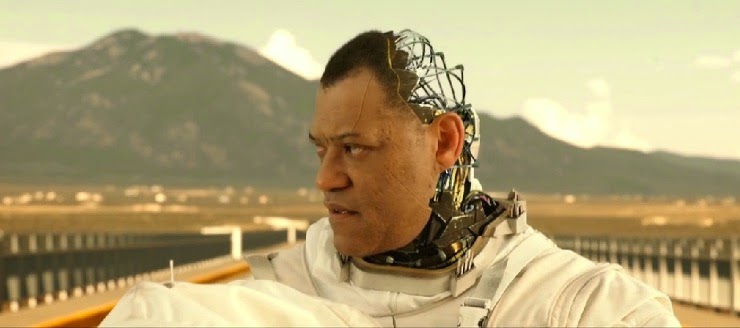
With Nic awake, he soon finds himself being questioned by government scientist Dr. Wallace Damon (Laurence Fishburne). Fishburne assures him that the hacker they were following was no hacker. He was instead an alien. Nic, kind of believes him, but not really until Nic tries to escape only to be thwarted by the alien apparently escaping and causing serious damage to the facility.

As the questioning sessions continue, Nic finds his girlfriend, who is in a coma, and makes contact with his other friend through the vents, though Fishburne assures him that is not really his friend. Nic, naturally, argues with Fishburne and doesn’t trust him. He then tries another escape attempt only to discover that his legs, which were useless due to muscular dystrophy, have been replaced by the alien with metal legs with serious superpowers.

Nic finally escapes and finds his other friend. He also manages to wake his girlfriend from the coma. The film then turns into a chase film with several more reveals before the ultimate ending.
What Pissed Me Off

Let me start by saying that I actually enjoyed this film a good deal as it progressed. No, I didn’t like the start, but once it got past that “grungy teens with emotional problems driving somewhere art film” section, the film actually started to build a really good mystery. It was well-enough paced at that point to hold my attention. The characters were interesting too, even if they weren’t all that smart. Nic in particular felt very clichéd, but Fishburne was interesting. The story also seemed to build very well, as did the mystery.
But then we hit the ending, and that ruined the film for me. Why did it ruin the film for me? Because it became obvious to me that the filmmakers had no idea how to end this film and how to answer the questions they had asked the audience to contemplate. And that made the whole film feel like a fraud.

MAJOR SPOILER ALERT

Here is the mystery the film builds. First, it presents this mysterious hacker who seems all powerful. And when the heroes find his home, it is empty. So who is he and what does he want? Why did he pick on them?

Then Nic wakes up in a government facility with Haley in a coma and his other friend missing. Nic also has this mystery tattoo, which he comes to believe means “Area 51” because that is what the numbers add up to. So where is he?

As Nic is questioned by Fishburne, you begin to wonder what Fishburne really wants. His questions seem pointless and it’s not clear why he seems to be holding Nic as a prisoner. He tells Nic that the hacker is really an alien and shows him some proof that is hard to believe. Then we see the residue of the alien attacking the facility, and that is really shocking. So is the alien evil or is Fishburne evil and the alien is his prisoner?
Suddenly, we are shocked to discover that Nic’s legs have been replaced and the new legs he has have super powers.

At this point, the film has raised so many questions. Who is the alien? Why is he here? Is he good or bad? He seemed like a malicious hacker and he seemed ultra-dangerous given the damage he did to the facility, but if he’s so dangerous, then why would he give Nic new legs?

Nic then escapes and we discover that Haley wakes up from her coma the minute they leave the facility and his friend has had his arms replaced. So the alien is good? But then we start meeting the locals and they all seem like they have been brainwashed to worship the aliens. So what the heck is going on? Fishburne also tells Nic that he can’t protect Nic from the aliens if he’s outside the facility.

But then Fishburne starts shooting people.

This is the moment, the film started to concern me because the characters seemed to become rudderless. Nic is ostensibly trying to escape, but just seems to run around randomly. Fishburne is following him, shooting everyone he comes into contact with for no reason I can tell. The alien gets dropped from the story. Fishburne then removes his protective clothing and shows us that his head is made of the same material as Nic’s leg, meaning he’s the alien? Or what?
All of this feels like the film is unwinding and the filmmakers didn’t know what to do, so they opted for chase scenes and actions that made little sense.

Then the ending arrives. The film ends when Nic runs across a bridge and breaks through a glass wall. The camera pans back and we see that he is onboard a massive spaceship. The credits role. No attempt is made to explain anything. How did Nic get aboard the spaceship? Why did the aliens do the ruse at all? It makes no sense and doesn’t seem to have a purpose that they would tell Nic about themselves or that they would do it in this manner. And why give Nic the new legs, especially as they are powerful enough to let him escape the holodeck or whatever it is, and why make him feel like a prisoner who needs to escape after giving him the legs? What are the aliens thinking?
If the aliens are good, then why pretend to be bad and why make Nic go through the whole fake prisoner thing just to give him new legs. And if they are evil, why give him powerful new super legs? It makes no sense and they don’t even try to explain it. They just give you this fake ending that is meant to trick you into thinking that they revealed the final mystery that explains it all!

This pisses me off.

If you’re going to sell a film to the audience on the basis of a mystery, then the mystery needs to be answered or it needs to be presented in a coherent enough way to allow the audience to think they understand it. Otherwise, it feels like fraud. Why? Because when these clues are presented as part of the same story, there is an assumption in the human mind that these clues will fit together as part of the same story and together will tell us something deeper about the story. Unfortunately, Lost taught a generation of writers that it is enough to just toss out clues without ever tying them into anything. But that’s bunk. In effect, the writer is asking for credit based on work they never did: judge my mystery even though I never bothered to think one through. And discovering that the writer has cheated feels like one of those moments where someone asks you a riddle they don’t know the answer to, or tells you a story to which they don’t know the ending... deeply frustrating. And that is not how films should make you feel.

Look, you can leave unanswered questions, but you need to provide enough clues for the audience to feel like they can answer the mystery. This film doesn’t do that. To the contrary, this film leaves you feeling like the writers didn’t know how the story should finish and they hoped that by throwing up a big, though meaningless, reveal to end the film that the audience wouldn’t be smart enough to see their failing.

Grrr.

Thoughts?
[+] Read More...