Showing posts with label Liam Neeson. Show all posts

Tuesday, August 12, 2014

Summer of Films: The Grey (2011)

I wasn’t entirely sure what to expect from The Grey. Would this be a pointless action film? Would it be a weepy “buddy” film? I wasn’t sure. One thing I did know was that this one would be a tricky film to get right. So imagine my surprise to find a very enjoyable film. I can’t call the film “great” because there just isn’t enough to it, but it certainly was a top notch film that will hold your interest and keep you waiting to see what happens next.

Plot

Liam Neeson works as a hunter for an oil company of some sort. He works up near the arctic circle, and his job is to shoot wolves before they attack the company’s workers. His tour of duty has come to an end, however, and it’s time for him to fly home. Hence, he and about a hundred others board a plane for the civilized world.
It crashes.

Waking up in the freezing wilderness, Neeson realizes very quickly that they will never be found. Thus, he tells the other survivors that they need to walk their way out of the wilderness. They don’t really agree... not until one of them gets eaten by wolves. See, it turns out that they have landed in the hunting grounds of a particularly vicious pack of wolves, run by a massive gray alpha wolf, and these wolves have a taste for human.

The rest of the story is simple: as Neeson and the rest make their way through the wilderness, the wolves hunt them and pick off the stragglers.
Why This Film Works

Films like this are difficult because they don’t give the director much to work with. On the one hand, you have “facing the elements,” fighting exhaustion, and fighting off the foe who can attack at will. That may sound like more than enough, but it’s not. The reason is that all of this has been done so often that it’s frankly rather dull. How many ways can you show wanting to fall asleep or freezing in the snow or doing the same things we know they must do to survive? The attacks are obviously more interesting, but they are necessarily rare or the film becomes a bit of a joke. So how do you fill in the rest of the film in a way which keeps the audience’s attention?
That’s where the other hand comes in. On that other hand, you have some personal drama that can be used to fill the time. This can include a dispute or tension or conflict between the survivors as they try to make their way to safety. The danger here, however, is that the drama will feel fake. Sure, some people don’t like taking orders or they may not trust someone else, but the further you go with this, the less believable it becomes because it starts to seem like the characters care more about fighting than they do the danger they face. Indeed, this is one of those moments where no matter what your differences are, you still stick together until it’s over.
The alternative is some sort of internal monologue where the main character does his best to keep himself motivated as his body slowly begins to fail. The danger here is that the audience may not like the main character enough to care about his plight. Moreover, directors often fall prey to the idea of trying to tell a completely different movie through the flashbacks, which hurts the pacing of the main film.

Director Joe Carnahan gets around these issues by embracing them all, but only in tiny amounts. Essentially, we are shown enough conflict to know that the men are scared, but not enough to see them as stupid. We are shown enough flashbacks to know what the men have to live for, but not enough to weigh us down or slow the story. We see Neeson’s story in flashback too, but it isn’t much longer than the others, though it has a strong punch. And we get an inner monologue from Neeson which is credible, intense, and gives us genuine insight into his character.
What really makes all of this work, however, is Neeson. Like so many other characters in this type of situation, Neeson has a tragic past. I won’t tell you what it is, but it builds expertly and when you find out the kicker, it may bring a tear to your eye. That gives you a strong reason to feel for him. But even without that, Neeson does several things that strike you throughout – things that are normally missing in films like this. For example, after the plane crash, when most characters are proving their macho cred so they can lead, Neeson takes charge because his personality is so strong and then he stops to console a dying man. And the way he does it is unique. He tells the man honestly that he will die, and then he calms him to the prospect. This is a powerful moment that sets Neeson apart from anything you've seen before and it turns him into the man you want with you in the event of a disaster. You also learn that he was suicidal the night before and his reason was philosophically inspired: “I’ve stopped doing this world any good.” He also has a fascinating moment where he calls out God: “Do something! Come on! Prove it! Fuck faith! Earn it! Show me something real! I need it now. Not later. ... I’m calling on you.” Throughout, his character surprises with clever moments like this.

The one downside... or maybe not... is the ending. I won’t spoil it for you, but I will say that it’s not a traditional ending and some people won’t like it at all. I personally wanted more at first, but felt satisfied as I thought about the meaning of it all.

All told, this is a film where you all know the plot, you all know what will happen, and you can guess most of the characters. Nevertheless, the film feels fresh and it will pull you in and hold your interest. I definitely recommend this one.
[+] Read More...

Wednesday, April 3, 2013

Guest Review: Battleship (2012)

by ScottDS

When the first trailer for Peter Berg’s Battleship hit the Internet, that sound you heard was a collective groan: “Really? A movie based on a board game*?!” It financially underperformed in the U.S. and most likely put an end to Taylor Kitsch’s sci-fi movie career (he of John Carter infamy). However, I’m pleased – no, surprised! – to say that the movie isn’t terrible. Dumb, loud, clichéd, stupid… yes. But not terrible, and infinitely better than the last two Transformers movies.

** spoiler alert **

NASA discovers an Earth-like planet in another star system and transmits a powerful signal from their array in Hawaii. Meanwhile, Commander Stone Hopper (Alexander Skarsgård, dreamy as usual) has a problem, and his name is Alex Hopper (Kitsch), Stone’s younger slacker brother, who gets into trouble while trying to impress Samantha Shane (Brooklyn Decker), who just happens to be the daughter of Pacific Fleet commander Admiral Terrance Shane (Liam Neeson). Stone forces Alex to join the Navy and we cut to the present where Alex is a trouble-making lieutenant aboard the USS John Paul Jones (JPJ), an Arleigh Burke-class destroyer. Stone is the commanding officer of her sister ship, the USS Sampson. Their ships are engaged in RIMPAC – Rim of the Pacific Exercise – in Hawaii.
Five alien ships arrive in response to NASA’s signal. Four land in the ocean off Hawaii and erect a force field, trapping the Sampson, JPJ, and the JMSDF Kongō-class destroyer Myōkō. A fifth ship crashes in Hong Kong. The Sampson and the Myōkō are destroyed and the JPJ is damaged, forcing Alex to assume command since he’s now the senior officer. They’re unable to communicate with anyone outside the force field and the radar is on the fritz, but Myōkō’s captain, Nagata (Tadanobu Asano), who had been rescued after the initial melee, comes up with an idea involving tsunami warning buoys (to detect water displacement). The JPJ sinks two alien ships but is ultimately destroyed herself. Upon returning to the mainland, Hopper and Co. assume command of the battleship-turned-museum ship USS Missouri. They destroy the communications array on the island – which the aliens had been using to contact their comrades – and with the force field down, jet fighters swoop in to destroy the last remaining alien vessel. Alex is promoted to Lieutenant Commander and asks Admiral Shane for his daughter’s hand in marriage. Shane rejects him but the two head off to lunch, presumably to discuss the situation.

This is a dumb movie... but there are different kinds of dumb. Whereas 2012 and the Transformers sequels are offensively dumb, this movie is likably dumb. It doesn’t set its sights too high, its intentions are (kinda) good, and while there are a handful of cheesy moments, there are no cringe-worthy ones. I won’t go so far as to say it’s self-aware, but I did laugh when one tough character tells a geeky character, “Let's see if we can buy the world another day!” and the geek replies, “Who talks like that?” Is Peter Berg winking at the audience? I doubt it, but it was an appreciated moment. One wishes the characters in Transformers knew how ridiculous they were sometimes. The rest of the script – if you can call it that – doesn’t do any favors. It cobbles together scraps from Armageddon, Pearl Harbor, Transformers, Star Trek: First Contact, Battle: Los Angeles, Top Gun, and even Space Cowboys. Thankfully, we don’t get any annoying parents, or robot testicles, or robots pissing on people... oh God, has the bar been lowered that much? Are we now supposed to be an impressed when a summer blockbuster doesn’t have those things? [smile]

When I speak of the film’s intentions, I’m referring to Peter Berg who is obviously a fan of the U.S. Navy, so much so that many people have referred to this film as “Navy porn.” Contrast that with Michael Bay: he may have had good intentions with Armageddon (the space program) and Pearl Harbor (our veterans) but with the Transformers films, any good intentions he might have had (selling cars?) are undone by excess. To be fair, Battleship has plenty of that but it also has shots that last longer than 12 frames and action that isn’t blurred by shaky-cam. How novel! And it’s nice to see a third act involving actual human beings working on plans to defeat an enemy, as opposed to CGI robots duking it out, and we can’t even tell which one is which. Battleship might be clichéd and simplistic, but it’s not convoluted and it doesn’t overstay its welcome. Okay, maybe it does but only by 10 minutes or so.
Taylor Kitsch isn’t bad as Alex Hopper – not bad for this movie, anyway – and his character arc can be seen a mile away, but he’s a little more comfortable here than he was in John Carter. Skarsgård (of True Blood fame) is good, but he doesn’t last long. Neeson brings his usual gravity to the role but it’s a thankless one that could’ve been played by any actor over 50. Speaking of actors, this film includes a few whose stock in trade ain’t acting. Samantha is played by model turned actress Brooklyn Decker. She’s... okay. Could a classically-trained actress have done better with the role? Maybe, but Decker is inoffensive and when she first walks in, all I could think was, “Boobs!” [smile] The JPJ’s weapons specialist is played by R&B singer Rihanna. All her dialogue is available here. I’m wondering why she chose this movie to make her big-screen debut. It’s a nothing role – one of those characters who makes sarcastic remarks and barks orders, but maybe it worked because if the character wasn’t played by a recognizable performer, no one would care. Tadanobu Asano is very good as Nagata (and even better as a marketing hook for the Asian market), who starts off as Alex’ RIMPAC rival but ends up an ally and Jesse Plemons plays a schlub Seaman who helps figure out the aliens’ weakness.

This brings up a problem. Remember Signs? The aliens in that film arrive on Earth, a planet consisting of 75% water, yet are allergic to water. The entire crux of Battleship’s “plot” involves a NASA mission to locate an Earth-like planet that is approximately the same distance to a star as Earth is to the Sun and is capable of supporting life. So what is the aliens’ weakness in this film? Direct sunlight! How did such a race manage to evolve on a planet like ours, let alone develop space travel? Sure, they wear visors but imagine if we all had to wear visors during the day, lest we become paralyzed. The aliens are also like Star Trek’s Borg, in that they only harm people that are considered a threat. To paraphrase one of the Trek DVD commentaries, “Well, gee, if only the aliens didn’t have that particular bit of programming, they could’ve conquered the galaxy by now!” They cause plenty of destruction, both on land and at sea, but people seem to be spared because it’s convenient to the plot, or because they’re played by recognizable actors!
I want to mention a couple of things this movie has, one cornier than the other. Samantha is a physical therapist and spends most of the movie with Lt. Col. Mick Canales, an Army veteran and double amputee. Canales is played by Gregory Gadson, a U.S. Army Colonel who just happens to be a “bilateral above-the-knee” amputee. No one will mistake him for Olivier or Brando, but again, this was something that could be appreciated. If this were a Michael Bay movie, Samantha would be a stuck-up model and she’d find a way to get aboard one of the ships, even though such a thing would be quite improbable. Now for cheese... the USS Missouri is a museum ship docked at Pearl Harbor. Assisting Hopper and Co. in reactivating her are several retired veterans... who just happen to be there... and who approach the camera in slow motion. Is the actual ship maintained 24/7 by veteran officers who served as far back as WWII? Maybe... I have no idea. I’d love to visit it one day, but man oh man, was this schmaltz with a capital “S-C-H”!
Like 99% of summer blockbusters, tech stuff is top-notch. The sound design is excellent and I envy those with a state-of-the-art sound system. ILM knocked it out of the park with the visual effects and the projectiles fired by the alien ships somewhat resemble the pegs used in the original Battleship board game. By the way, the aforementioned warning buoy scene is the one scene that gives the film its title, where the characters are able to detect the ships on a grid with a letter/number system. It’s quick and obvious but also pretty neat, though I doubt there are that many buoys and I doubt they’re arranged in the ocean on a perfect square grid! There are several different alien ship designs, including a spherical “buzz saw” weapon that wreaks havoc on land – again, excellent work by ILM and a variety of vendors. Considering the state of visual effects today, these people no doubt burned the midnight oil to get the work done on time.

I can’t help but recommend this movie – it’s not high art, or even low art… or even art. But it’s harmless and inoffensive. It’s PG-13 for generic “mayhem.” Two characters say the F-word but are cut off in comically awkward fashion. Why do I mention the rating? Because if you have young boys in your family, they’re gonna love it!

“They ain't gonna sink this battleship, no way!”

*Movies based on board games don’t have to be bad. Clue is a cult classic, and maybe it was just ahead of its time.
[+] Read More...

Friday, January 25, 2013

Film Friday: The Dead Pool (1988)

The Dead Pool is the last Dirty Harry movie. As cop movies go, this one is ok, but as Dirty Harry films go, this one stinks. Believe it or not, the reason is political. By the time The Dead Pool was made, there just wasn’t that much left for conservatives to complain about in the criminal justice system. And that left this film rudderless.
The Plot
The Dead Pool begins with Det. Harry Callahan, aka “Dirty Harry” (Clint Eastwood), being attacked by men working for a mobster Harry put in prison. Harry survives. He is then assigned to investigate the death of rock singer Johnny Square (Jim Carrey). Harry learns that the director of Johnny’s music video, Peter Swan (Liam Neeson), had put Johnny’s name into a dead pool – a game in which each participant picks celebrities who they think will die and the winner is the person with the most dead celebrities by the end of the game. Swan’s list also included other celebrities who had recently been killed, and it included Harry’s name.
As Harry investigates the case, he destroys a news camera when the news crew gets in the way of his investigation. To get the news crew not to sue the city, Harry is ordered to agree to a dinner/interview with reporter Samantha Walker (Patricia Clarkson). Low intensity sparks fly and she and Harry begin to fall for each other. After another attack from the mobster, she comes to see that the media does sensationalize crime and she learns she doesn’t like it very much when the cameras are turned on her.
Where This Film Goes Wrong
It’s hard not to like a Dirty Harry film. Not only does Eastwood have a great screen presence, and these films tend to be very well written, but Harry’s an iconic conservative hero. Indeed, Dirty Harry is an attack on the liberalism that infested the criminal justice system in the 1960s, which elevated the protection of the guilty above the protection of the public. Dirty Harry also slammed politicians who were more concerned with image than with actually protecting the public. This was a welcome message in an age when society seemed to be falling apart and when liberals kept telling us there was nothing anyone could do about it.
The sequel, Magnum Force upheld the idea of rule of law, which is a rare message in cop films, which usually are closer to revenge fantasies than anything else. The Enforcer went after politicians who tried to make politically correct policies without regard for who got hurt, and it even added a nice little message of judging people on their own merits rather than their identity groups. . . very conservative.

Sudden Impact is where things started to go wrong. This film really was just a revenge film. What’s worse, Harry was nothing more than a passenger in the revenge plot and his role in the film was just to bail out the vigilante.

Then along came The Dead Pool. In some ways, The Dead Pool was an attempt to go back to the original Dirty Harry formula of attacking some bit of leftism that was causing society problems. Unfortunately, the target they chose wasn’t really a good one, and the reason was that the things Dirty Harry attacked had all pretty much been removed from the criminal justice system by 1988. Indeed, by the time this film was made, many of the Supreme Court’s most egregious decisions from the 1960s had been overturned and obviously guilty criminals weren’t getting off on technicalities anymore. Moreover, police officers had come to be seen as heroes by most parts of society. Thus, nothing of which Harry complained in the past was an issue anymore.
So what liberalism does The Dead Pool attack? First, it starts by giving Harry an Asian partner. This harkens back to him being assigned an Hispanic partner in Dirty Harry and a seemingly unqualified female partner in The Enforcer. Both films made the point that liberals are assigning people by race or gender rather than ability. But here, no such message is given. There is no suggestion Harry’s partner is a political statement meant to benefit liberal ideology over rationality.

Secondly, the main thrust of this film is Harry’s relationship with the media, which is where this film goes wrong. In the prior films, Harry criticized something directly related to his profession. He criticized a legal system that let obviously guilty people go free for meaningless procedural mistakes. He criticized people who suggested that the cops should act like death squads. He criticized politicians who didn’t care about how many people were hurt so long as their own careers were protected or their own ideologies could be implemented. These were things which really bothered people because these things flew in the face of common sense, they exploited the public for personal reasons, and they got people hurt. That made those films resonate with people.

This time, it’s different. The message here is that the media is evil for sensationalizing crime. But this is problematic. For one thing, these reporters aren’t nearly as bad as other reporters shown on film. Indeed, it’s hard to see these reporters as particularly bad at all. So essentially, the film criticizes the existence of the press, which is an awkward message at best. For another, this isn’t something which affects the public. In other words, it may stink for Harry or the people who draw the media’s interest, but it doesn’t hurt the rest of us, not like a system that turns killers free. Thus, it’s hard for the audience to sympathize or feel this film applies to them in any direct way. An attempt is made in the film to argue that it does matter to everyone by showing a man who tries to set himself on fire to get media attention, i.e. the media causes us problems by encouraging these people, but even that doesn’t really affect us as he would only end up killing himself.
Then the message gets muddled because Harry and the reporter quickly fall for each other and they both agree that the other is right. Huh? Could you imagine Harry and Mrs. Gray from the personnel board in The Enforcer deciding that the other was right? Hardly. When Harry decides that journalists are just doing their job, he literally wipes out the entire point to the film. It’s like they couldn’t really find an issue for Harry to object to, so they came up with this one, but then weren’t sure they really believed it. And when Walker then says that Harry is right and that she now sees how bad journalists are, she converts her entire side into a straw-man argument, i.e. something that was created only so Harry could knock it down. Both of these points seriously undermine the film’s message and leave the film as little more than a cop film.

And as a cop film, The Dead Pool is an ok. . . not great. It’s got a decent if unsurprising mystery (prior Dirty Harry films were not mysteries), it’s got some action here and there, and it’s competently shot, though it’s not a very beautiful or creative film. Unfortunately, Eastwood seems to be on autopilot in the role and Harry largely spends the movie walking around acting like a grumpy tough guy/caricature of himself. The film also succumbs to big-gun = small-penis syndrome when Harry uses a harpoon cannon to finish off the villain. I guess the .44 Magnum just wasn’t big enough anymore. Still, as cop films go, this one was ok. It probably wasn’t as good as The Presidio or Black Rain, and it certainly wasn’t Die Hard, but it was better than Red Heat.

But unfortunately, this wasn’t just a cop film, it was also a Dirty Harry film. And as a Dirty Harry film, this one is truly disappointing. It lacks the bite of the other films. It lacks the sense of right and wrong. It lacks the sense of us the common people versus them the nutty elites. In essence, this is a cop movie staring a Dirty Harry caricature, not a Dirty Harry film.
[+] Read More...

Friday, March 30, 2012

Film Friday: Clash(es) of the Titans (1981) & (2010)

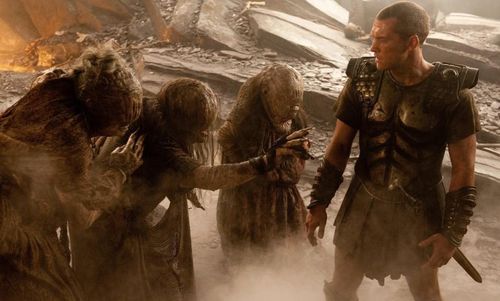
The 1981 version of Clash of the Titans really was an inspired movie. Clash 2010 wasn’t. In fact, it stank. And what better way to explain why it stank than to compare the two?

** spoiler alert **

Clash 2010 has better production values. Its costumes are more realistic. It has better scenery and thus feels more real than Clash 1981. The supporting actors are better too. Mads Mikkelsen is excellent as Draco, as are Liam Neeson and Ralph Fiennes as Zeus and Hades. After that, however, things gets sketchy. . .

Surprisingly, the effects in Clash 1981 are better, not in the technical sense, but in the sense of enjoyability. The effects in Clash 1981, done by legendary special effects man Ray Harryhausen, feel more lively and maintain the spirit of mythology which surrounds Ancient Greece. You know these characters when you see them in Clash 1981. By comparison, the effects in Clash 2010 are dreary and nondescript -- you’ve seen them in a dozen other recent films and wouldn’t spot them as Ancient Greek creatures. If you were asked to draw or describe the creatures in each movie, you could easily describe the creatures in Clash 1981, but those in Clash 2010 would end up just as blurs. And that makes a huge difference in how memorable these films are.

The lead actors in Clash 1981 are better as well. Harry Hamlin portrayed the heroic young Perseus perfectly. He had enthusiasm, brashness, and was clearly captivated by Andromeda, whose life he must save. He also let the character be just naive enough that we could discover the world with him, which pulls the audience in, without making him stupid. Judi Bowker similarly gave Andromeda a regal dignity and a flirtiness in her interactions with Perseus, which made her worth saving.

By comparison, the lead actors in Clash 2010 are crap. Sam Worthington gives his usual lifeless effort. He’s dull and dumb and stiffer than a board. He whines. Even worse, his character is impossible to like. He lacks initiative. He’s not clever. He doesn’t want to be the hero, as he keeps telling us, yet for some reason he just keeps moving right along with the plot. It’s like he just had nothing better to do. He also cares so little about Princess Andromeda that you wonder why he’s bothering to save her.

Andromeda is just as bad. She’s played by Alexa Davalos, who you might remember as Olivia Wilde or Emily Blunt or Megan Fox. She’s as lifeless as Worthington and basically just mopes and occupies space. We are given no reason to like her other than her being smarter than the hillbillies around her. Frankly, by the time the mob gets her, it’s really hard to care. Heck, she doesn’t even seem to care.

But where Clash 2010 really falls apart, compared to Clash 1981, is in the substance. Clash 1981 may not have been authentic Greek mythology, but it gave you the sense that it was. The characters, the creatures and the gods all acted correctly according to what we know about them from mythology. Clash 2010 is too modern to make that claim. Consider the gods. Greek gods were flawed because they had (near)absolute power combined with the worst of human traits. They were petty, vengeful, jealous, vain, deceitful, etc. They were narcissists of the highest order, and Greek mythology crawls with their misdeeds.

Clash 1981 captured this as the story revolves around a series of characters who get caught up in the petty quarrels and sexual trysts of the gods. Indeed, the primary story involves vengeance on the people of Joppa for offending the vanity of the goddess Thetis. These gods lie and cheat and abuse their power to get their way, which is how Greek mythology paints their gods. By comparison, the gods in Clash 2010 are a reserved lot. They are mostly caring and largely passive until they are forced to act -- except Hades who has a grudge against Zeus. Indeed, they only punish the city of Argos because the people of Argos declared war on the gods first. In effect, Clash 2010 has Christianized the gods, and rather than being a gang of ultra-powerful but petty thugs, Zeus in Clash 2010 is more like the Christian God of the Old Testament and Hades is like Satan. In fact, Zeus is so caring that the thrust of his story is Zeus trying to reconcile with his bastard son Perseus. Huh?

Along similar lines, the people of Argos don’t make any sense either, and this leads to a larger point. They have declared war against the gods, but for no apparent purpose. There is no indication what they hope to achieve, nor is it ever clear if this is a philosophical issue or something else? In other words, is this a declaration of atheism or do they just want to be rid of these gods? At times the story seems to be crawling with atheistic messages, but it always undercuts itself. For example, Perseus whines repeatedly that he has no need of the gods and he’s his own man. Only. . . he’s not. In almost every scene he’s helped by the gods while the writer pretends Perseus “does it himself.” He gets magical gifts. Zeus gives him tokens he will need. The gods send an advisor/guardian angel who tells him everything he needs to know. His strength and fighting skill come from the gods. He is even told that it is his destiny to free man from the gods? Think about the ludicrousness of that statement – the mythical force of destiny has chosen Perseus to free man from mythical forces? So is this film about atheism? Who knows? The film sure doesn’t.

The problem here is that the writers never bothered to fundamentally understand the nature of the characters. Are these gods or just foreign tyrants? Are the people of Argos declaring atheism or just swapping gods? And if they’re just swapping gods, what are they seeking instead? There’s a big underwear-Gnome-class hole there. Is Perseus a hero or not? Everyone treats him like a hero, yet he achieves nothing on his own -- he is always relying on others to win his fights or tell him the way to go. Etc.

Even the mythical creatures don’t make sense in Clash 2010. Pegasus, the winged-horse which cannot be tamed, simply comes to Perseus like any other horse -- he doesn’t have to find it or tame it (nor does he really need it). Calibos, the man Zeus twisted into a wretch for killing all the winged-horses except Pegasus and who pines for Andromeda, is now little more than an animal who attacks Perseus because Hades tells him to. The deceptive and cryptic witches are neither deceptive nor cryptic. And Medusa is little more than a tall snake.

Moreover, the writers keep undercutting the story. Perseus needs to save Andromeda because. . . well? He doesn’t live in Argos and he can leave any time. He doesn’t love Andromeda either -- halfway through the film it is imply he kind of digs the girl the gods sent him (Io). So why is he trying to save Andromeda? And she doesn’t really want to be saved either. So why should we care? In Clash 1981, Perseus loved Andromeda and she really seemed to want to live. That made sense. In Clash 2010, that’s gone.

They keep undercutting the tension too. For example, Clash 2010 tells us Perseus is a poor “everyman” -- a fisherman who’s never even held a sword (what Greek male never held a sword?). But then we’re told he’s the bastard son of Zeus, and he has special powers. And when he picks up a sword for the first time, he proves to be the ultimate swordsman. . . so much for our everyman. Think about what this does to the rest of the film. With Hamlin’s Perseus, you never knew how he would do in any fight. He got gifts from the gods to help him, but he had no extraordinary skills with which to use them. Perseus 2010 does, thus with Worthington, there’s no suspense. He will win every sword fight. Yawn. Similarly, in Clash 1981, Perseus needed to figure out the puzzles himself. In Clash 2010, Perseus is given advisors directly from the gods to make sure he figures it out. Yawn. We’re even told it’s Perseus’s destiny to win the movie. Yawn.

Clash 2010 is the perfect example of what happens when you take all the “things” out of a movie but none of the substance, and then remake the movie using those things. What you get is a truly forgettable, generic film.

[+] Read More...

Friday, March 16, 2012

Film Friday: After.Life (2009)

I’d never heard of After.Life until the other day. The film bombed in theaters, making only $3.2 million on a $4.5 million budget, and that’s a shame. This is a fascinating movie and is well worth watching. I can’t call it a great film, but it is an interesting film.

After.Life stars Liam Neeson as Eliot Deacon, the owner of a funeral home, and Christina Ricci as Anna, an unhappy school teacher. After a quick intro where we learn that Ricci and her boyfriend Paul Coleman (Justin Long) don’t really get along, Ricci wakes up on Neeson’s embalming table at the funeral home. She’s had an accident and has been pronounced dead. Neeson’s job is to prepare her for burial. But here’s the thing, she’s pretty sure she’s not dead. Neeson assures that she is. He explains that she had a car accident and was pronounced dead by the coroner at the scene. He shows her the death certificate and the wound on her head. She also suffers from periodic paralysis, which Neeson attributes to rigor mortis. But how can Neeson speak to her if she’s dead? He claims he has a gift which lets him speak to dead people.

The big thing this movie has going for it is mood. The whole film is creepy and you never once doubt the possibility that Ricci could be either dead or alive. And best of all, the film achieves this as a genuine psychological thriller, not a modern horror movie. Indeed, it rarely sinks to cheap scares or gross outs.

Neeson gives a strong performance, as I’ll discuss below. Ricci is quite good as well. Long is weak as the boyfriend who can’t shake the idea that Ricci might be alive, but he’s a sideshow. The real heart of this film lies is the question of whether or not Ricci is really alive or dead. And in that regard, this film is thought provoking. Why do we cling to life? Or do we? What would it take to convince us that we are dead? And how would you prove you wanted to live? I would have preferred a little more depth on the answers provided here, but the film certainly raises the questions well.

Beyond that, there’s nothing I can say without giving you a major spoiler warning. This film’s ambiance comes from trying to understand what is really going on and I’m about to tell you, so don’t read on if you haven’t seen the film.

** Spoiler Alert – I recommend seeing this film before continuing. **

Let’s talk about Neeson. Neeson gives a spectacular performance in this film. About three-quarters of the way through the film, it becomes fairly clear that Ricci is in fact alive and that Neeson is some sort of twisted serial killer. What’s interesting about Neeson’s portrayal up to this point, is that you can absolutely believe both scenarios. On the one hand, he comes across as exactly the kind of respectable man who would be a funeral director. He also plays the idea of the “gift” of being able to speak with the dead perfectly and you never doubt that it’s possible he is telling the truth. At the same time, he shows these moments of intense-but-controlled anger, which give you the sense that he could easily build up enough rage to be a killer.

But even more importantly, he gives a genuinely believable motive. I’ve discussed this before, that bad people rarely think of themselves as evil. To the contrary, they think of themselves as justified or even doing something noble, and that’s the case here. Neeson believes that people who don’t value life don’t deserve to have it. And if you listen closely, you will hear Neeson on several occasions offer Ricci a chance to prove she values life by walking out the door to freedom. This is her trial and she is judging herself, only she doesn’t know it.

This is such a strong motive that it both makes the character instantly credible and it helps you understand his methods. He’s not some standard psycho who tortures people because it gives him pleasure. In his mind, he’s executing people who judge themselves unworthy. His fake-death game is the trial. And interestingly, he seems willing to let himself get caught if the person does in fact walk out the door. That is a fascinating motive and it’s highly believable. Not only does this make his insanity “rational,” but it adds the element of risk which serial killers and gamblers view as such a turn-on. Indeed, this feels like a much greater risk than any other movie serial killer has taken because he puts his fate in the hands of his victims.

The writer was also smart to expose this motive slowly. You start to get a sense for it early and with each passing scene it becomes more clear. This makes for a more fascinating film than those where you have a cliché scene where the otherwise-normal killer suddenly rips off their mask and spews their motive in a melodramatic speech because this film lets you discover the motive as you would in real life -- through small hints.

Now, I’ve said this is an interesting film, not a great film. There are several reasons for that. The story itself is great, as is the struggle between Ricci and Neeson, but Long is a rather poor distraction -- he is a standard, irrational “movie” character. But the bigger problem is that while you watch the film, lots of things don’t make sense. In particular, this seems like a rather impossible way for a serial killer to work. He’s basically relying on people to be injured and then for the coroner to mistakenly declare them dead. That’s a hard bit of disbelief to overcome. But here’s the thing, the film actually answers this, it just doesn’t do it clearly enough that most people will realize what is really going on.

When Ricci has her accident, she is actually forced off the road by a white van, not the truck which Neeson tells her killed her. The white van is the same white van Neeson drives at the end of the film when Long has his accident. What is going on is that Neeson picks a target. He causes them to have an accident. Then, because he’s at the scene, he gives them a shot of Hydronium Bromide, which mimics death and fools the coroner. This explains all of the seeming coincidences, like how he gets his victims. It also explains the coincidence of Jack being Neeson’s son and yet being in Ricci’s class and then getting to know Long -- it’s no coincidence at all, he was sent to target both. If the film had given just a little more hint of this, then I think it would have been better received because, as it is, I suspect most people left the film feeling this was all too coincidental to be real.

I also would have liked to see the film explore a bit more into the question of why Ricci wants to live. This started well, but I think the writer didn’t quite have a solid answer other than “because the plot needs it.” So there is a missed opportunity there.

In any event, the interesting take away from this film is Neeson’s character, who is one of the most convincing serial killers in a long time because he truly seems motivated by a twisted sense of righteousness, rather than the usual “just because I’m evil” attitude most serial killers display. And it’s fascinating to watch him toy with fate by offering to let these people leave and then simultaneously letting them judge themselves. It’s an interesting way for him to wash his hands of his dirty deeds.

There is much here to like and to think about. I definitely recommend this film.

[+] Read More...

Friday, February 3, 2012

Film Friday: Unknown (2011)

I like Taken a good deal and Unknown feels similar to Taken in many ways. It has some interesting facets too, some good, some bad. On the good side, Unknown handles the “stolen identity” concept better than any other film that comes to mind, and Liam Neeson is excellent as always. On the downside, the film ultimately feels flat and its politics are to blame.

** spoiler alert **
The Plot
As the film open, Dr. Martin Harris (Liam Neeson) arrives in Berlin to participate in a biotechnology conference. But he mistakenly leaves his briefcase at the airport, and on his way back to the airport to pick it up, his taxi accidentally plunges into a river. He’s saved by his taxi driver (Diane Kruger). When he wakes up in the hospital, he learns another man has taken his place. This man has identification cards in his name, family photos showing him with Neeson’s wife, and everyone accepts him as Dr. Martin Harris. Even Neeson’s own wife Liz (January Jones, who is awful here) seems to treat this man as the real Martin Harris. Is Neeson insane or is something else going on here? And why are people trying to kill him?
The Stolen Identity Issue
Generally, stolen identity thrillers face an uphill battle. While it’s certainly believable one person would impersonate another, it’s just not believable that they could fool the people close to the person being impersonated. Indeed, how could your family and friends not know the difference? What about co-workers? Even if you’ve only dealt with people over the phone, it still seems unlikely that an imposter could fake the voice, the speech patterns, and the level of knowledge needed to pull that off. Also, once you flash your ID to the cops, the imposter’s web starts to unravel.

So when I hear the words “stolen identity,” I cringe because I know I’ll be subjected to unbelievable setups, inexplicable behaviors, and a host of moments where characters need to act stupidly to make the concept work. This is problematic at best because any scheme that relies on everyone on the planet getting movie-stupid is not a great premise for a film.

But that wasn’t the case here. In fact, I was really impressed. I hate to give too much away and there are several twists, so I will proceed cautiously. The issue starts with the question of whether or not Neeson might actually be insane. Indeed for some period of time, you do genuinely wonder if the other guy isn’t the real Dr. Martin Harris and Neeson isn’t just suffering from head trauma. Soon, all the pieces start being explained bit by bit, and in the process a political intrigue is revealed.

Where this film truly deserves recognition is in the execution of that explanation. For one thing, the entire explanation makes sense. Indeed, every last aspect of it is perfectly logical once you understand what happened. Moreover, it is highly unexpected. This is not a solution you’ll see coming, but at the same time, it’s not so far beyond the bounds of common sense or so impractical that you can’t believe it. Further, it’s woven tightly into the political intrigue, meaning it never feels like a gimmick added to the film just to liven it up.

But most importantly, it’s executed perfectly in that the characters never act stupidly to make this work. The authorities don’t inexplicably ignore Neeson’s claims or become blind to obvious clues or throw up their hands in plot-driven helplessness. And all the pitfalls identified above are overcome. For example, it’s Thanksgiving, thus there’s no way to check with the American consulate to look for passport photos. Neeson can’t produce an ID because his wallet was in his briefcase. His wife’s behavior, the presence of his friend (Frank Langella) in Europe, and other similar issues are all reasonably explained. And Neeson isn’t a fool. That makes this a solid, enjoyable story.
Bland Liberalism Masquerading As Depth
All that said, however, there is a problem with this film. Specifically, the film lacks depth, both in the political intrigue and in the characters Neeson meets.

Drama comes from hard decisions, but there are no hard decisions here because the political intrigue is so one-sided. The film takes place in Berlin and it involves a conference where an Arab prince will giving the world for free an environmentalist-fantasy grain which would feed the world’s poor without the usual beefs environmentalists have with farming. Essentially, the greatest guy on earth is about to offer utopia. Yawn. This film would have been much stronger if there was some doubt as to who the good guys and bad guys really are. Yet, as Neeson discovers what’s going on, his choice becomes patently obvious. There’s some irony in what he’s doing, which I won’t go into, but there’s never a single moment where he needs to ask himself if he’s doing the right thing. That robs the film of a ton of drama which would have made the film so much stronger.

Moreover, outside of Neeson, the characters are flat. The bad guys belong to some generic conspiracy that kills people on behalf of rich companies. Yawn. There is never a sense of why they are actually doing this other than bland profit. As we’ve said many times, it’s hard to care about a villain who doesn’t even care about his own schemes.

And the good guys are even more pointless. By and large, they are nothing more than idealized liberal tropes. For example, there is an illegal alien from Africa who tells Neeson where he can find Diane Kruger, an illegal alien from Russia who becomes Neeson’s sidekick. This character adds nothing else to the plot, yet we’re supposed to care about him because the film tells us that Germans mistreat African immigrants and force them to live in slums (a total falsehood). And when he gets killed we’re supposed to care that his poor family in Africa will never know what happened to him or why the money he sends each month suddenly stops. Boo frick’n hoo. This has nothing to do with the story. And the fact the writer hopes to use this to humanize the story is a prime example that the writer had no idea how to connect the characters to the plot or the plot to the audience. This is what happens when you use an indifferent, generic villain.

Similarly, we are introduced to an ex-Stasi officer. He really does nothing to further the plot except explain the nature of the political conspiracy to the audience -- which actually detracts from the film, as it would have been better to have Neeson learn it himself. But again we’re supposed to care about him and again the reason we’re supposed to care is his liberal beliefs. He is presented as a kindly old former military officer who laments that, “We Germans are good at forgetting things. We forgot we were Nazis and then we forgot we were communists.” Oh gee, what a wonderful guy. Only, it’s crap.

For one thing, the Germans have spent the past 60+ years trying to atone for being Nazis. They’ve made themselves pacifists, built museums to war crimes, outlawed denial of Nazi crimes, made it illegal to sell Nazi paraphernalia, and given money all over the world to try to make good. No one in Germany has forgotten they were Nazis. But they did forget they were communists, and this film is a great example of that. It is a total whitewash to present the Stasi as just another military institution. They were in fact one of the more brutal organizations in history, and that gets whitewashed here, especially when this Stasi character describes how peacefully he questioned “suspects” without ever mentioning the torture, the killing and the spying.

But the bigger issue, again, is that he doesn’t fit into the story. He’s a plot convenience. The information he provides could have been found by Neeson in a newspaper. Yet, the writer mistakenly thinks he can humanize the story by giving us another liberal lament through this character. This is poor writing. It’s like the writer spent all his energy solving the stolen-identity puzzle and he didn’t have any energy left to put into the conspiracy and the supporting characters, so he just grabbed some liberal tropes out of the liberal-idiocy bag and jammed them into the story.

This is a good film, but it’s flawed, and that’s rather sad. Indeed, for a film that takes the horrid concept of a stolen identity and handles it exceedingly well -- a rare accomplishment -- the rest of this film doesn’t do it justice.

[+] Read More...