Monday, April 27, 2015

Mini-Major Discussion: Polygram Filmed Entertainment

by Jason

Last time I tackled ITC, based in Britain. Today I’m staying on that side of the pond for another mini-major, and this group made an even bigger impact in the States with a bigger and richer film library. Like other indie companies, Polygram didn’t carry the load by itself, but instead co-produced a lot of its titles with major studios and relied on them (or Gramercy in the 1990s, a company Polygram co-owned) to distribute them to theaters. This company was responsible for bringing us Hugh Grant, Bryan Singer, and…The Dude?

Who Were They?

PolyGram Filmed Entertainment was created in 1980 by its parent company, Polygram (a music outfit). They had some success with filmmaking prior, so they decided to create their own film studio. Early going was rocky, and some of their earlier pictures were not a success. But Polygram the music company had tons of cash to invest, and kept pumping Polygram with lots of money. The effort paid off in the 1990s, when Polygram struck gold a roster of critically acclaimed and commercial hits.

What Were They Known For?

Hugh Grant, a pregnant policewoman in snowy North Dakota, and being one of the first studios to make a movie from a board game (Clue), making it waaaay ahead of its time.

The Studio’s Peak Moment

The release of Fargo in 1996. Factor in Dead Man Walking and other assorted hits, and the mid-nineties were very good to Polygram.

The Studio’s Most Notorious Movie

The winner is likely Pamela Anderson’s attempt at movie stardom in the comic book adaptation (and pseudo-remake of Casablanca, believe it or not!) Barb Wire. Though some, including yours truly, find it a guilty pleasure. Actually, 1996 overall featured some of Polygram’s most notorious titles. In addition to Barb Wire, this year also released the bombs Eddie (a movie that gave Whoopi Goldberg a Razzi nomination), Kazaam (Shaquille O'Neal as a rapping genie) and the star-studded but somewhat controversial hit Sleepers.

The 1997 dark comedy Very Bad Things is a runner-up, though some do appreciate its dark humor.

And then there’s the 1997 Spice Girls flick Spice World. I’m already having flashbacks to the late 90s.

Finally, the 1994 Jodie Foster drama Nell is considered by some to be overly overt Oscar bait, though it has its admirers.

The Studio’s Up and Comers

For Flashdance (co-produced by Paramount), a lot of the behind-the-scenes folks. The director Adrian Lyne, the producer duo of Don Simpson and Jerry Bruckheimer, the screenwriter Joe Eszterhas, and its star, Jennifer Beals.

Tom Cruise made his film debut in Endless Love, while James Spader took his second film role here.

Hugh Grant. Four Weddings and a Funeral catapulted him to big success, and the studio gave him another big hit with Notting Hill.

New Zealand director Vincent Ward got major exposure with Map of the Human Heart. Polygram would later make the Robin Williams fantasy What Dreams May Come with Ward in the director’s chair.

Speaking of Map of the Human Heart, this was a breakthrough role for its star Jason Scott Lee, who would later play Bruce Lee in the biopic Dragon: The Bruce Lee Story for Universal.

Director Bryan Singer with The Usual Suspects. Remember when Singer was just known for Keyser Söze?

British action hero Jason Statham got his big break on the international stage with Lock, Stock and Two Smoking Barrels.

The Coen brothers directed The Hudsucker Proxy here before making two of their most famous films to date, also for Polygram: Fargo and The Big Lebowski.

Polygram was just the international distributor (Miramax distributed in America), but it’s worth noting the British 1996 flick Trainspotting for basically introducing Ewan McGregor to a wide audience.

And finally, Vin Diesel’s gravel-throated Riddick made its debut in one of the studio’s last films, Pitch Black.

Notable Movies.

Six Weeks, Endless Love, Clue, An American Werewolf in London, Flashdance, The Adventures of Priscilla, Queen of the Desert, The Hudsucker Proxy, Romeo Is Bleeding, Wild at Heart, Kalifornia, Terminal Velocity, Ruby, Candyman I and II, Home for the Holidays, Four Weddings and a Funeral, Dead Man Walking, Fargo, Nell, Mr. Holland's Opus, When We Were Kings, What Dreams May Come, Notting Hill, Sleepers, The Game, The Relic, Very Bad Things, Lock, Stock and Two Smoking Barrels, Pitch Black, The Borrowers, Hard Rain, The Portrait of a Lady, Arlington Road, Elizabeth, and The Big Lebowski.

And I’ll throw in Mystery Science Theater 3000: The Movie, even though it wasn’t produced by Polygram, but it was distributed by Gramercy.

What Killed the Studio?

It got sold to a beer corporation that had no interest in using it to make movies and ended up selling its film library.

Of the studios I’ve covered that went under, I cannot find anything to suggest Polygram was having financial trouble. This was a simple case of a company being sold off. In this case, the company that acquired Polygram, Seagram, was only interested in its vast music library, and since it already owned Universal studios, it did not see a need to maintain a second studio, so it folded most its operations into Universal, and sold the bulk of its pre-1996 library to MGM.

Legacy

Overall, Polygram had a good run in the 90s, and many of its stars and directors went on to bigger things. Exhibit A is Bryan Singer, who directed the first X-Men movie and laid the groundwork for the current Marvel movie renaissance. The importation of British leading men like Ewan McGregor and Jason Statham have also left their mark. On the other hand, romcoms like Four Weddings and a Funeral and Notting Hill seem to have disappeared from movie screens.

So what is your favorite Polygram picture? What do you think of the studio? Any other thoughts?
[+] Read More...

Thursday, April 23, 2015

Film Friday: Captain America: The Winter Soldier (2014)

A couple weeks ago, I reviewed Blue Thunder. I noted that Blue Thunder was a truly stupid film, but you didn't care because it was fun. Well, in 2014, Marvel put out a sequel to the first Captain America movie. This was called Captain America: The Winter Soldier and, like Blue Thunder, Captain America: TWS was stupid but quite enjoyable.

Plot

For being a superhero movie, Captain America: TWS has a surprisingly complex and interesting plot. The story starts when Samuel L. Jackson (Samuel L. Jackson) gets attacked by the Washington D.C. police for DWB. But these aren’t real cops. No. They are a private army under the control of a guy in body armor who is an unbelievable (i.e. not credible) badasp. Well, Mr. Jackson refuses to die, and he and his car KITT fight back. After wasting most of the bad guys, Mr. Jackson seems to escape but has suffered major wounds.
Mr. Jackson now travels to the lousy apartment of Captain America (Chris Evans), who has befriended a random black dude with post traumatic stress syndrome. Jackson tells the Captain that his secret organization, S.H.I.E.L.D. is full of people he doesn’t trust and he asks the Captain to somethingsomething with a data stick.

Soon, Jackson dies and Condor (Robert Red-Ford) takes over the agency. When this happens, the Captain discovers that some sizable percentage of S.H.I.E.L.D., including all the top managers, are actually bad guys. They decide to hunt him down because they realize he will never help them. Soon the good Captain is on the run with Scarlett Johansson (if that is her real name).
As they run, they are chased by this mystery figure who is “the Winter Soldier” (John Kerry). It turns out that through some vague and unexplained process, the Winter Solider is really Bucky, Captain America’s sidekick from the 1940s. He’s been brainwashed by the bad guys and now fights for them with his memory erased.

Anyhoo, they race to an old S.H.I.E.L.D. base that looks like it was abandoned at the end of WWII and they discover a supercomputer made of old sticks and bits of string. Inside this computer, someone preserved the consciousness of supervillain Armin Zola. They also discover that Hydra has infiltrated S.H.I.E.L.D. to the point of controlling it entirely except for Samuel L. Of course, Samuel L. isn’t really dead because you can’t kill Mr. Jackson.
Naturally, this means that the Captain must sneak back into S.H.I.E.L.D. HQ and destroy their latest weapons before they can be used to conquer the planet. Then the CGI machine gets turned on until the movie ends.

Stupid, But Fun

Wow is this film stupid. No part of it makes sense. How in the world can Hydra infiltrate S.H.I.E.L.D. for decades and no one knows? If everyone thinks the Captain is a bad guy, why not call in the other Avengers to help catch him? It’s not like anyone at S.H.I.E.L.D. can do it on their own. There is absolutely no reason for the inclusion in the film of Bucky as The Winter Soldier, nor does it make sense that Hydra waited this long to use him. Did they expect that one day the Captain would be thawed out?
You know what? I don’t even want to think about it. This movie is stupid and you have to ignore a LOT for it to work.

That said, however, the film does work. And what makes it work is similar to what made Blue Thunder work despite all the silliness. In Captain America: TWS, just as in Blue Thunder, you overlook the plot holes because the film keeps you too entertained to worry about it. It does that by giving you likable characters, clever dialog that engages your mind once in a while, little surprises throughout, and they do an excellent job presenting the action scenes.

Taking the action scenes first, what this film does which is so rare in superhero films today is that it uses short fight scenes, which are spread throughout the plot. By comparison, most action films these days turn on the old CGI machine and let the “action” run for twenty to thirty minutes at a time. That’s far too long for anyone except the most diehard nerd to care about. So by keeping the action scenes shorter, this film never causes its audience to zone out.

Moreover, the action scenes have two additional things going for them in Captain America: TWS. First, since you like the characters and care about them, you actually do care how the fights end. It’s the rare superhero film where I can say that’s true. When the Green Whogivesashit is fighting the big stinky fart monster, it’s impossible to care about the outcome. Either Ryan Reynolds wins and we need to endure a sequel or the fart monster wins and... well, somethingsomething. In this instance, the fights have meaning because we think Mr. Jackson was killed and we don’t want to see other people we like get killed.
Further, the fight scenes here have some suspense. We don’t know who will win each fight, nor do we know the consequences of winning or losing. That makes these fights more interesting. By comparison, in the circle jerk known as The Man of Steel you watch two guys who cannot even be scratched punch it out for an hour as they knock holes in buildings. Boooooring.

This film also does something else clever: it gives you constant little surprises. Indeed, throughout this film, almost every significant scene results in some revelation that adds to the plot. Few other superhero films do that. Most consider the generic twists (i.e. discovery of superpowers, when average loser morphs into supervillain, the fake victory of the bad guy, the discovery of the secret weapon/secret villain) to be enough. But they don’t feed you little things to keep the story interesting between those well-worn points. This film does. It was also packed with clever little moments in the dialog that play the cultural reference game, which is something people really like because it connects the film to their lives.
Finally, this film works because you really like the characters. Captain America is a dull character, but Evans plays him in a way that makes him endearing. Scarlett Johansson plays the hooker with the heart of gold very convincingly and Anthony Mackie plays the cool best friend you wish you had. Both are traditionally characters with strong appeal. And Samuel L. Jackson plays Motherf*cking Samuel L. Jackson, who is always compelling. It’s hard not to like these people and they pull you into their plight as they struggle to land the plot in a good way.

Once again, there is a lesson here. The lesson is that you don’t even need a super smart film to make a good film. All you really need is to do the things that good story-telling normally requires: put engaging characters on the screen and let them fight for stakes that interest the audience. That’s a pretty low standard. So why can’t more films, especially superhero films, at least achieve that bar?

Thoughts?
[+] Read More...

Monday, April 20, 2015

Guest Review: Godzilla vs. the Smog Monster (1971)

by Rustbelt

Well, it’s time for Earth Day. And so I’d like to recall the adventure of the largest green warrior of all time, (though his skin is actually charcoal gray)…Godzilla! He fights for Gaea and smelly tree-huggers in the aptly-titled, Godzilla versus the Smog Monster. Now we witness the ironic fight between a behemoth born of man’s tampering with nuclear power, and a leviathan created of man’s callous destruction of...

Ok, ok. Let’s not kid ourselves. With its environmental preachiness, bizarre (and often grotesque) imagery, and lack of anything resembling focus, this black sheep of the Godzilla kaiju canon (11th in the original, or Showa series, 1954- 1975), is hard for even diehard G-fans to stomach.

Plot Summary

A strange ‘tadpole’ is caught in the waters off Japan. The investigating scientist, Dr. Yano. is then wounded by a larger ‘tadpole’ while scuba diving. He realizes the creatures are made out of minerals and sludge. Even worse, these creatures can unite and form larger ‘tadpoles.’ And while the police are busy interrogating Hoggish Greedly and Sly Sludge, a creature dubbed “Hedorah” (based on the Japanese word for “mud” or “vomit,” depending on the source), morphs into a froglike creature and ends up fighting nuclear nightmare-turned-savior-of-Earth Godzilla in Tokyo.
Eventually, Hedorah grows larger, becoming a flying-saucer-like monster, (no explanation given, though Dr. Blight was implicated), and spreads sulfuric acid mist all over southeast Japan, killing thousands. Dr. Yano (well, actually, his son) figures out that since Hedorah is mostly sludge, they should just dry him out.
The film climaxes at Mt. Fuji where a now-bipedal Hedorah again fights with Godzilla while a group of teens hold a bonfire party. (They’re gruesomely killed by Hedorah.) After getting the better of the fight, Hedorah is drawn to a pair of super-sized electrodes set up by the army. Godzilla helps capture Hedorah and uses his flame to power the electrodes, partially dehydrating Hedorah. What’s left of the sludge fiend tries to flee, only to be caught when Godzilla puts on his Planeteer rings and uses the powers of wind and fire (in the form his breath) to fly- yes, fly!- and catch up with the beast. And as the Big G and the Army let their powers combine, Godzilla uses his atomic breath to charge the electrodes again and finish off the titular smog monster. Thus, the environment is saved through the use of atomic radiation…as Verminous Scum and Looten Plunder shake their fists in the distance, promising to get Captain Plan- er, uh, Godzilla next time!
OK, Let’s State the Obvious

Director Yoshitmitsu Banno came up with the idea for this flick while standing on deadly ground in Yokkaichi and staring at some polluted waters. At the time, (1971), the environmental moment was at its peak and Banno thought there were things more dangerous for Godzilla to fight besides aliens and rogue villains bent on enslaving humanity. (Interestingly, this was the first G-movie in years to use almost no recycled footage form earlier G-films.) Godzilla goes into full superhero mode to combat man’s foolish exploitation of nature and it’s about as subtle as using dynamite to blow up a tree stump. Plus, with executive producer/Godzilla creator Tomoyuki Tanaka hospitalized for a severe illness, Banno was free to do he pleased.

But, honestly, it’s not Banno’s over-the-top environmental diatribe that drives most viewers and G-fans crazy. It’s something else…

Who was this made for again?

Exactly what kind of film Banno wanted to make is anyone’s guess. Is this a kids’ movie? A family movie? An adult movie? Just what kind of tone was the director going for? It’s hard to say. (In a 2014 interview, Banno said he wanted to make a kids movie that adults could also enjoy. Hmm…) Banno was under orders from Tanaka to make the film applicable to then-modern youth culture. The director thus added all the trappings of the late 60’s/early 70’s- drugs, environmentalism, and psychedelic rock ‘n roll. (The flick even has an opening Bond-style theme song! –“Save the Earth” in early English versions; “Give Back the Sun” in Japanese versions.) Unfortunately, the results are uneven, (to say the least), leading G-fans to believe Banno either succumbed to reefer madness or got a bad case of happy feet and went bats*** insane. Consider the following…
What is this doing in a Godzilla movie?

This flick is loaded with shock and terror- and not the good kind. There are just plenty of “WTF?!” moments, such as:

-The scientist’s son, Ken, (a required character name for all Japanese B-movies), plays with Godzilla toys at the start of a Godzilla movie.
-The first time Hedorah goes on land, he crawls up a factory and breathes in smoke from a chimney. (The requisite Grateful Dead music was apparently too expensive to license.) Remember, pollution feeds monsters!
-At the same time, Ken’s family’s friend, Yukio, either drinks too much or does some brown acid (it’s not clear which), at a night club (complete with psychedelic liquid light show), and has a freakout where everyone turns into blue aliens! Just kidding. He suddenly sees everyone wearing fish masks. (Did I mention his girlfriend, Miki, dances in a nude suit as the club is invaded by some of Hedorah’s sludge in a scene that bears more than a passing resemblance to the Blob?) Remember, pollution ruins parties!
-And in case you forgot the movie’s stated intentions, Dr. Yano gives several dogmatic speeches, Avatar-style, to Ken about the dangers of sulfuric acid, the making of sludge, and nuclear power. (It’s a wonder a test wasn’t added to the end credits.) Remember, pollution leads to boring lectures!
-As Hedorah “evolves,” bizarre animation sequences (that Monty Python look like Pixar by comparison), are used to debut his new forms. And you thought Hanna-Barbara was stiff! So don’t forget, pollution gives bad animators undue attention!
-Death, death, death… This was the first film in the series to show human casualties since Godzilla’s original 1954 appearance. Most of the time, the victims collapse from Hedorah’s smog and quickly decompose (albeit in a psychedelic light show kind of way). At other times, like at the Mt, Fuji fight, Hedorah simply sprays victims with sludge, leaving 40 to 50 partially rotted teenage corpses in the grass- and all in front of young Ken’s eyes. In other words, pollution- like this movie- ruins childhoods!
Good Grief...

This movie goes from scenes of slapstick to images of outright horror in seconds. One moment, Godzilla swings Hedorah around by the tail in Tokyo. The next, some of Hedorah’s sludge smashes through the window of a gambling den, leaving the men inside (whom we saw alive and healthy only a few seconds before), covered in muck and frozen in agonal death poses.

There are countless other instances of these bizarre tonal shifts. As noted above, there’s plenty of drug imagery and gratuitous violence to confuse the kids the film was supposedly made for. (As a side note, the infamous ‘flying Godzilla’ scene was intentionally added by Banno to lighten the film a little.)
Aw, Son of a Banno!

One of the better-known stories of this film’s production involves a classic case of on-set surgery. Kenpachiro Satsuma, the actor who portrayed Hedorah inside the suit, began to suffer from fire down below during filming and was quickly diagnosed with appendicitis by the film’s doctor. The condition was so serious that the medical team couldn’t wait for Satsuma to take the suit off before surgery, so they operated on him on set and through the Hedorah costume. During the appendectomy, Satsuma, likely to his chagrin, learned that painkillers have no effect on him. Ouch...

Fortunately, Satsuma was a trooper. He recovered and finished the film. He even went on to play the monster Gigan in two of the next four Godzilla movies. He also played the Big G himself in all seven of the Heisei series (1984- 1995) of Godzilla films.
What? There Are Two of These Things?!

Believe it or not, this movie has been dubbed into English twice. The first English version came out in 1972 and was released by American International Pictures. It ends with Godzilla saluting Ken as he walks into the rising sun. (This one contains the English theme song, “Save the Earth.”) After the turn of the millennium, Toho declared, “The power is OURS!” and commissioned a new dub track by Axis International for the first DVD release. This time, another Hedorah rises from polluted water with “The End?” as the credits roll. (The theme song in this one is the Japanese, “Give Back the Sun.”)

It’s possible that few movies can better show the difference between good and bad dubbing. The AFI version was clearly handled with care. The dialogue was translated and re-written into conversational English, Also, the voice actors sound appropriate and put a lot of effort into the characters’ voices and behavior. The Toho-Axis version, on the hand, apparently rose form the same sludge that spawned Hedorah. The dialogue was translated directly and comes off like a poorly-written comic book adaptation. The voice actors here, well, um…they made an effort. (The same effort you would expect from work-a-day actors who showed up, mumbled into the mic, got their check, and then sped off for fear of being late for work at Taco John’s.)

Sadly, Toho only uses the Axis dub for DVD’s, Blue-Rays, and TV showings of this film. If you want the good version, it’s off to eBay to bid on a VHS copy of the AIP dub.
Aftermath and Legacy

After getting out of the hospital, producer Tanaka saw the film, hated it, declared that Banno had “ruined Godzilla,” and made it clear that Banno would never work on a Godzilla movie again. (And he didn’t; meaning Banno’s plans for a direct sequel also fell through.) However, Banno was a consultant on the 2014 Godzilla movie. Roger Ebert liked it. Michael Medved put in his book, The Fifty Worst Movies of All Time.

Hedorah has only appeared in only one other G-movie, Godzilla: Final Wars (2004). In a cameo appearance, he and Eibrah (a giant lobster) are vaporized in one blast of Godzilla’s atomic breath. (The Smog Monster has, however, become quite popular among fans of horror author H.P. Love craft.)

Hedorah was also referenced in the movie, Godzilla vs. Destroyer (1995). Godzilla’s opponent of the title went through a similar evolution, albeit through means unrelated to pollution.
So, remember everyone, give a hoot. Don’t pollute. Because, due to the environmental movement’s suppression of nuclear power, there just aren’t enough giant, mutated monsters with atomic breath to save us from alien* monsters that thrive on the toxic output of our cruel, nasty technological progress.

(*-What? Didn’t I mention that Hedorah originally came to Earth via a meteor? Well, it was a throwaway line in the movie and if Banno didn’t really care, then neither do I.)
[+] Read More...

Monday, April 13, 2015

Mini-Major Discussion: ITC Entertainment

by Jason

Not all mini-majors and independent film companies are Hollywood or even American-based. For this Mini-Major Discussion, I decided to focus on a film company that was actually based in Britain, and although it didn’t produce many films, chances are we have seen at least one ITC flick in our lifetime. Also, it may be a surprise to learn that this outfit actually was responsible for the rise of…the Muppets?

Who Were They?

ITC was a British television company founded in 1955 by television mogul Lew Grade. For its first few decades, the company produced many television shows for Britain, with some for an eye for American audiences such as Space: 1999, but in the 1970s, ITC branched out into filmmaking.

What Were They Known For?

A whole lot of British TV shows, though none named Doctor Who.

American audiences may recognize names like The Saint, Thunderbirds, UFO, Space: 1999, and The Prisoner, as well as the mini-series Jesus of Nazareth. All of these programs were produced by ITC. But their best known TV show was actually produced by an American, Jim Henson. After Henson failed to get traction with American network heads to make The Muppet Show, Lew Grade offered to back the show, provided it was filmed in England. Later, when Henson decided to end the show and take the Muppets to movies, he made The Muppet Movie, The Great Muppet Caper, and The Dark Crystal with ITC.

Their movie catalog isn’t very large, but it includes a few cult classics like The Boys From Brazil, The Last Unicorn, The Brave Little Toaster, and The Stepfather, as well as Academy Award winners On Golden Pond and Sophie's Choice.

The Studio’s Peak Moment

The Muppet Movie. It was a smash hit, grossing 65,200,000 in the U.S. alone, and was the highest grossing Muppet movie in Jim Henson’s lifetime.

The Studio’s Most Notorious Movie

Okay, this isn’t a movie, but some would say the second season of Space: 1999 was notorious for being a poor follow-up, and its producer sometimes gets a share of the blame, Fred Freiberger. You may recognize him as the guy who produced the poorly received third season of Star Trek. (Poor guy couldn’t catch a break!)

Runner up: The Legend of the Lone Ranger. ITC tried to reboot the iconic hero, previously portrayed by actor Clayton Moore in the classic Lone Ranger TV series, in a new feature film, but they did not want Moore, by now 65 years old, to go around making appearances wearing the iconic mask, as they wanted their actor to be identified with the role and didn’t want Moore’s appearances to confuse people that he would be reprising his role in the film. So they got a court order telling him to stop going around in costume.

Which turned out to be a big, big mistake. The controversy damaged the film before release and effectively killed its chances. It didn’t help that the actual Lone Ranger didn’t don his mask until an hour and ten minutes into the film.

Second Runner Up: Can’t Stop the Music. This was a musical comedy based on the rise of the Village People, which had the worst timing you can imagine. It was released in 1980, by which time disco was not only dead, but reviled. CSTM was so bad, it inspired the creation of the Razzie Awards.

But the dubious winner of the title must go to Raise the Titanic. RTT is why there were no Clive Cussler movie adaptations until Sahara. (And needless to say, Sahara is why there have been no Cussler movies since)

The Studio’s Up and Comers

Jim Henson wasn’t exactly an unknown even back in the 1970s, but ITC did produce The Muppet Show and the films The Muppet Movie, The Great Muppet Caper, and The Dark Crystal, launching Henson and his Muppets to the height of their success.

Steve Guttenberg got early roles in The Boys from Brazil and Can’t Stop the Music.

Terry O'Quinn, for his role as the serial killer in The Stepfather.

Notable Movies

The Muppet Movie, The Great Muppet Caper, Saturn 3, The Big Sleep, Where the Boys Are '84, Sophie's Choice, The Stepfather, Farewell, My Lovely, The Legend of the Lone Ranger, Without a Clue, The Dark Crystal, The Brave Little Toaster, The Company of Wolves, Backfire, The Boys from Brazil, The Evil That Men Do, The Eagle Has Landed, Inside Moves, Capricorn One, Desperate Characters, The Return of the Pink Panther, and The Tamarind Seed.

What Killed the Studio?

Again, Raise the Titanic.

Raise the Titanic started out as a novel written by Clive Cussler, part of his numerous “Dirk Pitt” novels. Grade thought the series would work as a possible James Bond-style type adventure series, and bought the rights to the novel. However, actually getting a workable script written proved difficult. It was said as many as seventeen writers took a crack at the movie, with one claiming the original novel was more like a manual how to raise a big ship from the ocean than an actual adventure piece. Then the production struggled to depict the Titanic being raised from the ocean. The initial tank built for the model Titanic was too small, so six million was sunk (pun intended) into building a bigger one. The cost of the movie prompted Grade to quip, “It would have been cheaper to lower the Atlantic!”

Cussler hated the movie and refused to endorse it. The film was one of two big bombs for ITC, the other Can’t Stop the Music. The box office disasters of both movies led to Grade pulling out of the filmmaking business. ITC sold Universal its distribution rights to movies still in post-production, including On Golden Pond, Sophie's Choice, The Dark Crystal, and The Great Muppet Caper. Ironically, as with Orion’s troubled bankruptcy period, some of these films would end up being some of the most acclaimed titles the studio would put out.

Legacy

Despite having the wind knocked out of its sails, ITC continued on for some years after, even releasing a few more films, before being bought by Polygram in 1995, and then Universal bought up Polygram in 1998. Grade would be brought into Embassy Pictures and later returned to head ITC after Polygram purchased it, before his death in 1998. So like many other mini-majors, ITC would see its library swallowed up by a bigger company.

Jim Henson moved the Muppets on to TriStar and later planned to sell the Muppets property to Disney shortly before he died. After a series of middling films, Disney successfully revived the Muppets with the 2011 film The Muppets but the 2014 sequel Muppets Most Wanted ended up a bust.

So what are your favorite ITC movies? (Actually, I’ll go ahead and throw in any of their television shows for the discussion, since ITC has such a big television catalog). Any other thoughts?
[+] Read More...

Friday, April 10, 2015

Film Friday: Blue Thunder (1983)

Have you ever run into a movie that is just stupid on so many levels and yet the film still rocks? No, I’m not talking about Captain America 2, I’ll talk about that next week. I’m talking about Blue Thunder, a movie that I just can’t resist. And do you know what it is that makes Blue Thunder so great? I have no idea. Let’s see if we can figure it out.

Plot

Blue Thunder is the story of Chief Martin Brody (Roy Scheider) who got sick of fighting sharks in Amity, changed his name to Frank Murphy and decided to become a divorced police helicopter pilot for the LAPD’s Astro Division. Roy plays things fast and loose and is constantly in trouble. In fact, he’s just been called in again for a psych evaluation because a great many people suspect he’s crazy because he suffers from PTSD from Vietnam.
As our story begins, Roy gets introduced to his new partner, Officer Lymangood (Daniel Stern). Roy takes Lymangood around town and shows him the sights, which include a motorcycle cop having an affair and a model who strips naked and dances in front of her window and is apparently deaf to helicopters inches outside her window. Her neighbors are not and Roy and Lymangood get in trouble. They get in extra trouble too because while they were peeping, a city councilwoman was killed in an apparent rape attempt a few blocks away. Roy, however, suspects it wasn’t really an attempted rape because there was an abandoned car in the area that disappeared. Makes sense, right?

Anyhoo, Roy and his partner are chosen to be the test pilots for a new program the federal government is testing in Los Angeles. Under this program, the cops will be armed with one kick ass helicopter called “Blue Thunder,” which will patrol the skies of the city. This thing has a canon on the front which shoots very precisely, except when it doesn’t, and the feds admit that they want to use the chopper for “crowd control from the air” during the upcoming Olympic games. Roy smugly tells them that “crowd control from the air” didn’t work so well in Vietnam.
It soon turns out that the feds are working with Malcolm McDowell, a Brit, who commanded Roy in Vietnam and wanted to have him up on charges for refusing to commit war crimes. Malcolm warns the feds that Roy is “totally unsuitable” for their purposes, but then tells them not to ask for his removal from the program. Instead, Malcolm tries to kill Roy... but fails.

Roy then goes on his first patrol with Blue Thunder. Fortunately for him, the feds are having a midnight meeting with their brigade of killers while Roy is in the air and they speak openly about wanting to use Blue Thunder for crowd control. Oh, and they talk about killing Roy. Roy makes a video of the meeting using Blue Thunder’s recording equipment. At the same time, Roy discovers that the supposed rape of the council woman is connected to Blue Thunder because Blue Thunder is part of something called “Project Thor,” and the “rapist” dropped a note at the scene which included the word THOR.

Roy decides to steal Blue Thunder and take the video to the press. The rest of the movie is a sort of three-dimensional chase scene where Roy is chased by choppers and F-14s while protecting his girlfriend’s car from the pursuing police.
Why Blue Thunder Rocks!

Hmm. Ok. Let me start by admitting that this movie is nonsense. It is packed with key points that are flat out stupid and seriously flawed. Consider these issues:
● Roy is a troublemaker and is viewed as crazy enough to need psychological evaluation. Yet strangely, he gets chosen to be the lead pilot in this impressive new program with its ultra-expensive new chopper? Who made that decision?

● Roy determines that the council woman wasn’t raped because he saw an abandoned vehicle in the area and it later vanished. He assumes this means it was a professional hit. But, um, why? Why would a professional drive a beater but a rapist wouldn’t?

● At the scene of the rape/assassination, they find a paper with the word THOR written on it. This is the name of the government’s secret project. Why would a competent hit man carry around such a paper? Also, Roy later connects this to prove that the council woman was assassinated. This is meant to vindicate Roy, only Roy was just guessing about the rape and his crime was peeping instead of working, not guessing wrong about the rape.

● How can the naked dancer not hear a helicopter right outside her window? Those things aren’t silent. And again, why would Roy get this plum Blue Thunder assignment after getting caught messing around on the job?

● Malcolm McDowell was in Vietnam? Really? He’s British.

● If Malcolm and the feds thought Roy was unsuitable, presumably because he won’t stop insulting Malcolm and complaining that the program is immoral, then you would think it would be easy for them to pick a different pilot. Why risk putting him on the project? And why not put a federal observer in the chopper instead of Roy’s buddy?

● Why are the feds holding a meeting at night? Why are they meeting with their assassins?

● Finally, the reason we (and Roy) are supposedly outraged by Blue Thunder, i.e. the thing that motivates the entire movie, is that Roy discovers that the government wants to use it to quell riots at the Olympics. And supposedly it is Roy’s discovery of this which causes him to steal and destroy Blue Thunder. But the feds actually tell this to Roy right at the beginning when he tells us that “crowd control from the air” didn’t work so well in Vietnam. In other words, they are up front with him the whole time, and everyone just acts like this is still a secret.

What’s more, what riots? There aren’t any in the film and America hadn’t seen riots in nearly 20 years at that point. Also, as an aside, nothing of the sort actually happened in Vietnam as the US military never got involved in riots or crowd control.
Arg. What a load of stupidity! So you have a guy who is given a key assignment no sane person would ever give him. He is given that assignment by the bad guys who then decide to kill him when they discover that he’s been assigned to their project... a project for which they no doubt had the power to select the pilots. He freaks out about something he already knew an hour earlier in the film, after watching the stupidest meeting ever between the bad guys and their hired killers, and a running shootout begins.

This is a stupid film.

And yet... it’s fricken awesome. Yes, it is.
What I love about this film is that it is an unapologetic action film. All the stuff above is basically just flavor that you aren’t supposed to think about. McDowell works, despite being British, because he’s an odious villain. Roy gets the assignment because we like Roy. We like his personality. We trust the actor, even if we would never trust the character, and that trust washes away the character’s flaws for us. Moreover, he’s anti-establishment enough to be the rebel this movie needs, and his kind of crazy is risk-taking, which is what makes it believable that he has extraordinary skills.

So as bizarre as it may sound, the unbelievably of this film is precisely what makes it believable.

Beyond that, shooting this thing was an amazing technical challenge. For example, to get many of the air shots, Director John Badham (Saturday Night Fever, War Games) actually placed stuntmen with cameras on the outside of helicopters to get the right shots. That makes some of the flying scenes second to none. Check out this photo...
The writing is superior too in that the film does an amazing job of ratcheting up the tension in every scene. And the payoff is very strong because the film skillfully builds the hero (Roy) and villain (McDowell) as equals, which makes Roy’s victory all the stronger, not to mention that Roy must do what we are told is impossible to win. Compare that with modern films where the villains turn out to be mindless cowards or nut jobs. None of that is true with McDowell, who is skilled and rotten. And that creates real tension in the final challenge.
Ultimately, what sells this film however is the presence of Roy Scheider... and the helicopter. Almost every screen minute is dominated by Roy. Fortunately, there is just something about Roy that makes you like him. Roy is loyal, courageous and morally right. He is the underdog. He is the everyman who is crapped on by everyone else, but keeps rising above by giving as good as he gets. And he blows things up. And do you know what else? The helicopter is fricken cool!

What more could you want?

Check this one out if you haven’t. You’ll like it.

[+] Read More...

Monday, April 6, 2015

The Fairy Tale Wars Have Been Won!

We have touched upon fairy tales a bit lately. In particular, we have touched upon the idea that the left is at war with fairy tales. I thought it would be worth pointing out that despite decades of attacks, the left hasn’t managed to gain an inch of ground. If anything, they are going backwards.

Here’s the issue: the left hates fairy tales. The reason is that fairy tales teach kids certain values and ways of processing information which basically inoculate kids from the left’s attempt to brainwash them. Essentially, fairy tales teach kids the value of independence, to despise conformance, the value of questioning authority, the reasons why wealth is better than poverty, and an entire set of values that not only disdain coveting, theft, and demonization, but make those into crimes punishable in ways that make the Biblical plagues look tame. These values in turn make kids understand at a fundamental level that the left is full of crap when they try to indoctrinate these kids into becoming rich-hating, asexual automatons.

Moreover, feminists HATE the idea that fairy tales teach little girls that the best thing in the world is to be a princess, and that life is best when a boy rescues them, and that children are worth more than professional kudos. They HATE the lack of gays and the fact that wimpy males and “strong women” are always the villains.
Socialists hate the fact that fairy tales teach kids that there is no free lunch, and that those who promise something for nothing are villains. They hate that the rich can be seen as heroes... that poverty is not shown to be noble... that attempts to make everyone equal always result in society’s collapse. Environmentalists hate the fact that kids are taught that people matter more than trees and animals. Race baiters hate the fact fairy tales don’t include proportional representation. Peaceniks hate the idea that fighting is always shown to be necessary when confronted with evil... negotiation and appeasement are never the answer in a fairy tale.

That’s a lot of hate.
So what the left started at least as early as the 1960s, but really took off in the 1990s, was to attack fairy tales. They mocked them and twisted them. They whined about the messages they sent. They screamed for them to be re-written in gender neutral, anti-violent, pro-collectivist ways. They made the princes gay (not that there’s anything wrong with that... oh, wait). They made the villains misunderstood victims of society. They re-described the stories as spousal abuse, tales of oppression and filled them with perverts.

This was happening all over the world and it was mainly spearheaded by barren female professors.

But just like Fat Barbie, no one bought that crap except elitist leftists who wanted to further indoctrinate their own retarded kid(note the singular).

Anyways, I often wondered if any of this took hold. After all, we do live in a cynical world where “adults” love to spoil everything for everyone else they can... especially children. So presumably, some of this would filter down and ruin fairy tales, right?

Wrong.

Now that I’ve been yanked into kid culture by my two girls, ages 12 and 9, I can assure you that things are much, much worse for the left than they ever were when I was a kid. From what I’ve seen, there isn’t a girl over the age of 2 who doesn’t dream of being a Disney princess. Yep. 100% of the human race never agrees on anything but this is pretty darn close.
The theaters and video racks are packed with films staring the Disney princesses, Tinkerbell, and a dozen other princesses (and they all dress like the worst nightmares of feminists (see below)). If you aren’t a princess, don’t bother applying. In fact, it’s so bad that Disney has had to redefine each of their heroines as a princess, lest they be ignored. Even the little girl in Wreck-It-Ralph had to be made into a princess, when there was no other reason for it except that girls demand it en mass.

As an interesting aside, the grievance against Disney’s The Princess and the Frog wasn’t that it included a princess, it was that (1) Disney waited so long to finally create a black princess and (2) she wasn’t a princess by birth, which makes her a second class princess.

Anyway, continuing... if you go to the toy store, you will see a metric ton of princess costumes. You will see princess play sets, princess dolls, and princess accessories. But just try finding a costume for a girl soldier or fireman or cop. Ain’t no such thing. So all those messages about “girls can do anything” that flooded us in the 1990s were internalized and the unified response was: “Then we want to be princesses!”

(As another aside, every time a little girl puts on a princess costume, a college professor feminist gets hit again by the ugly stick.)

And what about those cynical fairy tale stories meant to denigrate princesses? Good luck finding those in stores anymore. They’ve all be recycled into fake tiaras. By the way, check out the costumes from Monster High and imagine the response of feminists... none of this unusual these days for girl's sitcoms.
And it gets worse. If you watch Disney Channel, I actually find myself shocked at the messages their sit-coms send. To a one, they tell girls to worship the very things feminists hate. And in that regard, I can tell you that all girls are into clothes, makeup and boys. There is shocking consistency, except for the occasional girl who has been forced into soccer.

So what about the boys? Have they learned to play with gender neutral toys and to want to grow up to be neutered baristas and secretaries? Hardly. They’re all soldiers and astronauts and ninjas.

I find it both amazing and comforting that despite decades of full-on attempts by the left’s culture warping machine to try to turn out little androgynous drones, kids just shrug them off and go hard-core for the same things they have been after since time began.

It’s no wonder the left has become unhinged.

Thoughts?
[+] Read More...

Thursday, April 2, 2015

Film Friday: Into The Woods (2014)

I didn’t know what to expect from Into The Woods. The trailer looked good and I do enjoy a good musical. And this one apparently did pretty well on Broadway and in London for over three decades. It seemed to have good actors in it too and great effects. So it probably should have been pretty good. Yet, I’m going to use this film to discuss what I really despise about Broadway.

Plot

Into The Woods binds together several fairy tale stories to create a new story. The plot is meant to come across as complex and clever, but honestly it feels derivative, predictable and muddled and far too cynical.

The story follows a whiny Baker (James Corden) and his Wife (Emily Blunt), who want to have a child. The reason they can’t have a child is because their neighbor, an evil Witch (Meryl Streep) cursed the Baker’s father because he stole magic beans from her garden. Her curse was that the Baker’s father’s family tree would be barren.
Streep, however, has decided that she wants to undo the curse. She doesn’t give a reason for her change of heart, but it seems that undoing the curse will give her back her youthful good looks, which were stolen from her by some other curse. To end the curse, the Baker must collect a white cow, a red cloak, a golden slipper, and some golden hair. So the Baker sets out into the forest to collect these items.

As you might expect, he trades Jack some magic beans for his white cow. He saves Little Red Riding Hood from the wolf. His Wife steals Cinderella’s (Anna Kendrick) slipper. And the golden hair comes from Rapunzel, who was his father’s daughter until she was taken by the Witch and hidden in the tower. Of course, each of these stories is corrupted to a degree and the characters all seem to be randomly roaming the forest as the plot needs.
Fast forward: the Baker gets the stuff and the Witch reverses the spell. That’s where the film should have ended, but it doesn’t. Instead of rolling credits, as should have been done, the film falls way off the rails. The Prince (Chris Pine) marries Cinderella and then proves to be unfaithful because he’s a prince and little girls need to be warned that they can’t rely on princes!! (Sorry, I was channeling a feminist.) He fools around with the Baker’s cougar Wife, who the writer seems to think is only living up to her potential by having an affair. Rapunzel learns to hate her mother the Witch for a reason she already knew long ago. A giant attacks and get this... it’s a woman! Ha ha! OMG Isn’t that clever?! Well, of course it is... because the characters tell us so four or five times. Several characters die because life is about suffering when you work in theater, and the story just kind of winds down with no one living happily ever after because leftists don’t know jack about how to end a story.

Why I Liked This Less and Less As It Dragged On

Where do I start about what I hated about this film. How about at the beginning?
The story felt derivative. And I don’t just mean because I saw Once Upon A Time first. The problem is this: the writer took the most well-known fairy tales and wove them together in the exact way you would have expected. No attempt was ever made to get off the most obvious path. For example, if you’re going to use Cinderella, the most obvious way would be to create a need to steal her slipper. Ditto on Red Riding Hood’s cloak and Rapunzel’s hair. Yet the writer never thought to make them important to the story for some other reason. Thus, there isn’t a single moment where you are surprised in the least.

The characters are awful too. I hated them all and just didn’t care what happened to them. The Baker was unbelievably whiny. Even worse, because liberals believe intent is what matter, we were supposed to like these people even though they spent their time abusing and defrauding everyone they met because they claimed to feel bad about it. Huh? The Princes (there are two) were gay lounge lizards. Jack was a thug in the body of a child. Red Riding Hood was as wooden as a robot and seemed psychotically cold about death. Cinderella was full of anguished indecision in every scene, but the things she anguished about weren’t things anyone cares about. And all of them, every single one, was self-obsessed. The end result was that the characters came across as rotten, whiny and unpleasant. They aren’t people you want to see succeed... or spend time with.
The songs were crap too. Did I mention that this was a musical? Yeah. It was the type of musical with very few actual songs, but lots and lots of dialog being sung as pretend songs. This is something I hate about many Broadway productions. It seems that there are three or four standard song formulas Broadway uses. Depending on the emotion of the scene, the correct formula song is chosen and the dialog is jammed into the form with the proper rhyme scheme. The end result is that you spend the whole time hearing them sing whatever stupid lyrics they have while humming the more famous versions of the same song from prior musicals... “Isn’t that ‘The Candy Man’ from Willy Wonka?” What’s more, the songs are so forgettable and generic that you can replace them with their counterparts from other musicals and I seriously doubt anyone would know the difference.

This is lazy and it’s annoying. It also encourages the actors to engage in melodramatic Broadway acting styles. “Golly gee whiz (swing arm like a newsie).” I find this super annoying. Why? Think of it this way. How sick are you of Johnny Depp playing the same drunk over and over on film these days? This is the same thing... only it’s being done in musical after musical for decades regardless of who the actor is. Talk about annoying!

The writer was an ass too. Three crimes against writing come to mind here in particular. First, it was obvious that the writer carefully avoided doing anything clever for the first four or five hours of the film... ok, it was only 124 minutes, but it felt twice as long. At no point does this writer ever trust the audience to use their brains; everything is spoon-fed to you and served on white bread. Secondly, the writer has insecurity issues. I know this because the story is full of moments where the writer has characters tell you how clever the writing is. If you find yourself doing that, it’s because you suck. And third, the ending is total crap.
The film should have ended about twenty minutes sooner than it does. But it didn’t. Instead, the characters venture back into the woods for no valid reason. Once in the woods, the writer has them engage in out-of-character moments (like having an affair) so he can effectively slander them one by one. Then the film just kind of ends. This entire scene is confusing, pointlessly dark, pointless and it doesn’t fit in with the rest of the film at all. And the only reason I can see for doing it is that the writer is a cynical prick who thinks it’s clever to twist these characters into rotten people. Since attacking these characters was a popular activity on the left at the time this was first written, I assume this was ideological.

All in all, I have to say that this film stunk. The characters are impossible to like. The story is mind-numbingly boring and predictable until the ending, which is random and hateful. The songs are entirely forgettable and derivative. And the story seems intent on making you hate fairy tale characters.

This is Broadway at its worst. Thoughts?
[+] Read More...

Monday, March 30, 2015

Mini-Major Discussion: Orion Pictures

by Jason

Today we have the latest entry in the “They made so many cool movies so how did they fail” sweepstakes with the bearer of that iconic constellation logo, Orion Pictures. Like so many indie studios, they lived movie to movie, with further financial backing depending on the parent company or millionaire that owned the studio. The financial rollercoaster got to the point where Orion would release the biggest hits of the studio’s existence, but they weren’t enough to save the studio from bankruptcy.

Who Were They?

Orion was founded in 1978 by five former executives from United Artists. The execs formed a partnership with Warner Bros, who would distribute their films but Orion retained creative control. In 1982, Orion split with Warner Bros and struck out on its own. Orion’s initial going was shaky, but it began to score big by distributing Mario Kassar’s First Blood in 1982, and then struck gold in 1984 when it released the Academy Award winning Amadeus. The studio also snagged Woody Allen for a few films like A Midsummer Night's Sex Comedy, and served as a distributor for some of Hemdale’s titles, including The Terminator, Hoosiers, and Platoon. It wasn’t long before Orion was a major player in the film market, releasing movies that both audiences and critics enjoyed.

What Were They Known For?

The only major film bio of Mozart, two of the decade’s most iconic movie cyborgs, and that cool constellation logo. Also, that Hannibal cannibal guy.

The Studio’s Peak Moment

1986-1987. Orion was on top of its game, with a steady stream of hits that included Back to School, Robocop, Platoon, Hannah and Her Sisters, and No Way Out.

You would think it would be late 1990-early 1991, the period when Dances With Wolves and Silence of the Lambs were released. Arguably, none of Orion’s other movies had such an impact on pop culture, in conjunction with their great critical acclaim and Oscar wins, but the studio was actually in dire straits. Read on further, and you’ll see what I mean.

The Studio’s Most Notorious Movie

Clifford, starring Martin Short. *Shudder*

A good runner up is Car 54, Where Are You?, a film adaptation of the TV show. This was part of the first wave of TV show-to-film adaptations, and the fact that it didn’t kill the trend off is a miracle. Sigh…and to think Orion sold off The Addams Family to Paramount.

Orion only distributed, not actually produced, the E.T. rip off/McDonalds infomercial Mac and Me, but it deserves a mention.

Finally, RoboCop 3 is notorious for being a watered down PG-13 entry that killed the franchise. Also, RoboCop 2 is sometimes criticized for its fowl-mouthed child drug dealer character. Actually, one could say RoboCop suffers from “Highlander syndrome” in that none of its sequels or remakes are as beloved as the original.

The Studio’s Up and Comers

Plenty.

Bo Derek made her film debut in 10, one of Orion’s first movies and also one of that year’s biggest hits.

Most of the cast of the 1981 hit Excalibur, including Patrick Stewart, Liam Neeson, Gabriel Byrne, Helen Mirren, Nicol Williamson, and Ciaran Hinds, none of which were as well known then as they are today.

Likewise, some of the cast of Amadeus, including Tom Hulce, F. Murray Abraham, and Jeffrey Jones.

Star Trek II & VI director Nicholas Meyer made his directorial debut with the 1979 film Time After Time.

The 1983 sex comedy Class saw the film debuts of Andrew McCarthy, John Cusack, Virginia Madsen, and Alan Ruck.

Orion co-produced Caddyshack with Warner Bros (but not its sequel), so it gets some of the credit for the boosts that film gave to Rodney Dangerfield’s film career and Harold Ramis’ directing career.

The 1985 surprise hit Desperately Seeking Susan starred Madonna, when she was hitting her peak as a pop star.

The Fugitive director Andrew Davis made the well received Chuck Norris vehicle Code of Silence for Orion.

Paul Verhoeven, for directing Flesh and Blood, and two years later, Robocop.

Finally, the biggie of the bunch would be Kevin Costner. Orion gave us 80s Costner entries No Way Out, Bull Durham, and then distributed Costner’s produced Dances With Wolves.

Notable Movies

Amadeus, Arthur, Sharky's Machine, Lone Wolf McQuade, A Midsummer Night's Sex Comedy, Zelig, The Woman in Red, The Cotton Club, Desperately Seeking Susan, Flesh and Blood, The Purple Rose of Cairo, Remo Williams: The Adventure Begins, Haunted Honeymoon, Radio Days, Robocop I-III, Back to School, Prancer, Three Amigos, Bull Durham, Eight Men Out, The Unbearable Lightness of Being, Johnny Be Good, Colors, Dirty Rotten Scoundrels, Cadillac Man, Mississippi Burning, F/X 1 and 2, Throw Momma from the Train, UHF, Farewell to the King, Valmont, Great Balls of Fire!, Little Man Tate, The Silence of the Lambs, Original Gangstas, and Ulee’s Gold.

What Killed the Studio?

Really, really uneven box office performance.

It’s true Orion put out some of the most successful movies of the 80s, both critically and commercially. However, these hits were not distributed very equally year to year. Some years Orion struck gold, but other years Orion would produce nothing but stinkers, or at least just plain underperformers.

1984 had big hits with The Terminator and Amadeus, but Francis Ford Coppola’s The Cotton Club cost 58 million and didn’t make half of it back. 1985 was even worse, with only the Madonna headliner Desperately Seeking Susan and Code of Silence as major hits. But the studio came back in a big way the next year, helped by Rodney Dangerfield’s Back to School. Orion hit a hot streak until 1989, and then things went downhill. The studio took a 31 million dollar bath on Valmont, one of two dueling adaptations of the novel Dangerous Liaisons; the flick barely edged out a million. Dennis Quaid’s Great Balls of Fire! was badly received. The SCTV-alumni starring car comedy Speed Zone cashed in at just 3 million. Conan scribe John Milius saw his flick Farewell to the King bid farewell by audiences at just under 2 and a half million.

Desperate for a hit, Orion turned to music parodist “Weird Al” Yankovic. His starring debut UHF was posting great test audience numbers, so they shuttled it to the summer…where Lethal Weapon 2, Ghostbusters 2, Indiana Jones and the Last Crusade and Tim Burton’s Batman were waiting to chew it up and spit it out. The only bright lights of 1989 were Bill and Ted’s Excellent Adventure, a rescue from the defunct De Laurentiis Entertainment Group, and Prancer, a Christmas family film about a girl who nurses a wounded reindeer back to health.

The losses hurt Orion going into 1990. Again, most of that year’s movies flopped or just didn’t make enough to help the studio. Robocop 2, directed by Irvin Kershner, cost twice as much as the first film but wasn’t the success the first one had been. Not even Dances With Wolves, nor Silence of the Lambs, which were huge gushers, could make up for the years of losses. Orion’s dire straits became the fodder for Billy Kristol’s jokes at the Oscars. In 1992, he said on stage:

“Take a great studio like Orion. A few years ago Orion released Platoon, it wins Best Picture. Amadeus, Best Picture. Last year, they released Dances with Wolves wins Best Picture. This year The Silence of the Lambs is nominated for Best Picture. And they can't afford to have another hit! But there is good news and bad news. The good news is that Orion was just purchased, and the bad news is it was bought by the House of Representatives.”

Orion was so bad off, in 1991 it lost $102.1 million. It was no surprise that on December 11, 1991, Orion filed for Chapter 11 bankruptcy protection. Over the next few years, movies that Orion had made before bankruptcy would see staggered releases over time.

It took five years for Orion to emerge from bankruptcy, but it was pretty much a husk of its former self. It made fewer films, most of them for niche audiences. It released one of Joe Pesci’s last movies before his retirement, (until Pesci returned for a couple of movies in the late 2000s-early 2010s), the comedy 8 Heads in a Duffel Bag. It acted as distributor for Live Entertainment’s The Arrival, The Substitute, and Phat Beach. The only distinguished movie of the era was the Academy Award-nominated Peter Fonda flick Ulee’s Gold.

The writing was on the wall. In July of 1997, Metromedia, the owners of Orion, sold it to MGM, laying off over a hundred employees, and the studio was dead.

Legacy

Orion stayed dormant until MGM revived the Orion label in 2014 to release the horror flick The Town That Dreaded Sundown. So the constellation logo is back in theaters, mostly to put out “specialty films” as MGM puts it.

Most of Orion’s film library is now the property of MGM, as well as Hemdale-made films like Platoon and Terminator and the Nelson Entertainment-made Bill & Ted movies. The movies Orion made with Warner Bros, however, remain with that studio. So chances are most Orion DVD releases will come with the Leo the Lion logo on the top cover.

Of course, the biggest reminder of the Orion legacy to date was 2014’s remake of RoboCop. However, the new version only made about half of its production budget in the U.S., showing once again in many cases there’s nothing like the original.

So what is your favorite Orion picture? What do you think of the studio? Any other thoughts?
[+] Read More...

Thursday, March 26, 2015

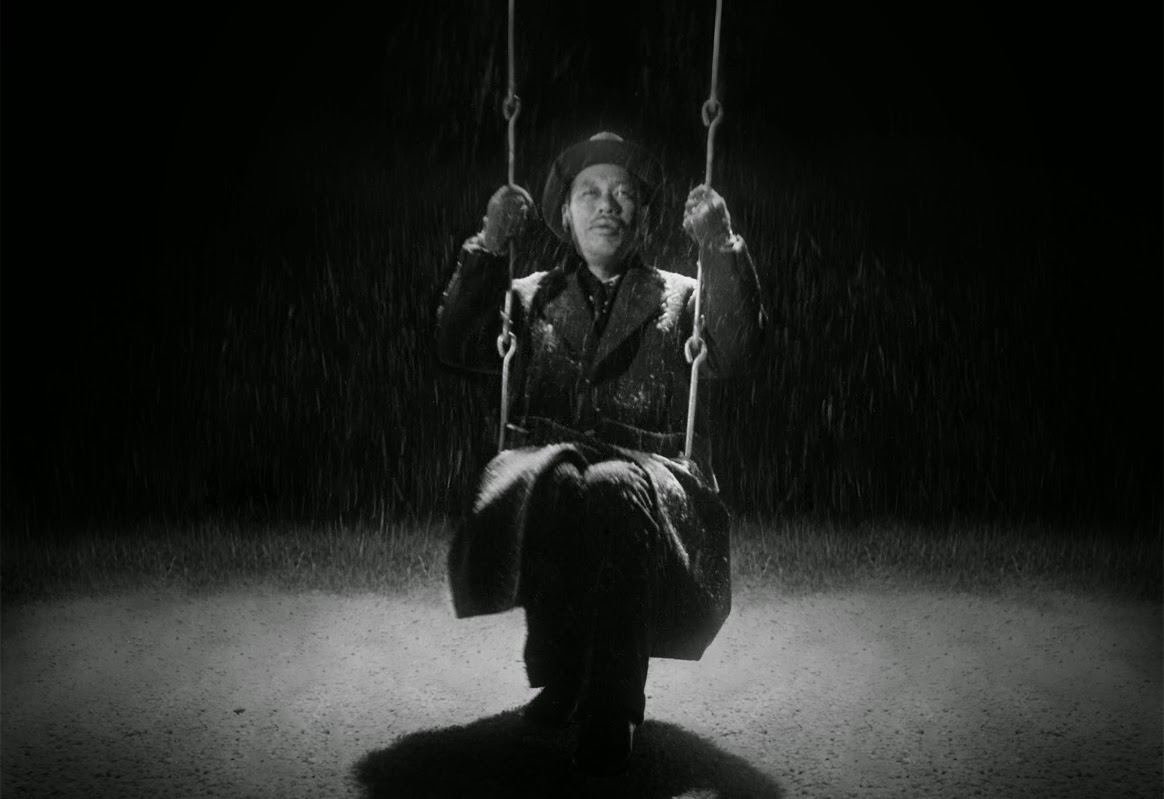
Kurosawa Week: Ikiru (1952)

Without a doubt, Kurosawa’s Ikiru ("To Live") is my overall favorite Kurosawa film. There is just so much to love about this film. First, it is unique. There is nothing else like it on film. Secondly, despite poor film quality, the film is very well shot and perfectly acted. Finally, this film is intensely emotional. This film will fill you with rage at some points, pride at others, and make you cry, and it has an amazing and unique message.

Plot

Ikiru is the story of Kanji Watanabe (Takashi Shimura), a middle-aged petty bureaucrat who learns that he is dying. The film is about him trying to find some meaning in his life.
Kanji tries to find meaning at home at first. He wants to tell his son and daughter-in-law, with whom he lives, that he is dying, and he hopes to become closer to them. But they won’t pay any attention to him. All they care about is his pension and what they will inherit from him one day. He quickly realizes that he will not find meaning here, so he never tells them that he is dying. Instead, he ventures out into Tokyo’s nightlife. Out on the town, he finds a novelist who guides him to a wild nightclub. He quickly realizes, however, that he will not find meaning there either.

The next day, Kanji finds himself drawn a young woman he meets at the office. She seems energetic and vibrant, and he starts to spend time with her. But she eventually begins to wonder what he’s after. He then asks her what makes her so happy and she tells him, but she also tells him that he needs to find a purpose in his own life; he can’t just take someone else’s purpose.
Kanji then finds a cause. He decides he will help a group of mothers build a playground. To do this, however, he must guide the project over a dozen insurmountable bureaucratic hurdles. I’ll let you discover for yourself if he succeeds.

In the ending, a group of co-workers, family and friends meet at his wake and they discuss, from their self-centered perspectives, how his behavior changed before he died. I have never wanted to punch a couple film characters more in my life.

This Is An Amazing Film

This is the only film I have ever seen that has received a 100% rating from Rotten Tomatoes, and it is well deserved. Once again, Kurosawa is at the top of his game in terms of storytelling and getting us to delve into what makes us who we are. At its core, this film is about how we live and how we find meaning in our lives, something we all struggle with. As if that were not interesting enough, however, Kurosawa also gives us so much more.

For example, the film criticizes the attitudes that most of display in our daily or professional lives. The film criticizes our penchant for being self-absorbed and ignoring people who we view as not important. It attacks the greed of Kanji’s family, which is a form of greed any lawyer has seen play out in thousands of families. It attacks bureaucratic laziness and fear. It attacks the “don’t make waves” attitude. And best of all, it tells us that if you truly understand what is important in life, then none of the things the rest of society values really matter.
Let me repeat that: if you truly understand what is important in life, then none of the things the rest of society values really matter.

This is a revolutionary message, particularly in conformist Japan, but even here. This is the message that tells us both how to change the world and why to change the world. It is that second part that you never see tackled in films and which so many people will never understand.

Indeed, the fact that many people will never get this is put on display at the ending, when Kanji’s oblivious friends and family and coworkers struggle to put Kanji’s life back into a box that they can understand rather than understanding why he really did what he did... a behavior that many of us will have seen by the oblivious people in our own lives.
It is this scene, by the way, which will fill you with rage, bring you to tears and fill you with joy. I can’t think of any other film that punches this hard emotionally, and yet Kurosawa does so with pure subtlety and without manipulation. There is nothing fake or heavy-handed here. There are none of the tricks Spielberg would use to manipulate you... just great storytelling. In fact, it is an awesome display of storytelling that in such a short film you can come to see Kanji as such a worthwhile character that you feel the slings and arrows of slander and misunderstanding lobbed at him even after he is dead. You will cry when he dies.

It’s amazing writing.

You need to see this film.
[+] Read More...