Tuesday, January 10, 2012

Politics of Trek: “The Conscience of the King”

Let’s continue the Politics of Trek series with Episode 13: “The Conscience of the King”! This is a fascinating episode about a man who executed thousands of people to save thousands more. What conservative message could this send? How about, the ends never justify the means.
The Plot
As the episode begins, the Enterprise has been diverted to Planet Q by Kirk’s friend Dr. Thomas Leighton. Leighton claims to have discovered a new food source, but he’s lying. He really wants Kirk to investigate a visiting actor, Anton Karidian, whom Leighton believes to be Kodos the Executioner. Kodos was the governor of Tarsus IV, where he executed 4,000 people, including members of Kirk’s family. He did this because the colony was running out of food and Kodos hoped to save half the colonists by executing the other half. Kodos was believed killed when he was overthrown, but his body was never found. Kirk initially refuses Leighton’s request. But when Leighton is mysterious killed, Kirk arranges events so the Enterprise gives the acting troupe their ride to the next planet. One thing leads to another and Kirk confronts Karidian, who is in fact Kodos.
Why It’s Conservative
A fundamental difference between conservatives and liberals involves the question of whether motives can excuse behavior. With rare exceptions, e.g. self-defense, conservatives judge people on their actions, not on what motivated those actions. Liberals, by comparison, take motives into account. This is why they consider things like root causes, the relative economic power of the parties, and whether the person’s goals outweigh the tactics they use to achieve those goals, i.e. do their attempted ends justify their means. Conservatives reject this and look only at the means you have chosen. This episode comes down firmly on the conservative side.

For example, Leighton lies to bring the Enterprise to the planet and Kirk reprimands him for it, despite the extreme importance of his request. Kirk then engages in trickery himself and thereby alienates and endangers his friends and crew. Both times the message is that the ends, no matter how important, did not justify the chosen means. But the real focus is on Kodos. Here Kodos tries to justify his crimes to Kirk:
KARIDIAN: Kodos, whoever he was—
KIRK: Or is.
KARIDIAN: Or is. Kodos made a decision of life and death. Some had to die that others might live. You’re a man of decision, Captain. You ought to understand that.
KIRK: All I understand is that four thousand people were needlessly butchered.
KARIDIAN: In order to save four thousand others. And if the supply ships hadn’t come earlier than expected, this Kodos of yours might have gone down in history as a great hero.
KIRK: But he didn’t. And history has made its judgment.
KARIDIAN: If you’re so sure that I’m Kodos, why not kill me now? Let bloody vengeance take its final course! And see what difference it makes to this universe of yours.
KIRK: Those beautiful words, well acted, change nothing.
Kodos is walking through standard liberal arguments here. First he argues that he acted with the best of intentions. This is the argument liberals use to excuse abuses of power: that the ends were very important and justify the means. Then he argues that he deserves “understanding” because he was charged with making life and death decisions. This is moral relativism because it asks that he be judged under a different standard than others because of the circumstances he faced. This is the idea behind the liberal root-causes argument, which says that criminal behavior should be judged in light of a person’s economic circumstances or personal history. Finally, he argues that punishing him will not undo the crime. This is the liberal impulse to dismiss all aspects of criminal justice except reformation. Kodos essentially presents liberal criminal law in a nutshell.

Kirk rejects these arguments with disgust and derision and doesn’t even bother to refute the logic: “all I understand is that four thousand people were needlessly butchered.” That is conservatism: all that matters is what Kodos did, not why he did it. Guilty.

So what about punishment? McCoy, the show’s bleeding heart, suggests there’s no point in punishing Kodos because his victims are dead:
MCCOY: What if you decide he is Kodos? What then? Do you play God, carry his head through the corridors in triumph? That won’t bring back the dead, Jim.
KIRK: No, but they may rest easier.
Kirk rejects this because he sees justice as a matter of principle and asserts that it must account to the victims even if they are dead. Liberals increasingly see this view as “vindictive,” which is why they oppose long sentences, victim’s rights laws and so-called “victimless crimes.”

Kodos then suggests he has suffered enough when he says he no longer treasures life and he laments how he has been haunted by his crimes:
KARIDIAN: Blood thins. The body fails. One is finally grateful for a failing memory. I no longer treasure life, not even my own. I am tired! And the past is a blank.
Actor Arnold Moss does a tremendous job of conveying how this has tormented Kodos even with only these few words, but Kirk dismisses this idea out of hand. Unlike liberal Captain Picard in “The Survivors”, Kirk does not accept the idea that self-imposed suffering is sufficient. Instead, Kirk takes the conservative position that crimes must be punished objectively and cannot be overlooked just because the criminal thinks the punishment is too harsh.

So what does Kirk do? Interestingly, he tells Kodos that he won’t kill Kodos despite wanting to:
KARIDIAN: Did you get everything you wanted, Captain Kirk?
KIRK: If I had gotten everything I wanted, you might not walk out of this room alive.
This is the conservative answer, though it is frustrating. This is Kirk returning to conservative form after his earlier abuses of power. This is his declaration that he will not use improper means to achieve his desired ends, i.e. he will not repeat Kodos’ mistake. Instead, he will let the system extract justice, which dovetails with Kirk’s law-and-order / rule-of-law conservatism.

So Kirk has acted conservatively. But merely arresting a man who thinks he was justified in killing 4,000 people isn’t enough to establish the complete conservative moral, which requires the imposition of a proportional punishment. Since there’s no time to show Kodos’ trial and execution (plus television is about drama), the writer imposes a little proportional cosmic justice and in the process makes the dual points that great crimes require great punishments and evil begets evil. Indeed, it turns out Kodos’ daughter has been killing the witnesses who can expose him. Kodos thought he had shielded her from his past and it destroys him to learn his deeds have poisoned her.
KARIDIAN: What have you done?
LENORE: What had to be done. They had to be silenced.
KARIDIAN: All of them? All seven? More blood on my hands?
LENORE: No Father, not anymore. I’m strong, Father. It’s nothing. . . . Don’t you see? All the ghosts are dead. I’ve buried them. There’s no more blood on your hands.
KARIDIAN: Oh, my child, my child. You’ve left me nothing! You were the one thing in my life untouched by what I’d done. . . Murder, flight, suicide, madness. I never wanted the blood on my hands ever to stain you.
She then kills her own father while trying to kill Kirk. The punishment is complete, justice is had, and the moral is clear: evil means are never justified and evil will receive the punishment it deserves. And that is a strong conservative message.

[+] Read More...

Sunday, January 8, 2012

The Great (film) Debates vol. 20

People’s tastes change over time, which is good or we’d all be wearing bell bottoms and listening to grunge. And sometimes, this means our taste in films changes too.

What movie did you like a lot at one point, but no longer like. . . and why?

Panelist: BevfromNYC

Mary Poppins. I loved Mary Poppins when I was a child. It was colorful and magical and my parents bought me a “Mary Poppins In The Painting” doll when I was in the hospital after an appendectomy. And it was the first movie that I got to see twice! I loved Mary Poppins. Well, many years passed and I finally got a chance to watch it about 10 years ago. Hmmm, Mary Poppins was kind of mean and stern. And, though I still love Dick van Dyke as Bert, his cockney accent was just bad.

Panelist: T-Rav

There are many I no longer like, but one I used to really like was The Lost World: Jurassic Park. I thought it was a good film the first time I watched it, with lots of visuals, and you can't hate Jeff Goldblum. But there's a lot that bothers me about it now. The raptors are basically shoehorned in, the ending is little more than a rip-off of every Godzilla film, and the underlying political message is. . . just awful. Taking dinosaurs off the island is evil and wrong; therefore our "heroes" try to save them by destroying the would-be captors' equipment and thereby get a lot of those guys killed. But it's okay, because they're capitalists and mercenaries and we should be okay with their deaths. I wonder if this was the inspiration for Avatar.

Panelist: Tennessee Jed

Robert Altman's Nashville. I liked this film when it first came out. Years later, I bought the DVD for a song. Even liked it the first time I re-watched it. Then, I popped it in a few years later and it just sucked. Nothing worked - the jokes didn't work, the acting seemed wooden. I just had to turn it off. Comedy is the most fertile field for this phenomenon. If you are in the right mood, you can laugh yourself silly. Wrong mood and you don't even crack a smile. Jim Carey's Liar, Liar fell into that category.

Panelist: ScottDS

The Fifth Element. I didn't like it the first time I saw it. Then, for some reason, I watched it again once it premiered on HBO and I liked it. Several years passed by and it aired on HBO again. . . and I didn't like it. I'm usually the last person to complain about a film that tries to do something different but it's just too goofy and ridiculous (and French?) for me to take seriously. I like Bruce Willis and Gary Oldman, Ian Holm, and Brion James (R.I.P.) are always fun to watch... but I simply want to kill Chris Tucker whenever he's on the screen and, dare I say it, Milla Jovovich never did anything for me. There, I said it!

Panelist: AndrewPrice

I really hate saying this, but Octopussy. When I was a kid, this movie was awesome. You had dirty Russians, exotic locations, a nuclear bomb and James Fricken Bond! But as I’ve gotten older, I’ve started to realize a few things about this film. For one thing, every scene is ridiculous and the bad guys are incompetent. Those exotic locations? Well, the cinematography is so narrow it could have been shot outside Atlanta. The Indian guy is a lame, racist stereotype. The action is slapstick. And frankly, Roger Moore was getting too old and prissy by this point.

Comments? Thoughts?

[+] Read More...

Friday, January 6, 2012

Film Friday: Apollo 18 (2011)

I’m of two minds about Apollo 18. On the one hand, I’m glad I saw it. But on the other, I cannot recommend it and I never want to see it again. Why? Well, it has a solid story, ruined by its presentation. It had excellent effects, squandered by its presentation. It was simultaneously too long and too short, both because of its presentation. Put simply, this was a potentially excellent film ruined by a misused gimmick.

** spoiler alert **
The Plot
The last manned moon mission was Apollo 17 in December 1972. Or was it? In December 1974, the Department of Defense secretly launches three NASA astronauts to the moon aboard Apollo 18. Their ostensible reason for going is to install an ICBM detector on the moon to warn the US in the event of a Russian missile launch. But when they get to the moon, they discover a mystery in the form of an abandoned Russian moon-lander and a dead cosmonaut. Then things get worse.
Why This Film Could Have Been Excellent, But Wasn’t
When I first heard about this film, I was excited. After all, the plot description above is pretty stellar. It promises intrigue, mystery, action, science fiction and has tons of potential for terror. Imagine the horror of not being able to see or hear things approach, of not being able to breath outside of the suit or the capsule, of communications blackouts, and of the horrific unknown. Add in a trailer which appeared to show a dead astronaut walking around on the moon and this became one of the few films last year that I genuinely wanted to see.

Then it got released to universal derision. My hopes were dampened. Then I heard it was yet another “found footage” film and my hopes died. But it gets worse. Not only is this a found footage film, but they completely mishandled the already awful concept.

The concept of “found footage” films (e.g. Blair Witch and Paranormal Activity) is premised on the idea that someone has cobbled together a movie from film found at the scene of a mysterious tragedy, film taken by some amateur to whom the tragedy befell. This is actually a brilliant concept for several reasons. For one thing, it allows you to make movies cheaply because low quality film and cameras can be used. It also reduces the cost of special effects because any time something is too expensive to produce, the director just has the “amateur” photographer pan away from the action or drop the camera or something like that. Similarly, this approach gives great leeway in editing by allowing longer-than-normal shots with no cuts because audiences excuse the lack of multiple angles and Hollywood-style editing. It also allows jump cuts to skip over boring parts of the film because the director can simply pretend the amateur turned the camera off during that period or that the film was destroyed. This allows directors to skip from highlight to highlight while simultaneously allowing the director greater latitude in letting individual scenes develop.

But found footage films can be annoying for these same reasons: low quality images, the shaky cam effect, annoying jump cuts, and a tendency to over-tease the audience by revealing too little. All of these problems are present in Apollo 18 along with a new and truly annoying problem: aggressive, seizure-inducing edits.

Unlike most found footage films which rely on one camera, Apollo 18 involves at least five cameras which run simultaneously. Thus, it is legitimate to show scenes from multiple angles, which means more Hollywood-style editing can be employed -- this is usually not possible in found footage films.

Unfortunately, the director/editor took this way too far. Rather than doing something clever with the angles or some subtle manipulation, they pound your brain into submission with a never-ending stream of constant cuts, often settling on angles for less than a couple seconds. Even worse, to justify this constant hopping from camera to camera, each edit is preceded by fake interference to suggest the rest of that particular footage in that camera was destroyed. But this nausea-inducing style of constant quick cuts prevents you from ever seeing anything (like the special effects) and it starts to eat up considerable amounts of film time with nothing but annoying static.

Worse yet, the director/editor used these constant cuts as a way to hide a lack of story by trimming the dialog to short bursts of words. Thus, you will encounter large parts of the film which seem like a fever dream where the dialog only gives the impression of what is going on: “hold truths— [static/new angle] self-evident— [static/new angle] created equal— [static/new angle] perfect union.” Even the longer expositive scenes begin right as something is happening and end seemingly randomly before you have gotten all the necessary information to understand the scene: “That’s correct Bill, and the murderer is—” In many ways, the dialog is so disjointed it’s often like skipping ahead randomly in a film and only stopping for a few seconds at a time. What this does is take a story that seems compelling and make it meaningless. Indeed, the elements for a good story seem to be present, but they never show it to you, they only suggest it.

This approach also makes the film feel simultaneously too long and too short. At 85 minutes, the film is very short and it feels lightweight. It feels rushed and it feels like they took the easy route over and over again by cutting away every time you would normally expect something substantive -- not to mention a big chunk of time is lost to static. Yet, at the same time, this film feels far too long because the constant static and jumpcuts wear you down and make it impossible to get into the story -- because the story moves forward in random bursts. Thus, the story drags and feels laborious.

All and all, this could have been a tense and superb film. It had tremendous potential. The concept is solid, though not original. The premise, the setting, the effects, the ambiance are all top notch. The potential for mystery and horror are obvious throughout. Even something more deeply philosophical could have been done, e.g. what if they found something Biblical? But to pull that off, the film needed to be shot in a traditional manner where these things could have been exploited, or at least the found footage approach needed to be done more cleverly and less obtrusively, by for example, revealing the footage through a briefing where the pace could be controlled better and the mysteries better maintained.

But that didn’t happen and that’s too bad. This is a good film ruined by a gimmick.

[+] Read More...

Wednesday, January 4, 2012

The Power of Clichés


They say the eyes are the window of the soul. They also warn us there be monsters in a film. Monsters like the Cheese Burglar!


When the Cheese Burglar was young, he fell in love, which apparently makes you feel like you have a giant head. . . floating over the ocean.


But it was not to be. The fast lane was where he wanted to be, fast women, fast cars, fast food.


Arson, guns, unlimited cans of whoopass, this was his new life and he flame broiled anyone who got in his way. . . it was all so black and white.


But even arsonists get the blues, and things began to go crooked for our Cheese Burglar when he lent a friend money to buy a cheeseburger. . . he said he would gladly pay Tuesday.


He didn’t. Now the Cheese Burglar roams the streets alone looking for the man who took his money.


I noticed long ago browsing the video store aisles (and book stores) that movie posters and book covers are all about clichés. On the one hand, I guess, this is a good thing. Clichés exist because they have become universally recognized as having meaning. And since we all know what they mean, that lets you pack more information into simpler images. Indeed, single images can now tell whole stories and simple phrases can take the place of whole pages.

But too often clichés become a substitute for substance. When the clichés leave the marketing world of the movie poster and book covers, and they begin to occupy the substantive world of plots, then things go wrong. And too many films today are little more than clichés strung together to create the impression of a film.

Is it any wonder box office attendance is down 11% over two years? The problem isn’t even the topic of films or the incredible number of reboots or sequels, it’s that these films are lifeless, meaningless, and void of any substance when you get into them. This is because Hollywood has begun to speak in clichés rather than ideas. It’s stopped being the dream factory and become the film assembly center. And as long as they continue down that path, things will only get worse.

What are your most despised clichés?

[+] Read More...

Tuesday, January 3, 2012

Questionable Trek vol. 1

Let’s start Star Trek Tuesdays by introducing a new debate series: Questionable Trek. In this series, Scott and I will ask each other questions and debate the answers in a quest to get to the heart of everything Star Trek. Today we begin with a simple toss up question:

Rank the top five Star Trek films in order.

Andrew:
1. Star Trek VI: The Undiscovered Country
2. Star Trek II: The Wrath of Khan
3. Star Trek: First Contact
4. Star Trek: The Motion Picture
5. Star Trek: Nemesis
For me, there were two difficult decisions here. First, there’s the choice of Undiscovered Country over Wrath of Khan. I know that’s probably Star Trekrilege, but I just feel like Undiscovered Country is the better movie. It moves quicker, its plot is more unexpected, and the characters aren’t as depressed. That said, there is no more poignant scene on film that Spock’s death. The other difficult decision was choosing Nemesis over Star Trek V: The Final Frontier. Despite its flaws, Frontier is still fairly enjoyable and I think Sybok is great. But Nemesis is simply the better movie.

Scott:
1. Star Trek II: The Wrath of Khan
2. Star Trek IV: The Voyage Home
3. Star Trek: First Contact
4. Star Trek VI: The Undiscovered Country
5. Star Trek: The Motion Picture
I’ve never been good at ranking films (in case you haven’t noticed) and this was pretty tough. I honestly don’t think any of the Trek films are God awful - even the worst ones have one or two redeemable qualities. When I was younger, I’d watch Star Trek II at least once a week. It has arguably the best villain, quotable dialogue throughout, and the themes of aging and mortality are explored rather well, as opposed to future Trek films that simply try to shoehorn those moments into the story. Star Trek IV is just a lot of fun. Yeah, it’s a fish out of water tale and there are some dated elements but it’s just done so well and the crew’s chemistry has never been better. Star Trek: First Contact is the best TNG film though that may not be saying much. I’ve always enjoyed Star Trek VI but when I watch it now, I can’t help but notice some signs of a rushed production and Nick Meyer’s nautical quirks on display. Star Trek: The Motion Picture has, in my opinion, aged like a fine wine and, like Andrew says, it’s one of the only films where the crew gets to go on an actual adventure into the unknown.

[+] Read More...

Friday, December 23, 2011

Merry Christmas and Happy Holidays!

Merry Christas and Happy Holidays to everyone! I’m taking a break until January. But we’re planning some good stuff for the new year. . . All the posts will be moving to mornings instead of afternoon so you can tune in earlier. Also, Bev will be joining the film debates. And I’m adding a Star Trek Tuesday every Tuesday!

In the meantime, leave your thoughts below. Tell me what films you’ve seen that were good or bad or just ugly, and tell me if there’s anything you want to see at the site in the new year!
[+] Read More...

Wednesday, December 21, 2011

The Boiler Room Elves’ Top 5 Santa Films

As Boiler Room Elves, we’re usually pretty busy around Christmas time. There are cookies to bake and the boilers need extra attention in winter. But we don’t go in for that whole making presents for free thing. We may be unionized, but we’re not communists. So when Bossman Andrew asked us to write about Santa, we told him we didn’t have the time. Then he showed us our contract. Grr. So here are our five favorite portrayals of Santa.

1. Miracle on 34th Street (1947): Probably the best known Santa film, this one perfectly shows the true spirit of Santa. In it, a man is accused of being insane because he thinks he’s Santa. A trial is held. Is he the real Santa or not? The films lets you decide and it’s pretty heartwarming along the way. A bit of trivia here, the real Santa has a cameo. Next time you watch, see if you can spot him.

2. The Santa Clause (1994): This one completely annoys Santa and he won’t even watch it because he’s offended by the suggestion he’s under contract to be Santa! He does it all out of the goodness of his heart (plus he failed out of business school after some prof told him his business plan would never fly. . . but you didn’t hear that from us). Still, the movie is enjoyable, heartwarming and funny, just the kind of thing to make you laugh at Christmas time.

3. South Park: Red Sleigh Down (2002): How can you not love this episode: Santa Claus as action hero! In this South Park episode, Santa gets shot down over Iraq and must be saved by Jesus. And in the end, Santa dispenses a little hot red justice on his captors and then magnanimously tells people that they shouldn’t just think of Santa on Christmas, they should think of Jesus too. Good stuff.

4. Santa Claus Conquers the Martians (1964): True story. Elves are really big on documentaries.

5. Rudolph The Rednosed Reindeer (1964): Although this story is mainly about Rudolph, they do a great job depicting life at the Pole (minus a few labor violations) and Santa. The one complaint we have about this show it the depictions of the Elves. We’re waaaaaaaaaay cooler than that. And there aren’t enough cookies.

So if you want, list your favorite Santa films, memories or whatever below. Or more importantly, tell us what your favorite cookies are. You never know when you may get a surprise care package down your chimney.

[+] Read More...

Sunday, December 18, 2011

The Great (film) Debates vol. 19

A couple weeks ago we talked about our favorite James Bonds. But who would Bond be without a cool villain?

Who is your favorite James Bond villain?


Panelist: Tennessee Jed

Favorite Bond villain was Robert Shaw as Red Grant. He was a ruthless killing machine, and J.B. was lucky to survive. Probably the most realistic. Odd Job is a close second.

Panelist: T-Rav

I think you have to rank Blofeld pretty high up there. Maybe it’s because he dates to the Connery era, but he’s become almost as iconic as Bond himself. Well, maybe not, but he’s a major part of the stories regardless.

Panelist: ScottDS

If we’re including henchmen, then my answer would have to be Red Grant, played by Robert Shaw in From Russia with Love. I haven’t seen the film in years but it’s my favorite Connery Bond film and I just love Robert Shaw (he passed away too soon, at the young age of 51). He’s as cool and ruthless as ever in this film, with blond hair and piercing eyes. The fight scene aboard the Orient Express was particularly brutal for its day.

Panelist: AndrewPrice

I also picked Robert Shaw as Red Grant. He’s one of the few villains who was truly on Bond’s level. He was strong, smart, clever and unbelievably, ruthlessly violent. He was the only villain who legitimately got the drop on Bond and really tried to kill him. . . no inexplicable stupidity at the critical moment. My runner up would be Dr. No because he’s the grand daddy of them all.

Comments? Thoughts? Who would you choose and why? And while we're at it, who was the worst Bond villain?

[+] Read More...

Friday, December 16, 2011

It’s a Wonderful(ly Capitalist) Life(!)

by tryanmax
It’s a Wonderful Life, the quintessential tale of selflessness, gratitude, and the blessings of friends and family—traditional values all—is for many as much a holiday tradition as trimming the tree and baking cookies. So it may seem odd that Frank Capra’s beloved tale should be considered by many to be strongly anti-capitalist. Indeed, back in the HCUA days the FBI fingered the film in a memo entitled “Communist Infiltration of the Motion Picture Industry.” And just last year, Glenn Beck got into a back and forth with a progressive blogger over the issue.

One could simply brush off the interpretation of these Grinches, these Scrooges, these Mr. Potters, if you will, as “missing the point.” Yet that does little to reduce the embarrassment that a film so adored for epitomizing the best in human nature would cause to conservatism by disparaging the free-market. Gladly, this is not the case.

Quite the contrary, It’s a Wonderful Life praises a far more substantial vision of free-enterprise than its detractors seem to apprehend. Besides that, the film is also a tribute to family, a salute to Americanism, an homage to goodwill, and an ode to traditional values all wrapped up in a beautiful golden-age Hollywood Christmas card.
NOTE: If you haven’t seen It’s a Wonderful Life, what’s the matter with you!? Go out and find a copy and watch it right away! In the meantime, here it is re-enacted by bunnies in 30 seconds: LINK. Of course, there’s much more to the story, but for the sake of brevity (hah!), this article assumes familiarity with the film.
The Director
Before discussing the movie, I’d like to examine Frank Capra’s directorial style. Many of the ideas explored in It’s a Wonderful Life are not unique to that picture. Capra explored similar themes in almost all of his work. He intentionally centered his films around values he acquired growing up in the Italian neighborhoods of early 20th c. L.A.; hard work, self-reliance, and a love of freedom and the American Dream. (The real one, not that chicken-in-every-pot nonsense.)

This decision wasn’t made without controversy. His diatribe against political corruption, Mr. Smith Goes to Washington, met with unilateral opposition from the US Senate. Meet John Doe attacked exploitation of the poor by politicians and the media. His last film bearing a strong political message, State of the Union, took on special interests and crooked electioneering with a message that would likely resonate with the Tea Party today. If It’s a Wonderful Life contained an anti-capitalist message, it would be coming from the most unlikely of sources.
A Tale of Two Capitalists
How then can anyone find such a message in the film? I suspect it comes partly from accepting one of liberalism’s favorite bogeymen: the heartless capitalist. The confusion makes some sense because actual specimens do exist. There are unscrupulous men in this world who can justify almost anything that garners profit. (George Soros comes to mind.) The bogeyman is crafted simply by painting all entrepreneurs and businessmen with this broad brush. This is the sort of “capitalist” vilified in the film, and I shudder to think that any “conservative” would defend it.

Henry F. Potter is presented as such a capitalist, a wealthy businessman, banker, and slumlord who looks down on everyone and is frequently credited with “owning the town.” In other words, Potter controls virtually all means of production and exchange in Bedford Falls. He may be the primary purveyor of jobs, but he also has considerable sway over the way the town is run, which he is apparently not shy about exercising. Potter is the picture of a small-town oligarch rather than the enterprising businessman.

Opposite him is George Bailey, the reluctant but principled proprietor of the Bailey Building and Loan. While Potter’s form of capitalism is underhanded, monopolistic, exploitive, Bailey's is straight forward, even-handed, and, most importantly, competitive. The B&L is just about the only venture in Bedford Falls that Potter hasn’t got his fingers in, and he can’t stand it. Throughout the film, Potter attempts every angle to take over the B&L from takeover to buyout to outright theft.

Through all of Potter’s attacks, however, Bailey presses on and invests himself into turning the marginal B&L into a cornerstone of the community. He wards off a run by delivering an econ-lesson in brief, explaining how the patrons' money isn't in the B&L, but in the homes and ventures of all their neighbors. He founds Bailey Park, providing a modest but better alternative to Potter’s slums—and considerable consternation to Potter himself. Bailey doesn’t mean to irk Potter, it’s just a side-effect of his selfless approach.

A Visit to Potterville

To underscore the superiority of George Bailey’s brand of capitalism, Capra gives us, in a flight of fancy, a glimpse of the town as it would be if Potter were left to run roughshod over it. No one can argue that the pursuit of a dollar is still the driving force in town. However, without Bailey to compete with Potter, the emphasis has changed from the honest buck to the easy one.

Gone are the quaint storefronts, replaced with seedy bars and dance halls. Not only has the respectable nature of the town vanished, but so has the optimism. The vibrant Bailey Park is replaced by a cemetery (no subtle symbolism there). The human toll is apparent in the creased faces and impatient demeanors. Whereas Bailey’s enterprising ways lifted people up, Potter’s exploitation has brought them down.
What’s Missing
If that isn’t enough to convince you, It’s a Wonderful Life continues to praise the free-market in what it leaves out from the story. For one, not once does anyone insinuate that Potter is a criminal, or that he even ought to be. Until the climactic moment when Potter discovers Uncle Billy’s misplaced deposit, every thing he does is perfectly legal. Furthermore, even his sole act of theft goes undetected that we know.

Also, it is revealed that Bailey’s business acumen is such that he is able to build houses for half the cost of their finished value. With skills like his, Bailey could have easily padded his own salary and hiked his rates. Instead, he continues in his—and his father’s—original mission, to help his clients realize their own American dreams.
Final Thoughts
Like many good stories, It’s a Wonderful Life clues the audience in to what the story is about from the outset. It starts on Christmas Eve. The town of Bedford Falls lies still under falling snow. The only sound to be heard are the rising prayers of the townsfolk, all pleading for the same thing—the well being of George Bailey. Above, the prayers are received and an angel named Clarence is recruited to answer them.

“Is he sick?” Clarence asks of Bailey. “No, worse,” replies another angel, “He’s discouraged.”

Right away this exchange reveals this to be a story about discouragement and its counterpoint, hope. Capra’s message isn’t simply about what is right or wrong, and it certainly isn’t about what is fair. It is about the hope that upholds principles in the face of adversity. Hope isn’t just a bunch of fanciful wishful thinking as some might suppose. It is derived of opportunity and possibility. These things are also the underpinnings of a free society in all respects, be it in the market, speech, worship, or whatever.

[+] Read More...

Wednesday, December 14, 2011

My Problem with Judd Apatow

By ScottDS

Whenever the media does a story on today’s “Hollywood comedy renaissance,” one name continues to crop up: writer/producer/director Judd Apatow. While I’m a huge fan of his earlier work in TV (The Larry Sanders Show, The Critic, Freaks and Geeks, and Undeclared), his cinematic offerings leave me wanting. I don’t believe The 40-Year Old Virgin, Knocked Up, and Funny People deserve half the praise they’ve been given. I also want to stress that I have nothing against the man personally. He’s worked hard to get where he is and he is partially or wholly responsible for some classic television comedy. Also, I don’t entirely blame him for his reputation – that fault lies, as always, with the media.

The elephant in the room is improv comedy. Like anything else, it can be wonderful if wielded correctly but Apatow and Co. simply don’t know when to cut back. While filmmaking is a collaborative medium, there is a world of difference between a director asking his actors before a take, “Can you guys think of anything better?” and what Apatow does, which is to tell his actors, “We’re leaving the camera on for ten minutes. Go!” This is probably due (at least in part) to Apatow’s collaborations with Adam McKay, the co-writer/director of Anchorman, Talladega Nights, and The Other Guys (Apatow produced the first two). McKay is an alumnus of Chicago’s famous Second City comedy troupe (Apatow started as a standup comedian) and seems to belong to the “Throw everything at the wall and see what sticks” school of filmmaking. There’s nothing inherently wrong with this – I would say the same thing about the ZAZ team who brought us Airplane! and The Naked Gun – but McKay, like Apatow, simply doesn’t know when to stop. There are gags in Anchorman that look as if they were lifted straight off the improv stage, with the actors constantly trying to top each other with no payoff.

Let’s take the “You know how I know you’re gay” scene in 40-Year Old Virgin in which Seth Rogen and Paul Rudd ask each other this question for what seems like an eternity. It doesn’t really have anything to do with the story and it goes on for entirely too long. It’s telling that even critics who adore Apatow’s work think his films are too long, and the “unrated extended” editions that show up on DVD and Blu-Ray are even longer, with prolonged sequences that destroy the pacing and, in comedy, pacing is everything. To be fair, most of Bill Murray’s material in Caddyshack was improvised but director Harold Ramis knew when to rein him in and Murray is a much better actor than Seth Rogen. (On the other hand, I do credit Apatow with making me a fan of Paul Rudd.)

Technology also plays a role here. With digital cinematography becoming the norm, directors can let their actors go on without having to worry about how much film is left in the magazine. Likewise, with digital editing, directors and their editors can experiment, leaving things out, adding things in, etc. whereas they would’ve had to be more judicious in the past when the editor had to physically cut a piece of film – a laborious process if there ever was one.

Improv is also deadly for memorable dialogue. Quick, give me a line from Knocked Up! [waits five minutes] Yeah, that’s what I thought. Years later, we still quote the Marx Brothers, Abbott & Costello, Woody Allen, This is Spinal Tap (yes, it’s improvised but with much greater discipline and within a mockumentary framework), the various 70s/80s films of John Landis and Ivan Reitman, not to mention classic sitcoms from The Honeymooners to Seinfeld to The Simpsons. While there are the occasionally clever lines in Apatow’s films, improv, like jazz, is often ephemeral. There is no lasting impact because there was no thought put into the joke – it was simply the first thing the actor said and too many actors Apatow works with (cough, Rogen and Jonah Hill) don’t know any better so they resort to an easy F-bomb (I’m no prude but it loses its shock value after a while) or an easy pop culture reference, which will only date the movie in the years to come. Improv is a skill that’s tough to master but there’s nothing like a witty, well-crafted line of dialogue. Again, improv can be a good thing (see: the films of Christopher Guest) but it’s too often used as a main course when it should be desert.

Apatow’s films are also boring to look at it. Don’t get me wrong – in comedy, nothing can get in the way of the joke, but a director can still make a comedy that looks good. Blake Edwards, Billy Wilder, Mel Brooks, John Landis and Ivan Reitman in their prime… they all made comedies that looked good and, as far as today’s filmmakers are concerned, I would include Edgar Wright, Wes Anderson, Spike Jonze, and David O. Russell in that category as well. Lighting, color, contrast, framing… they are all tools in the director’s bag of tricks, yet Apatow’s films all look as if they switched on one key light and said, “Okay, let’s go!” I’m not saying his films need to look like Blade Runner, nor should they, but there is something to be said about films that are pleasing to look at. One explanation I’ve read is that, due to the heavy use of improv, Apatow uses multiple cameras which means the lighting has to have a more uniform look (one camera can’t capture an errant shadow, for instance).

I want to like Apatow’s films more than I do. I sat in the theater watching The 40-Year Old Virgin with a grin on my face but I have no need to see it again, I can only quote two lines of dialogue from it (one is a David Caruso reference!), and I still can’t believe my local paper gave it four stars. Knocked Up fairs even worse in this regard and there’s one shot during the birth scene that is completely gratuitous. I know Apatow can do better. Whether it’s a case of dealing with the restrictions imposed by the TV world (including HBO) or perhaps a change of actors is needed, I don’t know. I hate to sound like I’m looking at the past through rose-colored glasses but it’s telling that I’d rather watch a 70-year old comedy than one made five years ago and since Hollywood studios all love to capitalize on the latest trend, every other comedy that’s released today is basically “Apatow lite.” (I don’t blame him for this, but it doesn’t help.)

To wrap it up, while I remain an Apatow fan (albeit a slightly disgruntled one), I remember watching The 40-Year Old Virgin and, five minutes in, there was a gag that involved Steve Carell trying to urinate with an erection. My first thought wasn’t, “This is funny,” but, “I’ve seen this before… and this is the new comedy god the papers are raving about?”

[+] Read More...

Sunday, December 11, 2011

The Great (film) Debates vol. 18

At one point, Hollywood held a lot of mystery for average Americans. Actors were larger than life and lived exotic lives. These days they're all rehab junkies and political morons. But think back to Hollywood's Golden Age:

Who is your favorite classic Hollywood actor and what is their best role?

Panelist: AndrewPrice

This is one of those impossible questions. Bogart exuded "tough guy." Jimmy Stewart was the most honorable man alive. John Wayne was America personified. And Cary Grant defined class. But I'm going with Steve McQueen. I understand he was a bit of a monster in person, but on screen he was just compelling. You couldn't help but watch him and pull for him even when he was the bad guy.

Panelist: Tennessee Jed

Bogie. Why? he had a magnetism that is hard to explain. He isn’t an obvious looking "man’s man" like the Duke, but a "man’s man" he was. His best role? Maltese Falcon by a hair over African Queen and Sierra Madre. That may be due to a slight bias on my part for the genre. African Queen was one of the first "grown up" films I remember seeing.

Panelist: T-Rav

There are a lot of them I like--Clark Gable, Jimmy Stewart, etc.--but my personal favorite would probably be the lesser-known Danny Kaye. I watched his The Secret Life of Walter Mitty some years ago in high school and just loved it. He did a great job of playing the ordinary, looked-down-on guy who suddenly gets thrust into an important event. I think he was in White Christmas as well, or whatever that big '40s movie was; I liked him in that too. Great all-around actor.

Panelist: ScottDS

Ask a hard one, why don’t ya?! Since I can’t decide between Jimmy Stewart and Humphrey Bogart, I’ll go with James Cagney instead. I haven’t seen every film he ever did (far from it) but the one that sticks with me is Yankee Doodle Dandy. Yeah, it’s a little cheesy at times but it’s great and wonderfully optimistic. Anyone who thinks Cagney could only play gangsters needs to watch this film. He sings! He dances! He does not shove a grapefruit in a woman’s face! "My mother thanks you, my father thanks you, my sister thanks you, and I thank you."


Comments? Thoughts? Who would you choose and why?

[+] Read More...

Friday, December 9, 2011

Film Friday: The Muppet Christmas Carol (1992)

With Christmas just around the corner it’s time for a holiday film. There is no more quintessential Christmas story than Dickens’s “A Christmas Carol.” This story is so perfect that it’s been adapted at least 22 times in film and dozens of other times in other ways. So why is my favorite version the Muppet version? Read on. . .

The Plot

The story should be familiar to all. Ebenezer Scrooge (Michael Caine) is a money lender and a rotten man. He’s nasty and mean- spirited to his employees and unbelievably cheap. In fact, he’s so mean-spirited that his one loyal employee, Bob Cratchit (Kermit the Frog), must beg him to give the employees the day off for Christmas. Bah humbug!

On Christmas Eve, Scrooge is visited by the ghosts of his former business partners, Jacob and Robert Marley (Statler and Waldorf). They have been condemned to an afterlife in chains for their evil deeds, deeds which are shared by Scrooge. They have come to warn Scrooge that he will be visited by three ghosts who will show Scrooge the error of his ways.

These ghosts include the Ghost of Christmas Past, who shows Scrooge that he was once a decent man, the Ghost of Christmas Present, who shows Scrooge how miserable he is compared to others who value families over money, and the Ghost of Christmas Yet to Come, who reveals that Scrooge will die unlamented and his miserliness will lead to the death of Tiny Tim. Naturally, Scrooge changes his ways and the story ends happily.
Why The Muppet Version Is The Best
There are many fantastic version of this story. The 1951 version is excellent as is the 1984 version with George C. Scott as Scrooge. Bill Murray gives us an excellent modern version in Scrooged. Even the most recent Doctor Who had a nice adaptation of this. But of them all, the Muppets are the best. Why?

Different types of stories require different methods of storytelling to be effective. Alien would not have worked as a musical. Ghostbusters would not have worked as a drama. And A Christmas Carol works best as a fable, not as a drama as it is typically portrayed.

The goal of a fable is to impart certain lessons or warnings to the audience. This is done by a narrator who talks directly to the audience, explaining the motivations of the characters and their flaws, describing their mistakes, explaining the consequences of those mistakes, and then summarizing the lessons learned. It’s like a legal brief presented with puppets.

Dramas, by comparison, have none of this. Instead, they require the audience to draw its own conclusions from the actions and words of the characters and the consequences of the plot. Moreover, characters in dramas must come across as real before we can accept their plight and find their stories interesting. Characters in fables do not. In a fable, the only “real” person is the narrator who tells us the fable to impart some point. So long as the narrator entertains us sufficiently, the story is a good one without regard to how true the details of the story seem. Because of this, fables can be told in parts, i.e. vignettes, and we can simply be told of necessary changes in the characters or their circumstances between scenes. Dramas, on the other hand, must demonstrate such changes.

A Christmas Carol is, at its core, a fable. It is the moral of Scrooge’s failings and how he came to save himself. It is a series of vignette, each of which affect Scrooge differently and Scrooge has significant growth from scene to scene which is not shown in the plot. Thus, the best structure for telling this story is the fable structure, with a narrator to walk us through the story, point by point, and explain how each segment of the story, i.e. each vignette, affects Scrooge. Further, Scrooge is too one-dimensional to be a “real” character. This is intentional. Scrooge is an archetype of our worst, greediest, miserly natures, and he works best when we see him as such -- as part of ourselves rather than as a real person to whom these events transpire.

This is why the Muppet version is the best, because they treat this story as a fable. Gonzo acts as Dickens the narrator. Caine brilliantly provides the wide mood swings needed to be an archetype. And the Muppet players provide important levity and breaks to let us digest each scene before we move on and to distract us enough to let us think sufficient time has passed for Scrooge to undergo the personality changes needed. George C. Scott’s version may be excellent, but it is a drama and it lacks these critical elements which connect us to the heart of the story.

Finally, let me add two things. Michael Caine is an incredible actor. He never disappoints and he doesn’t disappoint here. Indeed, Caine does something brilliant. By soft-pedaling Scrooge’s cruelty and retaining his sense of humor, though he has misdirected it in cynical directions, Caine plays Scrooge not as a cruel man who must change his nature, but as a decent man who has lost his way. This connects us better to Scrooge than prior versions because (1) it is harder to connect with a truly cruel Scrooge because none of us wishes to see any part of ourselves as cruel, and (2) it is easier to believe a return to our better natures than a fundamental change of character.

And lastly, the Muppets deserve tremendous credit for playing this film “straight.” Specifically, the Muppets are adept at blending their antics into the film so you’re never distracted from the film. Too often when a comedian is brought into a film, they become a distraction (e.g. Robin Williams, Robin Williams, Robin Williams) as they turn their time on screen into an advertisement for themselves. Not here. The Muppets do the things you love about them, but they do them quickly and within the confines of the storytelling. Thus, there are no breaks in the story where you feel like you’re about to watch a couple minutes of a generic Muppet routine jammed into the film.

These are all brilliant choices which put this version ahead of all the others.

So what are your favorite Christmas films?

[+] Read More...

Wednesday, December 7, 2011

The Sound of Inconsistency

Humans are fascinated by time. We have a million words to describe it and explain it. We measure it and measure ourselves by it. And we wonder about its nature. Does it move in a straight line or does it exist all at once? Can we move through it? Can we go back in time and change the past or is the past simply gone? And science fiction loves this concept. But sometimes the concept gets mishandled.

In particular, I’m thinking about a film called A Sound of Thunder. This film bombed. Lousy effects, indifferent acting and a weak story all resulted in the film earning only $12 million against its $80 million budget. But I think the real failure was its utter misuse of the concept of time travel. Observe.

Based on Ray Bradbury’s short story of the same name, Thunder involves a private company that sells hunting tours to the past. For a large fee, you can go back in time and bag an Allosaurus. But wait! Won't that change the future? That’s what the butterfly effect tells us: if you go back in time and kill so much as a butterfly, you can change the present/future in unimaginable ways. Why? Because that's how butterflies roll.

To avoid changing history, this company has chosen a specific, doomed Allosaurus to be hunted. This Allosaurus is seconds away from sinking into a tar pit, and the tar pit will be covered by a volcanic blast a couple minutes later. Thus, killing the doomed Allosaurus a minute or two early won’t change anything.

But in the process of hunting the doomed Allosaurus, something goes wrong and one of the hunters steps on a butterfly. BamO! The future begins to change.

Right away, the flaws appear in this premise. For starters, how did they find this Allosaurus and pinpoint his time of death? And how can they take back more than one hunting party since each party will arrive at the same time? But much more importantly, how can killing the butterfly matter when the volcano will kill everything in the area, including the butterfly in a matter of minutes? In other words, if it’s ok to kill the doomed Allosaurus, why isn’t it ok to kill the doomed butterfly?

Then it gets worse. When they get back, nothing has changed. But a few hours later, things do begin to change. Only, they change in waves. At first, some of the plants become more jungle-like. Then some animals begin to change. Then some humans become more animal-like. Then new species begin to appear. And if our intrepid team can’t get back to the lab and go back in time and fix this by stopping the butterfly-slaughter (or maybe giving it mouth to mouth), then soon everything will change.

But this doesn’t really make any sense. Why would time change in waves? Further, why would it only change a little bit at a time, e.g. making some plants jungle-like, but not others, changing some humans, but not others. This reeks of "plot convenience"! Indeed, what’s going on here is rather than sticking with a consistent concept of how time should work, they are just doing whatever the plot needs. That makes the whole premise a joke.

This film highlights the real danger of doing time travel paradoxes in films. People find this stuff fascinating and they like to think about it. And if your theory isn’t consistent or doesn’t make sense then you’re doomed. You can’t just fake this stuff scene by scene because science fiction audiences are too savvy for that.

So while we’re on the topic, let me leave you with a couple questions.

1. Do you think time exists and can we change the past?
2. Would you change the past if you could?
3. What are some of your favorite time travel films/stories?

[+] Read More...

Sunday, December 4, 2011

The Great (film) Debates vol. 17

Casablanca was an ok film, but it could have been so much better with a bunch of young hotties like Justin Timberlake and the tragically constipated Kristen Stewart. . . what? You don't agree? Ok, then you tell me:

If you were going to recast Casablanca with modern actors, who would you choose?

Panelist: T-Rav

As Rick Blaine, I'd pick George Clooney. Yes, I know, but he can do the romantic lead and the debonair man of mystery very well in the right role. I could also see Russell Crowe playing this character. For Ilsa Lund--honestly, I don't think there are any actresses who could nail it as well as Ingrid Bergman. Only Naomi Watts and Cate Blanchett come to mind as capable of filling her shoes; I'd give it to Watts because she has a bit softer, '40s look to her. Victor Laszlo strikes me as kind of a stiff nonentity and not as important, but someone like Liev Schreiber could do a good job as him. And for Captain Louis Renault, I'd have to go with Geoffrey Rush, partly because he impressed me as the morally conflicted police inspector in a recent film production of Les Miserables.

Panelist: AndrewPrice

I am sorely tempted to make Jason Statham Rick, but I won't. George Clooney would be Rick. Maura Tierney would be Ilsa -- I think she plays tragic roles well -- and Daniel Craig would be her husband. Johnny Depp would replace Peter Lorre as Ugarte. Jean Reno would replace Claude Rains. Frank Langella would replace Sydney Greenstreet. And Gabriel Byrne would play Strasser.

Panelist: ScottDS

Hmm... Jon Hamm as Rick. Yeah, that’s my cop-out answer! Cate Blanchett as Ilsa, Guy Pierce as Victor Laszlo, Jude Law as Captain Renault, Andy Serkis as Signor Ugarte, Bob Hoskins as Signor Ferrari, and Bill Nighy as Major Strasser. I went through a lot of great British actors but they were either too young or too old. And for the love of God, keep Steven Soderbergh the f--- away! He had his chance to make a movie in the style of Casablanca but failed miserably.

Panelist: Tennessee Jed

I want Colin Farrell and Naomi Watts in the Casablanca leads.


Comments? Thoughts?

[+] Read More...

Friday, December 2, 2011

Film Friday: The Tourist (2010)

The Tourist can’t decide if it wants to be an unfunny comedy, a romance without chemistry, or a dull action film. In the end it splits the difference. It also adds an awful twist which makes everything so much worse. But its biggest flaw is rampant unbelievably.

** spoiler alert -- I will talk about the twist/ending **

The Plot

Angelina Jolie’s boyfriend is a financier who absconded with billions in mob money. He owes ₤744 million in taxes on this money. But he’s disappeared and got plastic surgery so no one can recognize him. Scotland Yard wants their money. They follow Jolie hoping she will lead them to him. And as the film begins, she gets a message from her boyfriend to board a train, find a man with his same build and features and make the cops think he is the boyfriend. She picks Johnny Depp, an American high school teacher who happens to be on vacation. Jolie takes him to Venice, where they get a mansion-like hotel room. Once there, mobsters try to kill him because they think he’s the boyfriend. Some stuff happens, there’s a twist, and everyone leaves the theater disappointed.
The Problems
This film stinks because there’s a total lack of chemistry between the stars. Indeed, Jolie and Depp have all the chemistry of an accountant and a construction worker sitting across from each other on a bus. But it isn’t all their fault. Before any relationship can work in film, be it a romance, a friendship or even absolute hatred between two enemies, the audience must believe the characters’ feelings are genuine. That’s impossible here.

For one thing, Jolie isn't believable in her role. She’s plastic and her acting is stiff. It’s like the director told her apathy is her motivation. She’s way overdressed for day-to-day life. And while she’s clearly rich, she has nowhere to live and owns nothing personal. In effect, she’s the kind of blank character who doesn’t exist off screen.

Moreover, her premise stinks. She’s supposed to be so in love with the boyfriend that she continues to pine for him every waking moment of her life even after he’s been gone a year, yet she never displays any passion about him. Even when she’s asked directly, she muddles something about not being sure she really loves him. Huh?! Then why live her life waiting for his call?! Nor is it ever explained why she didn’t go with him when he left in the first place. Why the Rube Goldberg plot contrivance of “hey, let’s separate for a year and then you see if you can spot me!”? Also, despite being so deeply in love, she immediately falls in love with Johnny Depp. This again contradicts her entire character which is premised on waiting for her true love’s return.

Depp is no better. The film tries to establish Depp and Jolie as a sort of “opposites attract” scenario with her being sophisticated Euro trash and Depp being an American bumpkin. But he isn’t. Depp is supposed to be a simple high school teacher on vacation, but nothing about him fits that description. He’s got traces of an English accent. He dresses unorthodoxly like an actor at a publicity function. He spouts views you would find in European political journals, and there’s nothing about him to suggest a real life outside the plot.

Further, his character is incredibly unappealing. He’s smug and effete. He’s also entirely reactive in the film. Not once does he take the lead in any scene. Instead, he allows himself to be pushed around by Jolie, by waiters, by hotel clerks and by the cops. And since these other characters are ridiculous, it gets tiring.

What do I mean by ridiculous? Simple. Their actions are not credible -- they act purely in ways to drive the plot. For example, a police officer watches the mobsters chase Depp across rooftops and shoot at him. But when Depp hits the ground and knocks the cop over, the cop magically forgets everything he just saw and arrests Depp for assaulting him. Why? So Depp can get arrested, betrayed by the cops to the mob, and then Jolie can save him.

The Scotland Yard officers are incompetent buffoons like the Keystone Cops, only without the sense they are meant to be funny. The head agent is obsessed and keeps the investigation going even after his boss cancels it. . . why the other agents go along with this is never explained. He also acts incredibly recklessly just to further the plot, like when he tells his snipers not to fire as the mobsters are about to kill Depp and Jolie just because he wants to see if the boyfriend will somehow show up to save them. At one point, in the climax of a stakeout just as the mobsters put a gun in Jolie’s face, he decides that he and the other officers should “have some fun” with Depp by pretending to think Depp is really the boyfriend. This. . . makes. . . no. . . sense! Cops do not play pointless practical jokes when someone they are watching is being threatened with a gun. Then, inexplicably, Depp escapes from the van unnoticed as the cops turn their backs.

It get worse. The agent waits too long to call the snipers, so Depp and Jolie die, right? Nope. The agent’s boss has come from Britain to Venice in the middle of the night, found the stakeout van, and arrives just in time to give the order to shoot. Huh?! How did he find them? They didn’t even know where they were going. And why did he find them at all? Why not call when he learns about the illegal operation and have the agent arrested? And how did he even know to give the order to fire? He literally just burst into the van a second before giving the order. For all he knows, they just realized they were aiming at the wrong targets. This. . . is. . . nonsense!

And it doesn’t stop there because there’s still the twist. Actually, there are two twists. First, Jolie is an Interpol agent. Surprise! Of course, this means nothing you’ve seen up to this point makes sense anymore. Why is a deep cover agent sent after a man who owes taxes? Just seize his bank accounts (he actually draws a check for the amount owed at the end). Heck, why did they even assign a deep cover agent in the first place? It’s not like he owed the taxes until he skipped out, so Interpol assigned a deep cover agent to seduce him before he even committed the crime. Why? And why the cat and mouse game between her and Interpol? Oh, because she went rogue somewhere along the way. Then arrest her. No, let’s leave her as bait and have twenty men incompetently follow her 24/7 for over a year. Yeah, good use of resources. Also, to make the plot move, she inexplicable decides to rejoin Interpol (and they even more inexplicably agree) only for this to turn out to be a trick with no discernable purpose whatsoever. Seriously. This decision does not affect the plot in any way. It is merely something the writer thought would be cool.

Then the second twist is revealed. Guess who the boyfriend is? Yeah, that’s right. It’s Depp. This is just awful. Now we’ve added an impossible coincidence to the story. She supposedly “randomly” picks Depp out of an entire train packed with people, yet somehow she just happens to pick the guy who is really her boyfriend? Bullship! And then, despite being in close proximity to him for a day and a half while she falls deeply in movie-love, she never recognizes him? This is incredible, even if he did have plastic surgery. And do you know how they “explain” this to us? Jolie makes a particular point of mentioning that she was fooled by him having his teeth whitened and straightened. Seriously. Would that keep you from recognizing someone you love?

This film is a clinic on sloppy writing at its worst. I am being kind when I say the writer is an idiot and should have his fingers broken. This was written by someone who stole a bunch of scenes from other movies and didn’t know how to tie them together, so he just rammed them into each other. When it came time to explain the parts that made no sense, he just plopped down a line of dialog with the first explanation that came to mind. There isn’t a moment of cleverness or beauty or competence in the entire script.

I honestly don’t know what could have made this film worse? Maybe Jar Jar Binks.

[+] Read More...

Wednesday, November 30, 2011

Defending Temple of Doom

by ScottDS

Few films stir up more conversation on this blog than Indiana Jones and the Temple of Doom, Steven Spielberg’s 1984 sequel (prequel, actually) to Raiders of the Lost Ark. I love the first three Indiana Jones films equally and while Raiders is rightfully accepted as a masterpiece, Temple of Doom does nothing but divide. It’s either an action-packed piece of pulpy fun... or an annoying mess of a movie – Spielberg and George Lucas doing nothing more than indulging themselves at the expense of the audience (and, at times, their stomachs).

I don’t think Temple of Doom is better than Raiders but it isn’t nearly as bad as its detractors suggest. It accomplishes exactly what it sets out to do, mainly serve as a delightful throwback to the two-reel serial adventures of old. It’s still more fun and more action-packed than most summer blockbuster movies made today. Having grown up watching these films on television, it never once occurred to me that this film was inferior. The central Macguffin may not be as relevant or meaningful as that of the first film (Sankara stones vs. the Ark of the Covenant) but does it really matter? After all, it’s only a plot device. Did anyone watching North by Northwest care about the secret microfilm? If Indiana Jones – played once again by Harrison Ford who’s game for anything – is interested, then we’re interested, and since the exposition is handled relatively well (i.e. not boring or confusing), then we know all we need to know and we’re not confused an hour into the film.

This brings me to sidekicks. Short Round never bothered me. In the pantheon of kid sidekicks, he is far from annoying and, unlike so many unnecessary supporting characters, he doesn’t just pop up out of nowhere (like Jar Jar Binks). Using history as a template, it’s established that Indy befriended Short Round after the kid’s parents were killed when the Japanese bombed Shanghai. The relationship between the two is rather endearing and “Shorty” gets a few good lines of dialogue as well.

And then there’s Miss Willie Scott. I know what you’re thinking… she does nothing but scream her way through the film. But that’s exactly what a sheltered showbiz dame like that would do in those situations. (It’s a miracle Kate Capshaw married Steven Spielberg after the arthropod hell he put her through!) I suppose when people watch this film, they can’t help but compare her to the strong, feisty Marion Ravenwood from the first film. Willie is your classic damsel in distress and her rocky relationship with Indy results in a fun seduction scene that is equal parts romance and screwball comedy. Besides, it works both ways: people who like her don’t have a problem and people who hate her get to see her put in uncomfortable situations!

As for villains, while Indy and Belloq had an interesting working relationship, Mola Ram, high priest of the Thuggee cult, is just a badass! He was played by an imposing Indian actor, the late Amrish Puri, and just oozes villainy without being campy. Subtle? Not at all. But he’s no 60s-era Batman villain either, speechifying with cheesy catchphrases. His sheer physical presence makes up for the lack of a previous “relationship” with Indy and the basic idea of the Thuggee cult is horrifying enough without any mustache twirling. He’s certainly more memorable than Walter Donovan, the Nazi villain from The Last Crusade, and Agent Spalco from Crystal Skull. Roy Chiao appears to be having a blast as the Chinese gangster Lao Che in the opening of the film and Roshan Seth plays the bespectacled Chattar Lal, sneering Prime Minister of Pankot Palace and Thuggee acolyte.

As for the film itself, it’s beautiful to look at and to listen to. The cinematography by Douglas Slocombe B.S.C. is lush, vibrant, and he and Spielberg knew how to take advantage of the widescreen 2.35:1 frame. Interestingly, Mr. Slocombe never used a light meter – he would simply judge the amount of light based on the shadow his thumb cast over the rest of his hand. Unlike many summer blockbuster films made today, the action is easy to follow, geography and spatial relationships are properly established, and the film is bathed in more than two colors. (Seriously, did you ever notice most action films today are a mix of blue and orange?)

Ben Burtt’s sound effects give the film a creepy ambience (as if the insects didn’t do that already) and the music score is one of John Williams’ masterpieces. He reuses his famous Raiders march from the first film and develops a love theme, a theme for Short Round, a march for the slave children, and he even reprises the Raiders “sword trick” music for a gag in which Indy reaches for his gun to dispatch two sword-wielding bad guys... and finds his holster empty. Even Cole Porter gets in on the fun with an opening musical number featuring Willie performing “Anything Goes” in Mandarin. I have no idea what audiences were thinking at the time but I applaud the filmmakers for doing something different. Imagine if The Bourne Supremacy began with Jason Bourne attending a performance of Cats!

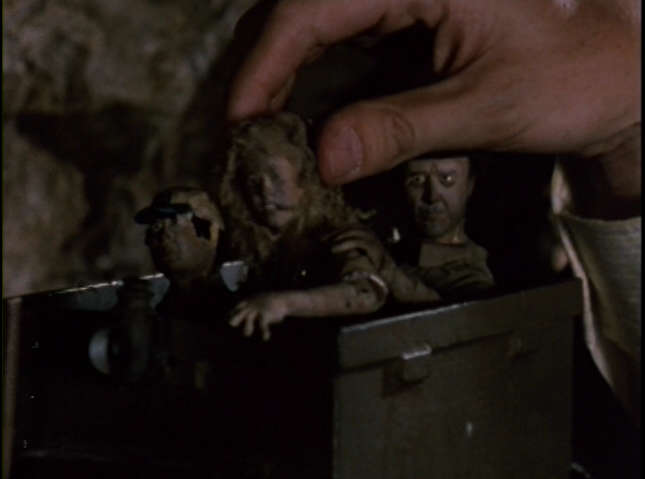
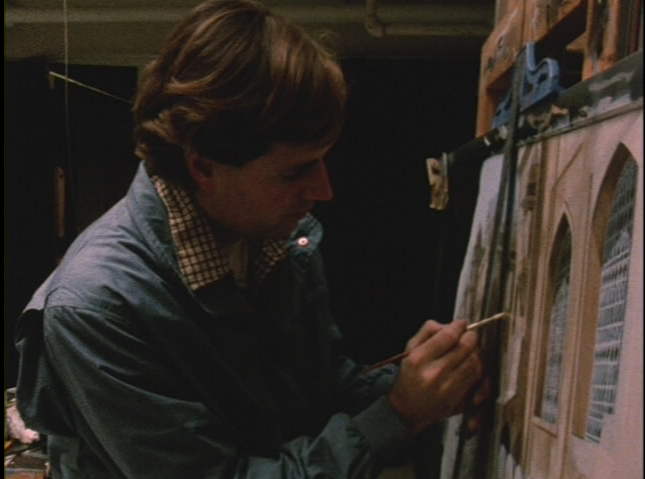
The Oscar-winning visual effects by ILM are top-notch. Miniatures, stop-motion, matte paintings on glass – they simply don’t make movies like this anymore. I’m not a member of the “CGI sucks!!” brigade – computers are just a tool – but the limitations of real-world objects and the photochemical process meant filmmakers more often than not had to improvise. For instance, a modified 35mm Nikon still camera was used to film the mine car miniatures. Speaking of mine cars, the last twenty minutes of this film are non-stop action: the fight in the temple, the aforementioned mine car chase, the waterfall, the rope bridge, the death of Mola Ram, and the arrival of the British riflemen... it simply never ends and it takes real talent to sustain that kind of excitement over an extended period of time without overwhelming the audience. Unlike most of the Star Wars films, we’re not constantly cutting from one battle to another and unlike the other Indy films, it’s less stop-and-start and more “This goes to 11!” Now that I think of it, the opening 20 minutes are a rollicking ride, too: an old-fashioned music number, a melee in the club (in which Indy accidentally punches a cigarette girl!), a car chase on the streets of Shanghai, a plane crash, and an inflatable boat ride down the slopes of the Himalayas and a raging river, all scored with wall-to-wall John Williams music.

In conclusion, this film has plenty to offer. It may not be fair to compare it to its predecessor or action movies of today but it does pass one very important test: if it comes on TV, I don’t change the channel!

“Kali Ma!”

[+] Read More...