Friday, April 10, 2015

Film Friday: Blue Thunder (1983)

Have you ever run into a movie that is just stupid on so many levels and yet the film still rocks? No, I’m not talking about Captain America 2, I’ll talk about that next week. I’m talking about Blue Thunder, a movie that I just can’t resist. And do you know what it is that makes Blue Thunder so great? I have no idea. Let’s see if we can figure it out.

Plot

Blue Thunder is the story of Chief Martin Brody (Roy Scheider) who got sick of fighting sharks in Amity, changed his name to Frank Murphy and decided to become a divorced police helicopter pilot for the LAPD’s Astro Division. Roy plays things fast and loose and is constantly in trouble. In fact, he’s just been called in again for a psych evaluation because a great many people suspect he’s crazy because he suffers from PTSD from Vietnam.
As our story begins, Roy gets introduced to his new partner, Officer Lymangood (Daniel Stern). Roy takes Lymangood around town and shows him the sights, which include a motorcycle cop having an affair and a model who strips naked and dances in front of her window and is apparently deaf to helicopters inches outside her window. Her neighbors are not and Roy and Lymangood get in trouble. They get in extra trouble too because while they were peeping, a city councilwoman was killed in an apparent rape attempt a few blocks away. Roy, however, suspects it wasn’t really an attempted rape because there was an abandoned car in the area that disappeared. Makes sense, right?

Anyhoo, Roy and his partner are chosen to be the test pilots for a new program the federal government is testing in Los Angeles. Under this program, the cops will be armed with one kick ass helicopter called “Blue Thunder,” which will patrol the skies of the city. This thing has a canon on the front which shoots very precisely, except when it doesn’t, and the feds admit that they want to use the chopper for “crowd control from the air” during the upcoming Olympic games. Roy smugly tells them that “crowd control from the air” didn’t work so well in Vietnam.
It soon turns out that the feds are working with Malcolm McDowell, a Brit, who commanded Roy in Vietnam and wanted to have him up on charges for refusing to commit war crimes. Malcolm warns the feds that Roy is “totally unsuitable” for their purposes, but then tells them not to ask for his removal from the program. Instead, Malcolm tries to kill Roy... but fails.

Roy then goes on his first patrol with Blue Thunder. Fortunately for him, the feds are having a midnight meeting with their brigade of killers while Roy is in the air and they speak openly about wanting to use Blue Thunder for crowd control. Oh, and they talk about killing Roy. Roy makes a video of the meeting using Blue Thunder’s recording equipment. At the same time, Roy discovers that the supposed rape of the council woman is connected to Blue Thunder because Blue Thunder is part of something called “Project Thor,” and the “rapist” dropped a note at the scene which included the word THOR.

Roy decides to steal Blue Thunder and take the video to the press. The rest of the movie is a sort of three-dimensional chase scene where Roy is chased by choppers and F-14s while protecting his girlfriend’s car from the pursuing police.
Why Blue Thunder Rocks!

Hmm. Ok. Let me start by admitting that this movie is nonsense. It is packed with key points that are flat out stupid and seriously flawed. Consider these issues:
● Roy is a troublemaker and is viewed as crazy enough to need psychological evaluation. Yet strangely, he gets chosen to be the lead pilot in this impressive new program with its ultra-expensive new chopper? Who made that decision?

● Roy determines that the council woman wasn’t raped because he saw an abandoned vehicle in the area and it later vanished. He assumes this means it was a professional hit. But, um, why? Why would a professional drive a beater but a rapist wouldn’t?

● At the scene of the rape/assassination, they find a paper with the word THOR written on it. This is the name of the government’s secret project. Why would a competent hit man carry around such a paper? Also, Roy later connects this to prove that the council woman was assassinated. This is meant to vindicate Roy, only Roy was just guessing about the rape and his crime was peeping instead of working, not guessing wrong about the rape.

● How can the naked dancer not hear a helicopter right outside her window? Those things aren’t silent. And again, why would Roy get this plum Blue Thunder assignment after getting caught messing around on the job?

● Malcolm McDowell was in Vietnam? Really? He’s British.

● If Malcolm and the feds thought Roy was unsuitable, presumably because he won’t stop insulting Malcolm and complaining that the program is immoral, then you would think it would be easy for them to pick a different pilot. Why risk putting him on the project? And why not put a federal observer in the chopper instead of Roy’s buddy?

● Why are the feds holding a meeting at night? Why are they meeting with their assassins?

● Finally, the reason we (and Roy) are supposedly outraged by Blue Thunder, i.e. the thing that motivates the entire movie, is that Roy discovers that the government wants to use it to quell riots at the Olympics. And supposedly it is Roy’s discovery of this which causes him to steal and destroy Blue Thunder. But the feds actually tell this to Roy right at the beginning when he tells us that “crowd control from the air” didn’t work so well in Vietnam. In other words, they are up front with him the whole time, and everyone just acts like this is still a secret.

What’s more, what riots? There aren’t any in the film and America hadn’t seen riots in nearly 20 years at that point. Also, as an aside, nothing of the sort actually happened in Vietnam as the US military never got involved in riots or crowd control.
Arg. What a load of stupidity! So you have a guy who is given a key assignment no sane person would ever give him. He is given that assignment by the bad guys who then decide to kill him when they discover that he’s been assigned to their project... a project for which they no doubt had the power to select the pilots. He freaks out about something he already knew an hour earlier in the film, after watching the stupidest meeting ever between the bad guys and their hired killers, and a running shootout begins.

This is a stupid film.

And yet... it’s fricken awesome. Yes, it is.
What I love about this film is that it is an unapologetic action film. All the stuff above is basically just flavor that you aren’t supposed to think about. McDowell works, despite being British, because he’s an odious villain. Roy gets the assignment because we like Roy. We like his personality. We trust the actor, even if we would never trust the character, and that trust washes away the character’s flaws for us. Moreover, he’s anti-establishment enough to be the rebel this movie needs, and his kind of crazy is risk-taking, which is what makes it believable that he has extraordinary skills.

So as bizarre as it may sound, the unbelievably of this film is precisely what makes it believable.

Beyond that, shooting this thing was an amazing technical challenge. For example, to get many of the air shots, Director John Badham (Saturday Night Fever, War Games) actually placed stuntmen with cameras on the outside of helicopters to get the right shots. That makes some of the flying scenes second to none. Check out this photo...
The writing is superior too in that the film does an amazing job of ratcheting up the tension in every scene. And the payoff is very strong because the film skillfully builds the hero (Roy) and villain (McDowell) as equals, which makes Roy’s victory all the stronger, not to mention that Roy must do what we are told is impossible to win. Compare that with modern films where the villains turn out to be mindless cowards or nut jobs. None of that is true with McDowell, who is skilled and rotten. And that creates real tension in the final challenge.
Ultimately, what sells this film however is the presence of Roy Scheider... and the helicopter. Almost every screen minute is dominated by Roy. Fortunately, there is just something about Roy that makes you like him. Roy is loyal, courageous and morally right. He is the underdog. He is the everyman who is crapped on by everyone else, but keeps rising above by giving as good as he gets. And he blows things up. And do you know what else? The helicopter is fricken cool!

What more could you want?

Check this one out if you haven’t. You’ll like it.

[+] Read More...

Monday, April 6, 2015

The Fairy Tale Wars Have Been Won!

We have touched upon fairy tales a bit lately. In particular, we have touched upon the idea that the left is at war with fairy tales. I thought it would be worth pointing out that despite decades of attacks, the left hasn’t managed to gain an inch of ground. If anything, they are going backwards.

Here’s the issue: the left hates fairy tales. The reason is that fairy tales teach kids certain values and ways of processing information which basically inoculate kids from the left’s attempt to brainwash them. Essentially, fairy tales teach kids the value of independence, to despise conformance, the value of questioning authority, the reasons why wealth is better than poverty, and an entire set of values that not only disdain coveting, theft, and demonization, but make those into crimes punishable in ways that make the Biblical plagues look tame. These values in turn make kids understand at a fundamental level that the left is full of crap when they try to indoctrinate these kids into becoming rich-hating, asexual automatons.

Moreover, feminists HATE the idea that fairy tales teach little girls that the best thing in the world is to be a princess, and that life is best when a boy rescues them, and that children are worth more than professional kudos. They HATE the lack of gays and the fact that wimpy males and “strong women” are always the villains.
Socialists hate the fact that fairy tales teach kids that there is no free lunch, and that those who promise something for nothing are villains. They hate that the rich can be seen as heroes... that poverty is not shown to be noble... that attempts to make everyone equal always result in society’s collapse. Environmentalists hate the fact that kids are taught that people matter more than trees and animals. Race baiters hate the fact fairy tales don’t include proportional representation. Peaceniks hate the idea that fighting is always shown to be necessary when confronted with evil... negotiation and appeasement are never the answer in a fairy tale.

That’s a lot of hate.
So what the left started at least as early as the 1960s, but really took off in the 1990s, was to attack fairy tales. They mocked them and twisted them. They whined about the messages they sent. They screamed for them to be re-written in gender neutral, anti-violent, pro-collectivist ways. They made the princes gay (not that there’s anything wrong with that... oh, wait). They made the villains misunderstood victims of society. They re-described the stories as spousal abuse, tales of oppression and filled them with perverts.

This was happening all over the world and it was mainly spearheaded by barren female professors.

But just like Fat Barbie, no one bought that crap except elitist leftists who wanted to further indoctrinate their own retarded kid(note the singular).

Anyways, I often wondered if any of this took hold. After all, we do live in a cynical world where “adults” love to spoil everything for everyone else they can... especially children. So presumably, some of this would filter down and ruin fairy tales, right?

Wrong.

Now that I’ve been yanked into kid culture by my two girls, ages 12 and 9, I can assure you that things are much, much worse for the left than they ever were when I was a kid. From what I’ve seen, there isn’t a girl over the age of 2 who doesn’t dream of being a Disney princess. Yep. 100% of the human race never agrees on anything but this is pretty darn close.
The theaters and video racks are packed with films staring the Disney princesses, Tinkerbell, and a dozen other princesses (and they all dress like the worst nightmares of feminists (see below)). If you aren’t a princess, don’t bother applying. In fact, it’s so bad that Disney has had to redefine each of their heroines as a princess, lest they be ignored. Even the little girl in Wreck-It-Ralph had to be made into a princess, when there was no other reason for it except that girls demand it en mass.

As an interesting aside, the grievance against Disney’s The Princess and the Frog wasn’t that it included a princess, it was that (1) Disney waited so long to finally create a black princess and (2) she wasn’t a princess by birth, which makes her a second class princess.

Anyway, continuing... if you go to the toy store, you will see a metric ton of princess costumes. You will see princess play sets, princess dolls, and princess accessories. But just try finding a costume for a girl soldier or fireman or cop. Ain’t no such thing. So all those messages about “girls can do anything” that flooded us in the 1990s were internalized and the unified response was: “Then we want to be princesses!”

(As another aside, every time a little girl puts on a princess costume, a college professor feminist gets hit again by the ugly stick.)

And what about those cynical fairy tale stories meant to denigrate princesses? Good luck finding those in stores anymore. They’ve all be recycled into fake tiaras. By the way, check out the costumes from Monster High and imagine the response of feminists... none of this unusual these days for girl's sitcoms.
And it gets worse. If you watch Disney Channel, I actually find myself shocked at the messages their sit-coms send. To a one, they tell girls to worship the very things feminists hate. And in that regard, I can tell you that all girls are into clothes, makeup and boys. There is shocking consistency, except for the occasional girl who has been forced into soccer.

So what about the boys? Have they learned to play with gender neutral toys and to want to grow up to be neutered baristas and secretaries? Hardly. They’re all soldiers and astronauts and ninjas.

I find it both amazing and comforting that despite decades of full-on attempts by the left’s culture warping machine to try to turn out little androgynous drones, kids just shrug them off and go hard-core for the same things they have been after since time began.

It’s no wonder the left has become unhinged.

Thoughts?
[+] Read More...

Thursday, April 2, 2015

Film Friday: Into The Woods (2014)

I didn’t know what to expect from Into The Woods. The trailer looked good and I do enjoy a good musical. And this one apparently did pretty well on Broadway and in London for over three decades. It seemed to have good actors in it too and great effects. So it probably should have been pretty good. Yet, I’m going to use this film to discuss what I really despise about Broadway.

Plot

Into The Woods binds together several fairy tale stories to create a new story. The plot is meant to come across as complex and clever, but honestly it feels derivative, predictable and muddled and far too cynical.

The story follows a whiny Baker (James Corden) and his Wife (Emily Blunt), who want to have a child. The reason they can’t have a child is because their neighbor, an evil Witch (Meryl Streep) cursed the Baker’s father because he stole magic beans from her garden. Her curse was that the Baker’s father’s family tree would be barren.
Streep, however, has decided that she wants to undo the curse. She doesn’t give a reason for her change of heart, but it seems that undoing the curse will give her back her youthful good looks, which were stolen from her by some other curse. To end the curse, the Baker must collect a white cow, a red cloak, a golden slipper, and some golden hair. So the Baker sets out into the forest to collect these items.

As you might expect, he trades Jack some magic beans for his white cow. He saves Little Red Riding Hood from the wolf. His Wife steals Cinderella’s (Anna Kendrick) slipper. And the golden hair comes from Rapunzel, who was his father’s daughter until she was taken by the Witch and hidden in the tower. Of course, each of these stories is corrupted to a degree and the characters all seem to be randomly roaming the forest as the plot needs.
Fast forward: the Baker gets the stuff and the Witch reverses the spell. That’s where the film should have ended, but it doesn’t. Instead of rolling credits, as should have been done, the film falls way off the rails. The Prince (Chris Pine) marries Cinderella and then proves to be unfaithful because he’s a prince and little girls need to be warned that they can’t rely on princes!! (Sorry, I was channeling a feminist.) He fools around with the Baker’s cougar Wife, who the writer seems to think is only living up to her potential by having an affair. Rapunzel learns to hate her mother the Witch for a reason she already knew long ago. A giant attacks and get this... it’s a woman! Ha ha! OMG Isn’t that clever?! Well, of course it is... because the characters tell us so four or five times. Several characters die because life is about suffering when you work in theater, and the story just kind of winds down with no one living happily ever after because leftists don’t know jack about how to end a story.

Why I Liked This Less and Less As It Dragged On

Where do I start about what I hated about this film. How about at the beginning?
The story felt derivative. And I don’t just mean because I saw Once Upon A Time first. The problem is this: the writer took the most well-known fairy tales and wove them together in the exact way you would have expected. No attempt was ever made to get off the most obvious path. For example, if you’re going to use Cinderella, the most obvious way would be to create a need to steal her slipper. Ditto on Red Riding Hood’s cloak and Rapunzel’s hair. Yet the writer never thought to make them important to the story for some other reason. Thus, there isn’t a single moment where you are surprised in the least.

The characters are awful too. I hated them all and just didn’t care what happened to them. The Baker was unbelievably whiny. Even worse, because liberals believe intent is what matter, we were supposed to like these people even though they spent their time abusing and defrauding everyone they met because they claimed to feel bad about it. Huh? The Princes (there are two) were gay lounge lizards. Jack was a thug in the body of a child. Red Riding Hood was as wooden as a robot and seemed psychotically cold about death. Cinderella was full of anguished indecision in every scene, but the things she anguished about weren’t things anyone cares about. And all of them, every single one, was self-obsessed. The end result was that the characters came across as rotten, whiny and unpleasant. They aren’t people you want to see succeed... or spend time with.
The songs were crap too. Did I mention that this was a musical? Yeah. It was the type of musical with very few actual songs, but lots and lots of dialog being sung as pretend songs. This is something I hate about many Broadway productions. It seems that there are three or four standard song formulas Broadway uses. Depending on the emotion of the scene, the correct formula song is chosen and the dialog is jammed into the form with the proper rhyme scheme. The end result is that you spend the whole time hearing them sing whatever stupid lyrics they have while humming the more famous versions of the same song from prior musicals... “Isn’t that ‘The Candy Man’ from Willy Wonka?” What’s more, the songs are so forgettable and generic that you can replace them with their counterparts from other musicals and I seriously doubt anyone would know the difference.

This is lazy and it’s annoying. It also encourages the actors to engage in melodramatic Broadway acting styles. “Golly gee whiz (swing arm like a newsie).” I find this super annoying. Why? Think of it this way. How sick are you of Johnny Depp playing the same drunk over and over on film these days? This is the same thing... only it’s being done in musical after musical for decades regardless of who the actor is. Talk about annoying!

The writer was an ass too. Three crimes against writing come to mind here in particular. First, it was obvious that the writer carefully avoided doing anything clever for the first four or five hours of the film... ok, it was only 124 minutes, but it felt twice as long. At no point does this writer ever trust the audience to use their brains; everything is spoon-fed to you and served on white bread. Secondly, the writer has insecurity issues. I know this because the story is full of moments where the writer has characters tell you how clever the writing is. If you find yourself doing that, it’s because you suck. And third, the ending is total crap.
The film should have ended about twenty minutes sooner than it does. But it didn’t. Instead, the characters venture back into the woods for no valid reason. Once in the woods, the writer has them engage in out-of-character moments (like having an affair) so he can effectively slander them one by one. Then the film just kind of ends. This entire scene is confusing, pointlessly dark, pointless and it doesn’t fit in with the rest of the film at all. And the only reason I can see for doing it is that the writer is a cynical prick who thinks it’s clever to twist these characters into rotten people. Since attacking these characters was a popular activity on the left at the time this was first written, I assume this was ideological.

All in all, I have to say that this film stunk. The characters are impossible to like. The story is mind-numbingly boring and predictable until the ending, which is random and hateful. The songs are entirely forgettable and derivative. And the story seems intent on making you hate fairy tale characters.

This is Broadway at its worst. Thoughts?
[+] Read More...

Monday, March 30, 2015

Mini-Major Discussion: Orion Pictures

by Jason

Today we have the latest entry in the “They made so many cool movies so how did they fail” sweepstakes with the bearer of that iconic constellation logo, Orion Pictures. Like so many indie studios, they lived movie to movie, with further financial backing depending on the parent company or millionaire that owned the studio. The financial rollercoaster got to the point where Orion would release the biggest hits of the studio’s existence, but they weren’t enough to save the studio from bankruptcy.

Who Were They?

Orion was founded in 1978 by five former executives from United Artists. The execs formed a partnership with Warner Bros, who would distribute their films but Orion retained creative control. In 1982, Orion split with Warner Bros and struck out on its own. Orion’s initial going was shaky, but it began to score big by distributing Mario Kassar’s First Blood in 1982, and then struck gold in 1984 when it released the Academy Award winning Amadeus. The studio also snagged Woody Allen for a few films like A Midsummer Night's Sex Comedy, and served as a distributor for some of Hemdale’s titles, including The Terminator, Hoosiers, and Platoon. It wasn’t long before Orion was a major player in the film market, releasing movies that both audiences and critics enjoyed.

What Were They Known For?

The only major film bio of Mozart, two of the decade’s most iconic movie cyborgs, and that cool constellation logo. Also, that Hannibal cannibal guy.

The Studio’s Peak Moment

1986-1987. Orion was on top of its game, with a steady stream of hits that included Back to School, Robocop, Platoon, Hannah and Her Sisters, and No Way Out.

You would think it would be late 1990-early 1991, the period when Dances With Wolves and Silence of the Lambs were released. Arguably, none of Orion’s other movies had such an impact on pop culture, in conjunction with their great critical acclaim and Oscar wins, but the studio was actually in dire straits. Read on further, and you’ll see what I mean.

The Studio’s Most Notorious Movie

Clifford, starring Martin Short. *Shudder*

A good runner up is Car 54, Where Are You?, a film adaptation of the TV show. This was part of the first wave of TV show-to-film adaptations, and the fact that it didn’t kill the trend off is a miracle. Sigh…and to think Orion sold off The Addams Family to Paramount.

Orion only distributed, not actually produced, the E.T. rip off/McDonalds infomercial Mac and Me, but it deserves a mention.

Finally, RoboCop 3 is notorious for being a watered down PG-13 entry that killed the franchise. Also, RoboCop 2 is sometimes criticized for its fowl-mouthed child drug dealer character. Actually, one could say RoboCop suffers from “Highlander syndrome” in that none of its sequels or remakes are as beloved as the original.

The Studio’s Up and Comers

Plenty.

Bo Derek made her film debut in 10, one of Orion’s first movies and also one of that year’s biggest hits.

Most of the cast of the 1981 hit Excalibur, including Patrick Stewart, Liam Neeson, Gabriel Byrne, Helen Mirren, Nicol Williamson, and Ciaran Hinds, none of which were as well known then as they are today.

Likewise, some of the cast of Amadeus, including Tom Hulce, F. Murray Abraham, and Jeffrey Jones.

Star Trek II & VI director Nicholas Meyer made his directorial debut with the 1979 film Time After Time.

The 1983 sex comedy Class saw the film debuts of Andrew McCarthy, John Cusack, Virginia Madsen, and Alan Ruck.

Orion co-produced Caddyshack with Warner Bros (but not its sequel), so it gets some of the credit for the boosts that film gave to Rodney Dangerfield’s film career and Harold Ramis’ directing career.

The 1985 surprise hit Desperately Seeking Susan starred Madonna, when she was hitting her peak as a pop star.

The Fugitive director Andrew Davis made the well received Chuck Norris vehicle Code of Silence for Orion.

Paul Verhoeven, for directing Flesh and Blood, and two years later, Robocop.

Finally, the biggie of the bunch would be Kevin Costner. Orion gave us 80s Costner entries No Way Out, Bull Durham, and then distributed Costner’s produced Dances With Wolves.

Notable Movies

Amadeus, Arthur, Sharky's Machine, Lone Wolf McQuade, A Midsummer Night's Sex Comedy, Zelig, The Woman in Red, The Cotton Club, Desperately Seeking Susan, Flesh and Blood, The Purple Rose of Cairo, Remo Williams: The Adventure Begins, Haunted Honeymoon, Radio Days, Robocop I-III, Back to School, Prancer, Three Amigos, Bull Durham, Eight Men Out, The Unbearable Lightness of Being, Johnny Be Good, Colors, Dirty Rotten Scoundrels, Cadillac Man, Mississippi Burning, F/X 1 and 2, Throw Momma from the Train, UHF, Farewell to the King, Valmont, Great Balls of Fire!, Little Man Tate, The Silence of the Lambs, Original Gangstas, and Ulee’s Gold.

What Killed the Studio?

Really, really uneven box office performance.

It’s true Orion put out some of the most successful movies of the 80s, both critically and commercially. However, these hits were not distributed very equally year to year. Some years Orion struck gold, but other years Orion would produce nothing but stinkers, or at least just plain underperformers.

1984 had big hits with The Terminator and Amadeus, but Francis Ford Coppola’s The Cotton Club cost 58 million and didn’t make half of it back. 1985 was even worse, with only the Madonna headliner Desperately Seeking Susan and Code of Silence as major hits. But the studio came back in a big way the next year, helped by Rodney Dangerfield’s Back to School. Orion hit a hot streak until 1989, and then things went downhill. The studio took a 31 million dollar bath on Valmont, one of two dueling adaptations of the novel Dangerous Liaisons; the flick barely edged out a million. Dennis Quaid’s Great Balls of Fire! was badly received. The SCTV-alumni starring car comedy Speed Zone cashed in at just 3 million. Conan scribe John Milius saw his flick Farewell to the King bid farewell by audiences at just under 2 and a half million.

Desperate for a hit, Orion turned to music parodist “Weird Al” Yankovic. His starring debut UHF was posting great test audience numbers, so they shuttled it to the summer…where Lethal Weapon 2, Ghostbusters 2, Indiana Jones and the Last Crusade and Tim Burton’s Batman were waiting to chew it up and spit it out. The only bright lights of 1989 were Bill and Ted’s Excellent Adventure, a rescue from the defunct De Laurentiis Entertainment Group, and Prancer, a Christmas family film about a girl who nurses a wounded reindeer back to health.

The losses hurt Orion going into 1990. Again, most of that year’s movies flopped or just didn’t make enough to help the studio. Robocop 2, directed by Irvin Kershner, cost twice as much as the first film but wasn’t the success the first one had been. Not even Dances With Wolves, nor Silence of the Lambs, which were huge gushers, could make up for the years of losses. Orion’s dire straits became the fodder for Billy Kristol’s jokes at the Oscars. In 1992, he said on stage:

“Take a great studio like Orion. A few years ago Orion released Platoon, it wins Best Picture. Amadeus, Best Picture. Last year, they released Dances with Wolves wins Best Picture. This year The Silence of the Lambs is nominated for Best Picture. And they can't afford to have another hit! But there is good news and bad news. The good news is that Orion was just purchased, and the bad news is it was bought by the House of Representatives.”

Orion was so bad off, in 1991 it lost $102.1 million. It was no surprise that on December 11, 1991, Orion filed for Chapter 11 bankruptcy protection. Over the next few years, movies that Orion had made before bankruptcy would see staggered releases over time.

It took five years for Orion to emerge from bankruptcy, but it was pretty much a husk of its former self. It made fewer films, most of them for niche audiences. It released one of Joe Pesci’s last movies before his retirement, (until Pesci returned for a couple of movies in the late 2000s-early 2010s), the comedy 8 Heads in a Duffel Bag. It acted as distributor for Live Entertainment’s The Arrival, The Substitute, and Phat Beach. The only distinguished movie of the era was the Academy Award-nominated Peter Fonda flick Ulee’s Gold.

The writing was on the wall. In July of 1997, Metromedia, the owners of Orion, sold it to MGM, laying off over a hundred employees, and the studio was dead.

Legacy

Orion stayed dormant until MGM revived the Orion label in 2014 to release the horror flick The Town That Dreaded Sundown. So the constellation logo is back in theaters, mostly to put out “specialty films” as MGM puts it.

Most of Orion’s film library is now the property of MGM, as well as Hemdale-made films like Platoon and Terminator and the Nelson Entertainment-made Bill & Ted movies. The movies Orion made with Warner Bros, however, remain with that studio. So chances are most Orion DVD releases will come with the Leo the Lion logo on the top cover.

Of course, the biggest reminder of the Orion legacy to date was 2014’s remake of RoboCop. However, the new version only made about half of its production budget in the U.S., showing once again in many cases there’s nothing like the original.

So what is your favorite Orion picture? What do you think of the studio? Any other thoughts?
[+] Read More...

Thursday, March 26, 2015

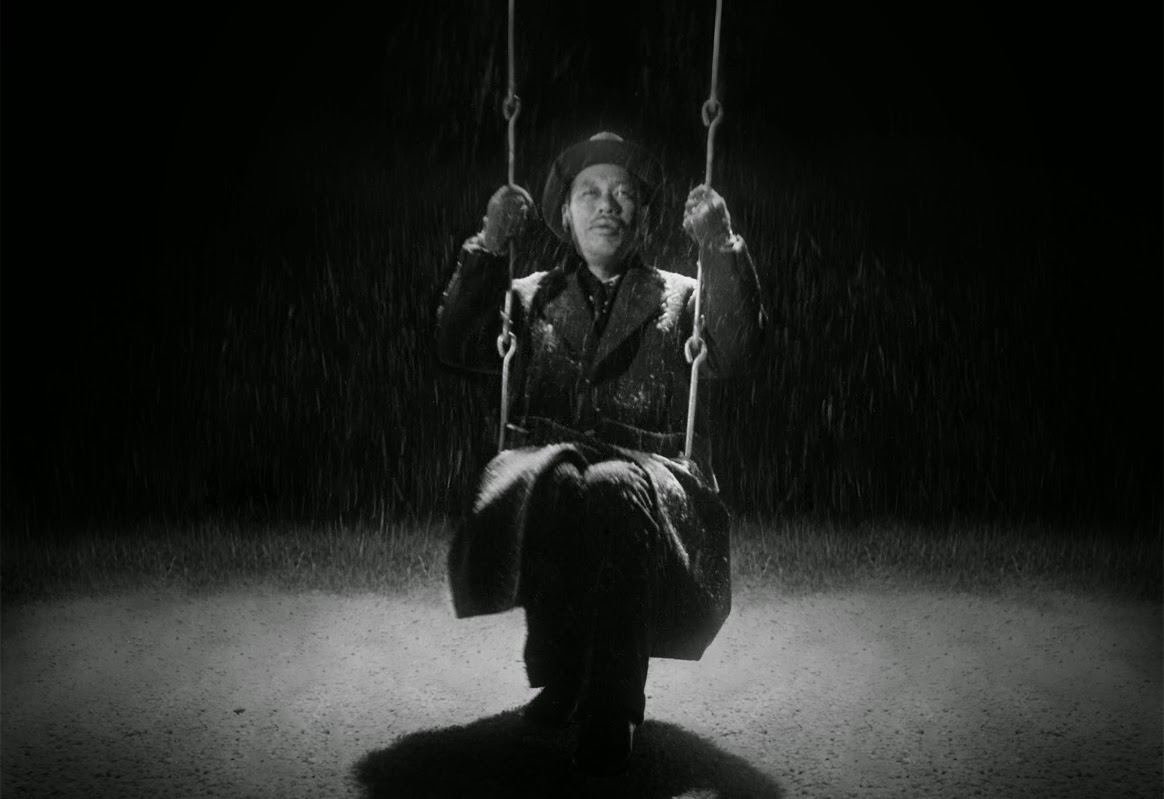
Kurosawa Week: Ikiru (1952)

Without a doubt, Kurosawa’s Ikiru ("To Live") is my overall favorite Kurosawa film. There is just so much to love about this film. First, it is unique. There is nothing else like it on film. Secondly, despite poor film quality, the film is very well shot and perfectly acted. Finally, this film is intensely emotional. This film will fill you with rage at some points, pride at others, and make you cry, and it has an amazing and unique message.

Plot

Ikiru is the story of Kanji Watanabe (Takashi Shimura), a middle-aged petty bureaucrat who learns that he is dying. The film is about him trying to find some meaning in his life.
Kanji tries to find meaning at home at first. He wants to tell his son and daughter-in-law, with whom he lives, that he is dying, and he hopes to become closer to them. But they won’t pay any attention to him. All they care about is his pension and what they will inherit from him one day. He quickly realizes that he will not find meaning here, so he never tells them that he is dying. Instead, he ventures out into Tokyo’s nightlife. Out on the town, he finds a novelist who guides him to a wild nightclub. He quickly realizes, however, that he will not find meaning there either.

The next day, Kanji finds himself drawn a young woman he meets at the office. She seems energetic and vibrant, and he starts to spend time with her. But she eventually begins to wonder what he’s after. He then asks her what makes her so happy and she tells him, but she also tells him that he needs to find a purpose in his own life; he can’t just take someone else’s purpose.
Kanji then finds a cause. He decides he will help a group of mothers build a playground. To do this, however, he must guide the project over a dozen insurmountable bureaucratic hurdles. I’ll let you discover for yourself if he succeeds.

In the ending, a group of co-workers, family and friends meet at his wake and they discuss, from their self-centered perspectives, how his behavior changed before he died. I have never wanted to punch a couple film characters more in my life.

This Is An Amazing Film

This is the only film I have ever seen that has received a 100% rating from Rotten Tomatoes, and it is well deserved. Once again, Kurosawa is at the top of his game in terms of storytelling and getting us to delve into what makes us who we are. At its core, this film is about how we live and how we find meaning in our lives, something we all struggle with. As if that were not interesting enough, however, Kurosawa also gives us so much more.

For example, the film criticizes the attitudes that most of display in our daily or professional lives. The film criticizes our penchant for being self-absorbed and ignoring people who we view as not important. It attacks the greed of Kanji’s family, which is a form of greed any lawyer has seen play out in thousands of families. It attacks bureaucratic laziness and fear. It attacks the “don’t make waves” attitude. And best of all, it tells us that if you truly understand what is important in life, then none of the things the rest of society values really matter.
Let me repeat that: if you truly understand what is important in life, then none of the things the rest of society values really matter.

This is a revolutionary message, particularly in conformist Japan, but even here. This is the message that tells us both how to change the world and why to change the world. It is that second part that you never see tackled in films and which so many people will never understand.

Indeed, the fact that many people will never get this is put on display at the ending, when Kanji’s oblivious friends and family and coworkers struggle to put Kanji’s life back into a box that they can understand rather than understanding why he really did what he did... a behavior that many of us will have seen by the oblivious people in our own lives.
It is this scene, by the way, which will fill you with rage, bring you to tears and fill you with joy. I can’t think of any other film that punches this hard emotionally, and yet Kurosawa does so with pure subtlety and without manipulation. There is nothing fake or heavy-handed here. There are none of the tricks Spielberg would use to manipulate you... just great storytelling. In fact, it is an awesome display of storytelling that in such a short film you can come to see Kanji as such a worthwhile character that you feel the slings and arrows of slander and misunderstanding lobbed at him even after he is dead. You will cry when he dies.

It’s amazing writing.

You need to see this film.
[+] Read More...

Wednesday, March 25, 2015

Kurosawa Week: Hidden Fortress (1958)

by Kit

Kurosawa’s The Hidden Fortress, the inspiration for Star Wars, is rarely ranked among his best but compared to most films, especially those released today, it is an astounding action movie. It tells an amazing adventure of a general having to escort a princess from a hidden fortress back to her kingdom with 200 rho of gold needed to rebuild the kingdom —all while evading enemy armies and patrols. However, this story adds a unique twist; telling it from the point-of-view of two greedy and bumbling peasants who are not that likable.

Plot

The movie begins with the two peasants, Tahei and Matashichi, who are wandering, now impoverished after trying and failing to join the Yamana Clan, and now quarreling just over whose fault it is. Their bickering gets so vociferous they decide to part ways. But both are soon captured by the Yamana Clan and forced to dig for the missing gold of the recently defeated Akizuki clan.
After a prison uprising they manage to escape and stumble across some pieces of hidden gold, as well as its owner, Princess Yuki, now wanted by the Yamana Clan, and one of her generals, Makabe (Toshiro Mifune), who are now hiding at a fortress hidden in the mountains.

Soon, however, they have to leave the fortress with the Makabe pretending to be a poor peasant and Princess Yuki pretending to be a mute as they carry the gold hidden in sticks all the way across Yamana Clan to Yuki’s home where she and Matabe can rebuild her clan and continue the war against the Yamana Clan, rescuing one of Yuki’s slave girls in the process.

Why it Works

This is not easy but a lot easier than say, Seven Samurai. But I have noticed a few things.

First, The two comic foils, are introduced with enough time for us to understand who they are and what they will be doing for the next two hours; getting greedy and getting into trouble because of their greed. He also establishes what writing courses call a “need,” they need to stop being so greedy. Kurosawa is smart enough to do this subtly, as, though Makabe and Yuki comment on their greed, he never throws it at us with some character telling them that they “need to stop being greedy because it will get you nowhere” and bla-bla-bla. Thus, announcing to us morons in the audience what is going to happen in the movie.

He also manages to make the dramatic action story interesting by making Yuki and Makabe, two characters who could easily have become bland and boring, interesting and likable. The scenes where they are forced to act as straight men, annoyed by the antics of Tahei and Mataschichi, are funny largely because we get the scene not strictly from the point-of-view of the two peasants (how some might have done it) but from Yuki’s or Makabe’s point-of-view. They are annoyed at these two peasants for causing them trouble on what is a very important task.
And on that point, while the movie, as other films like to do, uses the characters of Yuki, the General, and the slave girl to define the greed and bumbling nature of the peasants, it also uses the peasants to define them. The peasants almost naked sense of self-interest shows the courage and determination of Yuki and the General as well as the loyalty of the slave girl to Yuki. And it does so without announcing it in the BIG BOLD WORDS most movies like to use.

He also makes sure transitions between the comic relief scenes involving the peasants and more serious scenes focusing on Princess Yuki and General Makabe flow seamlessly. We’ve all seen movies like this where you have a group of characters that are clearly comic relief plucked into a drama and the result is you have two separate, very different movies going on. And you feel it.

One example, and it will be strange referencing this in a Kurosawa review, would be Madea’s Family Reunion (see, told ya) where the comedy scenes involving Madea’s antics and the scenes with the domestic abuse plot line sometimes come one after the other creating a jarring affect. It jolts you out of the movie.

Hidden Fortress never does this, instead you never notice the transition from comedy to drama/action, making the movie an enjoyable, rollicking adventure film that will have you laughing and gripped with suspense.
Flaws

I didn’t watch the Criterion version but the Essential Art House version, instead. Now, having watched a fair number of films from the early-1930s I’m kind of used to films where the print has clearly aged so I didn’t notice any flaws there.

But just comparing my Criterion DVD of Seven Samurai with the Art House DVD of Hidden Fortress I am going to make a guess that Criterion does a better job writing the subtitles for their movies than Essential Art House does. Some of the dialogue in the subtitles was, compared to the work done on Seven Samurai, not that good. Or maybe that was just the script, but I do remember seeing a version of Seven Samurai on TCM where the subtitles were also much poorer than the Criterion version so, who knows?

All-in-all, a great movie and one worth checking out.
[+] Read More...

Monday, March 23, 2015

Kurosawa Week: High and Low (1963)

In many ways, High and Low (aka Heaven and Hell) is my favorite Kurosawa film. This film is beautifully acted, raises amazing ethical questions, and provides rather a good bit of suspense. This film is also very accessible as it’s modern in its sensibilities.

Plot

High and Low is the story of Kingo Gondo (Toshiro Mifune), a executive who is making a power play to take over the company for which he works, National Shoes. He is trying to stop the company from shifting to low quality shoes which will cheat consumers and ruin the brand, and he has set up a secret leveraged buyout attempt to take control of the company. To achieve this, he has gambled everything he owns.
As his plan heats up, he receives a phone call. His son Jun has been kidnapped and a massive ransom is demanded. Paying this ransom will destroy the leveraged buyout and wipe out Gondo. Nevertheless, Gondo prepares to pay the ransom because it is his son. Then he sees his son playing in the yard. The ransom call has apparently been a hoax.

Only, it hasn’t. The kidnappers grabbed Shinichi, the son of Gondo’s chauffeur by mistake. Despite this mistake, the kidnappers still demand that Gondo pay the same ransom. What will he do? I’ll save that for you to discover.

Toward the end, by the way, this film becomes a fascinating police procedural which gives you some interesting insight into Japanese culture.

What A Great Film!

This is a fantastic film. And before I say anything else, let me toss out two words that say so very much: Toshiro Mifune. Mifune is, in my opinion, the greatest actor the world has ever produced. He is amazing. He is entirely believable in any role he plays. He has a stunningly noble screen presence, but boils over with emotion just beneath the surface. You feel everything his characters feel as if it were you. He is amazingly physically gifted and he can make complex athletic moves seem as simple as sitting down, yet he can also turn every day motions into intensely meaningful gestures. And he does all of this with a subtle approach that seems impossible.

Mifune plays the lead and watching him is truly a joy. He puts you in this film and makes you feel every single punch the script sends his way. He raises this film to a whole new level.

Apart from Mifune, this film has a strong script. For one thing, none of the film’s characters are the least bit cardboard. Each character has unique traits. Some are smart and competent. Some are incompetent or careless. Some are opportunists, some are devious, and some are helpless. Each character is given a unique motivation. Even the kidnapper’s motive is examined in depth. This makes this a very real world. Moreover, little in this film happens according to the normal order of events in films like this. It zigs at every opportunity. There is no deus ex machina, nor do characters do stupid things just to drive the plot either. It feels real at every turn.
More importantly, however, this is one of the most thoughtful films I’ve ever encountered. Think about the ethical dilemma and how it develops: Gondo is fighting for the life and soul (no pun intended) of the shoe company he loves and has staked all of his assets on it. Unexpectedly, he is confronted with the dilemma of saving his son and losing everything else or losing his son and obtaining everything he wants in his business life. Then suddenly, he learns that it’s not his son who has been kidnapped. But does it matter? Should it? He is the only one who can pay the ransom and if he doesn’t, then the son of his chauffeur will be killed, but can we really put the responsibility on him? Does it matter that he is the reason the man’s son was kidnapped? Does it matter that he was ready to pay to save his son? Is it right or wrong to refuse to save this other man’s son?

When word of this leaks out, his supporters face the dilemma of whether or not to stick with a man who is likely to destroy his own plan and ruin their careers or do they turn to the other side? The police face a series of dilemmas as well about how to respond and how far to go to solve this crime without endangering the boy.
(MAJOR SPOILER ALERT) And finally, when you learn the motive of the kidnappers, you are confronted with some interesting twists. It turns out that the killers were simply jealous of the rich man whose house they could see from their slum, so they decided to take what he had. Socialists would feel a great deal of sympathy for this. But look at what they cause. First, they end up taking the son of a poor working class man by mistake, putting him entirely at the mercy of the charity of the rich man they hate. They even end up making Gondo into a national hero! But even further, they end up stopping Gondo from gaining control of National Shoe, which means that consumers will now be cheated, and shaming the company in the process, which means the company will likely fold soon enough, causing hundreds of workers to end up unemployed. Interesting. Think about the messages here! (End Spoiler Alert)

All of this makes this an amazing film experience, and I won’t ruin it for you by telling you any of the other twists and turns the film takes. This film is intense. It is thought-provoking. It is unpredictable. And driving this film is the amazing acting of Toshiro Mifune, the fantastic script, and the perfect camera work of Akira Kurosawa. I absolutely love this film.

Finally, as an aside, I find the pedigree of this film interesting. It is said to be based on the novel “King’s Ransom” (1959) by Ed McBain. However, it is very, very similar to the Glenn Ford/Donna Reed movie Ransom from 1956 (remade by Mel Gibson in 1996). I suspect that McBain may have copied the Glenn Ford movie and somehow this fact has fallen through the cracks. In any event, I recommend giving the Ford movie a peek after you see High and Low, as it too is excellent.
[+] Read More...

Sunday, March 22, 2015

The Greatest Director You Never Heard Of: Akira Kurosawa

This week is the 105th birthday of Akira Kurosawa, perhaps the greatest film director ever. Famous for films like Seven Samurai, Rashomon and Ran, Kurosawa's innovations became movie staples throughout the world and his films were copied, with the copies often becoming mega-hits in their own rights. This is Kurosawa week around here and we plan to have an article every day. Today, I'm going to talk about a couple famous copies of his films to help explain the tremendous influence he has had on American film. Here are the biggies:

Seven Samurai: The most famous remake of an Akira Kurosawa film is the western The Magnificent Seven, which is a remake of Seven Samurai. In this case, seven expert gunmen agree to defend a helpless village against Mexican Bandido Eli Wallach and his army of pistoleros. Among the seven are such amazing actors as Yul Brynner, Steve McQueen, Charles Bronson, James Coburn and Robert Vaughn. The film was directed by John Sturgess and is arguably the best western ever made. In fact, not only is the film routinely ranked among the best films of all time, but this is the second most shown film on television behind only The Wizard of Oz. And what makes this film so great is the same thing that made the original so compelling, watching a group of tough, loners and drifters decide to stand for something, not for money, but because they want their lives and talent to have meaning for the first time.

Akira's version, by the way, gave us such innovations as the telephoto lens, the use of multiple cameras to capture the same action, and the image of the bad guys riding over the hill to attack. Each of these things had become standard techniques by the time of The Magnificent Seven.

Yojimbo: This one was remade as a A Fistful of Dollars. Directed by Sergio Leone and starring Clint Eastwood as a man with no name who plays two competing crime families off against each other, this was the film that made Eastwood into a superstar. It would then spawn two more collaborations between Eastwood and Leone -- For A Few Dollars More and The Good, The Bad and the Ugly, which would guarantee his movie star status. As with Yojimbo, A Fistful of Dollars involves a drifter, gunfighter anti-hero with no apparent conscience, who is undone by the fact that he does really have a conscience. As with many Kurosawa films, the inability of good people to ignore their consciences is a powerful theme he goes to over and over, and it's a theme that calls to all of us... or should.

This film was later remade again by Bruce Willis and Walter Hill as Last Man Standing, an overlooked gem.

The Hidden Fortress: The story of two squabbling peasants who accompany a defeated General who tries to save a princess from an enemy clan, this film wasn't directly remade so much as it was completely re-imagined as a film staring two robots. What film? Star Wars. Seriously. As an aside, the defeated General in Hidden Fortress is played by Toshiro Mifune, who is an amazingly compelling actor and is perhaps the greatest actor Japan has ever produced. He and Kurosawa worked together several times.

Rashomon: Rashomon was remade by Sydney Lumet for television and then later remade as the film The Outrage, starring Paul Newman, Edward G. Robinson and William Shatner. However, I think the bigger angle is that the concept behind this film has been remade over and over and over. Indeed, what made Rashomon so innovative was the concept itself, which is that the same story is told repeatedly by different characters from different perspectives, with each telling the story slightly differently. This story also involves the use of the unreliable narrator and nonlinear story telling, and is now considered one of the greatest films of all time.


That's an impressive lineage. Anyway, join us this week as we talk about our favorite Kurosawa films. In the meantime, tell us what your favorite Kurosawa films are?

[+] Read More...

Friday, March 20, 2015

Film Friday: Real Genius (1985)

The film Real Genius came up in our discussion the other day and that reminded me that I’ve been meaning to review that film. Real Genius is a film that I found to be ingenious in its writing, its casting and its story. It was funny, clever and inventive, and I truly enjoyed it, with one huge caveat... its politics piss me off.
The Plot
Written by Neal Israel, Peter Torokvei and Pat Proft (Hot Shots, The Naked Gun), Real Genius is the story of Mitch, an overachieving genius teenager who gets into Pacific Tech University long before his age should allow it. He gets into PTU because Professor Jerry Hathaway (William Atherton) needs Mitch’s mind to shake up his research team.
The team, led by Chris Knight (Val Kilmer), is working on a laser which, unbeknownst to them, will be used by the military to conduct assassinations from space. The team, however, is stuck and has become distracted by Kilmer’s short-timer attitude; he will graduate soon and really doesn’t care about the project.

Mitch arrives and immediately discovers that he doesn’t fit in. The team is self-obsessed and into partying. They view him as too serious. The other students ignore him because he’s too young. The bully and his friends decide to make Mitch’s life hell. In the process, they humiliate him. Mitch is soon overwhelmed and crying to his mother to come home.

Meanwhile, Kilmer finds himself threatened by Atherton. If he doesn’t solve the problem of the laser burning out every time it is fired, then Atherton won’t let him graduate and won’t recommend him for jobs.

This lights a fire under Kilmer and he decides to fly right. He helps Mitch fit in and focuses the rest of the team. Soon, they get the laser functioning. They celebrate. At their moment of success, however, mystery character Laslo, a burned out genius who keeps walking into Mitch’s closet and vanishes, comes to them and tells them that the laser they are working on is really a weapon. They are horrified and they arrange to sabotage the test of the laser the military is preparing, with hilarious results involving popcorn.
The Good, The Bad and the Angry
I really liked this film. The story was fun and original. The film was also populated with original, interesting characters with bizarre flaws, which is always fun to watch. The writing was clever too. In fact, I can still recall a bunch of the jokes twenty years since I saw the film the last time. For example:
Atherton: I want to see more of you around the lab.
Kilmer: Fine. I’ll gain weight.

Kilmer: Do you mind if I name my first child after you? Dipshit Knight has a nice ring to it.

Kilmer: If there’s anything I can do for you, or more to the point to you—
Susan: Can you hammer a six-inch spike through a board with your penis?
Kilmer: Not right now.
Susan: A girl’s gotta have her standards.
Notice that these involve completely unexpected turns of phrases. The setups to get to this point are well thought out too, i.e. these lines don’t just drop out of the blue. And what’s more, the whole film is packed with them.
Making the writing all the better, the film is very well cast. Kilmer in particular was about to hit as a major actor with serious talent... before burning out with a reputation for being impossible to work with, and he was at the top of his game here. Indeed, he displays excellent timing, a real feel for how to play each scene, and strong screen presence. Atherton too was the perfect choice for the vile Professor Hathaway. He was so convincing, that I honestly can’t separate out the character he plays from what I expect his real-life personality to be like. The supporting cast was good too. Each fit their role perfectly as the team of misfit and malcontents.

The story is strong too. The film hits many themes that appeal to us all, such as fitting in, dealing with sneering underlings and credit-stealing bosses, and getting revenge against bullies. Moreover, the plot is believable, but just insane enough to keep the story light-hearted even when its topic can get kind of heavy.
So I recommend this film without reservation, right?

Well, no. I do enjoy this film and I recommend it highly, but it has one serious problem: its politics are noxious. To understand this, a comparison to War Games is in order. War Games involved a political message that nuclear war could never be “won” and that the doctrine of Mutually Assured Destruction was so insane that anyone who played basic strategy games, i.e. tic tac toe, should know it was untenable.

Whether you agree with that or not is not the point, and I note as an aside that the left would soon flip flop from being anti-MAD to having great reverence for MAD once Ronald Reagan announced the SDI initiative, which they saw as ending MAD. But as I said, that’s not the point. The point is that the politics of the film doesn’t offend. And the reason it doesn’t offend is that the film makes its points honestly and it earns them. Indeed, before we are told that MAD and nuclear war are insane, we go through an hour’s worth of game play which shows us that a real nuclear war would destroy everything, i.e. there would be no winners. Moreover, the film never uses straw men characters, like evil generals who talk about acceptable losses and seem to relish the idea of killing hundreds of millions of civilians. Instead, you get earnest people who don’t want to hurt anyone, though they are prepared to do their duties, and you watch them struggle when faced with the reality of an actual war.

It’s hard to feel offended by that because the facts they present are well founded, the moral dilemma is a genuine one, and neither side is treated with disrespect.
Real Genius, by comparison, never earns its political message. To the contrary, it throws its message in your face as a fait accompli and with the assumption that everyone automatically agrees with the point... except the retarded bullies (Hathaway’s assistant), the evil money-grubbers (Hathaway), and the mouth-foaming murders (CIA). In other words, the film tells you what to believe without supporting its position, it presents its opinion as a settled matter which is beyond debate by reasonable people, and it demonizes those on the other side. That’s an offensive way to present a controversial message.

And what message does this film send? It tells us that all moral scientists will refuse to create weapons for the military. Well, that’s bullship. How anyone can argue that the building of weapons to defend a peaceful democracy against an aggressive, murderous communist empire is immoral is simply beyond me. Sure, I get that some people are pacifists, but that is a personal choice and their view does not morality make. There is nothing in morality besides pacifism which suggests that defending yourself is immoral.

Nor was this a widely-held view. In fact, I was in engineering school shortly after this film and I can tell you that not a single person I met bought this line of crap. Yet, here is the film telling you that this is the only acceptable position reasonable people could hold and that anyone opposed to it is a self-interested, murderous retard. That’s propaganda.

It really is to the credit of the strength of the film that I can recommend it despite this twisted message, but make no mistake that the message grates on me every time I see the film.

Thoughts?
[+] Read More...

Monday, March 16, 2015

Mini-Major Discussion: TriStar Pictures

by Jason

Most moviegoers my age will remember the iconic Pegasus logo (I picked out the older version for the article, which is probably better known) of the film studio TriStar Pictures. For a while, TriStar pictures popped up regularly every year, but have you noticed you haven’t seen the Pegasus take flight much in the past decade? So, let’s sit back and re-live the glory days of the studio that gave us Robin Williams playing Peter Pan, David Bowie singing to Muppets, an army of giant bugs, a sports agent who screams over the phone, and a giant lizard who eats a lot of fish…

Who Were They?

TriStar originally began, fittingly, in 1982 as a pooled effort by three entities, HBO, Columbia, and CBS, to share costs in a film industry that had been growing expensive. However, CBS and HBO would divest their interests in TriStar, and later Coca-Cola, which owned Columbia, would sell that studio to TriStar in 1987. Columbia and TriStar were then reformed into separate film studios, later to be bought by Sony, creating the TriStar Pictures that we know to this day.

TriStar got off to a good start with their first produced film, the Robert Redford headliner The Natural, a hit that also scored a few Oscar nods. The studio also secured distribution deals with mini-majors like Carolco, Cannon, Hemdale, as well as the Salkind producers for Supergirl and Santa Claus: The Movie. TriStar also worked with Jim Henson on his film projects after Henson’s previous partner, ITC, went under. TriStar scored another coup by bankrolling a few Robin Williams projects, Hook, The Fisher King, and Jumanji, all hits or cult classics that retain followings to this day. With a lot of successes under its belt, TriStar flourished in the 1980s and 1990s.

What Were They Known For?

Having a film logo that everyone, especially children, would love to ride.

As far as their movies, a pretty well rounded collection of audience favorites, Oscar winners, and a few stinkers. Not terribly different from what most big studios would put out.

The Studio’s Peak Moment

1996’s Jerry McGuire. Big hit and five Oscar nods, and that catchphrase, “Show me the money!” Yeah, how long did we go listening to that everywhere?

The Studio’s Most Notorious Movie

TriStar had a few duds, even a few really infamous ones:

I Know Who Killed Me is credited with burying Lindsay Lohan’s film career even deeper than it already was.

Baby Geniuses was pretty horrible but its reputation was eclipsed by its sequel, which would surely have made it on here if it wasn’t distributed by Sony’s Triumph division instead. TriStar, you dodged a bullet…

And then there’s Bruce Willis’ Hudson Hawk, a movie to this day is held as a premiere example of a flop although its notoriety has faded with time.

Suspense and horror author Dean Koontz found TriStar’s adaptation of his novel Hideaway to be pretty notorious. Many of his fans would agree.

But the prize for TriStar’s most notorious flick has to go to one of the most infamous slasher flicks of all time: Silent Night, Deadly Night. Serial killers dressed in painted William Shatner masks or hockey masks, no problem. A killer dressed like jolly old Saint Nick, big frickin’ problem. Yes, the killer of Silent Night, Deadly Night is a man dressed in a Santa Claus outfit and hunts his victims with an axe. This film was utterly hated by parents who did not like the killer Santa motif in the movie’s ad campaign. It even pissed off Gene Siskel, who called out the ad campaign, called out the movie for its horribleness, then called out the movie makers by name: LINK.

After two weeks, the studio actually pulled the movie from theaters. Today, TriStar no longer owns the rights, and is no doubt happy not to. Not surprisingly, the movie spawned a lot of cheapie sequels.

The Studio’s Up and Comers

Jennifer Connelly. Labyrinth was her first major motion picture, though it would take a while for her career to really take off.

English actress Helena Bonham Carter had one of her early film roles in the Kenneth Branagh directed Mary Shelley's Frankenstein.

Bruce Willis’ first feature film role was in Blind Date.

Denzel Washington and Morgan Freeman got great mileage out of Glory, with Freeman’s performance garnering great notice and Washington winning an Academy Award for Best Supporting Actor.

One of Billy Zane’s first starring roles was in 1993’s Sniper.

Future Bond girl Denise Richards and future Romulan senator Dina Meyer got early gigs in Starship Troopers.

One of Mark Wahlberg’s first starring roles was in The Big Hit.

Catherine Zeta-Jones won a star-making role in The Mask of Zorro.

Director Neill Blomkamp had his breakout hit District 9 partially produced by TriStar, and the studio would later bankroll his followup, Elysium.

Finally, TriStar gave John Travolta’s film career a big shot in the arm (he had been on the wane in the 80s since his Grease glory days) with Look Who's Talking, a comedy that nearly made 300 million worldwide (seriously). Travolta’s career resurrection would be completed a few years later with Pulp Fiction.

Notable Movies

The Natural, Runaway, the Short Circuit movies, Labyrinth, Sunset, The Blob (remake), Look Who's Talking (and sequels), The Muppets Take Manhattan, The Last Dragon, Steel Magnolias, Glory, The Freshman (1990), Real Genius, Peggy Sue Got Married, Switching Channels, Hudson Hawk, Weekend at Bernie's II, So I Married an Axe Murderer, Family Business, The Fisher King, Hook, Rudy, Philadelphia, Guarding Tess, Mary Shelley's Frankenstein, Devil in a Blue Dress, Legends of the Fall, The Quick and the Dead, Jumanji, Mary Reilly, Matilda, Donnie Brasco, Starship Troopers, Godzilla (1999), The Mask of Zorro, Universal Soldier: The Return, Elysium.

What Happened To the Studio?

“Gojira…Gojira…”

TriStar’s streak was stomped on by their monster-sized would-be blockbuster, Godzilla. TriStar and Sony thought they had the surest thing of surest things, a CGI-powered remake of a well known franchise directed by the guys who did Independence Day. The studio even picked out the release date to correspond with the day Spielberg’s The Lost World came out. They figured they’d beat that movie’s opening weekend with a 100 million gross on opening weekend.

Instead, the moviegoing public was largely turned off by the hype, and the final result left a lot of people cold, with the acting, script, and the new Godzilla singled out for criticism. The film was ridiculed as the worst example of studio overhype. Some people claimed the Taco Bell commercials featuring the Taco Bell dog trying to trap Godzilla to be more entertaining than the movie they was promoting.

The movie wasn’t a flop - it did make around 300 million worldwide - but the backlash and underperformance was so stinging that it knocked a studio that was once riding high on its heels. In 2000, the next year after Godzilla, TriStar released nothing except an English dub of Toho-produced Godzilla 2000. For pretty much the entirety of the 2000s, TriStar limped along with low-budget efforts, comedies like Daddy Day Care, or foreign-made films and a few anime movies.

Legacy

TriStar found a niche in the 2010s as a distributor of Christian-themed films like Soul Surfer, Courageous, Heaven Is for Real, Moms' Night Out, and When the Game Stands Tall. Since most of these films were made by the Sony-owned Affirm Films, we can say synergy was a factor.

The studio got back into the big-budget game with 2013’s Elysium, a not-well received movie that probably drained a lot of goodwill for its director Blomkamp, as his current flick, Chappie, debuted with a thud. As of today, TriStar has definitely fallen from its glory days, sticking mostly to low-budget fare, and although it’s owned by Sony, the Japanese corporation has seen fit to place its big budget movie eggs in Columbia instead.

The studio’s iconic Pegasus logo remains a fond memory for many moviegoers. The logo has inspired a number of parodies, including the “Joe Swanson Theatres” logo from Family Guy as well as this “Tri Sunn” parody on Youtube: LINK.

So what is your favorite TriStar picture? What do you think of the studio? Any other thoughts?
[+] Read More...