Showing posts with label Akira Kurosawa. Show all posts

Thursday, March 26, 2015

Kurosawa Week: Ikiru (1952)

Without a doubt, Kurosawa’s Ikiru ("To Live") is my overall favorite Kurosawa film. There is just so much to love about this film. First, it is unique. There is nothing else like it on film. Secondly, despite poor film quality, the film is very well shot and perfectly acted. Finally, this film is intensely emotional. This film will fill you with rage at some points, pride at others, and make you cry, and it has an amazing and unique message.

Plot

Ikiru is the story of Kanji Watanabe (Takashi Shimura), a middle-aged petty bureaucrat who learns that he is dying. The film is about him trying to find some meaning in his life.
Kanji tries to find meaning at home at first. He wants to tell his son and daughter-in-law, with whom he lives, that he is dying, and he hopes to become closer to them. But they won’t pay any attention to him. All they care about is his pension and what they will inherit from him one day. He quickly realizes that he will not find meaning here, so he never tells them that he is dying. Instead, he ventures out into Tokyo’s nightlife. Out on the town, he finds a novelist who guides him to a wild nightclub. He quickly realizes, however, that he will not find meaning there either.

The next day, Kanji finds himself drawn a young woman he meets at the office. She seems energetic and vibrant, and he starts to spend time with her. But she eventually begins to wonder what he’s after. He then asks her what makes her so happy and she tells him, but she also tells him that he needs to find a purpose in his own life; he can’t just take someone else’s purpose.
Kanji then finds a cause. He decides he will help a group of mothers build a playground. To do this, however, he must guide the project over a dozen insurmountable bureaucratic hurdles. I’ll let you discover for yourself if he succeeds.

In the ending, a group of co-workers, family and friends meet at his wake and they discuss, from their self-centered perspectives, how his behavior changed before he died. I have never wanted to punch a couple film characters more in my life.

This Is An Amazing Film

This is the only film I have ever seen that has received a 100% rating from Rotten Tomatoes, and it is well deserved. Once again, Kurosawa is at the top of his game in terms of storytelling and getting us to delve into what makes us who we are. At its core, this film is about how we live and how we find meaning in our lives, something we all struggle with. As if that were not interesting enough, however, Kurosawa also gives us so much more.

For example, the film criticizes the attitudes that most of display in our daily or professional lives. The film criticizes our penchant for being self-absorbed and ignoring people who we view as not important. It attacks the greed of Kanji’s family, which is a form of greed any lawyer has seen play out in thousands of families. It attacks bureaucratic laziness and fear. It attacks the “don’t make waves” attitude. And best of all, it tells us that if you truly understand what is important in life, then none of the things the rest of society values really matter.
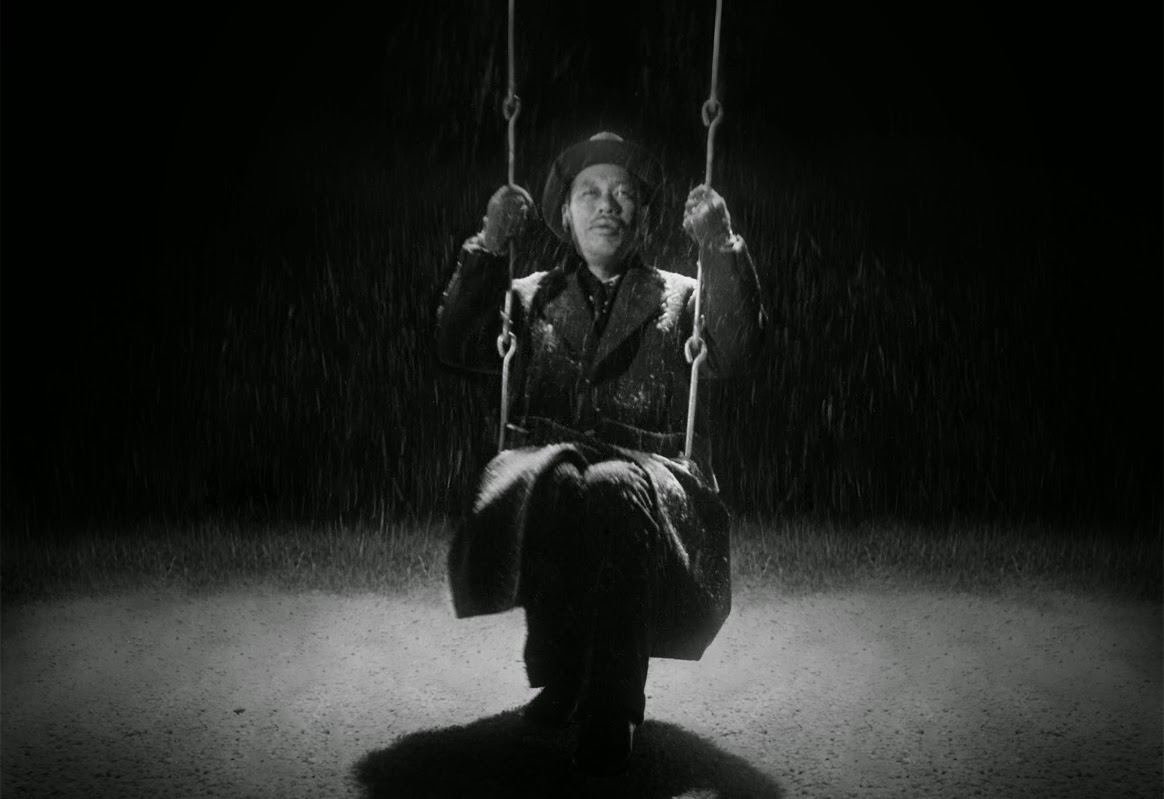
Let me repeat that: if you truly understand what is important in life, then none of the things the rest of society values really matter.

This is a revolutionary message, particularly in conformist Japan, but even here. This is the message that tells us both how to change the world and why to change the world. It is that second part that you never see tackled in films and which so many people will never understand.

Indeed, the fact that many people will never get this is put on display at the ending, when Kanji’s oblivious friends and family and coworkers struggle to put Kanji’s life back into a box that they can understand rather than understanding why he really did what he did... a behavior that many of us will have seen by the oblivious people in our own lives.
It is this scene, by the way, which will fill you with rage, bring you to tears and fill you with joy. I can’t think of any other film that punches this hard emotionally, and yet Kurosawa does so with pure subtlety and without manipulation. There is nothing fake or heavy-handed here. There are none of the tricks Spielberg would use to manipulate you... just great storytelling. In fact, it is an awesome display of storytelling that in such a short film you can come to see Kanji as such a worthwhile character that you feel the slings and arrows of slander and misunderstanding lobbed at him even after he is dead. You will cry when he dies.

It’s amazing writing.

You need to see this film.
[+] Read More...

Wednesday, March 25, 2015

Kurosawa Week: Hidden Fortress (1958)

by Kit

Kurosawa’s The Hidden Fortress, the inspiration for Star Wars, is rarely ranked among his best but compared to most films, especially those released today, it is an astounding action movie. It tells an amazing adventure of a general having to escort a princess from a hidden fortress back to her kingdom with 200 rho of gold needed to rebuild the kingdom —all while evading enemy armies and patrols. However, this story adds a unique twist; telling it from the point-of-view of two greedy and bumbling peasants who are not that likable.

Plot

The movie begins with the two peasants, Tahei and Matashichi, who are wandering, now impoverished after trying and failing to join the Yamana Clan, and now quarreling just over whose fault it is. Their bickering gets so vociferous they decide to part ways. But both are soon captured by the Yamana Clan and forced to dig for the missing gold of the recently defeated Akizuki clan.
After a prison uprising they manage to escape and stumble across some pieces of hidden gold, as well as its owner, Princess Yuki, now wanted by the Yamana Clan, and one of her generals, Makabe (Toshiro Mifune), who are now hiding at a fortress hidden in the mountains.

Soon, however, they have to leave the fortress with the Makabe pretending to be a poor peasant and Princess Yuki pretending to be a mute as they carry the gold hidden in sticks all the way across Yamana Clan to Yuki’s home where she and Matabe can rebuild her clan and continue the war against the Yamana Clan, rescuing one of Yuki’s slave girls in the process.

Why it Works

This is not easy but a lot easier than say, Seven Samurai. But I have noticed a few things.

First, The two comic foils, are introduced with enough time for us to understand who they are and what they will be doing for the next two hours; getting greedy and getting into trouble because of their greed. He also establishes what writing courses call a “need,” they need to stop being so greedy. Kurosawa is smart enough to do this subtly, as, though Makabe and Yuki comment on their greed, he never throws it at us with some character telling them that they “need to stop being greedy because it will get you nowhere” and bla-bla-bla. Thus, announcing to us morons in the audience what is going to happen in the movie.

He also manages to make the dramatic action story interesting by making Yuki and Makabe, two characters who could easily have become bland and boring, interesting and likable. The scenes where they are forced to act as straight men, annoyed by the antics of Tahei and Mataschichi, are funny largely because we get the scene not strictly from the point-of-view of the two peasants (how some might have done it) but from Yuki’s or Makabe’s point-of-view. They are annoyed at these two peasants for causing them trouble on what is a very important task.
And on that point, while the movie, as other films like to do, uses the characters of Yuki, the General, and the slave girl to define the greed and bumbling nature of the peasants, it also uses the peasants to define them. The peasants almost naked sense of self-interest shows the courage and determination of Yuki and the General as well as the loyalty of the slave girl to Yuki. And it does so without announcing it in the BIG BOLD WORDS most movies like to use.

He also makes sure transitions between the comic relief scenes involving the peasants and more serious scenes focusing on Princess Yuki and General Makabe flow seamlessly. We’ve all seen movies like this where you have a group of characters that are clearly comic relief plucked into a drama and the result is you have two separate, very different movies going on. And you feel it.

One example, and it will be strange referencing this in a Kurosawa review, would be Madea’s Family Reunion (see, told ya) where the comedy scenes involving Madea’s antics and the scenes with the domestic abuse plot line sometimes come one after the other creating a jarring affect. It jolts you out of the movie.

Hidden Fortress never does this, instead you never notice the transition from comedy to drama/action, making the movie an enjoyable, rollicking adventure film that will have you laughing and gripped with suspense.
Flaws

I didn’t watch the Criterion version but the Essential Art House version, instead. Now, having watched a fair number of films from the early-1930s I’m kind of used to films where the print has clearly aged so I didn’t notice any flaws there.

But just comparing my Criterion DVD of Seven Samurai with the Art House DVD of Hidden Fortress I am going to make a guess that Criterion does a better job writing the subtitles for their movies than Essential Art House does. Some of the dialogue in the subtitles was, compared to the work done on Seven Samurai, not that good. Or maybe that was just the script, but I do remember seeing a version of Seven Samurai on TCM where the subtitles were also much poorer than the Criterion version so, who knows?

All-in-all, a great movie and one worth checking out.
[+] Read More...

Monday, March 23, 2015

Kurosawa Week: High and Low (1963)

In many ways, High and Low (aka Heaven and Hell) is my favorite Kurosawa film. This film is beautifully acted, raises amazing ethical questions, and provides rather a good bit of suspense. This film is also very accessible as it’s modern in its sensibilities.

Plot

High and Low is the story of Kingo Gondo (Toshiro Mifune), a executive who is making a power play to take over the company for which he works, National Shoes. He is trying to stop the company from shifting to low quality shoes which will cheat consumers and ruin the brand, and he has set up a secret leveraged buyout attempt to take control of the company. To achieve this, he has gambled everything he owns.
As his plan heats up, he receives a phone call. His son Jun has been kidnapped and a massive ransom is demanded. Paying this ransom will destroy the leveraged buyout and wipe out Gondo. Nevertheless, Gondo prepares to pay the ransom because it is his son. Then he sees his son playing in the yard. The ransom call has apparently been a hoax.

Only, it hasn’t. The kidnappers grabbed Shinichi, the son of Gondo’s chauffeur by mistake. Despite this mistake, the kidnappers still demand that Gondo pay the same ransom. What will he do? I’ll save that for you to discover.

Toward the end, by the way, this film becomes a fascinating police procedural which gives you some interesting insight into Japanese culture.

What A Great Film!

This is a fantastic film. And before I say anything else, let me toss out two words that say so very much: Toshiro Mifune. Mifune is, in my opinion, the greatest actor the world has ever produced. He is amazing. He is entirely believable in any role he plays. He has a stunningly noble screen presence, but boils over with emotion just beneath the surface. You feel everything his characters feel as if it were you. He is amazingly physically gifted and he can make complex athletic moves seem as simple as sitting down, yet he can also turn every day motions into intensely meaningful gestures. And he does all of this with a subtle approach that seems impossible.

Mifune plays the lead and watching him is truly a joy. He puts you in this film and makes you feel every single punch the script sends his way. He raises this film to a whole new level.

Apart from Mifune, this film has a strong script. For one thing, none of the film’s characters are the least bit cardboard. Each character has unique traits. Some are smart and competent. Some are incompetent or careless. Some are opportunists, some are devious, and some are helpless. Each character is given a unique motivation. Even the kidnapper’s motive is examined in depth. This makes this a very real world. Moreover, little in this film happens according to the normal order of events in films like this. It zigs at every opportunity. There is no deus ex machina, nor do characters do stupid things just to drive the plot either. It feels real at every turn.
More importantly, however, this is one of the most thoughtful films I’ve ever encountered. Think about the ethical dilemma and how it develops: Gondo is fighting for the life and soul (no pun intended) of the shoe company he loves and has staked all of his assets on it. Unexpectedly, he is confronted with the dilemma of saving his son and losing everything else or losing his son and obtaining everything he wants in his business life. Then suddenly, he learns that it’s not his son who has been kidnapped. But does it matter? Should it? He is the only one who can pay the ransom and if he doesn’t, then the son of his chauffeur will be killed, but can we really put the responsibility on him? Does it matter that he is the reason the man’s son was kidnapped? Does it matter that he was ready to pay to save his son? Is it right or wrong to refuse to save this other man’s son?

When word of this leaks out, his supporters face the dilemma of whether or not to stick with a man who is likely to destroy his own plan and ruin their careers or do they turn to the other side? The police face a series of dilemmas as well about how to respond and how far to go to solve this crime without endangering the boy.
(MAJOR SPOILER ALERT) And finally, when you learn the motive of the kidnappers, you are confronted with some interesting twists. It turns out that the killers were simply jealous of the rich man whose house they could see from their slum, so they decided to take what he had. Socialists would feel a great deal of sympathy for this. But look at what they cause. First, they end up taking the son of a poor working class man by mistake, putting him entirely at the mercy of the charity of the rich man they hate. They even end up making Gondo into a national hero! But even further, they end up stopping Gondo from gaining control of National Shoe, which means that consumers will now be cheated, and shaming the company in the process, which means the company will likely fold soon enough, causing hundreds of workers to end up unemployed. Interesting. Think about the messages here! (End Spoiler Alert)

All of this makes this an amazing film experience, and I won’t ruin it for you by telling you any of the other twists and turns the film takes. This film is intense. It is thought-provoking. It is unpredictable. And driving this film is the amazing acting of Toshiro Mifune, the fantastic script, and the perfect camera work of Akira Kurosawa. I absolutely love this film.

Finally, as an aside, I find the pedigree of this film interesting. It is said to be based on the novel “King’s Ransom” (1959) by Ed McBain. However, it is very, very similar to the Glenn Ford/Donna Reed movie Ransom from 1956 (remade by Mel Gibson in 1996). I suspect that McBain may have copied the Glenn Ford movie and somehow this fact has fallen through the cracks. In any event, I recommend giving the Ford movie a peek after you see High and Low, as it too is excellent.
[+] Read More...

Sunday, March 22, 2015

The Greatest Director You Never Heard Of: Akira Kurosawa

This week is the 105th birthday of Akira Kurosawa, perhaps the greatest film director ever. Famous for films like Seven Samurai, Rashomon and Ran, Kurosawa's innovations became movie staples throughout the world and his films were copied, with the copies often becoming mega-hits in their own rights. This is Kurosawa week around here and we plan to have an article every day. Today, I'm going to talk about a couple famous copies of his films to help explain the tremendous influence he has had on American film. Here are the biggies:

Seven Samurai: The most famous remake of an Akira Kurosawa film is the western The Magnificent Seven, which is a remake of Seven Samurai. In this case, seven expert gunmen agree to defend a helpless village against Mexican Bandido Eli Wallach and his army of pistoleros. Among the seven are such amazing actors as Yul Brynner, Steve McQueen, Charles Bronson, James Coburn and Robert Vaughn. The film was directed by John Sturgess and is arguably the best western ever made. In fact, not only is the film routinely ranked among the best films of all time, but this is the second most shown film on television behind only The Wizard of Oz. And what makes this film so great is the same thing that made the original so compelling, watching a group of tough, loners and drifters decide to stand for something, not for money, but because they want their lives and talent to have meaning for the first time.

Akira's version, by the way, gave us such innovations as the telephoto lens, the use of multiple cameras to capture the same action, and the image of the bad guys riding over the hill to attack. Each of these things had become standard techniques by the time of The Magnificent Seven.

Yojimbo: This one was remade as a A Fistful of Dollars. Directed by Sergio Leone and starring Clint Eastwood as a man with no name who plays two competing crime families off against each other, this was the film that made Eastwood into a superstar. It would then spawn two more collaborations between Eastwood and Leone -- For A Few Dollars More and The Good, The Bad and the Ugly, which would guarantee his movie star status. As with Yojimbo, A Fistful of Dollars involves a drifter, gunfighter anti-hero with no apparent conscience, who is undone by the fact that he does really have a conscience. As with many Kurosawa films, the inability of good people to ignore their consciences is a powerful theme he goes to over and over, and it's a theme that calls to all of us... or should.

This film was later remade again by Bruce Willis and Walter Hill as Last Man Standing, an overlooked gem.

The Hidden Fortress: The story of two squabbling peasants who accompany a defeated General who tries to save a princess from an enemy clan, this film wasn't directly remade so much as it was completely re-imagined as a film staring two robots. What film? Star Wars. Seriously. As an aside, the defeated General in Hidden Fortress is played by Toshiro Mifune, who is an amazingly compelling actor and is perhaps the greatest actor Japan has ever produced. He and Kurosawa worked together several times.

Rashomon: Rashomon was remade by Sydney Lumet for television and then later remade as the film The Outrage, starring Paul Newman, Edward G. Robinson and William Shatner. However, I think the bigger angle is that the concept behind this film has been remade over and over and over. Indeed, what made Rashomon so innovative was the concept itself, which is that the same story is told repeatedly by different characters from different perspectives, with each telling the story slightly differently. This story also involves the use of the unreliable narrator and nonlinear story telling, and is now considered one of the greatest films of all time.


That's an impressive lineage. Anyway, join us this week as we talk about our favorite Kurosawa films. In the meantime, tell us what your favorite Kurosawa films are?

[+] Read More...