Showing posts with label Holidays. Show all posts

Tuesday, December 10, 2013

Toon-arama: How The Grinch Stole Christmas

How The Grinch Stole Christmas is perhaps my favorite Christmas cartoon. What I love about it most is how it has several layers of meaning and those layers become more apparent to you as you grow older. It is, in essence, a cartoon you must see many times over your life to fully understand. Consider some of these ideas:

Good Will Triumph: The first meaning you probably took from The Grinch when you were a kid was that good will triumph over evil. Simple. As a kid, it was obvious that the Grinch was the villain. He's a mean one. He wants to ruin everything for everyone. He's not even nice to his dog! And he tries to ruin everyone's Christmas. But he fails because Christmas is such a powerful force that it melts his evil heart and he actually returns everything he stole. For a child, this is a simple and reassuring message. It is what we want to believe about the universe and, at Christmas, all things are possible.
The Real Meaning of Christmas I (people matter, not things): Over time, as we mature, we start to see another meaning in this story. Rather than simply seeing that good will defeat evil, we start to focus on why good defeated evil. This brings us the next level of meaning. In this instance, we realize that the reason the Grinch lost was because he valued the wrong things. He thought the gifts were what made Christmas so special, and he never realized that what gave Christmas its joy and meaning was the people we love, not the things we exchange. Since he could never take that away, he could never win. Thus, the true meaning of Christmas is that the people in our lives are what matter, not the things in our lives.
The Real Meaning of Christmas II (redemption): As a corollary to our discovery that Christmas is about the relationships of the people in Whoville, and not the gifts they exchange, we also see the Grinch decide to give the gifts back. There are many possible reasons for this, but the one we are told is that the Grinch suddenly felt the Christmas spirit and decided he wanted to make their Christmas brighter.

But if you think about it, there is something strange in this. For one thing, if Christmas isn't really about the gifts, then what does it matter if he gives the gifts back? Indeed, if he couldn't kill Christmas by stealing the gifts, then he can't restore Christmas by giving gifts), ergo his return of the gifts is ultimately a hollow gesture when it comes to the harm he tried to inflict. Hmm. So does this mean the Grinch still doesn't get it? Well, no.

By taking the gifts back, the Grinch is atoning for his sins. He is trying to make right the wrong he has done. But the real atonement isn't in the return of the gifts, it is in doing so publicly. Basically he is submitting himself to their judgment, and in the process is seeking forgiveness. Had he simply left the gifts at the edge of town, he would not have been redeemed. Thus, the meaning of Christmas according to this story is that the Grinch can be redeemed, and if such a villain can be redeemed by atoning for his sins, then so can you. All you have to do is seek forgiveness.

Now we get more complex.
The Real Meaning of Christmas III (forgiveness): There is another lesson here, and it's the one most people have forgotten in the modern age. The people of Whoville must forgive the Grinch to make his redemption possible. If they don't, then he cannot be redeemed. If he cannot be redeemed, not only will he go back to his evil ways, but then there would be no possibility of redemption for any of them. Thus, the most complex lesson is forgiveness. If someone seeks redemption, the right thing to do is to forgive them. This is a lesson that is all but lost in our cynical world, but it's true.
Loyal Max: The loyalty of Max is another interesting message in this story. Yes, Max is a dog and therefore presumptively loyal, but he knows that the Grinch is wrong. You can see it. And what's interesting about his loyalty is that he doesn't sell out or abandon his friend. Instead, he does his best to change the Grinch's mind. The lesson I take from this is actually "love the sinner, hate the sin." If Max had walked away he wouldn't love the sinner. He would have just left the Grinch to his unredeemed ways. If he had turned the Grinch in, he wouldn't have helped either because he would have denied the Grinch the one thing he needed for redemption: a chance to change his mind on his own. So by telling him that he was wrong and letting the Grinch reach the conclusion himself, he gave the Grinch exactly what he needed.

Who's The Grinch: Finally, there's one last lesson, which is probably the hardest for most people to see -- what made the Grinch into the Grinch and set him off on his life of crime was his intolerance for the happiness of others. The Whos never did anything wrong to him, but he came to hate them. And the reason he hated them was that they had something he did not, they had happiness. What's more, they found their happiness in something he did not understand. This is the same impulse that gets people complaining about "those kids today." If the Grinch had focused on his own happiness and had been happy for the Whos that they had found happiness, rather than being upset that others found happiness in things he did not and trying to bring down their happiness, then he never would have woken up one day to find that he was alone and in desperate need of redemption.

That's an awful lot of layers to stick into a cartoon, but it's all there.

Thoughts?
[+] Read More...

Wednesday, December 4, 2013

Hollywood And Holidays

We’ve touched upon this a couple times in the past: Hollywood doesn’t do the holidays well. That’s kind of fascinating if you think about it, since the holidays seem like they are ready-made for storytelling. Not only are they well defined, they are a common experience, and they have their own emotional base. That should make for a heck of a fertile ground for stories. So what’s wrong?

Here are some possible answers. I suspect they are all in play to a degree, though some less than others.

Hollywood Is Out of Touch: This is a pretty standard talk radio conservative line. The argument is that Hollywood is run by who-knows-what, and they hate us and our traditions. The problems with this are obvious, however. (1) Hollywood isn’t actually “run” by anyone. Hollywood is whoever has the money to produce films. So any theory that relies on a monolithic Hollywood misunderstands the structure. (2) This doesn’t explain why old Hollywood didn’t do any better. So while some people may be like this, this theory simply doesn't make sense to explain the issue.

Stories Need Angst: This argument goes that audiences don’t want to see films that are puppies and unicorns, so if you do a holiday fail, it generally needs to be darker. This is why you get stories like Planes, Trains and Automobiles and Jingle All The Way, which are about the negative side of the holiday experience. But negative doesn't sell during the holidays. So few holiday films are made.

I disagree with the angst argument. Good stories need conflict of some sort, i.e. something that the hero must accomplish despite challenges, but those conflicts don’t need to be negative, nor do they need to be presented negatively. One of the things that makes The Wizard of Oz so engaging, for example, is that while Dorothy must overcome various evil hurdles, Dorothy is relentlessly positive and all the other characters feed off her strength. So I don’t accept that this angst argument is true. That said, however, I do firmly believe that a lot of people believe the angst argument, so I can see this motivating Hollywood to avoid more positive holiday portrayals.

It’s All Been Done Before... By Icons: Hollywood isn’t really concerned about originally, far from it. But every once in a while, an iconic film comes along and you can’t make anything remotely like it without people calling it a rip-off. An example of this would be Star Wars. No one has tried to copy the elements of Star Wars because they know people will be upset. In fact, the first real copy I can think of was Eragon, which was written 35 years later and even then was panned for being “Star Wars with dragons.”

When you look at the stories that dominate the holidays, you see a couple iconic stories that really do eat up large parts of the holidays. Foremost among those, you have the claymation Rudolph the Red Nosed Reindeer, which completely dominates the story of Santa, and you have A Christmas Carol, which completely dominates the idea of repentance which comes with Christmas. What does that leave really? Rudolph encapsulates the “story” of the holiday (apart from the religious aspect) and Christmas Carol dominates the emotional aspect. Between them, that's everything that has meaning about the holiday, and any story you write that touches upon either of those will be seen as little more than a knock-off (the religious aspect is covered by the Nativity Story). That leaves only pieces at the edges, like the shopping experience (Jingle All the Way), and parodies like Bad Santa (parody of A Christmas Carol) or Elf (parody of Rudolph). Indeed, ask yourself what Christmas tale you could tell that doesn’t feel like you are borrowing heavily from one of these icons.

I think there is a lot to this. Anyone doing a Christmas movie will find that the more they strive to include an emotional impact, the more they are accused of copying. That creates a pretty strong incentive to make something else... or just to do a remake of A Christmas Carol.

Fantasy Won’t Do: Finally, we come to the reason that I think really keeps Hollywood out of the holiday business. Hollywood is about fantasy. They get rich by selling us dreams, stories we would love to witness but which will never happen in our lives. In effect, they are selling “The Vicarious Experience.” But you can’t do that with the holidays because we’ve all lived it.

Think about it this way. When you watch a sport movie, you get to imagine yourself as the sports star you never were who overcomes incredible odds to win the game on the last play in an amazing manner. When you watch action films, you get to dispense justice against criminals and terrorists you can’t touch in real life. When you watch a romance, you are the suave lover with all the right words who makes all the right decisions and in the end wins true love with the ideal mate – people who don’t fart or burp or forget to shower or get drunk watching a ballgame, people who only care about you every waking moment. You love these things because for that brief moment in that film, you get to experience something real life will never give you.

But what do you get out of a holiday film? You get a sense of being with people you love. Got that. You get a sense of happiness as people give you presents. Got that too. The holiday spirit. Ditto. You get a chance to fix relationships that aren’t always grand throughout the year. Yep, got that too. See the problem? There is nothing a film about Christmas can provide you that you can’t already feel yourself. People don't see films that offer them nothing they don't already have. And all this really leaves, again is parodies, like Christmas Vacation or Jingle All the Way, which poke fun at what you've experienced, or the retelling of classic stories. But those things don't sell all that all. So again, it's better to avoid the issue and make a different movie.

Thoughts?
[+] Read More...

Tuesday, November 26, 2013

Toon-arama Thanksgiving Special: A Charlie Brown Thanksgiving

by tryanmax

“We've got another holiday to worry about. It seems Thanksgiving Day is upon us.”

So says Charlie Brown near the beginning of his Thanksgiving special, and it pretty well sets the tone for the show as Charlie tries to cope with the demands of the holiday wedged neatly between Halloween and Christmas. I think it’s fair to say that, of all the holidays we celebrate, Thanksgiving is regarded as more of an ordeal than any others. A quick mental inventory of every Thanksgiving movie or special I’ve seen seems to confirm this. So while the Peanuts gang may be a cynical bunch, it seems to fit with the general outlook regarding this holiday.

Charlie Brown’s ordeal is this: Peppermint Patty has invited herself over for Thanksgiving dinner along with her friends Marcie and Franklin. The trouble is, Charlie already has plans to visit his grandmother for dinner, and he can’t cook. Linus suggests having a separate dinner beforehand. Enlisting the help of Snoopy and Woodstock, they prepare a feast of buttered toast, popcorn, pretzels and jelly beans. Patty is not impressed and demands to know where the turkey and mashed potatoes are. Charlie Brown is thoroughly humiliated. Marcie takes Patty aside to remind her of the reason for Thanksgiving, giving thanks. Patty apologizes to Chuck and, with amends having been made, Charlie calls his grandmother to explain he will be late and she invites the whole gang over. They pile into the back of the station wagon, singing “Over the river and through the woods,” despite Charlie’s misgivings that his grandmother lives in a condominium.
True to form for a typical Peanuts special, original strips do the work of storyboards and are strung together to form a loose narrative. Even if you don’t remember the original strips, the regular pattern of set up and punch line makes it pretty clear what’s going on. The Thanksgiving special is a close echo of the Christmas special that preceded it by a number of years. Linus’ table grace might not have the same impact as his nativity soliloquy, and Marcie tag-teams on driving the moral of the story home, but all the parts are there. It’s a neatly packaged, simple story leaving little to discuss.

What makes A Charlie Brown Thanksgiving worth talking about, honestly, is the filler. Of all the Peanuts specials, this is likely the most puffed up. Not only are there the usual gags we expect to see, like Lucy and the football and Sally flirting with Linus, but there is a ton of time devoted to Snoopy and Woodstock’s high jinks. Really, this is the story of how Charlie Brown’s dog single handedly prepares a Thanksgiving meal, sort of.
In a series of sequences that would normally be skimmed over via montage in almost any other show, we actually watch Snoopy go through all the steps of preparing his feast. We start with him digging through the garage for a table, only to get sidetracked by basketball, ping-pong, and literally wrestling with a lawn chair. The Vince Guaraldi tune “Little Birdie” which plays over this sequence, is still one of my favorite jazz tracks.

Then, Snoopy is off to the kitchen. I remember as a kid being fascinated by this scene for the various styles of toasters. Later, a remarkably inordinate amount of time is devoted to Snoopy plating up each of the guests. And, in a final gag, as Charlie Brown and the others head toward grandma’s, Snoopy and Woodstock return to the doghouse to feast on the turkey and pumpkin pie that Snoopy had been holding back from the rest of the gang. Thanks to Snoopy’s dominance, this Peanuts holiday special feels a lot more “cartoony” than many of the others.

What do you think? Is A Charlie Brown Thanksgiving just a nice story? Or did I miss something? Did I leave out any of your favorite bits? And while you’re at it, tell me some of your Thanksgiving horror stories.
[+] Read More...

Thursday, October 31, 2013

Halloween Special: The Great Pumpkin

It’s time for a little sacrilege. I have a like-hate relationship with Peanuts. Like most people, I have fond memories of the images created by Charles Schulz, such as Snoopy fighting the Red Baron. And I fondly remember the holiday specials as being part of my childhood. But at the same time, there is much to dislike about Peanuts. The kids are cruel, the humor is sparse, and the whole thing has the cynical defeatist quality that crept into so much produced in the late 1960s and early 1970s. “It’s the Great Pumpkin, Charlie Brown” falls into that.

“It’s the Great Pumpkin, Charlie Brown,” is the Peanuts Halloween holiday special. The story begins with Linus van Pelt writing his annual letter to the Great Pumpkin. According to Linus, the Great Pumpkin is a bit like Santa Claus who “will rise out of the pumpkin patch that is most sincere. He flies through the air and brings toys to all the children of the world.”

For having this belief, Linus is ridiculed. Charlie Brown disbelieves him, though he isn’t rude enough to make fun of him (until the end, when he essentially calls him stupid). Snoopy, however, laughs. Patty condescendingly assures us that the Pumpkin is fake. Lucy threatens Linus with violence if he doesn’t stop talking about the Pumpkin and then refuses to help him mail his letter. Linus eventually convinces Sally to stay with him in the pumpkin patch because she’s stupid and is easily influenced by her attraction to Linus. She will eventually abandon and angrily denounce him when he mistakes Snoopy for the Great Pumpkin and gets her hopes up.
Of course, nothing happens because Linus is wrong.

Nice.

So the Peanuts kids are assholes. They show nothing but contempt for their friend and his beliefs. In fact, Lucy even threatens to violently suppress his beliefs. Sally is shown to be shallow and stupid and ultimate hypocritical. Even Charlie Brown, who is himself constantly ridiculed by others, fails to support his friend. These are horrible characters and a horrible lesson to teach kids.

Moreover, the fact that the Pumpkin never does show up essentially makes Linus’ vigil a joke. Some have said this is a parody of Evangelical Christianity, though Schulz denies it. I can see that, though I personally see it more as a cynical adult mocking children who uncritically believe in Santa, particularly with the specific mention of the Great Pumpkin being drawn by “sincerity” and by the rest of the story being just as cynical.

Indeed, while Linus is engaged in his quest, the other kids go trick-or-treating. They receive an assortment of goodies, except for Charlie Brown, who somehow gets nothing but rocks. The reason, it is implied, is because Charlie Brown’s ghost costume is poorly done. What is the message of this? It’s either the cynical message that life simply craps on some people and, no matter what you do, you will fail if you are one of these people – a great thing to tell kids. Alternatively, this reeks of some sort of quasi-socialist message about the horrible way the poor are treated compared to everyone else.
The kids then go to Violet’s Halloween party. When Lucy hears that Charlie Brown has been invited, she informs him that this must have been a mistake:
“Charlie Brown, if you got an invitation, it was a mistake. There were two lists, Charlie Brown: one to invite, and one not to invite. You must have been put on the wrong list.”
Again, this is pointless cruelty as there is no lesson that comes from this. Violet doesn’t admit her mistake and end up thankful that Charlie Brown arrived. The other kids don’t mention their outrage at the exclusion of their friend. Essentially, this is just more of the same message that you will be excluded if you are unpopular and that’s ok with everyone else... tough luck kid.

This is what bothers me about the whole Charlie Brown empire. Snoopy is drawn quite cutely and he merchandizes well, but the stories and characters themselves are cruel, unpleasant and uncaring. For the handful of good lessons, such as at the end of the Christmas special, there are dozens of nasty, discouraging messages.

In fact, one of the tests to really see what is going on in a cartoon is to substitute adults into the roles to remove the “cute factor” and then to ask yourself how the show would be perceived. If you put adults into these roles, I think people would at best view this as a dark comedy, but would more likely simply dismiss it as a cruel, unfunny, offensive film like The Invention of Lying.
[+] Read More...

Friday, December 21, 2012

A Very Linky Christmas

Today we begin our Christmas Break... time to impersonate Santa. Look for big changes when we get paroled starting January 2. We'll be adding a regular Thursday post to discuss Bond... James Bond (and rank the films). We'll be mixing up the questionable articles on Tuesdays for greater variety. Scott will examine some disaster films and defend a film many consider a disaster. Naturally, we'll continue with the Toon-arama series and the Sunday Debates and the Friday reviews and watch for an interesting change in the link articles. So be sure to tune in! Meanwhile, to keep you busy over the holidays, here are some links from Scott.

A shot-by-shot analysis of the latest Star Trek teaser

You can find a link to the teaser in the opening paragraph. In short, I'm excited. However, it would be nice to see a new Star Trek film that didn't feature a megalomaniacal villain out to destroy Earth. We've had that twice in a row, plus it's pretty much the plot in every other superhero movie that's out there now. And if the villain does indeed turn out to be Khan, then color me disappointed. Why bother rebooting the franchise if you're just going to re-use old characters? Having said that, I'm sure this will be a lot of fun, and the effects wizards at ILM seem to have outdone themselves once again. But this all brings me to...

Are all franchise films essentially the same now?

It's hard to argue with this: "In the first Star Trek episode ever, “The Cage” a race of aliens called the Talosians is introduced. These guys got so into creating illusions with their minds that they forgot how the technology of their ancestors even worked. They forgot how to be original and grew bored and warped and immoral. Are the big-franchise filmmakers of today like the Talosians? Giant pulsing brains who’ve created the same illusion over and over, reusing the same formulas so often that they have forgotten how to be creative? How to take a risk?" Also, the author's comment on Tim Burton's Batman is spot on!

A look at the 2012 Black List

No, not that Black List. This list is the annual list of the best unproduced screenplays in Hollywood, though a few of them are currently in some phase of development. I've perused the loglines and, while some of the films are your standard TV-movie "Guy/girl returns home to reconcile with family" routines, there are some really cool stories here. My favorites are, without a doubt, Seuss, Wunderkind, If They Move... Kill 'Em!, Man of Tomorrow, Untitled Cops Script, and Hibernation.

Geek culture has gone mainstream but at what cost?

A TV writer recently compared nerds who like The Bang Bang Theory to black people who like Amos 'n' Andy. Okay, so all things geek are now mainstream but has this damaged the "geek" label, or is it much ado about nothing? After all, history has shown that once something becomes popular, it often gets diluted. And our 24/7 media-saturated culture hasn't helped: "Armed with Wikipedia and an Idiots or annotated guide to just about everything, the average citizen can, in minutes, discover the tantalizing bits of canonical knowledge it once took years to accumulate - years in which some of us clung to our semi-secret predilections for fantasy or science fiction, playing Dungeon and Dragons instead of dodgeball."

With 35mm film dead, will classic movies ever look the same?

This could turn out to be a big problem. A.) companies that deal with film - suppliers, labs, etc. - are shutting down, B.) while (most) classic films will always get much-needed restorations, what about that B-western no one but your father remembers?, and C.) people now expect older films to look like new ones which is why too many Blu-Rays technicians pump up the color and try to get rid of the grain, usually with awful results. There are plenty of folks in Hollywood who value the industry's legacy but that and five cents will get you a cup of coffee and at the end of the day, it's about the bottom line and demographics. Or maybe I'm just a pessimist. [smile]

The terribly true story behind the Super Mario Bros. movie

I remember seeing this in the theater. I was a Mario-loving 10-year old and I enjoyed the movie (for what it was). Looking back on it almost 20 years later, I'm literally ashamed of myself! Bob Hoskins and John Leguizamo have both said how much they hated making the movie and it seems no one knew how to adapt a video game, because it had never been done before. The problem with video game movies is that watching one is like watching your sibling play a video game - you don't want to watch, you want to play! And for some reason, they changed the locale from the Mushroom Kingdom to a Blade Runner-esque alternate universe Manhattan. The film has developed a cult audience (size: unknown) and after reading this article, I kinda want to see it again.

Searching for the real movie Lincoln

"Sources agree that Abraham Lincoln is the president most often represented on film, though an exact count of portrayals is difficult to determine. The editors at Guinness list 136 featured roles in films in The Guinness Book of Movie Facts and Feats, but that doesn’t include television and shorts. The Movie List Book estimates over 150 films, but that reference was published in 1990. Internet sources such as Suite 101 and Great History.com weigh in at over 200 film portrayals, though I fear they inflate in order to push their point that Lincoln is our most iconic president. The popularity of Steven Spielberg’s Lincoln with Daniel Day-Lewis’s magnetic interpretation of the 16th president has inspired bloggers to recount the portrayals and mine them for best performances, historical accuracy, and bizarre depictions."

Celebrating 50 years of James Bond title design

As a preamble to our new James Bond series in 2013, I've included this piece which takes a look at each and every Bond title sequence, featuring work by Maurice Binder, Robert Brownjohn, Daniel Kleinman, and the studio MK12. "As with the films themselves, most Bond titles draw from a self-governed set of themes, but they are also liberal in their application of them. Female forms, stylized violence, implied danger, guns, imaginative photography, motion graphics, and academic typography are paired with a billboard anthem and presented through the thematic lens of the film itself - as in the underwater ballad of the Thunderball titles or the cosmic backdrops of Moonraker."

Last night's listening:

There's a good chance that if it's mentioned on this list, I was listening to it! (My last purchase included the second, third, and fourth items in the La-La Land Records category.)

Merry Christmas and Happy Hanukkah everyone!
[+] Read More...

Wednesday, December 19, 2012

A Toon-arama Christmas

by tryanmax
Christmas time is a season of traditions. Some are very old like decorating trees and exchanging presents. And there are some traditions that have come more recently. Clearly one of my favorite traditions of the modern age is the annual lineup of animated Christmas specials that fill up the primetime TV schedule like a stocking stuffed with trinkets. Most of the classics have been around since before I was born. I can’t imagine a world without A Charlie Brown Christmas, Mickey’s Christmas Carol, the Grinch, “The Chipmunk Song,” or any of the dozens of Rankin-Bass Productions.

Along with the classics, the networks throw some new stuff our way each year. Most of these don’t have much staying power. The He-Man & She-Ra Christmas Special just doesn’t jingle many bells these days. But every now and then, something new comes along that manages to capture the Christmas spirit in a way that earns it a spot on the nice list for years to come. It may be too soon to tell, but I’d like to share with you a couple of more recent Christmas specials that just might make the cut.
Shrek the Halls (DreamWorks, 2007)

If you don’t know the lovably uncouth ogre named Shrek by now, you’re probably living deeper in the swamp than he is. And while he and his interminable series of films are not for everyone he appears to have left a mark on the culture at least for a generation. As for me, I actually enjoy watching the grumpy green giant anachronistically deconstruct beloved children’s tales in his antisocial way. But, surprisingly, Shrek doesn’t give Santa Claus for a sardonic makeover—at least not directly—and that’s a good thing.

The limited action of the special focuses on Shrek trying to prepare the “perfect” Christmas for his wife Fiona and their infant triplets. The problem is, being an ogre, Shrek has never celebrated Christmas before. So the fairytale characters encountered in the films offer to help out, much to Shrek’s chagrin. This leads to lots of gags related to the characters’ stories and conflicts between their different personalities, including plenty of slapstick.

Amid the chaos, Shrek attempts to read “A Visit from St. Nicholas (The Night Before Christmas)” but is interrupted by Donkey, Gingy, and Puss in Boots who each have their own version of the tale rife with hilarious idiosyncrasies—but I leave those for your viewing pleasure.

Eventually Shrek grows impatient with all the commotion and orders everybody out in a fit of anger. Naturally, Fiona and Shrek talk it out and Shrek apologizes to everyone in a scene that isn’t nearly as schmaltzy as it could have been. Finally, Shrek gets the chance to tell his version of the story, not about Santa, but of Ogre Claus.

This Christmas special hits a lot of the right notes. For starters, it’s just fun. I think the producers did a very smart thing by keeping it simple rather than setting Shrek off on an epic Christmas Quest. (Though there is a hint of that as Shrek quickly treks to Far Far Away to pick up a copy of Christmas for Village Idiots.) Much of what made the Shrek films so popular is the social awkwardness of the main character, so a Christmas gathering provides more than ample fodder on its own.

Also, good parody has inherent longevity, especially when the source is long-lived as well. The alternate takes on “A Visit from St. Nicholas” are highly imaginative, memorable, and comprise the bulk of the special. More importantly, one does not need to be very familiar with the Shrek franchise to get the humor. The stories that Puss and Gingy tell are simply from the perspectives of a cat and a cookie, respectively, and one only need know that Donkey is a goofball to understand his oddball rendition.

Marks against Shrek the Halls are few, but those who don’t enjoy gross-out humor simply do not enjoy it. This is not for them. I have a hard time imagining anyone being offended by this special otherwise—the most irreverent gag is a choir singing “Waffle Santa” to the tune of the Hallelujah Chorus. Finally, deconstructing classics is a bit of a fad right now. As such, Shrek is at risk of simply fading away. However, his films and Christmas special may be enduring enough to be a perennial reminder of this time rather than a relic of it. We’ll see…
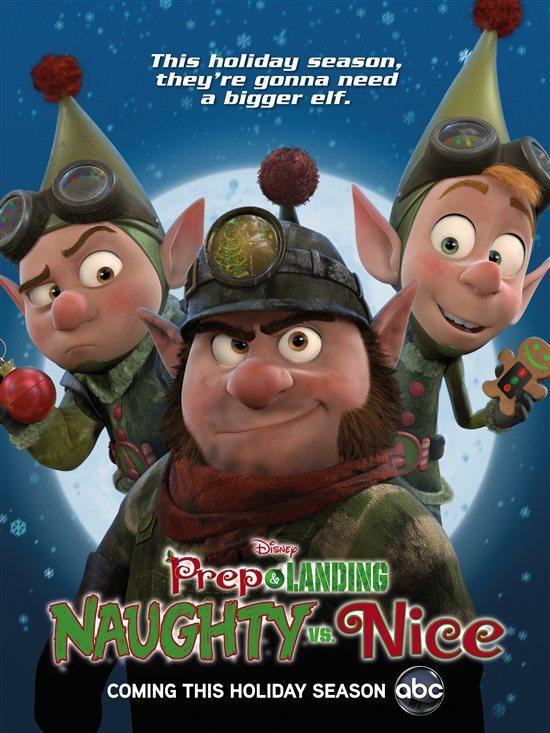
Prep & Landing/Prep & Landing: Naughty vs. Nice (Disney, 2009/2011)

Where Shrek keeps it simple, Prep & Landing goes in the other direction by adding a brand new element to the Christmas mythos that is stylish and hi-tech. Normally I would say that is a recipe for dating a program and making sure it slips right away, but not in this case. I’ll elaborate in a bit.

The story follows Wayne and Lanny, a pair of Christmas elves who are part of an elite squad known as “Prep & Landing.” They are basically Santa’s advance team whose job it is to ensure that the children are snug in their beds and not a creature is stirring before the big guy arrives. To accomplish this task, they are equipped with loads of high-tech gear (cleverly disguised as Christmas novelties), direct two-way communication with the North Pole and a dictionary of holiday-themed code words.

But all is not well with the P&L crew. Wayne is disgruntled at having been passed over for a promotion after 227 years of faithful service and has become disenchanted with the job. As such, he is less than a perfect mentor to the rookie, Lanny. Wayne slacks off, leaving the inexperienced Lanny to do all the work. It’s a disaster. So much so that it looks like Santa will have to cancel the landing, something never done before. Of course, the dire prospect causes Wayne to pull himself together and save the landing, Mission Impossible style!
The sequel, Naughty vs. Nice, introduces the “Coal Elf Brigade,” the rehabilitation arm of Santa’s gift program. Their job—you guessed it—is to deliver coal to the children on the Naughty List…along with encouraging notes such as, “Try Harder Next Year.” In this episode, Wayne and Lanny are called upon to perform a special mission: to recover classified North Pole technology that has fallen into the hands of an unknown hacker. For this mission, the pair have been assigned to work with the foremost expert on naughty children from the Brigade, Wayne’s younger (but bigger) brother Noel.

The hacker, a girl by the name of Grace Goodwin, is intent on removing herself from the naughty list, believing herself framed by her little brother. Their sibling rivalry parallels similar tensions that persist between Wayne and Noel. When Grace hacks into the “Fruit Cake” (a sort-of elfin iPhone) the device malfunctions threatening to put the whole world on the Naughty List. Wayne and Noel must resolve their issues and work together to execute a risky operation which will save Christmas.

As cheesy and predictable as both of these storylines sound, they actually work pretty well in context. This is because they present appropriately high stakes without ever getting too serious about it. Of course we never really doubt that Christmas will be saved in the end, either.

While the stories are solid enough for 20+ minute specials, the real entertainment comes from exploring this previously unseen aspect of the Santa story. As I said before, throwing hi-tech at the Santa myth has usually been a disservice to the story. That’s because in most cases, it gets shoehorned in as Santa receives a mid-movie makeover and it serves more as a punch line than a plot point. But in Prep & Landing the tech is integral to the story from the very beginning. It is, in fact, what makes events seem plausible.

Furthermore, the tech doesn’t strike me as the sort that will become dated in any bad way. Rather, it is more like the tech seen in Bond movies or, perhaps more similarly, The Incredibles. Little of it is realistic in the first place, but it bears a rough similarity to tech we know and understand. Plus, much of the humor takes place at the North Pole Christmas Eve Command Center, which is a healthy mix of Christmas puns and timeless office humor.

If I had to give one more reason why I think Prep & Landing will stick around, it’s because it has the Disney marketing machine behind it, which will certainly help, but in this case it’s a good product worth promoting.

What about you, have you seen any recent Christmas specials that you think will stick around for years to come? What about your favorite forgotten specials that have gone away? And feel free to discuss the perennial favorites like those I mentioned at the beginning, too. Merry Christmas!
[+] Read More...

Wednesday, December 12, 2012

Guest Review: Die Hard 2 (1990)

By ScottDS
Most sequels aren’t as good as the originals and that holds true here. While Die Hard 2 isn’t nearly as good as its predecessor, I’ve always been a fan. It’s wonderfully entertaining in its own right, even if it personifies the “Make it bigger!” ethos that has permeated genre filmmaking ever since.

John McClane (Bruce Willis) is at Dulles Airport waiting for his wife’s plane to land when the airport is taken over by terrorists led by Colonel Stuart (William Sadler), formerly a U.S. Special Forces operative. He and his men hack into the air traffic control system in order to intercept General Ramon Esperanza (Franco Nero), former dictator of Val Verde, who is being extradited to the U.S. on drug trafficking charges. McClane gets involved after spotting two of Stuart’s men acting suspiciously. None of the airport authorities believe him at first but once again, McClane manages to save the day and his wife.
This film has one of the greatest teaser trailers of all time, in which McClane wonders how the same thing can happen to the same guy twice. Indeed, you’ll be asking yourself the same question during this film. McClane just happens to be in the wrong place at the wrong time. Holly (Bedelia again) just happens to be on one of the planes, all of which are running low on fuel as they circle the airport. Even reporter Dick Thornburg (Atherton again) just happens to be on Holly’s plane! But I’d be lying if I said this film wasn’t genuinely entertaining. It literally has more of everything: more gunplay, more chases, more violence (including a cringe-inducing death by stalactite), more explosions… you get the idea. On the other hand, it doesn’t have the same sense of style that makes the first film so distinctive. Like the first one, this film is also based on a novel, 58 Minutes by Walter Wager, though I couldn’t say how faithful it is to the text.

With John McTiernan busy hunting for Red October, the directing baton was passed to Renny Harlin, a Finnish filmmaker best known at the time for A Nightmare on Elm Street 4 and The Adventures of Ford Fairlane (which was released one week after this film, with Harlin having edited both simultaneously). I’ve always defended Harlin, even though his career never quite recovered after the one-two punch of Cutthroat Island and The Long Kiss Goodnight (the latter is actually pretty good; the former not so much). The man knows how to stage an action scene though he admits in his DVD commentary that he’d never make the film the same way today. He’s genuinely surprised by the amount of profanity and blood in the film, which perhaps proves that we soften a bit as we get older (I’m looking at you, Spielberg!).
Like in the first film, geography and spatial relationships are all well-established and I have to say I’m thankful these films were made before the era of shaky-cam and ADD-riddled editing. Many of the clichés we complain about today appeared in this film (and the first one) when they were still relatively new: I’m referring to elements like smoke and steam, industrial fans, blue and orange lighting, hanging from catwalks, etc. It’s hard to believe there was a time when the action genre wasn’t replete with these things. Volumes have been written about this but many believe it’s mainly due to the influence of television and the influx of music video directors. Video killed the radio star but MTV may have just killed the coherent action sequence!

Willis is in his element as McClane, though I sympathize with the criticism that he comes off as too “movie star” with a few too many well-placed one-liners this time around. William Sadler is Col. Stuart and while he’s a great actor, he isn’t given much to work with. He’s quite sadistic and in fact, the most controversial scene in any of these films is when he decides to crash a passenger jetliner with over 200 innocent people on board. (This scene went on much longer in the rough cut – thank God the studio put the kibosh on that.) Stewart’s henchmen are all drones and, unlike the first film, they don’t have any distinctive personalities. One of them is played by Robert Patrick, just a year before his breakout role in Terminator 2. Another is played by John Leguizamo, but the filmmakers didn’t use him as much as they wanted due to his height (or lack thereof).

Dennis Franz chews the scenery as Captain Carmine Lorenzo, head of Dulles’ police force. He has no love for McClane, despite “that Nakatomi thing.” And oddly, he comes off as more of a New York cop caricature even though they’re in DC! Fred Dalton Thompson plays Trudeau, head of airport operations. He has the perfect air of authority and makes everything (almost!) believable. Art Evans plays Dulles’ engineer Barnes, and for some odd reason, I love that his first name is Leslie. I can’t explain it. [smile]
The supporting cast is rounded out by Sheila McCarthy as a reporter who actually does some good; Robert Costanzo as Sgt. Vito Lorenzo (Carmine’s brother!) who has McClane’s car towed away in the opening; Tom Bower as an eccentric janitor who helps McClane when no one else will; and John Amos as Major Grant, head of a Special Forces team sent to take back the airport… except it turns out they’re on the same side as the bad guys! Seriously, this film has more twists than an M. Night Shyamalan film, though this particular reveal is pretty cool. McClane discovers that Grant’s men are using blanks and then demonstrates this to great effect by “shooting” Captain Lorenzo.

However, this all brings to mind a common complaint: by putting McClane in a larger area (an airport and its environs), the film is less effective. The first film was successful in large part due to its use of confined space, but this film throws that out the window. McClane can go anywhere he wants – he isn’t confined. On the other hand, maybe we're too quick to judge. This was only the second film. There had only been one film previously so who was to say what worked? Sometimes I think franchises need two films to work out all the kinks… but if that were the case, then every third film in a franchise would be great, and that obviously doesn’t happen all the time! Also, I think it might've been a mistake to make the plot "international" with talk of dictators, foreign countries, etc. I think these films work better on a "local" level, so to speak.

On a technical level, this film is very good, but there are some noticeable flaws. It takes place at Dulles, yet there’s a conspicuous Pacific Bell logo. Harlin may not have been familiar with the intricacies of the Bell system but someone should’ve pointed this out to him! The visual effects – this time by ILM – are fine though the famous shot of McClane in an ejector seat wasn’t done very well, but it’s so over the top that I can forgive it. The pre-CGI airplane effects are state of the art for their day, with models being crashed onto a small airstrip covered with fake snow. The final shot – a wide vista of the airport with crowds, planes, vehicles, etc. – was one of the first digital matte paintings in a motion picture. Michael Kamen’s score is, like the film, bigger and bolder. This time, instead of Beethoven’s 9th, it’s Jean Sibelius’ “Finlandia.”
By the way, it’s probably best not to analyze this film’s portrayal of airport operations – no film can be 100% authentic but if the actors look like they know what they’re doing, then we believe them. On the other hand, Stuart’s team cuts off communications but the planes could’ve easily communicated with other airports! The climax involves an exciting fight on the wing of a plane between Grant and McClane, and then Stuart and McClane, and is topped off by a ridiculous gag in which McClane lights a trail of leaking jet fuel on fire that manages to make the bad guys’ plane explode from several feet away! To be fair, if the film were made today, this sequence would be in the first five minutes!

Die Hard 2, while not as artistically successful as its predecessor, is just a lot of fun. It’s a bit muddled at times and McClane manages to get himself involved with people who really have no reason to talk to him, but it works. I know it sounds like damning with faint praise but this is one of the great “If it’s on TV, I need to watch it” movies.

“This is my mother-in-law’s car. She's already mad at me because I'm not a dentist!”

P.S. For a good laugh, check out this montage of TV-friendly edits. Holy [crap]!

P.P.S. Reviews of the third and fourth films will be coming in 2013!
[+] Read More...

Wednesday, December 5, 2012

Guest Review: Die Hard (1988)

By ScottDS
I spend Chanukah with my family but I spend Christmas with John McClane. What more could possibly be said about Die Hard? It’s a modern action classic – my generation’s equivalent of a John Wayne movie. To the best of my knowledge, it does everything perfectly, so much so that it spawned an entire subgenre: “Die Hard on a [blank].”

NYPD detective John McClane (Bruce Willis) arrives in LA to reconcile with his wife Holly (Bonnie Bedelia) who works for the Nakatomi Corproation. The building is soon seized by a group of terrorists led by Hans Gruber (Alan Rickman in his American film debut). In a twist, it turns out that they’re nothing more than simple bank robbers who are after the $640 million in negotiable bearer bonds in the company vault. McClane – who had been in the bathroom during the initial melee – is left up to his own devices to save the day. He’s assisted on the outside by LAPD Sgt. Powell and is encumbered by several others, including a deputy police chief in over his head, a couple of cowboy FBI agents, and an overzealous reporter. Ultimately, McClane manages to rescue his wife and save the day, killing Gruber by dropping him off the building.
With the exception of some hairstyles and a couple effects shots, this film has aged remarkably well. It’s based on the novel Nothing Lasts Forever by Roderick Thorpe, which tells the story of a cop named Joe Leland who visits his daughter who works for an oil company which is soon taken over by a German terrorist group. Director John McTiernan – who has since run into some unfortunate legal problems but managed to give his A-game here – wanted to give the film a sense of “joy” which is why the terrorists in this film are merely bank robbers. In his view, terrorism isn’t fun and movies about terrorism (at least back then) were more often than not dreary and needlessly violent affairs. But with bank robbers, the audience could sit back and enjoy the film without feeling bad. After all, people love a good caper and there is comic relief to be had among the villains. Also – and this is something I’ve said before – with terrorism, you’re often forced to go political. McTiernan had no interest in the characters’ ideology; he simply wanted to craft a great piece of summer entertainment.

I feel bad for young people who watch it for the first time, having been exposed since childhood to all the clichés pioneered by the filmmakers. The craftsmanship is top-notch and European cinematographer Jan de Bont (who would later direct Speed and Twister) gives the film a wonderful sense of style. Geography and spatial relationships are clearly established and the camerawork actually helps to create a psychological reaction: the camera closes in on Willis at just the right time (usually when it appears he’s doomed), the exteriors actually feel more cramped than the interiors thanks to the use of long lenses (which compress the foreground and background), and there’s a great use of triangular composition, with the camera for instance starting on a henchman, then moving to the henchman’s gun, then to McClane in another area of the shot. We understand everything in one shot with no dialogue. That’s direction.
At that point in his career, Bruce Willis was best known for ABC’s Moonlighting. He’s perfect as John McClane who, at the time, was a new kind of hero. He was a blue-collar working stiff as opposed to a muscle-bound superman like Arnold or Sly. His relationship to his wife is what grounds the movie and according to McTiernan, they finally managed to get a handle on the character when they realized that McClane doesn’t really like himself very much… but like all of us, he does the best he can. He’s an underdog and people love to root for an underdog. Everything you need to know about him can be summed up in one shot. The company has sent a limo to pick him up at LAX. He meets his driver, Argyle (De'voreaux White), and decides to sit in the front with him instead of the back – a genuinely human moment. I’m not familiar with much of her work but Bonnie Bedelia more than holds her own as Holly (Gennaro) McClane. After Gruber kills her boss, she becomes de facto leader of the hostages.

Hans Gruber, as played by Alan Rickman, will go down in history as one of the best movie villains of all time. He’s ruthless but he’s also stylish, well-spoken, and clearly the smartest one in the room. His fake American accent is not great but his voice is positively mellifluous. He’s accounted for every possible contingency and even has some fun at the government’s expense when it comes to his fake demands (“Asian Dawn?”). His team consists of some familiar faces including the late Alexander Godunov (Witness) as Karl and Andreas Wisniewski (The Living Daylights) as Karl’s brother Tony, whom McClane kills early on, seriously pissing off Karl who is hellbent on revenge. Another familiar face is Al Leong (as Uli). You’ve seen him before: the Asian guy with the big forehead who showed up in seemingly every Joel Silver action film in the 80s.

The rest of the supporting cast is filled with some great “Hey, it’s that guy!” character actors. Reginald VelJohnson lends humor and heart to the film as Sgt. Al Powell, who has his own character arc that is resolved at the end. He would go on to play a cop on TV’s Family Matters. The late Paul Gleason plays Deputy Police Chief Dwayne T. Robinson the same way he played all of his other characters back then: as a total prick! He and McClane get to spar over the walkie-talkie as Powell just watches in amusement. Hart Bochner plays Holly’s coked-up co-worker who soon regrets getting involved with the situation. James Shigeta plays Holly’s boss Joseph Takagi, a dignified and accomplished man who sadly becomes Hans’ first victim.
The Agents Johnson are played by Robert Davi and Grand L. Bush. They’re overbearing and irresponsible, bringing to mind the old line “We need to destroy the village in order to save it.” (Some have theorized about the Vietnam subtext in this film but I’m not qualified to do so.) Reporter Dick Thornburg is played by William Atherton and after the crap he got for playing a dick in Ghostbusters, it’s amazing he agreed to play another one! He gets his comeuppance in the end and the media actually plays a minor role in the movie, with McTiernan cutting to news reports featuring know-nothing anchors and clueless talking heads. As I said, the film has aged quite well. [smile]

The Oscar-nominated visual effects – supervised by Richard Edlund of the late Boss Film Studios – still hold up for the most part. It’s not an “effects movie” per se, but the filmmakers obviously couldn’t blow up parts of the building. The Nakatomi building seen in the film is actually Fox Plaza in Century City, which was brand new at the time and, in a typical display of Hollywood accounting, the studio actually charged itself rent! (Funnily enough, I had a job interview in the building when I lived in LA. I didn’t get the job but it was still worth the trip!)

The Nakatomi lobby is a replica of Frank Lloyd Wright’s Fallingwater and on the DVD commentary, production designer Jackson De Govia mentions the subtle political subtext: that a Japanese corporation (this was the 80s) had the nerve to purchase Fallingwater and re-create it in the lobby, ironically presenting it to people who would never otherwise see it. As I said, the attention to detail is immaculate. Even the Playboy centerfold taped to the wall in a stairwell serves a purpose: as a “breadcrumb” so to speak, helping McClane get his bearings in this densely-packed industrial jungle.
And yes, the music. The score by the late Michael Kamen pays homage to both Christmas and Kubrick. In addition to the bells, there are references to “Singin' in the Rain” and Beethoven’s 9th Symphony, both of which were used to great effect in A Clockwork Orange. The Beethoven music is mainly used as a theme for the villains and both Gruber and his hacker Theo (Clarence Gilyard) hum it during the film. This all goes back to McTiernan’s wish for joy in the film. After all, the final movement of the 9th Symphony is “The Ode to Joy.”

I always enjoy revisiting the world of Die Hard. There’s nothing like a well-executed action film. Not to get all mushy but when I think of films like this, I think of my dad who, as I type this, is sitting in the TV room watching some action flick on Spike, and my late grandfather who had a large picture of John Wayne mounted in his pool room. Hopefully this tradition (for lack of a better word) will continue for a long time… if Hollywood doesn’t screw it up.

“Yippee-ki-yay, motherf---er!”
[+] Read More...

Wednesday, November 21, 2012

The Holiday Season Is Upon Us!

As we begin the holiday season, i.e. Turkey Day and Santa Day, it's time we ask everyone to share their favorite holiday films with us! Is it Christmas Vacation? Elf? Die Hard? Ghosts of Mars? Well, probably not, but you get the point. Tell us your favorite holiday films and tell us what makes them so special!

P.S. We're taking off until next week. Enjoy your holidays everyone!
[+] Read More...

Wednesday, December 21, 2011

The Boiler Room Elves’ Top 5 Santa Films

As Boiler Room Elves, we’re usually pretty busy around Christmas time. There are cookies to bake and the boilers need extra attention in winter. But we don’t go in for that whole making presents for free thing. We may be unionized, but we’re not communists. So when Bossman Andrew asked us to write about Santa, we told him we didn’t have the time. Then he showed us our contract. Grr. So here are our five favorite portrayals of Santa.

1. Miracle on 34th Street (1947): Probably the best known Santa film, this one perfectly shows the true spirit of Santa. In it, a man is accused of being insane because he thinks he’s Santa. A trial is held. Is he the real Santa or not? The films lets you decide and it’s pretty heartwarming along the way. A bit of trivia here, the real Santa has a cameo. Next time you watch, see if you can spot him.

2. The Santa Clause (1994): This one completely annoys Santa and he won’t even watch it because he’s offended by the suggestion he’s under contract to be Santa! He does it all out of the goodness of his heart (plus he failed out of business school after some prof told him his business plan would never fly. . . but you didn’t hear that from us). Still, the movie is enjoyable, heartwarming and funny, just the kind of thing to make you laugh at Christmas time.

3. South Park: Red Sleigh Down (2002): How can you not love this episode: Santa Claus as action hero! In this South Park episode, Santa gets shot down over Iraq and must be saved by Jesus. And in the end, Santa dispenses a little hot red justice on his captors and then magnanimously tells people that they shouldn’t just think of Santa on Christmas, they should think of Jesus too. Good stuff.

4. Santa Claus Conquers the Martians (1964): True story. Elves are really big on documentaries.

5. Rudolph The Rednosed Reindeer (1964): Although this story is mainly about Rudolph, they do a great job depicting life at the Pole (minus a few labor violations) and Santa. The one complaint we have about this show it the depictions of the Elves. We’re waaaaaaaaaay cooler than that. And there aren’t enough cookies.

So if you want, list your favorite Santa films, memories or whatever below. Or more importantly, tell us what your favorite cookies are. You never know when you may get a surprise care package down your chimney.

[+] Read More...

Friday, December 16, 2011

It’s a Wonderful(ly Capitalist) Life(!)

by tryanmax
It’s a Wonderful Life, the quintessential tale of selflessness, gratitude, and the blessings of friends and family—traditional values all—is for many as much a holiday tradition as trimming the tree and baking cookies. So it may seem odd that Frank Capra’s beloved tale should be considered by many to be strongly anti-capitalist. Indeed, back in the HCUA days the FBI fingered the film in a memo entitled “Communist Infiltration of the Motion Picture Industry.” And just last year, Glenn Beck got into a back and forth with a progressive blogger over the issue.

One could simply brush off the interpretation of these Grinches, these Scrooges, these Mr. Potters, if you will, as “missing the point.” Yet that does little to reduce the embarrassment that a film so adored for epitomizing the best in human nature would cause to conservatism by disparaging the free-market. Gladly, this is not the case.

Quite the contrary, It’s a Wonderful Life praises a far more substantial vision of free-enterprise than its detractors seem to apprehend. Besides that, the film is also a tribute to family, a salute to Americanism, an homage to goodwill, and an ode to traditional values all wrapped up in a beautiful golden-age Hollywood Christmas card.
NOTE: If you haven’t seen It’s a Wonderful Life, what’s the matter with you!? Go out and find a copy and watch it right away! In the meantime, here it is re-enacted by bunnies in 30 seconds: LINK. Of course, there’s much more to the story, but for the sake of brevity (hah!), this article assumes familiarity with the film.
The Director
Before discussing the movie, I’d like to examine Frank Capra’s directorial style. Many of the ideas explored in It’s a Wonderful Life are not unique to that picture. Capra explored similar themes in almost all of his work. He intentionally centered his films around values he acquired growing up in the Italian neighborhoods of early 20th c. L.A.; hard work, self-reliance, and a love of freedom and the American Dream. (The real one, not that chicken-in-every-pot nonsense.)

This decision wasn’t made without controversy. His diatribe against political corruption, Mr. Smith Goes to Washington, met with unilateral opposition from the US Senate. Meet John Doe attacked exploitation of the poor by politicians and the media. His last film bearing a strong political message, State of the Union, took on special interests and crooked electioneering with a message that would likely resonate with the Tea Party today. If It’s a Wonderful Life contained an anti-capitalist message, it would be coming from the most unlikely of sources.
A Tale of Two Capitalists
How then can anyone find such a message in the film? I suspect it comes partly from accepting one of liberalism’s favorite bogeymen: the heartless capitalist. The confusion makes some sense because actual specimens do exist. There are unscrupulous men in this world who can justify almost anything that garners profit. (George Soros comes to mind.) The bogeyman is crafted simply by painting all entrepreneurs and businessmen with this broad brush. This is the sort of “capitalist” vilified in the film, and I shudder to think that any “conservative” would defend it.

Henry F. Potter is presented as such a capitalist, a wealthy businessman, banker, and slumlord who looks down on everyone and is frequently credited with “owning the town.” In other words, Potter controls virtually all means of production and exchange in Bedford Falls. He may be the primary purveyor of jobs, but he also has considerable sway over the way the town is run, which he is apparently not shy about exercising. Potter is the picture of a small-town oligarch rather than the enterprising businessman.

Opposite him is George Bailey, the reluctant but principled proprietor of the Bailey Building and Loan. While Potter’s form of capitalism is underhanded, monopolistic, exploitive, Bailey's is straight forward, even-handed, and, most importantly, competitive. The B&L is just about the only venture in Bedford Falls that Potter hasn’t got his fingers in, and he can’t stand it. Throughout the film, Potter attempts every angle to take over the B&L from takeover to buyout to outright theft.

Through all of Potter’s attacks, however, Bailey presses on and invests himself into turning the marginal B&L into a cornerstone of the community. He wards off a run by delivering an econ-lesson in brief, explaining how the patrons' money isn't in the B&L, but in the homes and ventures of all their neighbors. He founds Bailey Park, providing a modest but better alternative to Potter’s slums—and considerable consternation to Potter himself. Bailey doesn’t mean to irk Potter, it’s just a side-effect of his selfless approach.

A Visit to Potterville

To underscore the superiority of George Bailey’s brand of capitalism, Capra gives us, in a flight of fancy, a glimpse of the town as it would be if Potter were left to run roughshod over it. No one can argue that the pursuit of a dollar is still the driving force in town. However, without Bailey to compete with Potter, the emphasis has changed from the honest buck to the easy one.

Gone are the quaint storefronts, replaced with seedy bars and dance halls. Not only has the respectable nature of the town vanished, but so has the optimism. The vibrant Bailey Park is replaced by a cemetery (no subtle symbolism there). The human toll is apparent in the creased faces and impatient demeanors. Whereas Bailey’s enterprising ways lifted people up, Potter’s exploitation has brought them down.
What’s Missing
If that isn’t enough to convince you, It’s a Wonderful Life continues to praise the free-market in what it leaves out from the story. For one, not once does anyone insinuate that Potter is a criminal, or that he even ought to be. Until the climactic moment when Potter discovers Uncle Billy’s misplaced deposit, every thing he does is perfectly legal. Furthermore, even his sole act of theft goes undetected that we know.

Also, it is revealed that Bailey’s business acumen is such that he is able to build houses for half the cost of their finished value. With skills like his, Bailey could have easily padded his own salary and hiked his rates. Instead, he continues in his—and his father’s—original mission, to help his clients realize their own American dreams.
Final Thoughts
Like many good stories, It’s a Wonderful Life clues the audience in to what the story is about from the outset. It starts on Christmas Eve. The town of Bedford Falls lies still under falling snow. The only sound to be heard are the rising prayers of the townsfolk, all pleading for the same thing—the well being of George Bailey. Above, the prayers are received and an angel named Clarence is recruited to answer them.

“Is he sick?” Clarence asks of Bailey. “No, worse,” replies another angel, “He’s discouraged.”

Right away this exchange reveals this to be a story about discouragement and its counterpoint, hope. Capra’s message isn’t simply about what is right or wrong, and it certainly isn’t about what is fair. It is about the hope that upholds principles in the face of adversity. Hope isn’t just a bunch of fanciful wishful thinking as some might suppose. It is derived of opportunity and possibility. These things are also the underpinnings of a free society in all respects, be it in the market, speech, worship, or whatever.

[+] Read More...

Friday, December 9, 2011

Film Friday: The Muppet Christmas Carol (1992)

With Christmas just around the corner it’s time for a holiday film. There is no more quintessential Christmas story than Dickens’s “A Christmas Carol.” This story is so perfect that it’s been adapted at least 22 times in film and dozens of other times in other ways. So why is my favorite version the Muppet version? Read on. . .

The Plot

The story should be familiar to all. Ebenezer Scrooge (Michael Caine) is a money lender and a rotten man. He’s nasty and mean- spirited to his employees and unbelievably cheap. In fact, he’s so mean-spirited that his one loyal employee, Bob Cratchit (Kermit the Frog), must beg him to give the employees the day off for Christmas. Bah humbug!

On Christmas Eve, Scrooge is visited by the ghosts of his former business partners, Jacob and Robert Marley (Statler and Waldorf). They have been condemned to an afterlife in chains for their evil deeds, deeds which are shared by Scrooge. They have come to warn Scrooge that he will be visited by three ghosts who will show Scrooge the error of his ways.

These ghosts include the Ghost of Christmas Past, who shows Scrooge that he was once a decent man, the Ghost of Christmas Present, who shows Scrooge how miserable he is compared to others who value families over money, and the Ghost of Christmas Yet to Come, who reveals that Scrooge will die unlamented and his miserliness will lead to the death of Tiny Tim. Naturally, Scrooge changes his ways and the story ends happily.
Why The Muppet Version Is The Best
There are many fantastic version of this story. The 1951 version is excellent as is the 1984 version with George C. Scott as Scrooge. Bill Murray gives us an excellent modern version in Scrooged. Even the most recent Doctor Who had a nice adaptation of this. But of them all, the Muppets are the best. Why?

Different types of stories require different methods of storytelling to be effective. Alien would not have worked as a musical. Ghostbusters would not have worked as a drama. And A Christmas Carol works best as a fable, not as a drama as it is typically portrayed.

The goal of a fable is to impart certain lessons or warnings to the audience. This is done by a narrator who talks directly to the audience, explaining the motivations of the characters and their flaws, describing their mistakes, explaining the consequences of those mistakes, and then summarizing the lessons learned. It’s like a legal brief presented with puppets.

Dramas, by comparison, have none of this. Instead, they require the audience to draw its own conclusions from the actions and words of the characters and the consequences of the plot. Moreover, characters in dramas must come across as real before we can accept their plight and find their stories interesting. Characters in fables do not. In a fable, the only “real” person is the narrator who tells us the fable to impart some point. So long as the narrator entertains us sufficiently, the story is a good one without regard to how true the details of the story seem. Because of this, fables can be told in parts, i.e. vignettes, and we can simply be told of necessary changes in the characters or their circumstances between scenes. Dramas, on the other hand, must demonstrate such changes.

A Christmas Carol is, at its core, a fable. It is the moral of Scrooge’s failings and how he came to save himself. It is a series of vignette, each of which affect Scrooge differently and Scrooge has significant growth from scene to scene which is not shown in the plot. Thus, the best structure for telling this story is the fable structure, with a narrator to walk us through the story, point by point, and explain how each segment of the story, i.e. each vignette, affects Scrooge. Further, Scrooge is too one-dimensional to be a “real” character. This is intentional. Scrooge is an archetype of our worst, greediest, miserly natures, and he works best when we see him as such -- as part of ourselves rather than as a real person to whom these events transpire.

This is why the Muppet version is the best, because they treat this story as a fable. Gonzo acts as Dickens the narrator. Caine brilliantly provides the wide mood swings needed to be an archetype. And the Muppet players provide important levity and breaks to let us digest each scene before we move on and to distract us enough to let us think sufficient time has passed for Scrooge to undergo the personality changes needed. George C. Scott’s version may be excellent, but it is a drama and it lacks these critical elements which connect us to the heart of the story.

Finally, let me add two things. Michael Caine is an incredible actor. He never disappoints and he doesn’t disappoint here. Indeed, Caine does something brilliant. By soft-pedaling Scrooge’s cruelty and retaining his sense of humor, though he has misdirected it in cynical directions, Caine plays Scrooge not as a cruel man who must change his nature, but as a decent man who has lost his way. This connects us better to Scrooge than prior versions because (1) it is harder to connect with a truly cruel Scrooge because none of us wishes to see any part of ourselves as cruel, and (2) it is easier to believe a return to our better natures than a fundamental change of character.

And lastly, the Muppets deserve tremendous credit for playing this film “straight.” Specifically, the Muppets are adept at blending their antics into the film so you’re never distracted from the film. Too often when a comedian is brought into a film, they become a distraction (e.g. Robin Williams, Robin Williams, Robin Williams) as they turn their time on screen into an advertisement for themselves. Not here. The Muppets do the things you love about them, but they do them quickly and within the confines of the storytelling. Thus, there are no breaks in the story where you feel like you’re about to watch a couple minutes of a generic Muppet routine jammed into the film.

These are all brilliant choices which put this version ahead of all the others.

So what are your favorite Christmas films?

[+] Read More...