Showing posts with label Timothy Dalton. Show all posts

Thursday, April 25, 2013

Bond-arama: No. 0019 The Living Daylights (1987)

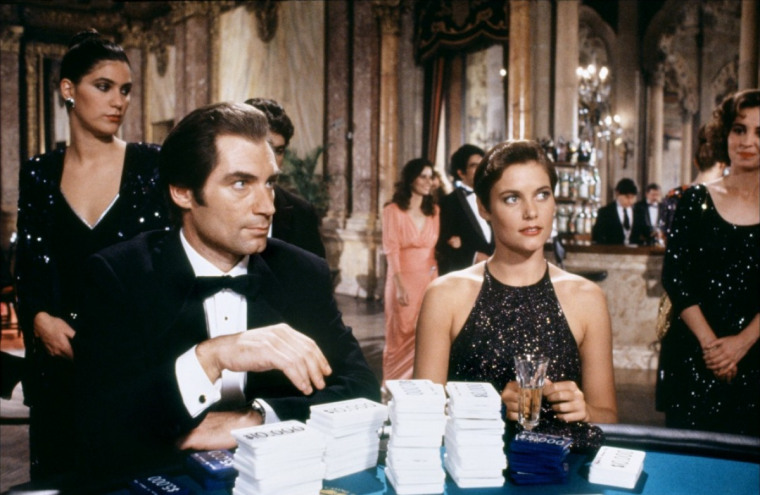
Today we continue our journey through the James Bond films with No. 0019 of 0023: The Living Daylights. This was Timothy Dalton’s first Bond film and it’s a very small movie. This film was meant to bring realism back to James Bond and explore his darker side. It didn’t. Instead, they created a film which felt small all around – small Bond (not larger than life), small-time villains, small-time plot, small sets confined to small areas. Even when Bond travels, you never get the travelogue feel of prior Bond films. Small, small, small.

Plot Quality: The Living Daylights begins with a bit of intrigue. During a mock 00-operative invasion of Gibraltar, some bad guy kills 004 and then nearly kills Bond. This leads to the discovery of something called Smert Spionam (“Death to Spies”). The scene then shifts to Czechoslovakia, where 007 has been assigned to protect KGB General Georgi Koskov (Jeroen Krabbe), who is planning to defect. Bond shoots the female cellist (Maryam d’Abo) who was assigned to assassinate Koskov if he tries to flee. But Bond doesn’t kill her because he recognizes her as an amateur. Bond then smuggles Koskov out of Czechoslovakia into Austria through a pipeline. This is the best part of the film, even though it is a small idea involving few people, low stakes and confined sets. It also involves an annoying trope – the inept bureaucrat who despises Bond being called in to handle “his” operation.
When Bond returns to Britain, he meets with Koskov, who is being debriefed at a safehouse. Koskov warns MI6 about Smert Spionam, an operation supposedly being run by the new head of the KGB, Gen. Pushkin (John Rhys-Davies), to assassinate British spies. Koskov claims this could start a war between the Soviets and the West. Koskov is then kidnapped from the MI6 safehouse. This is where the problems start with the film. For one thing, it’s not obvious how killing spies could lead to war – who goes to war over a dead spy? For another, the film now gets needlessly complicated with a series of double and triple crosses, which seem like they are included merely as filler.

Bond is ordered to kill Pushkin to stop this Smert Spionam operation and avenge the death of 004. Bond, however, decides that Pushkin would not have ordered this operation, so he confronts Pushkin, who tells Bond that Koskov is under investigation for embezzlement, which makes Bond realize the defection was faked by Koskov so he could trick MI6 into killing Pushkin for him. Bond then decides to track down the cellist, whom he believes helped Koskov fake his defection. Naturally, she falls for Bond and he escapes with her. Bond then returns to Tangier to find Pushkin, but Bond gets kidnapped by Koskov and taken to Afghanistan. There he meets the very westernized Mujahedeen. He then steals a Soviet military transport which Koskov is using to smuggle opium to enrich himself and an American arms dealer named Whitaker (Joe Don Baker). Bond saves the cellist and showers the countryside in opium. Then he goes to Tangier to kill Whitaker and Koskov. He kills Whitaker, but Koskov ends up being arrested by Pushkin, who will extract revenge. The film ends with the grateful Soviets letting the cellist leave for the West so she can play for Western audiences.

Unfortunately, despite this dizzying travel schedule, the audience never really gets a sense of travel in this film because the film never ventures out of closed sets, except at the Russian airbase in Afghanistan – and all you see there is dirt. This keeps the film small, as does the evil scheme. Indeed, ultimately, this scheme boils down to a guy looking to skim profits off a drug deal. This is hardly worthy of James Bond, especially because there are no real consequences if he doesn’t succeed. . . some opium gets to Europe. Big deal. They get all they want already. Moreover, the climax moment in the film is a fight between Bond and Koskov’s henchman Necros on an airplane. . . not even between Bond and Koskov himself. Again, small thinking.

Finally, as with License to Kill, there aren’t really any iconic moments and there aren’t really any memorable quotes. This isn’t a film that makes an impression.
Bond Quality: Timothy Dalton was a bad choice for Bond. With Roger Moore too old to play the role, the producers wanted Pierce Brosnan, but he was contractually bound to play Remington Steele. The next choice of the director and co-producers was Sam Neill, but Albert Broccoli wanted Dalton. Dalton had previously expressed disdain for the role and, frankly, he just didn’t have what he needed. For one thing, this film was meant to show a more realistic and darker Bond, but Dalton really couldn’t pull that off. For while Bond is meant to be cold-blooded, Dalton projects a lot of anger onto the screen. Bond is also meant to be stylish, but Dalton never once makes you wish you knew his tailor.

Dalton also never feels comfortable in the role. This is because Dalton is one of those Shakespearean-type actors who can’t shake his training. If you compare him in this role to his role in The Rocketeer or his role in Flash Gordon, they’re identical. And anyone who thinks you can play James Bond the same way you play Prince Baron just doesn’t understand acting.

The Bond Girl: The Bond girl here was Maryam d’Abo as Kara Milovy, the cellist. She’s kind of passive. She exudes no passion, no mystery, and she has no great motive to be in the film. She’s just the narcoleptic girlfriend along for the ride. Nor do you ever get the sense that she sees Bond as more than just a friend.
Villain Quality: Finally, we come to the villain(s). Yikes. This film has two villains, and neither is worthwhile. First, you have Koskov. Played by Jeroen Krabbe, the villain in The Fugitive, Koskov is not fitting to be a James Bond villain. Essentially, he’s an embezzler who tries to trick James Bond into killing his boss to keep from being discovered. This makes little rational sense and robs the story of any stakes. Indeed, whether Bond succeeds or not, nothing changes for the world. Perhaps realizing this, the writers try to up the stakes by telling the audience that Koskov is trading arms to the Mujahedeen in exchange for drugs, which he will sell in Europe. But how does this help? It’s not like Europe won’t get plenty of drugs either way, and the US was openly arming the Mujahedeen. So what do we care?

Moreover, his plan to get Bond to kill his boss is Rube-Goldberg silly. Does anyone really think the Soviet Union won’t figure out that he staged a fake defection and met with Bond right before Bond killed his boss? The Soviets would need to be retarded not to put those facts together. Seriously, just shoot Pushkin or stage a car accident like everybody else does. Of course, Koskov may be mental because he keeps not killing Bond for no apparent reason. Even worse, throughout the film Koskov comes across as a bungler who kisses everyone’s butt... like the Biff of the James Bond Villain world. This is not a Bond villain, not in scheme, not in personality.
The other villain is Joe Don Baker as Brad Whitaker. Baker is a B-grade actor at best and Whitaker is pathetic. He’s an arms dealer who likes to dress up like a general and play with toy soldiers. He doesn’t really have a scheme either because the writers assumed that the audience would accept the fact that he’s an arms dealer as proof enough of his villainy. Stupidly, his death is essentially treated as the climax of the film, even though he’s a bit player with an uninteresting story not worthy of Bond. In fact, there wasn’t even a reason for Bond to go after him because the cops could have picked him up just as easily.

Neither villain rises to the level of a Bond villain. This is probably why the film’s true climax involves Bond killing Koskov’s henchman aboard the Russian transport plane. And just to add insult to injury on that point, the only cool thing about the henchman is his name “Necros.” He has no other defining traits.

Conclusion

This was a rocky start for Timothy Dalton. The film began well enough, but quickly became a jumbled mess, and there was little to mark this film as a James Bond film: small time villains, small locations, small Bond, small plot, mousy Bond Girl, dated soundtrack. The only thing that wasn’t small was the transport plane fight, and that was too long to stay interesting and it lacked any real stakes. . . it was just a nice stunt. But this film was better than Dalton’s second attempt. That’s why this film is No. 0019 of 0023.
[+] Read More...

Thursday, March 21, 2013

Bond-arama: No. 0021 Licence to Kill (1989)

We continue our ranking of the Bond films with Licence to Kill. This film stinks. It’s a Miami Vice episode without the drama, the tension, or the style. It also lacks any sense of grandeur and offers nothing that would please a traditional Bond fan. That’s why it ranks No. 0021 of 0023 on our countdown.

Plot Quality: The film opens with Felix Leiter and our Mr. Bond arresting a drug lord named Sanchez (Robert Davi) whom the DEA has been after. Why the CIA is involved isn’t really explained. To add drama, they interrupt Felix’s wedding to make the arrest. Shortly thereafter, Felix gets maimed when the drug lord escapes and feeds Felix to a shark. Bond wants revenge, so he resigns and flees to Latin America against orders to kill Sanchez. Once there, he tricks Sanchez into taking him in like a lost puppy, then he kills Sanchez in a moderate-speed tanker truck chase.

That’s it.
The details don’t add much either. Bond is being chased by the Secret Service for resigning and escaping their grasp, so he teams up with a woman (Carey Lowell) who is a CIA informant and pretends to be an out-of-work assassin. Of course, the Secret Service captures him right away. . . and then Sanchez helps him escape because that makes the plot work. Bond then discovers that Sanchez has hidden his operation as a meditation retreat run by televangelist Professor Joe Butcher (Wayne Fricken Newton). This ultimately has nothing to do with the plot, what there is of it. Once Bond finds Sanchez they play a silly cat and mouse game and then end the film in a gas tanker truck chase which is packed with “uh. . . why didn’t he just ___” moments. That’s always a horrible sign.

All in all, the plot is beyond stale and little of it makes sense. The film billed itself as being “torn from the headlines” for its drug-revenge plot, but that idea had already been done two years before in similar ways by films like Lethal Weapon, RoboCop and Beverly Hills Cop II. Moreover, a lot of the characters’ actions aren’t things people would do in the real world. Bond is out-of-character throughout. There is no drama as there’s no sense that anything unexpected will happen. The bad guy and his scheme are uninteresting, and it’s impossible to care about Bond’s desire for revenge. Not to mention, there are no iconic moments and not a single memorable quote.

Bond Quality: This is the second and last Timothy Dalton Bond film and, honestly, two was too many. James Bond is a special character because he perfectly mixes sophistication, style and conscience-less brute force. Dalton was too huffy and curt to have style, too average and too self-conscious to be sophisticated, and this film proved he couldn’t do brute force either.
In fact, this film was a deliberate attempt to make Bond more “real” by making the violence shocking to audiences. Yet, the violence presented is no more realistic nor more brutal than we were seeing on average cop shows already. And, in making it more “real,” they stripped away the grandeur which Bond needs. He was no longer the suave superspy doing amazing feats of daring, he was just a whiny cop who sometimes shot people in self-defense. And when you compare the supposedly brutal Dalton Bond of this film with something like Craig’s Bond in Quantum of Solace, the claim that this film involves a brutal James Bond is laughable.

Further, to create the supposed brutality, they gave Bond this motive about Felix Leiter being maimed by the bad guy, but even putting aside the fact that James Bond isn’t supposed to lose his cool even when he seeks revenge, Dalton played this all wrong. He didn’t summon an inner-rage so much as an inner-pissiness, and he comes across more like someone upset at a waiter than someone upset about their friend being killed. Not to mention the ending scene is horrible where Felix laughs off his own maiming. If Felix doesn’t care, why should we?

The Bond Girls: Bond is pretty asexual in this, so it’s fitting that he got a totally forgettable Bond Girl – Carey Lowell as Pam Bouvier. She’s a pilot and a CIA informant with short hair and a total lack of mystery. There is no chemistry between them either. There’s also Talisa Soto as Sanchez’s girlfriend Lupe. There’s not really much to say about her.

Villain Quality: Finally, we come to the villain: Franz Sanchez. Even the name is pathetic. Sanchez is supposedly modeled on Kananga from Live and Let Die, but they must be from different mothers because I don’t see the resemblance. Unlike Kananga, he has no cool double-life, no cool sidekicks, no cool base of operations, and he doesn’t know Jane Seymour. There’s also nothing unique about him. Sanchez is blandly described as a powerful Latin American drug lord the DEA has been after for years. Yawn. The Miami Vice boys round those fellows up every week. And he is meant to suggest Manuel Noriega, who defines the term “petty tyrant.”

Sanchez is played by Robert Davi, whose acting career never rose above bit parts. He does ok here as a standard drug dealer, but there’s nothing to make you see him as anything special. His base of operations, for some reasons, involves using Wayne Newton as an evangelist as a front, but it’s never clear why this matters. His henchmen are just thugs, including Benicio del Toro who is not the least bit intimidating.
Even worse, Sanchez’s scheme is stunningly weak. He’s just trying to find a way to smuggle cocaine to other countries by dissolving it in gasoline. Big deal. If he succeeds, nothing changes in the world. Nor is this very interesting, it amounts to little more than one of a million unoriginal smuggling methods. This does not a Bond villain make. Moreover, to give you a sense of how lost the writers were on this one, there is a scene where Sanchez’s financial advisor spits out the scheme to a group of visiting Japanese tourists Asian drug kingpins, and the scheme is mindboggling in its ability to use an incredible amount of buzzwords without producing any actual meaning, like when he hands these drug kingpins a “demographic report, breaking down each of your territories by age and socioeconomic group” to prove to them that there is indeed a market for illegal narcotics in Asia. Who knew? Seriously, this is pitiful.

Conclusion

This film had a plot that would have been rejected by Miami Vice for being too bland, an out-of-character Bond played by an actor who lacked all the required elements to be a quality Bond, a villain without a plan other than competing with FedEx, no real Bond girl, and nothing else to commend it. There isn’t even a memorable quote. Hence, it sits at No. 0021 on our list. Not coincidentally, it is also the lowest grossing Bond film.
[+] Read More...