Showing posts with label Bond-arama. Show all posts

Monday, March 28, 2016

Books To Film: James Bond

I’ve been doing a lot of reading lately. In particular, I started reading the original James Bond books by Ian Flemming. In the past couple weeks, I’ve read the three “SPECTRE” related stories: Thunderball, On Her Majesty's Secret Service, and You Only Live Twice. It has been fascinating to compare these books to the films.

Movies rarely follow the books they adapt. More often than not, significant changes are made to make the book work on screen. As a general rule, I’ve found that it’s rare that a movie is as good as the book that inspired it, and even more rare that a movie is better than the book. So imagine my surprise to find that Thunderball, On Her Majesty’s Secret Service, and You Only Live Twice are all far superior as films than the books from whence they came.
To start with, the plots of the films are rather different than the books. Thunderball is the least changed, but it still has significant differences. In Thunderball the book, Bond goes to the health spa, as he does in the film, where he gets into a tit-for-tat with SPECTRE agent Count Lippe. Unlike the movie, where this scene is key to leading Bond to the Bahamas however, the book scene is only tangentially related to the bomb plot and Bond never seems to connect the dots. This makes the scene largely superfluous. In fact, M sends Bond to the Bahamas on M’s own hunch, rather than Bond connecting Lippe to Dominique. The rest of the story is fairly similar to the film, though with some caveats addressed below.

By comparison, You Only Live Twice is completely different from the film. In this book, Bond has lost his will to be an agent because of the death of his wife in On Her Majesty’s Secret Service and his inability to capture Blofeld for the crime. He is given a supposedly impossible assignment by M to prove why he shouldn’t be fired. This assignment takes him to Japan where he is supposed to befriend the head of Japanese Intelligence and get them to share their files because the CIA has cut British Intelligence off. In the process, Bond learns that a man who could be Blofeld his built a castle full of poisonous plants which has become a popular place for Japanese people to commit suicide. Bond wastes a lot of time, then goes to apprehend Blofeld and Blofeld ends up dead. No stolen space ships. No devastating plan. Zip.

On Her Majesty’s Secret Service is similarly without action, as Bond romances Tracy and then spends the rest of the book at Blofeld’s Swiss lair theoretically trying to find a way to arrest him, though there doesn’t seem to be any action in that regard.
Plot-wise, On Her Majesty’s Secret Service and You Only Live Twice both lack anything close to the punch of the films. You Only Live Twice got so dull that I struggled not to start skimming the page-long paragraphs that conveyed little information. Thunderball still works, but it takes a lot of twists and turns which end up as dead ends and it undermines its own tension.

Worse yet, the Bond character is not a good one in these novels. On film, he’s an amazing character. He’s suave, savvy, and violent yet playful. He’s like a combination of everything a man could want to be. Not so in the books. First, book-Bond has little in the way of savvy. He never displays anything approaching keen insight and, to the contrary, misses many obvious signs. He doesn’t seem to have any spy knowledge either, nor does he seem to like his job. He knows little about foreign cultures or languages, nothing about alcohol, and doesn’t seem to have much in the way of specialize combat knowledge. He is best described as a brawler. He doesn’t have the razor wit that film-Bond has either. Instead, he comes across more as a petulant employee.

Perhaps the biggest sin, from a character perspective, is that book-Bond is largely a passive character despite the occasional moment of big talk. In the films, Bond does it all, and he does it with a sense that what he can do easily, others simply cannot do. In the books, Bond lets others do all of the work. He falls into leads rather than chasing them down. He comes across more like a detective than a spy. And he lets others take the risks. Honestly, it’s a wonder that anyone reading these books would think they would make good films and then would transform the book-Bond into the film-Bond.
To make these films out of these books, the producers/directors/screen writers needed to completely overhaul them:
● They needed to give dead-end moments in the plot some meaning and sharpen the consequences so that the stories flowed better and the excitement level was much higher.

● They needed to reinvent the villain to give him bigger, more menacing ideas and a stronger organization (SPECTRE in the books is kind of like an alliance of petty thieves, blackmailers and cranks), to raise it to a world-class organization worthy of Bond’s attention.

● They needed to reshape Bond to be much smarter, more clever, more knowledgeable, more worldly and braver than in the books. They needed to swap out the character traits which make him come across as a petulant clerk who occasionally goes to arrest people for the traits of a solitary hunter, the traits of an indifferent policeman for those of an assassin, and the traits of a by-stander for a man of action. They even needed to give him the Bond-identifiers we have come to expect, like the Austin Martin, the vodka martinis, the sharp suits and “Bond... James Bond.” This is a bit like taking Columbo and turning him into Jason Bourne.
This is one time – three actually – where I’m glad they basically strip-mined the books and then made their own films using the elements they liked. That’s not something I will say often, but it is true here.

Thoughts?

** Hopefully, you enjoyed this article. I’m planning this as a new series, but it will take time because I need to read the books before I can write the articles. I do have a few more ready to go though. :)
[+] Read More...

Thursday, January 7, 2016

Film Friday: SPECTRE (2015)

I have mixed feelings about this film. On the one hand, Daniel Craig’s Bond films continue by and large to be better than anything since Sean Connery’s films. On the other hand, there was a lot I disliked about this film and my first reaction is to rank it as the worst of the Craig films. In particular, this film was confused, pointlessly-complex, and committed many of the sins which the Craig years have been about undoing. It also represents a seriously wasted opportunity.

Spoiler Alert: There Are Important Spoilers Herein

Plot

The biggest weakness of this film is the plot. The plot is needlessly complex and the writers seemed to get lost in it. What’s more, important chunks of the complexity are nonsense.
The story begins with Bond in Mexico City where he sets out to kill a man. In the process, he learns of another man who has a ring with an octopus on it. Bond returns to Britain, where we learn that he did all of this against orders and without the knowledge of MI-6. We also learn that MI-6 is being absorbed by MI-5, and MI-5’s boss wants to eliminate the 00 program.

Bond is ordered to stay in London, but he’s running his own mission this time. It turns out that he has been given instructions by Judi-Dench M in a deathbed video to kill a man, attend his funeral and then figure it out from there. So Bond escapes to Italy and attends the funeral. This is where the writing problems begin to appear. Watch for a trend: Bond somehow finds out where the private funeral will be held. Despite the funeral being a who’s who of villains, Bond somehow gets into the funeral and meets the widow. Bond somehow knows they plan to kill her. He somehow figures out when she will return home and arrives just in time to kill the killers who have come to get her. She somehow knows where her dead husband’s associates will meet to discuss how to replace him. Bond goes there and somehow gets through the door and attends a massive SPECTRE meeting. He then gets exposed and he somehow escapes because only one guy bothers to chase him.
Now, don’t get me wrong. These scenes are beautifully shot and they’re interesting and tense. The supercar chase scene is a tad long, but it’s broken up by Bond being on the phone throughout. And if you like, you can imagine all kinds of explanations for each of the somehow’s above. But the fact remains that none of this is explained and it all seems a tad flimsy. And it gets worse from there as this is just the beginning.

From here, Bond will meet a man who is a hermit but who somehow knows everything about SPECTRE but only gives Bond a one word clue, which Bond will somehow use to find a secret daughter, whom he must rescue. She will use that clue to lead him to a hotel in Africa where Bond somehow finds a hidden room which tells him how to end the movie at a volcano lair (Bond still needs to resolve a brutally obvious subplot which is so packed with somehow’s that it makes you wonder if they did more than give this a cursory thought before including it in the film).
Again, let me say that Sam Mendes is a director with an amazing eye for imagery. This film is visually beautiful if not stunning. Everything about it is perfectly handled from a visual point of view. The effects are great. Mendes mixes in some wonderful touches, like old cars and cool little homages to the Connery years, and most of the scenes are moody and interesting. The problem remains, however, that the story surges from visual to visual without ever bothering to fill in the plot points to explain how Bond got to where he got.

Equally problematic, the main villain, Blofeld, is a bore, and the plot involving Blofeld proves to be a dead-end to the plot. It’s almost like the writer figured that just introducing the character was enough for the film and didn’t think of what else to do. At the same time, the subplot has a much better villain. He’s more developed and better acted. When he’s on screen, the film just feels tense (when Blofeld is on the screen, the film feels stopped). Unfortunately, the writers all but ignore the subplot and what it could add to this film. And then when they do focus on it, what they do is horribly obvious and rushed. The subplot is where this film really should have gone.
Bond

Daniel Craig returns as Bond and there is a lot of talk that this may be his last Bond film. While I’ve felt that he’s been an amazing Bond, I am honestly ready for him to leave. This movie, even more than the last, kept projecting the idea that Bond hated his job and wanted to quit... something Craig has paralleled about the role in interviews. So while Craig was again smooth, suave and cold-blooded, and he therefore fit the role perfectly, he also came across as tired and perhaps a little indifferent to the film throughout.
The Villain (Spoilers)

This film had multiple villains. On the one hand, you had the main villain, Ernst Stavro Blofeld, played by Christopher Waltz. With him, you had Dave Bautista as Mr. Hinx, a kind of cross between Donald Grant in From Russia With Love and Oddjob in Goldfinger. And then there’s C.

Hinx is an assassin who fights Bond a couple times. The only “character” moment comes when he applies for the job of assassin at the SPECTRE meeting. Otherwise, he’s just walking muscle.
Blofeld is the head of SPECTRE. And when I heard that Waltz would play him, I was excited. Unfortunately, he’s a waste. His character is intensely boring as he drones on and on about things that sound kind of like a life philosophy but really are just words strung together. Even worse, this film commits the cardinal sin of making Blofeld a sort-of relative of Bond’s. He even claims to have sent all the villains Bond has been facing in the Craig movies after him and of ordering the deaths of everyone who has died in Bond’s life. In other words, forget everything you thought you knew about the prior films or Bond’s character because this ill-defined impossible character has manipulated every moment to punish Bond because his own father loved Bond more than him. Ug.

First of all, the idea that one person could cause all the unrelated events in the prior films, each of which involved unique motivations and plenty of luck, is ludicrous... so Blofeld somehow got M to piss off Silva before Bond was even an agent just so Silva would one day go after Bond? Yeah, right. Secondly, the idea that the world is essentially divided between one superspy and his sort-of supervillain brother is comic book thinking, and it takes it too far away from reality. Third, how can someone so obsessed form an organization like SPECTRE? It’s nonsense.
The most interesting villain is Andrew Scott as Max Denbigh or “C”. He runs MI-5 and he’s entered into a deal with SPECTRE to build a surveillance empire on behalf of the British government all in the name of stopping terrorism. What makes him interesting is that it’s easy to see him as a real creature haunting governments everywhere. He thinks he’s the good guy because he’s obsessed with bringing order to our chaotic world and he genuinely thinks that causing a few deaths and doing a dirty deal is worth the benefits the world will get. He can’t even see the danger of working with someone like Blofeld. Unfortunately, his character gets badly neglected by the film in favor of Blofeld, so we don’t see him much and we learn even less about him. What’s more, what we do see points so obviously to him being a villain that there’s no mystery to this. This is a lost opportunity. This would have been a better film if SPECTRE had been a red herring and C was the main villain, or if C was not a villain and he was being framed by SPECTRE. Instead, he’s just there to give M and Moneypenny something to do in the film.

The Good, The Bad, The Ugly

I don’t want to make it sound like I hated this film. I didn’t. I thought it was a decent movie and I enjoyed it. I enjoyed it a lot more than most of the Bond films after the Connery years. It was beautiful and had the travelogue film these films need. The pacing was excellent and the story offered enough to hold your interest. The ‘cool’ moments were indeed cool. The humor was funny. The action was tense. Craig did his usual great job with the role. The Bond girls were pretty, especially Monica Bellucci. Andrew Scott was creepy and believable. It was excellent escapism and could be the best “mindless action film” in the series.
Where this film disappointed me was that the film never bothered to explain so much of what happens except by saying, “Hey, he’s Bond... just accept it.” I also felt that Blofeld was a waste and his relationship with Bond was a horrible idea to inject, and was done so just to add a punch which his character was lacking in the story. It also bothered me to a degree that what made the Craig films so different was the return to basics, i.e. there were no supercars chases, no impossible stunts, no buildings blowing up, no nuclear-sized explosions, no larger-than-life villains, and no volcano lairs, but this film brought all of that back into the series. It was a retreat to fantasy.
So what I would say about this film is that it proved to be a genuinely missed opportunity. If they had kept more focus on Bond the investigator, had eliminated Blofeld and focused on the subplot, and bothered to connect a few more dots, this could have been the best film ever. But they didn’t. Ultimately, I would rank this as the worst film of the Craig era as a Bond film, even as it probably gets the highest marks in the series as a mindless action film.

Thoughts?
[+] Read More...

Wednesday, March 12, 2014

Bond-arama: Final Ratings/Final Thoughts

Today we conclude the James Bond series, all of which can be found at our Bond-arama page(LINK)! We’ve examined all the movies and ranked them. We’ve talked about what worked and what didn't and how they could have been made better. Now it’s time for some finishing thoughts.

The Rankings I: While many of you made very persuasive cases for why From Russia With Love (or even Thunderball) should be the number one movie, sadly, I think the public continues to see Goldfinger as the top Bond film. That’s the one that wins the polls and which people talk about the most. That’s the one people use to introduce people to the series too and it’s the one characters in other films (e.g. Trainspotting) talk about as the pinnacle of the series. So here are the final rankings for the top three:
Goldfinger (1964)
From Russia With Love (1963)
Dr. No (1962)
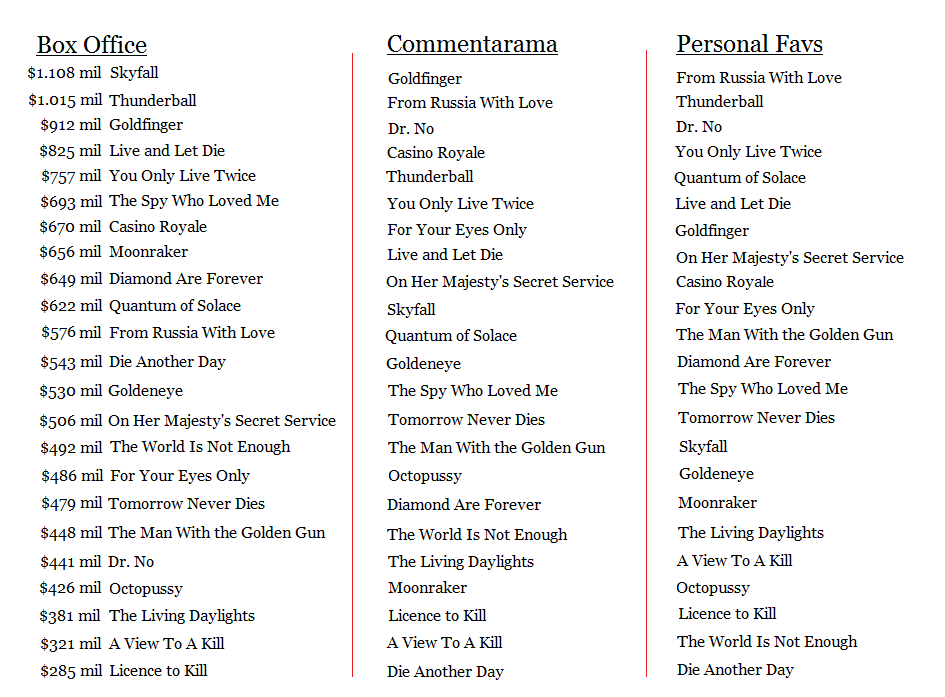
The Rankings II: That said... if I were rating the films on how much I enjoyed them, they would be ranked differently. They would be ranked differently too if we went by Box Office numbers. How differently? Check out this chart and you can compare all three sets of rankings. The first list is the Box Office results in 2012 dollars. The second list is the one we created here as an “objective public list.” The third list is how I would rank them in terms of how much I enjoy each film personally.
Click to Enlarge
Click to Enlarge

Notice a couple things. First, there are some real anomalies in the Box Office numbers. For example, Dr. No is near the bottom even as we ranked it near the top. For Your Eyes Only also sits nine spots lower than we ranked it. And somehow, Die Another Day moved up from the bottom to 12th place, i.e. the top half. What this suggests is something we already knew: Box Office results are not a guarantee of quality.

Notice too that the “big” films did better than the smaller films. Indeed, most of the top nine are all about volcano lairs, undersea bases, space stations, and nuclear weapons. Clearly, that is what draws people to the theater.

Also, look at how close the series apparently came to dying at the end of Roger Moore’s era through the Timothy Dalton’s films. The lowest performing films, by far, are the four films of that era.

Final Thoughts: Finally, I found it fascinating writing these. It was interesting to see how many really weren’t that great even though we tend to think of the series as generally superior to other films. It was even more interesting to see how easily so many of these films could have been dramatically improved with only minor tweaks. It struck me too how many of these films were copies of prior films.

Ultimately, what I found most interesting was that the elements that we think make Bond films (larger than life villain with big scheme, strong Bond girl, and complete Bond) are not what made the best Bond films. To the contrary, the elements that made the best Bond films seem to be the presence of a strong male relationship for Bond (Kerim Bey, Felix Leiter in Dr. No, Casino Royale and Thunderball, Rene Mathis, Tiger, Kristatos), a smaller but more clever threat/scheme (FRWL, Casino Royale, FYEO), and a complex rather than a larger-than-life villain (Dominique Greene, Red Grant, Le Chiffre, Columbo).

Anyway, I hope you enjoyed the series!

Thoughts?

(P.S. Feel free to share your own rankings!)
[+] Read More...

Thursday, March 6, 2014

Bond-arama: No. 00? From Russia With Love (1963)

Finally, we come to From Russia With Love. This one makes a strong case for being the top Bond film, but does it offer enough? In many ways, this is the most flawless Bond film; there is almost nothing to criticize. It also has all the elements we’ve come to expect from top Bond films. And the public rates this one very highly. But is it “big” enough to be No. 001 of 0023?

Plot Quality: From Russia With Love has one of the best plots in the series, if not the best plot. The story involves an attempt by SPECTRE to steal a Lektor cryptographic device from the Soviets and revenge themselves against James Bond in the process. The plan calls for having a cipher clerk (Tatiana Romanova) at the Soviet embassy in Istanbul help James Bond steal the device. To get her to do this, they trick her into believing that she is working under orders from Soviet intelligence. They achieve this with the assistance of the recently defected Rosa Klebb of SMERSH. Tatiana is to tell the British that she wants to defect and that she can deliver the Lektor, but she will only do so if Bond picks her up personally. Once Tatiana and Bond have the device, SPECTRE will kill Bond and take the device.
MI-6, of course, sees this as a SMERSH trap, but they think that it’s worth the risk if there is the slightest possibility of getting the Lektor, so they send Bond. Bond travels to Turkey, where he meets the station chief Ali Kerim Bey. Bey explains how the spy game is played in Turkey and helps Bond set up the theft from the embassy. As they plan this, the cold war in Turkey heats up because of the efforts of SPECTRE agent Donald “Red” Grant, who begins killing agents to spark the conflict, but simultaneously protects Bond from being killed so he can carry out the plan.
After the Lektor is stolen, Bond and Tatiana need to escape Turkey. They take the Orient Express. The plan here is to stop the train near the border and to leave the train for a waiting vehicle which can sneak Bond and Tatiana across the border to safety. However, Red Grant has killed Bond’s contact and now kills Kerim Bey. He tries to convince Bond that he must abandon Tatiana, but Bond becomes wise to him. They fight in an epic hand to hand struggle. Bond kills him and Bond and Tatiana escape the train using Grant’s contacts. This leads to a helicopter attempting to kill Bond and finally a boat chase.
In the end, Klebb tries to kill Bond herself in his hotel.

Bond Quality: This is Connery’s second film and it’s Connery at Peak Bond. In Dr. No, Connery focused on presenting cold-blooded Bond. Yes, he was still suave and had some sex appeal, he also gave hints of his loyal side with Felix Leiter, but the primary feeling one got of his Bond was his cold-blooded relentlessness. In this film, Bond maintains that cold-bloodedness, but he simultaneously adds a playful sexuality and a strong sense of loyalty. In effect, he completes the character in this movie and sets in stone the traits a good Bond is required to possess. This is the best Bond will ever be. Ironically, Connery never again presents the complete character in the rest of his films.
One of the things which helps Bond in this film is his relationship with the very likable Kerim Bey (Pedro Armendariz). Kerim Bey is part spy, part rogue, and part father figure, and he quickly becomes Bond’s best friend. The two mesh well both in terms of temperament and how their lines feed each other. They are a perfect match and you enjoy seeing them together. This rounds out Bond perfectly.
The Bond Girl: The Bond girl here is Daniela Bianchi, and she’s gorgeous. She also has solid chemistry with Bond, probably better than any other Bond girl. She’s also the first Bond girl to be the focus of the story as she is the bait used to trap Bond and she has a role in resolving the plot by choosing to shoot Kleb over Bond in the ending. Throughout the film, she’s also called upon to present a range of emotions, which is kind of rare in Bond girls. All told, she’s an excellent Bond girl.
Villain Quality: There are several villains presented in this film, though the main one is Red Grant. Aside from him, you have the mysterious head of SPECTRE, whose face you never see. He is a menacing character made all the more fascinating in that you don’t see him much. Then you have Kronsteen, an arrogant chess playing mastermind who sets the plan into motion. You also have Rosa Klebb, an evil woman who has defected from the Soviets to SPECTRE, and a bevy of minor hit men and the such. Each of these is a colorful character who provides us with a compelling glimpse into SPECTRE and the world of international spying. We even get to see a SPECTRE training facility.

In any event, Red Grant is the real villain and many people name him as the best villain ever. What makes Grant stand out compared to the rest is the savage nature of his character. This man is a hot-blooded killer who prefers to humiliate his victims and feel their last seconds of life drain from their body. He also seems to suffer a strong inferiority complex when it comes to the British agents and that makes him particularly savage to them.
Even better, Grant is played by Robert Shaw, who is easily one of the finest actors of the past fifty years when it comes to giving a part exactly what it needs. Shaw is one of those actors who vanishes into a role and he does that perfectly here again. He is completely believable as Grant.

If From Russia With Love has a problem, it’s the lack of a “big” plan on Grant’s part. When you get down to it, Grant is cool, but he’s just a thug. And SPECTRE’s plan sounds very much like something spies would do, but at the same time, this doesn’t feel like a story with major consequences. Yes, if Bond can steal the Lektor, that would be a major triumph, but there’s little in this one for the audience. It also doesn’t really have any iconic moments. That said, the story is fast-paced and tight, the characters are engaging and the story never wants for action or twists and turns, despite this. Also, the Lektor does have a MacGuffin feel to it, but probably not enough to bother the audience. So the story is strong even if it lacks the larger-than-life scheme, the larger-than-life villain, and the larger-than-life ending compared to the others.

So how should this film rank? Well, it’s a fantastic film with nothing to criticize. This film boasts the best Bond, a tremendous Bond Girl, some wonderful supporting characters, and the toughest, most visceral villain of them all. If there is a criticism it’s that this film doesn’t have the over-the-top stuff that the other films do. But does that set the film apart in a good or bad way? In terms of popularity, this one is always in the discussion of top films, but you rarely hear it win. So where should this film rank? Is it worthy of the top spot? You tell me.
[+] Read More...

Thursday, February 20, 2014

Bond-arama: No. 00? Goldfinger (1964)

Next we come to Goldfinger. Goldfinger is the first Bond film to put it all together and have all the elements required of Bond films. It has an excellent plot, memorable quotes, an iconic villain, and Bond girls out the wazoo. This one also routinely gets chosen as the best Bond film. On the other hand, this one has some serious flaws. Does it have enough to be No. 001 of 0023?

Plot Quality: Taken at face value, Goldfinger probably has the best plot of any Bond film. The story begins with Bond resting at a hotel in Miami. As he gets a massage, Felix Leiter appears and points out a man named Auric Goldfinger. Goldfinger is an industrialist who is vacationing in Miami and likes to cheat at a friendly game of cards. He cheats by having an escort, Jill Masterson, spy on the game with binoculars and tell him what the other man is holding over a radio transmitter. Bond meddles with this and then takes Masterson to bed. She will be killed during the night by being painted gold... perhaps the most iconic moment in the entire series.
Bond returns to London. He’s told to investigate Goldfinger, because MI-6 knows that Goldfinger is smuggling gold, but doesn’t know how. Bond proceeds to challenge Goldfinger to a round of golf at an exclusive club; they will play for a bar of gold Bond claims to have obtained from a lost Nazi hoard. Both sides cheat, but Bond cheats better and wins the match. The angry Goldfinger tells Bond they better never cross paths again.

Bond then follows Goldfinger to Switzerland, where the sister of Jill Masterson, Tilly, makes an attempt on Goldfinger’s life. Bond spies on Goldfinger at his plant and learns that Goldfinger smuggles gold by having various parts of his car made of gold, which then get removed once the vehicle passes through customs and get melted back down into bars. Bond also learns about something called Operation Grand Slam, which Goldfinger will perform for a Chinese communist agent. Right after learning this, Bond is captured in a chase which will leave Tilly dead. Goldfinger plans to kill Bond by dissecting him with a laser. This produces the most memorable exchange in the series: “Do you expect me to talk?” asked Bond. “No, Mr. Bond, I expect you to die,” retorts Goldfinger. Bond, however, talks his way out of this and convinces Goldfinger to keep him around as insurance.
The film next moves to Kentucky with Bond as Goldfinger's prisoner. Here, Bond learns that Goldfinger plans to explode a dirty atomic bomb at Fort Knox. His thinking is that by making the US Government’s gold supply radioactive the value of his own gold will soar. This will also suit the Chinese who want economic chaos in the West. But Bond stops Goldfinger’s plan with the help of Goldfinger’s henchwoman Pussy Galore. Goldfinger escapes however, and returns to try to kill Bond. He fails and dies. Bond prevails.

As plots go, this one is really strong. The story moves quickly and efficiently. The story is not dull. The stakes are high and there's plenty of action. And best of all, Bond and Goldfinger are constantly dueling with each other in one form or another, which really drives home the “worthy adversary” aspect of the film. The film also has an excellent travelogue feel, especially in Switzerland. The ending is exciting too as you watch Bond struggle to disarm an atomic bomb. Good stuff... great stuff.

Yep. But when you look beyond face value, there are problems, and the more you think about the film, the more obvious and glaring these problems become. For example, it makes sense that Goldfinger would not kill Bond in Switzerland and that Leiter would not come rushing in to save Bond in Kentucky. Those are actually explained well in the dialog. But why does Goldfinger give a lecture to the mafia about Operation Grand Slam? He clearly intends to kill them, so why go through the hoax of explaining the plan and offering them each a share of the outcome only to kill them moments later. Presumably, it’s just ego and he likes to hear himself speak, but it feels like he only does this to let Bond “discover” what is going on. Also, why would Pussy suddenly change sides merely because of one roll in the hay. That doesn’t fit her character at all. Perhaps if Bond told her something she didn’t know about the plan, e.g. the likely death toll, then it could be believable, but as it’s presented, it’s not.
The big issue, however, is that Bond does nothing to earn his victory. Goldfinger bizarrely tells him about the plan, i.e. Bond doesn’t “spy” it. Even so, Bond does nothing with that knowledge. He can’t tell the CIA or MI-6. Instead, he has sex with Pussy, hoping that she’ll go to Washington. But she already knows about the plan and doesn’t even need him to tell her what he learned. Further, Bond does nothing to persuade Pussy to change sides except have sex with her, and that feels like a nonsense reason for her to change sides.

Moreover, once the military plan starts, you right away realize that it’s a stupid plan. This plan meant they not only could not monitor Goldfinger, but they had no control over what he did. Basically, the planned called for Goldfinger to wait for the military to stop him. And Bond’s participation is irrelevant. Indeed, Bond doesn’t even know about the plan, and he doesn’t actually stop the bomb even though he’s there. He just fights with Oddjob until the experts arrive and stop the bomb. In effect, while the audience is told that Bond is the hero, he really does nothing except wait as Goldfinger’s prisoner until the military saves him and stops the bomb, and they only do that because Pussy told them about the plan.

As an aside, why did Goldfinger even bring Bond to the site of the bomb? Why not just shoot him and be done with him once the plan began? He doesn’t need him at that point.
The film does a good job of disguising these flaws with action, which is probably why most people don’t notice. Indeed, Bond is constantly escaping and getting caught again. But if you stop to think, then the whole thing starts to feel a bit like a fraud as you realize that nothing Bond does really affects the plot. Still, enough people either don’t notice or don’t care because this one is routinely chosen as the top Bond. And I think part of that is because this was the first film to pull it all together. Goldfinger is the first truly larger-than-life villain in the series. Red Grant is just a thug, and his plan feels rather run of the mill. Dr. No has a bigger plan, but he lacks the personality that has come to be seen as necessary in these villains. Goldfinger has it all. He also has the first silly henchman and the first fantastic theme song, which happens to be about him. And even beyond that, there is an enjoyability factor with this film which sets is apart. It certainly belongs in the top three.

Bond Quality: This is Connery’s third outing and I have to say that he’s taken a step back in this one. In Dr. No, Connery had the cold-blooded aspects down perfectly even as he projected the ultimate suave spy. He gave hints of being friendly and loyal to Felix, but was mainly deadly serious. In From Russia With Love, he maintained what he had in Dr. No while adding more loyalty and a sense of sexual playfulness which made him irresistible. In Goldfinger, Connery loses both his killer instinct and his sexual playfulness.
The problem is this. After Jill, Bond never really has much sexual chemistry with the women he meets. In fact, they seem to actively dislike him and the film never gives the relationships enough time to overcome this. At the same time, you start to realize that the only reason Bond survives the movie is that Goldfinger chooses time and again not to kill him (Miami, the golf club, Switzerland after car crash, Switzerland with the laser, twice at the Kentucky ranch, once when Operation Grand Slam begins, once when the military shows up to stop Operation Grand Slam). Several of these can be explained but most cannot. Even worse, however, Bond never seems to worry about this except the one time with the laser. In fact, he comes across as a man who has read the script and who knows he’s in no danger. Thus, he plays the role more as a smartass than a super spy. I actually suspect that the cold-blooded nature of Thunderball was an attempt to rectify this.

All that said though, Connery is still an excellent Bond and he's more relatable in this film than any other Bond film he made because he comes across as calm, charming and funny.

The Bond Girl: The Bond girl is a true weakness in this film. Shirley Eaton played Jill Masterson and had real chemistry with Connery. She ends up encased in gold, one of the most iconic moments in the entire series. Tania Mallet plays her sister Tilly Masterson, who seemed like she would have played well against Bond. Unfortunately, neither is in the film very long.
The official Bond girl was Honor Blackman as Pussy Galore. Blackman comes across as a rather cold, butch lesbian and she and Connery have no chemistry at all. Her character is also nonsense, being a daring pilot, flight instructor and misanthrope who decides to change sides after having implied sex with Connery in a barn. Then, somehow, she ends up helping Goldfinger try to kill Bond again at the end of the movie even as she’s on Bond’s side. That is really bad writing and Blackman lacked the acting ability to pull it off.

Villain Quality: If this film deserves to be ranked as the best Bond film, it is because of Goldfinger himself. Played by Gert Fröbe (and dubbed by Michael Collins), Goldfinger is one of the most richly drawn villains in the series. Goldfinger is an industrialist who is also a petty psychopath. He cheats at cards to win a few hundred dollars. He cheats at golf. He is a very insecure man who pretends to be an iron giant. His love of gold is almost fetishistic. And not only that, but each of these traits is used by the writers to drive the character. It is his desire to win, which makes him challenge Bond. It is his insecurity which lets Bond escape death. It is his arrogance which keeps him from succeeding. And all of this combines to create a character who is simultaneously the first truly larger-than-life villain in the series, but also such an insecure snippy little bastard that you loath the man. In effect, you want to see this man beaten because you hate him, not because you accept the goals over which the film is fought.
His plan too is the first true “Bond plan,” in that it is both larger than life and totally unexpected. Dr. No’s plan was larger than life, but the idea of toppling a rock felt very real world. It was something you could see a foreign enemy doing. Red Grant’s plan was something we would consider typical of spies. This plan, however, was ingenuous. Indeed, when you first hear that Goldfinger does not intend to remove the gold, but instead intends to radiate it, you know you’ve just heard something no one else has ever suggested. That provides this film with an incredibly strong touch and it forces you to rank Goldfinger very highly. He may in fact be the best Bond villain ever because of these two points.

So what we have here is a film with a strong and interesting plot if taken at face value. You have a more relatable Bond. You have a scheme that is truly ingenious and makes the film stand out. You have a strong villain who elicits an emotional response from the audience. And you have a film that is routinely listed as the best Bond film ever and which comes in at number three at the box office. Against this, you have the nagging feeling that Bond doesn’t earn his victory, that the good guys win because of deus ex machina, and that Bond has read the script and knows he’s in no danger.

So where should this film rank? Is it worthy of the top spot? You tell me.
[+] Read More...

Friday, February 14, 2014

Bond-arama: No. 00? Dr. No (1962)

As we enter the top three, I’m going to avoid putting a rank on these for the moment. Instead, I’m going to outline the cases pro and con for each being number one. Today we start with Dr. No. Dr. No is not the first time Bond has appeared on the screen, but this is the first James Bond film in the series... this is the film which started it all and which made Sean Connery into a superstar. It is a solid film with no real plot holes and all the elements we have come to expect from Bond. It has only a couple minor weaknesses. Could it be No. 001 of 0023?

Plot Quality: Dr. No’s plot is superb. Dr. No opens with the murder of British Intelligence Station Chief Commander Strangways and his secretary in Jamaica. His disappearance sets London into motion. A man is summoned. This man is found playing Chemin de Fer in a casino. He has amazing luck and he defeats a woman named Sylvia Trench, a woman who will follow him to his room. This man is Bond, James Bond.
Bond is briefed by M, the head of MI-6, and sent to Jamaica to investigate. Upon arrival in Jamaica, he is picked up by a driver who works for the bad guys. Bond captures the man, but the man kills himself rather than being questioned. This tells Bond the type of villain he is up against, a man who strikes suicidal fear into his henchmen. This also establishes the fact that Bond is not just your average police man. He deals with a special type of criminal.

Bond meets with his local contacts and learns that Strangways had been investigating an island named Crab Key, which belongs to a man named Dr. No. The issue at had is that NASA is planning to launch a rocket in a few days and the CIA is concerned that an attempt will be made to topple the rocket using radio jamming. Strangways thought he was on to something when he vanished.
As Bond investigates, he finds that one of the men closest to Strangways (Professor Dent) lies to Bond about this. He also finds the man who took Strangways to Crab Key. This is Quarrel, and he is working with CIA agent Felix Leiter (Jack Lord). He tells Bond that Crab Key is off limits because of stories of a dragon. This intrigues Bond and he focuses on Dr. No. This leads Professor Dent to make an attempt on his life, which fails. Another attempt is made by Miss Taro, the secretary of a British official, but Bond foils that as well. Bond has her arrested and kills Dent when he arrives at the scene.

Bond now sets his sights on Dr. No. He and Quarrel venture to Crab Key, where they find Honey Ryder (Ursula Andress), a nomadic woman who collects sea shells from the beach. They are attacked by Dr. No’s men and taken prisoner. Bond finally meets Dr. No and learns that he works for an organization which is tying to set East against West by toppling the rocket... SPECTRE. Bond eventually defeats Dr. No and destroys the base, saving the American rocket.
Everything about this film works. The travelogue feel is fantastic. The story is larger than life with huge stakes. The whole film has Bond doing actual spying, something he doesn’t do in later movies. The characters are richly drawn and interesting; they don’t feel cardboard. And this film establishes all the elements we want in Bond.

The only real downside to this film is after Bond is captured by Dr. No. It feels a bit like the film didn’t know how to create a real climax, so the story gets wrapped up too easily. It’s still a decent ending, but could have used something more. And what’s really missing is a more personal struggle between Bond and Dr. No.
Bond Quality: This is the first Bond in the series, so no one quite knew how to play him. Connery would set the standard. And while he is a little stiff in this compared to his future films, his Bond here is still suave and charming. Bond in this film is also one of the most cold-blooded of any in the series. The way he lets Dent build up his hope that he can escape his fate and then coldly shoots him down when he is essentially unarmed is something you just won’t see again until Daniel Craig. Even the cold-blooded Bond in Thunderball isn’t particularly cruel, but Bond is in the Dent scene. His misogynism is strong in this one as well, particular related to Miss Taro, the secretary who tries to kill him. He thinks nothing of having sex with a woman he is about to kill or have locked away. At the same time, Connery lets slip some genuinely warm and loyal moments, particularly when he’s among friends like Felix. Connery sets the bar amazingly high here.

The Bond Girl: The Bond girl is Ursula Andress, as Honey Ryder. She’s a creature of the 1960s. She’s an uneducated girl in a bikini whose job is to look up to Bond with awe and she does that well, but she’s hardly an engaging character. Nothing highlights this more than when Dr. No drugs her so that he and Bond can speak without having to worry about her being at the table as well. This moment feels as if the film itself tired of her. Still, she’s adequate when it comes to the task of creating “The Bond Girl.”
Villain Quality: Dr. No (Joseph Wiseman) is one of the hardest villains to judge. On the one hand, he’s the prototype for the super villain. He’s a man without a country who punches at the level of a superpower. He owns an island. He terrorizes the locals. He’s taking on the United States and winning, and his plan could lead to a whole host of bad things.

He has an interesting backstory too. A half-Asian, born to a Chinese girl and a German missionary, Dr. No became the treasurer of a Chinese crime syndicate, the Tongs. From them, he stole $10 million and he fled China. He then offered his serves as a scientist to the US and the Soviet Union, both of whom turned him down. He subsequently joined SPECTRE and set out on his plan to topple an American rocket for profit and revenge.

One of the more fascinating things Dr. No does is finish Bond’s character for us by telling us that he believed Bond to be more than “a stupid policeman” and he had hope Bond could join SPECTRE. That tells you that Bond is something truly special if he’s that respected by this organization of super villains. It also tells us something further that Bond shows no interest in the offer. This scene does a lot to lift Bond beyond the level of just being another secret agent.
On the other hand, all is not perfect with Dr. No. He’s one of the first to underestimate Bond. In fact, he seems to have no security whatsoever after having captured this super spy. That makes him a much weaker challenge for Bond than he’s been built up to be. He’s also not a very interesting character on screen. He speaks in monotone and affects being bored by everything. That makes him rather dull to watch. And in the end, he never really has his moment to take on Bond one on one.

So how should this film rank? Well, it’s a fantastic film with a weaker-than-expected, but still solid ending. The villain is great until you meet him. The Bond girl is iconic, but a little dull. Connery is in top form, even if he isn’t yet perfect in the role. And most importantly, this film set the series off to the right start. On the other hand, in terms of the public, this one always plays in discussions of the top film, but rarely wins. Its box office also was surprisingly weak, coming in at 19th.

So where should this film rank? Is it worthy of the top spot? You tell me.
[+] Read More...

Thursday, February 6, 2014

Bond-arama: No. 004 Casino Royale (2006)

Casino Royale is the first official “reboot” of the James Bond franchise, though unofficially there were several prior reboots. This time, they took the franchise is a much darker, smaller and more realistic direction. This is not the Bond of volcano lairs and stolen nuclear weapons, this is the Bond who fights modern terrorists. With a new Bond and a new style, they produced what is arguable one of the best Bond films ever. And if it weren’t for the historical advantage of the three films above it (and some problems near the end), this one could arguably rate at or near the top. As it is, it sits at No. 004 of 0023.

Plot Quality: Casino Royale has a unique plot. For one thing, this is really the story of the villain more than it is the story of Bond. For another, this is the “smallest” Bond film ever as most of it takes place in a casino. There are action scenes attached to it, but the driving force is the drama of the card game. There is nothing else like this in the series.
Casino Royale begins with Bond chasing down an explosives maker in Africa named Mollaka. Bond has just been promoted to double-O status and his job is to monitor and capture Mollaka, but he ends up killing him by nearly blowing up an embassy. M is furious and wants Bond brought in for a debriefing, but Bond ignores her and follows the clues he found to the Bahamas, where he finds Alex Dimitrios, an associate of a banker named Le Chiffre. Bond kills Dimitrios and follows his henchman Carlos to Miami International Airport, where he discovers that Carlos intends to explode a prototype jetliner. Bond stops Carlos by planting the bomb on Carlo’s body. Carlos then blows himself up by mistake.

With Bond having foiled Carlos, Le Chiffre finds himself in a world of trouble. He has taken his terrorist clients’ money and used it to short-sell the company who makes the jetliner. When the jet does not explode, the stock price does not fall and Le Chiffre loses his investment. He must now raise one hundred million dollars before his clients kill him for losing their money. To do this, he arranges a high stakes poker game in the Casino Royale in Montenegro.
MI-6 enters Bond into the tournament in the hopes of defeating Le Chiffre. If they can defeat him, then they can blackmail him into spying on his clients for them. Aiding Bond in this are a British Treasury agent, Vesper Lynd, whose role is to protect the $10 million Bond needs to buy his way into the tournament, and René Mathis (Giancarlo Giannini), a local MI-6 contact.

As the game unfolds, we see a rashness in Bond that proves to be his biggest weakness. Le Chiffre exploits this and soon Bond is wiped out. Vesper then refused to give him the rest of the money he needs to keep playing. At that point, we discover that another one of the players is Felix Leiter (Jeffrey Wright). He still has money but isn’t a very good player, so he agrees to sponsor Bond to keep him playing in exchange for Bond letting the CIA have Le Chiffre. Bond agrees and eventually beats Le Chiffre.
Soon thereafter, Le Chiffre abducts Vesper and Bond pursues him. But this is a trap and Bond is captured. Bond is then tortured for the codes to the Swiss bank account into which the money has been deposited. The torture, however, is interrupted when Le Chiffre’s superior, Mr. White, arrives and kills Le Chiffre.

Bond awakens in a hospital and has Mathis arrested for being a double agent. Then he admits to Vesper that he loves her and he plans to resign from MI-6 to be with her. They go to Venice, where Bond learns that Vesper never deposited the Treasury’s money. He chases her and is attacked by Mr. White and his henchmen. In the ensuing fight, the house they are in collapses into the water over which it is built and Vesper dies. The film ends with Bond shooting Mr. White in the leg and taking him in for interrogation.

This film does a lot really well. First, it’s beautifully shot and the sets and scenery are fantastic. One mistake they do make, however, is in going for extreme close-ups and shaky cam action pieces – they do some amazing stunts, but you never get to see them because the director shoots them as close-ups. The travelogue feel is definitely back. So is the sense of class or opulence we like in Bond as everyone is well-dressed and he only goes to luxurious places... no smelly tourists pushing $1 bets in these casinos.
The plot is fast and strong and intense too. It twists and turns throughout. The writing is good too and the dialog is strong. The film is also strewn with interesting moments where we see the Bond elements reassembled. We see him get the Aston Martin. He meets Felix for the first time. We see him make his first vodka martini. We hear his first use of “Bond, James Bond.” The relationships of the characters are interesting too. All told, this is an excellent film that is well put together on a great many levels. It could almost be the best in the series.

That said, there are some flaws. For example, the device of M being upset that Bond was promoted too soon grates, seeing as how Craig is already rather old looking. The big problem, however, is the ending. For one thing, the timing simply doesn’t work. The CIA failing to pick up Le Chiffre immediately and no one bothering to notice that Vesper hasn’t deposited the money with the government for what should be days don’t work. Mr. White coming in to save Bond at the critical moment isn’t very credible either. Indeed, the most likely realistic result of that scene is that White would have shot Bond and then tortured Le Chiffre. It is also hard to believe that aged, experience, cold-blooded Mr. Bond would chuck his job for Vesper.

Despite these flaws, this is a stellar film, but it would have been better with the last 15 minutes lopped off. They don’t fit the rest of the very tight script – they feel like someone felt forced to impose a “big ending” on a strong, personal film.
Bond Quality: This was Daniel Craig’s first outing as Bond and a lot of people thought he wouldn’t be up to the task. Craig wasn’t exactly internationally known and he doesn’t come across as suave. He’s short too, and people didn’t like that he was blond. A great many people seemed to want Clive Owen instead. Craig, however, proved them all wrong. From the very first frame of the film, he grabs the role and he never lets it go. And by the time the movie was over, people were calling him the best Bond since Connery.

What Craig brings to this role which the others didn’t is a sense of genuine menace and relentlessness. When Craig’s Bond targets you, there is no escape. He’s like the Terminator. Yet, at the same time, he’s so tightly wound that you think he’s always ready to explode even as he comes across as the most cold-blooded Bond ever. Connery had flashes of this cold-bloodedness, particularly in Dr. No, but Craig lives it in every scene. Apart from this, Craig does lack the charm Connery had, but the writers help hide that by matching him with equally cold women, which limits the sex in his films, and makes his male-female relationships almost combative.
The Bond Girl: The Bond girl here is Eva Green, who plays Vesper Lynd. Frankly, she’s the weak spot in this film. Yes, the story is largely about the love-hate relationship between these two, but there just isn’t enough passion between them to make it work. Still, Green is adequate and she’s not the focus of the film, apart from the last 15 minutes.

The real relationship(s) Bond has in this film are with men: Mathis and Leiter. Both are much closer relationships than the one he has with Vesper. In fact, it is the relationship between Bond and Mathis which drives the film and the relationship between Bond and Leiter that gives the film its second act. I would measure the quality of these relationships as being on a par with those in the Ocean’s franchise starring George Clooney and Brad Pitt. Wright and Bond and Giannini and Bond are simply compelling together. And they also bring a welcome heist feel to the film.

Villain Quality: Casino Royale has a fascinating villain. He is Le Chiffre (Mads Mikkelsen), a man whose primary villainy is that he launders money for terrorists. In other words, he makes it possible for them to use their ill-gotten funds to fund their activities. But there is more to Le Chiffre. Le Chiffre has been using his clients’ funds to gamble. Well, gamble is an odd word. What he’s done is take his clients’ money and use it to short the stock of the company that makes the Skyfleet airliner, a prototype plane being flown out of Miami. His plan is to have a henchman (Carlos) blow up the prototype, which will tank their stock and make him super wealthy when the stock price falls.
Things go wrong for Le Chiffre when Bond traces a terrorist to Carlos and follows Carlos to Miami. Once there, Bond saves the plane, preventing the stock price from falling and causing Le Chiffre’s bet to become worthless. Le Chiffre has lost his clients’ money and they will not be happy about this. In the hopes of saving his butt, Le Chiffre sets up a high-stakes poker game at the Casino Royale in Montenegro. The game has a $10 million buy in. MI-6 sees this as an opportunity to force Le Chiffre to work for them. They enter Bond in the tournament with the idea being that if Bond can win, then Le Chiffre won’t have the money he needs. To avoid being killed by his angry clients, Le Chiffre will then agree to spy for MI-6 if they agree to cover what he owes to his terrorist clients. That's "the scheme." No prior Bond film has had a scheme like this, where the villain's life is at stake.

This is all very cool and it’s different from any prior James Bond villain. What they’ve done here is take what would normally be the villain’s backstory, i.e. the background told to Bond by M as M briefs him about the mission, and they’ve made that the plot. This is an interesting choice which makes Le Chiffre perhaps the most interesting villain ever in a Bond film because you are actually watching his story rather than Bond’s story.
It also helps that Mikkelsen is fantastically creepy in the role, and he manages to walk the line between being seen as a genuine threat to Bond while being seen as terrified of the killers who want their money back from him. He is no ordinary banker. All of this makes him a fascinating and compelling villain, even if his “scheme” would normally be considered far too small to sustain a Bond film. What seems to help here in particular, is the sense that Le Chiffre is just a front for something much bigger.

All of this adds up to an excellent Bond film. Indeed, this could well be the best in the series, though I think at this point, we are largely in the “matter of personal taste” realm. And if it weren’t for the tradition with which the other films have been steeped and a bit of a strange left turn in the final fifteen minutes, this could easily be at or near the top. So in the future, I could see this entering the discussion of “best Bond,” but right now it still sits at No. 004 of 0023.
[+] Read More...

Thursday, January 30, 2014

Bond-arama: No. 005 Thunderball (1965)

When he strikes, he strikes like Thunderball. Heck yeah, he does. Of all the original James Bond films, this one is probably the most action-oriented. This thing is a rollercoaster ride of murder, chases, and near escapes. Nobody gets out alive. It also set a standard for underwater action scenes that few films have ever lived up to. That has earned this film its place at No. 005 of 0023.

Plot Quality: The plot is top notch. The story begins with Bond observing the funeral of a SPECTRE agent. He is here to make sure the dead man is indeed dead. He’s not. Bond realizes this and finishes the job. He then escapes with a jet pack. Way cool. That opening scene tells you the film is going to be violent, and it is. When next we meet Bond, he’s been sent to a rehab center for treatment of several wounds. While he’s there, he notices a Count Lippe, who just happens to have a criminal tattoo. Bond searches his room, but finds nothing. Bond is spotted, however, and Lippe makes an attempt on his life.
Meanwhile, we meet François Derval. Derval is a French pilot scheduled to fly as an observer aboard a NATO flight, an Avro Vulcan loaded with two atomic bombs. Derval is having an affair with a hot, but evil, Italian woman named Fiona Volpe, who just happens to be a SPECTRE agent. When Derval leaves to make his flight, he is surprised to find a double of himself at the door. The double kills him. This is Angelo, and he’s been surgically altered to take Derval’s place.

As Angelo boards the flight, Bond comes across the body of Derval at the clinic. Bond doesn’t know what this means. Angelo, however, does. Halfway through the flight, he kills the rest of the crew by turning off their air supply. He then pilots the Vulcan to Nassau, where he lands it on the water and it sinks to the ocean floor. A SPECTRE crew is waiting to remove the bombs... and kill Angelo.
Bond is called to MI-6 along with every other 00-agent in the world. They are told about the disappearing Vulcan and the bombs and a ransom note NATO has received from SPECTRE, who want £100 million in diamonds in exchange for the bombs. Bond is assigned to search Canada, but as he looks through the briefing package, he realizes that he saw Derval’s body the prior night, which means he couldn’t have been on the plane. Derval’s sister is in Nassau, so Bond asks to be given that assignment.

Once in Nassau, Bond finds Derval’s sister Domino, who happens to be the mistress of Emilio Largo, the number two man in SPECTRE. Bond begins a cat and mouse game with Largo, Largo’s henchmen, and Fiona Volpe, as he tries to locate the bombs. The story ends with a massive underwater battle between Largo’s crew and special forces.
Not only is this a truly solid plot, with no filler and no dead ends, but the story is exciting. The tension ratchets up scene by scene. The film is packed with tense chase scenes, witty dialog, and near misses. More importantly, the film includes a tremendous number of cold-blooded killings. This film is not for the faint of heart. Both good and bad people die, die hard and die quickly. All of this gives this film a real edge which makes it perhaps the most exciting Bond film ever. The film also sports the usual requirements for quality Bond: strong characters, the travelogue feel, and exciting visuals. He even does a lot of quality spying.

There are three things that let this film down, though they are minor. First, Volpe and Largo both fail to kill Bond when they should have. It is understandable why they didn’t, but it adds a hint of cartoon to the film. Largo should have shot Bond rather than relying on his sharks – even if it made sense that Bond would drown or be eaten. And Volpe should have shot him in the car, or the hotel, or the car a second time. Her failure seems to be that she was following orders to bring Bond in, but it still feels like stupidity.

The second problem is that once it becomes clear that Bond is right about the bombs, you would think Nassau would be flooded with agents, but MI-6 leaves this all up to Bond. That feels a bit like movie logic.
Those two problems, however, are minor and easy to overlook. The third problem is a little different. The third problem is actually the ending. Throughout the film, the script sets up this cat and mouse game between Bond and Largo personally. They are constantly running into each other. There are several near misses where Largo almost gets Bond. They even toy with each other verbally. This suggests a build up to a Clash of Titans Ending so to speak between Bond and Largo. And this film is violent enough to do that. Yet, when the ending comes, it really turns into a battle of color-coordinated henchmen as Bond chases the fleeing Largo (with some bad effects hurting the film), only to have Domino kill him. This is disappointing and deflates the ending a good deal. It’s still a good ending, but had this film delivered the mano-a-mano ending it builds up to, it would have been a good deal stronger.

Bond Quality: This is Connery’s fourth film and he’s got it all down at this point. His suave is fantastic and he’s super charming. His brutal is truly brutal, and is helped by a script that lets him kill several people indifferently. His delivery of the one-liners is perfect. His fierce loyalty is perhaps lacking a bit in this one, but the film is more about trading murders than it is about loyalty. All told though, Connery is just about perfect in this one. He’s at ease in the role and really hitting his stride.
The Bond Girl: Wow! This film has two Bond girls and they are both amazing. First, you have Claudine Auger as Dominique “Domino” Derval. A former Miss France and the first runner-up in Miss World 1958, Auger is amazingly beautiful. She’s also a great character. She is Largo’s mistress, who learns that Largo killed her brother. She then helps Bond find the bombs to help avenge her brother’s murder. Interestingly, her character is one of the more complex in the series. Despite being Largo’s mistress (she pretends to be his niece), she clearly has a great deal of shame about this, yet she’s not willing to leave him and what he offers her. None of this is ever said, but she manages to imply it all with her eyes and what is never said. That’s impressive. She’s also the first Bond girl to get to kill the villain. She will become the model for Melina Havelock in For Your Eyes Only.

As an aside, both Domino and Largo had to be dubbed.

The other Bond girl is Luciana Paluzzi as Fiona Volpe. She’s a ruthless SPECTRE agent who mixes sex with murder. At least, she uses sex as a trap and then becomes the ruthless killer. Normally, when you have one solid Bond girl, the other is kind of a waste, but not here. Volpe is the polar opposite of Domino and both are fantastic. Whereas Domino is scared or reserved, Volpe is aggressive and bold, and Paluzzi makes her a fascinating character. Paluzzi presents Volpe as an amazing mix of adorable, sexy, and deadly, and she moves effortlessly between the three. She truly comes across as a real psychotic. In fact, like many real psychotics, she is so compelling that, even knowing she is evil, it wouldn’t surprise me if men still flocked to her. And her death is one of the most memorable in the series too, coming as a major surprise to the audience... and to her. (Note the cold look in Connery's eyes.)
Villain Quality: Finally, we come to the villain. The villain here is Largo (Adolfo Celi), who is the number two man at SPECTRE. Celi absolutely looks the part. He projects just enough respectability that you could see him fitting in well in Nassau, but he simultaneously presents an incredible amount of menace. His scheme is fantastic too. It’s simultaneously simple, yet super complex. It feels like it could really happen, yet it also feels outlandish. That makes it brilliant: it is the perfect scheme you send a superspy to stop.
As I said before, where Largo falls down a bit is in not killing Bond, though ultimately that may not be a fair charge. We know who Bond is and that he will prevail. Largo doesn’t know that, and he needs to weigh whether killing Bond makes sense. After all, if he kills Bond, then who knows what the British will do to the island. As for his chances to kill Bond, Largo mainly meets Bond in public places, like a casino or a dance. When he invites Bond to the house, he can’t kill him because he doesn’t know who is watching Bond. And his other attempts, like dropping a grenade into the ocean or sealing the pool to drown Bond if the sharks don’t get him first, really do seem to him like they should have worked.

Where there is a flaw in Largo, it is the ending. As I noted above, the film strongly suggests a one-on-one fight is coming, but it doesn’t. To the contrary, Largo turns coward and tries to run away only to be shot in the back. That’s not worthy of the setup.

Ultimately, this is a great film and a great Bond film. Its images are iconic. Its characters are strong and each is interesting in their own right. Connery is at the top of his game. There’s so much to love about this film, and while it does have a few flaws, they can be explained or forgiven. If only the ending had been stronger, this film could have been the best Bond film ever, but the ending was a letdown. Thus, it sits at a well-earned No. 005 of 0023.
[+] Read More...