Showing posts with label Literature. Show all posts

Wednesday, September 14, 2011

Conservative Guide To Movies

Today is more a question than anything. I’m putting together a book: The Conservative Guide To Movies. I think this could be a useful tome to teaching conservatives how to take back Hollywood. So far, I’ve outlined most of the stuff I plan to cover, but I’m curious what you all think such a book should include?

In a general sense, I’m planning to define conservatism and liberalism and explain how to spot a film’s ideology. I’m thinking of debunking the liberal boogeymen that films often include, like the evil corporation. I’m planning to take an in-depth look at some conservative films and some liberal films and then compare and contrast a series of similar but ideologically opposite films (e.g. Dirty Harry v. The Star Chamber) and explain how their choices formed their ideology. And I’m thinking of pointing out some liberal hypocrisies, such as their professed feminism compared to their treatment of female roles. The idea would be to help conservatives express themselves better when Hollywood asks "what do you conservatives want?" and to give conservative writers some tips on how to slip conservatism into their work.

I can't promise you anything, but I would love to hear any thoughts you want to share! What else would you like to see in a book like this? Any films you think should definitely be covered? Anything you think should be debunked?

[+] Read More...

Wednesday, August 31, 2011

Stephen King: Idea Consolidator

I’ve said before that I no longer have any respect for Stephen King. When he was young, he wrote a couple great horror stories. But then he got lazy or lost that creative spark or just became full of himself. And for the past couple decades, all he's done is steal ideas. He’s more like an idea consolidator now than an author, and I’ve never once heard him credit anything he’s stolen.

It’s even worse with his miniseries and his movies. I can literally go through Rose Red or The Mist or Dreamcatcher or Desperation and tell you scene by scene what he stole from other films and which movies they came from. It’s like his new method for writing involves renting all the films in a particular genre, writing down the parts he likes from each, adding a retarded kid with superpowers to some of the scenes, and then calling his publisher. . . puff! Another masterpiece.

And I’m not even going to get into what for an ass the man is. Not only is he a nasty liberal who has attacked Republicans and called our military illiterate morons, but he fills his stories with vile slanders aimed at the military and religious people. He’s also taken unprovoked cheap shots at other authors (like the author of Twilight). . . I guess she had nothing he could steal?

But I digress.

So why am I writing this? Apparently, King has a new project. This one will appear on Showtime. It’s called Under the Dome and is based on “his” 2009 novel of the same name. What’s it about? Tell me if this sounds familiar. . . “locals at a Maine vacation spot battle one another when a force field suddenly surrounds their town and cuts them off from the rest of the world.” Hmmm. Where have I heard that before? What could King possibly have been watching when this brilliant, “original” idea just popped into his head? Hmmm.

As a complete unrelated aside, have I ever mentioned that I enjoyed the Simpson’s movie? You know the one. . . where the locals battle one another when a dome suddenly surrounds Springfield and cuts them off from the rest of the world.

Anyhoo, back to the topic at hand, King’s ultra-original and unique idea will be produced by the only man in Hollywood who is a bigger jerk than King: Steven Spielberg. Yep, it will be a battle royal of cliché characters! I’m envisioning a race to save the population. On one team you’ll have the asthmatic kid, the fat kid who can’t stop eating and the Asian kid who builds gadgets. On the other team you’ll have the alcoholic writer and the retarded kid with superpowers. And they will struggle against aliens called the Evilrepublicans, whose leaders are Sarapalin and Rikperry, who want to kill all the residents so they can pump oil out of the ground and bathe in it. I can’t wait to see who they cast for each character. . . I’m betting Clive Owen plays a character named “Moe Szyslaker,” a club owner.

In all seriousness, guys like King depress me. He’s got more money than he will ever need. And you would think that after reaching that point, he would get more interested in writing higher quality stories, i.e. doing it for the love instead of the all mighty dollar. Apparently, you would be wrong. Am I missing something here?

[+] Read More...

Thursday, August 4, 2011

Harry Potter: Conservative Hero?

Originally posted at Big Hollywood: LINK

Is Harry Potter now or has he ever been a communist? Just kidding. . . he’s no Smurf. When I first read the books, I recall some conservatives screaming that Potter sends the wrong messages. Imagine my surprise to discover the exact opposite. Indeed, at its core, the Harry Potter series is a truly conservative work, and it seems to me Harry should be considered a conservative hero.

** SPOILER-AMUS **

Let’s consider the various themes that run throughout the books and movies. Do you remember the individual v. collective thing from my prior post about what makes a film conservative (Portus)? Potter has it in spades:

• Anti-Government Themes. A common theme throughout the books is that the government not only cannot help you, but will abuse its power to harm you. The Ministry of Magic is hopelessly bureaucratic and ultra-intrusive. It regulates every trivial aspect of wizards’ lives, e.g. caldron sizes, but it cannot protect the people. Instead, it gets brutal trying to cover up its ineptitude. When Dumbledore warns the world that Voldemort has returned, the MOM tries to discredit Dumbledore and then Harry. When this proves ineffective, it tries to drive Harry from the magic world through a Soviet-style show trial. It then drums up fake charges against Dumbledore and chases him from Hogwarts, where he is replaced with a bureaucrat (Delores Umbridge) who imposes an educational agenda designed to lower all children to the lowest common denominator. The government also seizes key industries, hides behind a veil of secrecy, denies the truth, and locks up its opponents. Frankly, this sounds like something Ayn Rand or George Orwell could have written.


"You are charged with being an inconvenient truth."


• Pro-Capitalism Themes. Harry Potter is also unabashedly pro-capitalism. Time and again, the private sector, not the government, is shown to be superior. Whereas the government world is drab and oppressive, the private sector is vibrant and alive. This is true from the pro-commerce Diagon Alley, to the way The Quibbler (a tabloid) rises to meet consumer demand for the truth when the main paper falls under the influence of the government, to the Weasley brothers being a walking advertisement for the joys of starting your own business. Even the fight against Voldemort is handled without the "help" of the government.

• Anti-Cult of Personality Themes. The Death Eaters, Voldemort’s followers, worship him in a strange cult of personality. They do as they are told without question. . . “Yes we can, my master, yes we can.” Nothing is more classically liberal than thinking for yourself. Nothing is more modern liberal than uncritically believing what you are told by a "gifted" leader.

But what about traditional morality? That’s the second part of the equation (Portus). Well, Potter is deeply conservative there too:

• Rejection of Moral Relativism. Rowling simply does not accept shades of gray in these books. The good guys are good and the bad guys are bad. It’s black and white. Readers are told repeatedly that you cannot do evil and remain good, even where evil seems to offer an easy solution. And whenever a character suggests that an evil character might only be evil because they feel pressured or disadvantaged (like Dumbledore suggests about Malfoy or Tom Riddle), those characters always prove that person wrong with violence.

Further, Voldemort is an evil man. He is not evil because he is misunderstood, or the product of an unhappy childhood, or driven to evil by economics or lack of health care. . . he is evil by choice. And while various motivations are offered to explain him to the audience, it is never suggested that the audience should sympathize with him or excuse his behavior. This is a truly conservative message: evil should be fought, not sympathized with. Heck, this message is so conservative that if you put the third book to your ear, you can actually hear an ACLU lawyer weeping.


"My social worker said I have clarity issues. . . so I killed her to make myself clear."


• The Value of Hard Work/Self-Reliance. Unlike most modern heroes, Harry is actually nothing special. He’s not smarter or wiser or stronger or faster than the other kids. He doesn’t have super powers. What Harry does have, is a group of people who care about him and who push him to work harder. When he does, he succeeds. When he doesn’t, he fails. It’s that simple. In the Harry Potter world, hard work gets rewarded, slacking gets punished, and anyone can succeed if they are determined to succeed. What could be more conservative than that?

• Belief in Traditional Families. The series repeatedly stresses the importance of the traditional family. Harry’s mother and father died to protect him, and in so doing, put a charm on him, which protects him so long as he has family, even nasty family like his uncle and aunt. The happiest people in the series are the Weasley family, who impart invaluable lessons about love, responsibility and all the other things conservatives want parents to teach their kids. By comparison, the messed up kids, from Neville Longbottom to Luna Lovegood, come from single parent homes (though they rise above their problems -- another conservative theme). Similarly, Malfoy and Dudley, who have complete families, are taught the wrong lessons. Malfoy's family is loveless and spiteful. Dudley's family is over- indulgent and selfish. Consequently, Dudley and Malfoy became really messed up. The implication is clear throughout the book: a strong family is the best foundation. Love your parents, love your kids, and teach the right values. Indeed, the greatest moments in the book involve self-sacrifice to save family members.

• The Gay Issue. But what about Dumbledore being gay, you ask? Well, first, there’s no reason a gay person can’t be conservative. If Ronald Reagan had been gay, he’d still be my favorite President. And having gay characters in films really should not be a problem for conservatives unless they’re attacking traditional or religious values. Even then, remember that you have to look beyond single moments in films to determine the overall ideology. One leftist gay character does not a commie film make (Portus). And in any event, in the Potter series, the issue of Dumbledore being gay simply NEVER comes up. . . and no, that's not innuendo for anything -- you people have dirty minds. At no point is it ever mentioned.


"Um. . . Professor Dumbledore, will this be on the test?"


There you have it. Call me crazy, but that all seems pretty conservative to me?

Thoughts? Commento Lumos!!

[+] Read More...

Friday, June 3, 2011

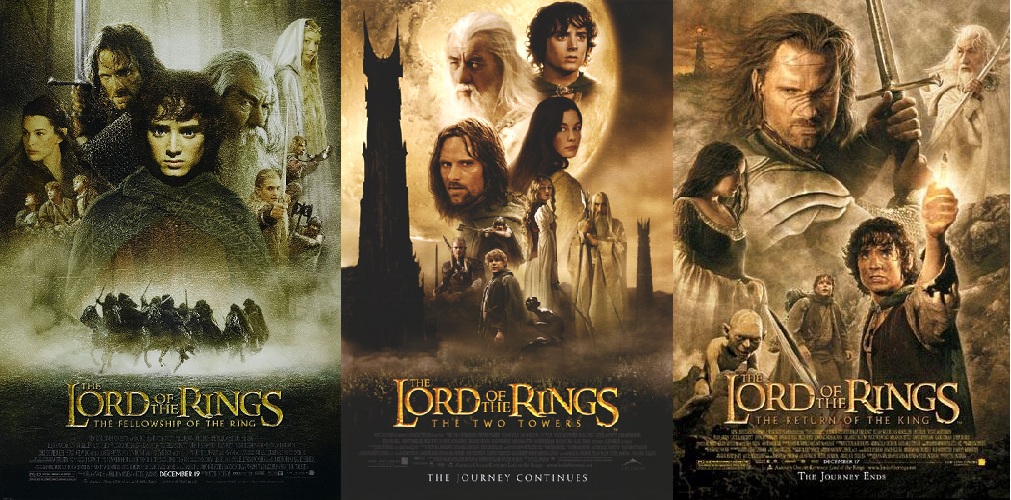
Film Friday: The Lord of the Rings (2001, 2002, 2003)

The Lord of the Rings trilogy is a top-notch fantasy action/ adventure and I absolutely and unequivocally recommend it. I own each film and have seen them many times. So if you love these films, let's stop there, mehl-on (that’s Elvish for “friend”). But if you want to see what’s wrong with these lifeless, shallow films and why they never came anywhere near their potential, then read on.

** spoiler alert **

Let me start by saying my criticism IS NOT that the films aren’t identical to the books. The Lord of the Rings trilogy are my favorite books, but I understand that books need changes to become effective films. My criticism IS that Peter Jackson made too many of the wrong kinds of changes, and thereby turned a nuanced, meaningful story with characters we care about deeply into an emotionless plot-driven film that's hard to care about.

Characters Lost: The first clue that something was going wrong with the characters occurred even before the film was released. One of the actresses gave an interview in which she repeated the marketing line that they were staying 100% faithful to the book, except where they absolutely had to make changes -- which is, of course, a lie. She then ominously said they had to change the characters because “the book doesn’t really have a lot of characterization.” This was a sign Jackson didn't understand the books and was about to strip the characters of their character to "Hollywood" them up. Consider these:
Frodo: In the book, Frodo resists leaving the shire. He’s not mentally or emotionally strong and he’s certainly not ready for an adventure, nor is he particularly mature. This makes his journey all the more impressive, as he must grow into the role thrust upon him. This is also why his decision to leave the group after Gandalf’s death is such a strong moment. He realizes he is endangering his friends and he chooses to leave them to save them. This is THE moment Frodo finally accepts his responsibilities, but we’re not sure he’s up the task.

Jackson tosses this away and turns Frodo into the modern fake-reluctant hero. While Frodo professes not to want to the responsibility, he is shown to be mature, competent and ready for the challenge, and he volunteers easily. Thus, there is no moment where Frodo grows up. There is never any doubt he would continue the journey with the ring after Rivendell. There is almost no motive for him leaving the group after Gandalf’s death, except that Boromir made him think his friends were becoming dangerous to him. Even the Nazgûl chasing him don’t seem all that dangerous because the film leads us to believe that he’s a competent adventurer ready to meet the challenge.

These are dramatic changes that rob the character of growth, the story of uncertainty, and the scenes of emotion. One of the key points in the book is that the least likely people can play vital roles in saving mankind. This is lost in the film because Frodo is set apart from the very beginning as a special character who is up to the task and only needs to be shown the direction to march. This cheapens his victories and lessens the drama of his choices.

Gimli/Legolas: Friendship Devalued: What Jackson does to Gimli is an atrocity. Book Gimli is a headstrong, excellent warrior who butts heads with the other companions. Moreover, as a Dwarf, Gimli dislikes and distrusts Elves, because of conflicts between the two races that go way back. This matters because it establishes the relationship between Gimli and Legolas, and sets up the group dynamic. Indeed, the ring companions don’t trust each other. They all have different motives and ancient grievances and this makes it hard for them to work together. But as they prove themselves to each other, they slowly earn each others’ trust and respect. Nothing shows this change more than the growing friendship between Gimli and Legolas, the most unlikely friendship in the group -- they don’t actually become friends in the book until Gimli greets Galadriel kindly, something he doesn't do in the film. Jackson throws this away and makes Gimli into pure comic relief. He also makes Gimli and Legolas into almost-instant friends.


Spot the dwarf. (click to enlarge)


This has several nasty consequences. First, it sucks out the very characterization Jackson claims is missing in the books because it denies Legolas and Gimli the chance to grow. Secondly, it eliminates an important dynamic within the group -- the need to come together. Third, it trivializes what they are doing. The world is facing its end as Sauron's rise is at hand. These people are fighting for their lives and the lives of all the other members of their various races. But Jackson’s decision to turn Gimli into comic relief turns this whole thing into a joke. Indeed, Jackson even has them engage in a counting game throughout the battle scenes, which makes their actions seem like a light-hearted videogame rather than the murderous struggle against desperate odds that it is.

Gandalf: When Gandalf dies in the book, it’s a shocking, weepy moment. In the film, not so much. Why? Because Jackson fails to connect us to his character. One reason is that his importance to the group isn’t obvious in the film because the group are already friends. Thus, nothing will change after his death. In fact, the group doesn’t even stop to mourn except that Boromir thinks the Hobbits need a break. The message: Gandalf is just an expendable member of the group. By comparison, in the book, Gandalf holds the group together and there's a real chance the group will fall apart after his death.

Also, the film never addresses what Gandalf means to the others personally. For all his skill, Aragorn is a lost soul. He literally roams the wilderness afraid to face his responsibilities, i.e. returning to Gondor and claiming the throne. Gandalf is the conscience trying to get him to face his responsibilities. Frodo has been manipulated into this quest by Gandalf with the assurance that Gandalf would always protect him. When he dies, Frodo must fend for himself and his will comes close to breaking. None of this makes it into the film. Aragorn is presented as a single-minded, determined hero, and his issue with reclaiming the throne is given short shrift in one quick scene with Liv Tyler. Frodo is the volunteer who is ready to take on the world. Because Gandalf’s importance to these people is lost, his death has little personal meaning. His death is no longer the death of a friend, a mentor, and the guiding hand that held them all together, he's just another member of the group. . . and one you don't even see that often.

Since he now means so little, his death means little to us. Since his death means so little, his resurrection means just as little. In fact, his resurrection isn’t even a resurrection in the film, it’s more of a reappearance. In the book, it’s clear Gandalf died and was reborn as Gandalf the White. In the film, he just sort of shows up again. Thus, the significance of his self-less act is cheapened, i.e. he goes from sacrificing himself for the group to just getting into a very hard fight.
CGI Stupidity: This is one of the most visually beautiful films of all time. They found incredible natural scenery in New Zealand, used fantastic costumes, and had stellar effects. Things like the city of Minas Tirith were flawless and amazing. But like children who can’t help themselves, they had to abuse the CGI:
Significance Diluted: Part of what makes the humans in LOTR The Book so heroic are the dire odds they face. The fact they stand their ground against these odds demonstrates their courage. Moreover, because of the small number of defenders, each death is tragic and costly. The film throws that away because Hollywood can’t stop itself from filling every millimeter of screen. Instead of the 2,000 defenders in Helms Deep mentioned in the book (including Jackson's gay hairdresser Elves) compared to Saruman’s 10,000 Orcs, or the 9,000 defenders at Gondor against Sauron’s 250,000 Orcs, the film creates a battle of millions on each side. Suddenly, the importance of any particular defender disappears. In other words, gone is an army of precious individuals and in its place the audience gets two giant CGI blobs slamming into each other. How can you feel any sense of loss for that? Not to mention, this makes some of the dialog pretty silly, like when King Théoden says, “so few came.” Really? There's no room for more on the field!

Not to mention this kills the realism. No battle in history, not Waterloo, Verdun or anything in World War II had anywhere near the number of troops shown on the field. This is probably more people than were alive in all of Medieval Europe. Thus, by trying too hard, they not only reduce the significance of each defender, but they create a battle that just doesn’t look real.

Moreover, even beyond the numbers, the CGI is downright stupid. Why does the movie begin with a line of Elves all the way to the horizon doing what appears to be a Dallas Cowboy Cheerleader linekick in perfect formation? Why is everyone wearing identical uniforms? And why are all the humans’ uniforms freshly laundered and their armor undented and shiny? Why are Orcs, an undisciplined army of thugs, standing in perfect Napoleonic squares? Why? Because everyone in Hollywood apparently suffers from Obsessive Compulsive Disorder combined with a uniform fetish. This is stupid and it sucks the realism right out of these battle scenes. Can I overlook it? Sure, just like I could overlook a cartoon rabbit defecating in the background of each scene, but that doesn’t excuse its inclusion in the film.

Realism Denied: Finally, even in up-close battles, the CGI people still go too far. Legolas in particular is subject to this. As he’s fighting the Orc Warg (wolf) riders in Rohan, he looks more like Rubberband Man than anything solid as he slides around the wolves and jumps from one to another to kill them off. Why are the war elephants at Pelennor Field 50 feet tall? It doesn’t make any sense or add anything. . . except that it lets the CGI people have Legolas swing from elephant to elephant like digital Tarzan, which they no doubt thought would be cool -- but just looks bizarrely unrealistic. These things detract from the realism the film otherwise works so hard to achieve. It’s literally like adding Roger Rabbit to Saving Private Ryan. And why include a fake-looking, comic-y “cave troll” in Moria in the middle of one of the most serious battles in the book? Because they couldn't stop themselves.
So let me finish with this point: my complaint is not that the movie is not the book (though I am offended they kept proclaiming they followed the book). My complaint is that the characters are lifeless and the story lacks any sort of emotion because every decision Jackson made reduced our emotional investment in the characters, reduced the reality of the film, and reduced the stakes for which they were fighting.

These things may not have interfered with your enjoyment, but you’ve got to admit that if Jackson had kept with what I say, this would have been a much stronger film.

[+] Read More...

Friday, March 4, 2011

Film Friday: Alice In Wonderland (2010)

I’m a fan of Tim Burton, but sadly he died right before making Corpse Bride. And rather than letting his memory rest in peace, the studio replaced him with a fake who’s been making films like Alice in Wonderland under Burton’s name. Alice is sloppy, unoriginal, and it kills the very spirit of what Burton was trying to capture. It’s studio-horrid.

** spoiler alert **

The Technicals

What can I say about this movie? Well, for starters, this movie is not for kids, even though Disney suggests it is. But feel free to disagree if you think your kids are ready to see eyes gouged out with needles, a moat floating with decapitated heads, and Alice drinking blood at the end. . . don’t worry, it’s purple, not red!

Visually, what Burton has done is pretty at times, but it’s all stolen. The Red Queen’s castle is Hogwarts with a different paint job. The White Queen’s castle is Rivendell from The Lord of the Rings. The way the animals were animated comes straight from the Narnia films. Some of the character actions (particularly the Dormouse) are straight from Labyrinth or Willow. And so on.

The writing is pathetic. There isn't a memorable moment or line in the film. The word choice is weak, the dialog is incomprehensible, and the plot is nonexistent. The story begins with a clichéd anachronism, as we’re presented with a lame leftist view of the British aristocracy as nose-picking, inbred fools. These people look like something from a Pride and Prejudice theme party, yet Alice acts like she’s from 1963, and this doesn't seem to bother anyone. For example, she's introduced right after burning her bra. . . er, refusing to wear her corset. She then roams around smugly and condescendingly insulting everyone. Fortunately for her, these characters are clichés and thus are too stupid to be able to fight back, so they just act shocked and cowed. She also skools the old businessman by telling him that she, a petulant, rebellious, stupid 19 year old girl who is prone to fantasies and unreliability should be given control over his firm's operations in China. Naturally, he agrees.

If I were to put a name to this “style” of storytelling, it would be "feminist revisionist period piece” or, more simply, “delusional feminist porno."

To try to seem clever during this opening, Burton and writer Linda Woolverton make several of the aristocrats mimic classic Alice in Wonderland characters, like the two nearly-twin girls who we are supposed to see as Tweedledum and Tweedledee, or the businessman we are to see as the White Rabbit. Of course, “clever” is a relative term as this trick has been done in virtually every other “child transported to fantasy world” story since The Wizard of Oz, and nothing original is done with it here.

From there, the story takes you nowhere. Alice falls down the hole, where she meets Johnny Depp, playing a schizophrenic cross between Michael Jackson and William Wallace of Braveheart. He looks like a methhead, and his character is ultimately pointless except as plot filler. Alice then learns that her destiny is to kill the Jabberwocky, and through a series of uninteresting plot points, she does. Ho hum. Along the way, she meets the Red Queen, who is bad, and she meets the White Queen, who seems to be doing a mix of pot and acid. There’s not much more to say about the plot.

Burton’s Real Failure

Alice’s Adventures in Wonderland (1865) has been loved by dozens of generations. What gives the story its staying power is the incredible world created by Lewis Carroll (real name Charles Lutwidge Dodgson). And what makes that world so incredible is that Carroll takes reality and turns it on its head by infusing the impossible with the illogical and making that reality. In other words, his world isn’t the real world only containing silly things, like The Hitchhiker’s Guide to the Galaxy, but it’s an entirely different world with a different set of rules. Thus, rather than being a mere story about strange events, Wonderland is a story about a unique place that tickles the imagination and inspires us to think about the possibilities of this new world.

Disney captured this spirit perfectly in its 1951 cartoon Alice in Wonderland, as Alice explores this world on our behalf and learns about its wonders. Tim Burton, based on his reputation, was expected to run with this concept and make the world even more fantastic or even more strange. He failed.

In the book and the Disney version, the world in which Alice finds herself is a reality. The characters within it accept its rules the same way we accept things like gravity and the way we know the sun to rise in the East. This is what creates the interesting tension, in that Alice finds herself in a world were everyone else knows what’s going on except her. And as she explores she finds that the impossible is not only possible, but common. Burton, however, tosses that structure away. What he presents instead is a world that is exactly like our own, and which plays by the exact same physical and logical rules as our own, only it contains strange looking characters with some odd traits.

That’s a huge difference. In the original and Disney worlds, we are pulled in as we learn the new rules and we love this world because anything is possible. In Burton’s Alice, by comparison, we get nothing of the sort. We already know the rules by which they live, and the only thing left to marvel at are the strangely dressed characters and their few abnormal traits. The difference between these two is like the difference between finding yourself at a tea party in a world with no physical laws versus finding yourself drinking tea at Michael Jackson's house.

Moreover, this gives the actors little to work with, and it shows. In most of Burton’s prior films, the actors could use the new realities of the worlds in which their characters live to find something to inject into the characters to make them interestingly bizarre, yet within the realm of normal for their worlds. Thus, the Joker’s psychopathic showmanship in Batman fit perfectly in his Gotham, though it would fail miserably in our world. Edward Scissorhands’ strange mechanical nature, Ichabod Crane’s terror at discovering a world of magic in Sleepy Hollow, and Pumpkin Jack’s inability to do joy instead of terror in Nightmare Before Christmas all infused these characters with drama, tension and depth. We understood who they were from how they fit in their worlds.

In Alice, there is nothing fantastic about the characters except that they are physically misshapen or strangely dressed. So the actors resorted to trying to seem “fantastic” by doing things like lisping their lines (Carter, Depp) or waving their arms around like idiots (Hathaway) or slinking about (Crispin Glover). But these things just make the characters look uncomfortable and out of place in this world, they don’t give us any sense of who the people are, nor do they make us think they are in some strange world. Instead, it feels like Burton simply shot this at a mental home. Compare that with truly unique characters like Disney’s Mad Hatter or the Caterpillar, who were fixtures of a different reality.

It really is sad. The studio took a guy with tremendous imagination and asked him to dream big, and what he came up with was a formulaic studio film using strangely-dressed characters all pretending to be crazy. Why even bother?

[+] Read More...

Friday, September 10, 2010

Film Friday: Deliverance (1972)

At first blush, Deliverance is just the story of four guys who go on a river rafting trip that goes horribly wrong. . . kind of the 1970s version of the modern hillbilly-cannibal slasher flick. But if you dig deeper, it’s actually a social commentary about the changing relationship between modern man and nature. It’s also the movie that solidified two ultra-negative stereotypes that have come to dominate how many Americans see each other today: hicks and elitists.

** spoiler alert **

Based on the 1970 novel Deliverance by James Dickey, the John Boorman directed film is the story of four Atlanta businessmen (Burt Reynolds, Ronny Cox, Ned Beatty and Jon Voight), who go rafting on the fictional Cahulawassee River in rural Georgia. The river is being dammed and will soon disappear, taking several communities with it. As they start down the river, they encounter a group of people who live in backwoods conditions. Toothless, dirty, and with little understanding of the world beyond 1930, these people become the enemy for the four men as they fight for their own survival.
Hillbillies v. Elitists
There has always been a tension between city folk and country folk. But until Deliverance, that tension wasn’t really as nasty as it’s become. Consider the portrayal of country folk in films like The Grapes of Wrath, Sergeant York or any number of films about the American South. Country folk were seen as simple, yet decent people, with a few bad apples in their midsts. At the same time, city folk were typically seen as bright, but impersonal and often yearning to return to the simpler life.

When told that his character "Toothless Bob" would need to rape another man, Herbert "Cowboy" Coward (with the shotgun) told the director: "I done worse."

Deliverance changed all of that when it create highly negative stereotypes for both groups. Instead of yearning to reconnect with the land, the four Atlanta businessmen are seen as condescending elitists who think they have the right to mistreat and ridicule the hillbillies. They see the hillbillies as a subspecies of humanity and are happy to let them know it. Thus, Reynolds goes so far as to insult these people to their faces, showing that he believes he can act with impunity to these inferior creatures. Beatty acts similarly, particularly pointing out their inbreeding, though he is more cowardly and thus talks about them only when he thinks he is protected by the group. Cox doesn't insult them intentionally, but he shows his condescension in the way he treats the hillbillies like children and is shocked when they demonstrate competence. Only Voight treats them as human beings. From this comes the stereotype that urbanites are cowardly and condescending types who see themselves as superior to ruralites and who feel they have the right to mistreat these people and impose their will on them. This has become a widely held stereotype in rural circles.

On the other hand, Dickey/Boorman’s hillbillies are dirty, inbred, toothless people who favor banjos, stills, shotguns and sodomy. This stereotype has easily overtaken the more noble view presented in the past. Indeed, the line “I'm gonna make you squeal like a pig. Weeeeeeee!” has become so infamous with urbanites that all you need to say is “squeal like a pig” and people who have never heard of this film know exactly what you mean.

Neither the hillbilly nor the urbanite stereotype is generally accurate, though there are people who fall into these categories (I’ve met both kinds). Nevertheless, these stereotypes have become so strongly ingrained in the American consciousness that people genuinely believe this is what they will find in the other, alien environment, i.e. small town or big city America. Indeed, the relationship between rural and urban America has probably never been worse than it is today, and these two stereotypes play prominently in explaining why that is. Deliverance is the movie that solidified these stereotypes.
Modern Man v. Nature
But there is more to Deliverance than sodomizing hillbillies. At its core, Deliverance is a movie about how these four distinct modern men handle their ordeal. And therein lies the social criticism and the real interest in the movie.

Three of the men represent distinct archetypes of the modern city-dwelling male. Burt Reynolds represents the throwback. He’s a man who worships sports, hunting and all things physical. He longs for the challenges presented by nature because they appeal to his primitive nature, and he disdains the modern world. He is aggressive, violent and acts without thinking. Ronny Cox is the polar opposite of Reynolds. He represents the modern intellectual. He can see all sides of every issue and is paralyzed by his inability to settle on a course of action. In the civilized world, he probably holds significant power, but his skills at handling theory count for nothing in the wild. Ned Beatty represents what happens when man loses touch with the physical world. He is fat and soft, weak and cowardly. His total surrender to modern convenience has made him helpless. Finally, Jon Voight, the fourth, represents the bridge between them. He is physically capable without being the beast that Reynolds is. He is smart, but in a real world sense rather than Cox’s theoretical sense. And he enjoys the creature comforts, though he has not become dependent upon them as Beatty has.

What they endure becomes a test of these archetypes, a test which all but Voight fail. Reynolds fails because his aggression brings on all of their problems. He alienates everyone they encounter, foreclosing any chance of getting help from the locals and fostering the suspicion that isolates the four. Moreover, his aggressive disdain for the weak Beatty makes teamwork impossible, leading to the two canoes splitting up, which makes them vulnerable to being attacked. Beatty collapses in a pool of his own helplessness and loses his manhood as the self-emasculated Beatty’s fate is to be sodomized by the hillbillies. Cox becomes paralyzed with indecision because he can’t pull his head out of the world of theory long enough to come to grips with the real world. His rather symbolic fate is to die when his head disappears beneath the water. Only Voight is capable of rising to the challenge.

And within this formula, Dickey lodges several criticisms. First, he argues that the throwbacks are the cause of our problems because of their mindless aggression. . . an argument made by elitists today. But he also argues that the intellectuals cannot help us because they can’t come to any conclusions on real world issues. . . an argument made by middle-Americans today. He also argues that modern humans have become so dependent on the comforts of the modern world that they would simply die if left in nature. . . an oft-repeated criticism that has become more and more valid as obesity rates rise and reliance on the internet takes off. And in the end, he tells us that the solution is to be as Jon Voight -- stay in touch with our physical natures but don’t let them dominate us, use our minds but don’t lose touch with the real world for some theoretical existence, and enjoy the comforts of the modern world but don’t become dependent on its conveniences.

These are themes that touch a nerve in modern America, where we are quickly losing touch with nature and what it takes to survive away from our modern conveniences. This is why the past forty years have seen concerns about the Alan Alda-ing of America, why ridiculous camps have appeared for males to “rediscover” their primitive side, and why such an animosity has arisen between city dwellers and country folks. We are living in a moment where our relationship to the natural world is changing significantly and it’s not clear yet how it’s all going to turn out.

[+] Read More...

Monday, August 3, 2009

Harry Potter: Conservative Hero

Whenever a new Harry Potter movie rolls into theaters, conservative political pundits whip out the long knives and go after the books. Strawman after strawman is torn asunder in a veritable strawbath of ill-informed and poorly-reasoned diatribes of the type that can only come from the poisoned pens of people who have never read the books. So let’s cut through some of the garbage, and reintroduce you to this unfairly maligned series.

At its core, the Harry Potter series is a truly conservative, i.e. classical liberal, work. Seriously. It imparts excellent values, values that should make conservatives giddy. But before we detail those values, let us dispatch the complaints of the unread punditocracy.

And Although I Know It’s Strictly Taboo. . .

The complaints of these “conservative” pundits generally come in three flavors of stupid: gays, witchcraft and rewarding misbehavior.

The gay complaint holds that Harry Potter promotes homosexuality because Dumbledore is gay. Oh my! But when did being gay become inconsistent with being conservative? It’s not. And if the complaint is that no book that includes a gay character can be conservative, then one wonders what is left for these pundits to read. . . assuming they can read. Hence, a few of the more clever pundits, will assure you that they aren’t opposed to gays, it’s just that Dumbledore promotes the gay lifestyle. Really? Does he take a lover? Does he attend a parade? Hand out pamphlets? Shower the crowd in condoms? Take Harry to a Turkish bathhouse? No, this issue is never mentioned in the books. In fact, Dumbledore’s sexuality was never brought up until after the books were all published.

The complaint that Harry Potter promotes witchcraft is almost too stupid to mention, except we saw this once before. . . during the the great Dungeons & Dragons crisis of 1983, when millions of young children sold their souls to the devil and disappeared in a fiery poof. Tragic. In any event, it is worth pointing out that (1) this silly complaint would apply equally to the entire fantasy genre, so put down that copy of The Lord of the Rings you Satanist, and (2) unlike The Golden Compass, which truly is anti-Christian, Harry Potter makes no attacks on any religious figures, principles, or beliefs.

The third complaint usually involves some moment where Harry “does not pay” for his “bad behavior.” But these complaints are typically made by people who have not read the books. For example, in a silly recent diatribe, one shrill conservative pundit proclaimed that Rowling “ignores ethics and encourages dishonorable behavior” when Harry “cheats” by using “a textbook that has all the answers in the margins,” and he’s not even punished for it! For shame! Thus whines said critic: “Rowling’s readers will conclude it’s OK to go on eBay and buy a teacher’s edition of a textbook.” Or critique a book they haven’t read! The horror, the horror. What this whiner misses is that the “answers” written in the text book are not “answers” to test questions, they are the work of a rather genius young wizard who invented dozens of new spells, most of which have nothing to do with the class itself. A more accurate conclusion would be “Rowling’s readers will conclude it’s OK to go on eBay and buy an independent study guide!” But that doesn’t have the same ring to it.

Moreover, in terms of not getting busted, some of these spells prove to be quite dangerous, and when Harry injures a fellow student using one of these spells, he gets showered with disdain and ostracized by his fellow students. Indeed, most of the series is about Harry making mistakes, for which he pays and from which he learns.

But enough of sweeping away straw. Let’s talk about what makes the Harry Potter books conservative books.

What Makes Harry Potter Conservative

I will save for another day what it takes to consider a particular film or book to be a conservative work. Suffice it for now to say, that we should not consider a work conservative unless it promotes themes that are philosophically conservative, and it does so consistently. In that regard, the Harry Potter series delivers time and time again.

Consider, for example, that the bad guys throughout the series read like a who’s who of things conservatives despise:
• Government. A common theme throughout the books is that the government not only cannot help you, but will actually abuse its power to harm you. The Ministry of Magic is hopelessly bureaucratic, and ultra-intrusive. It regulates every aspect of Wizards’ lives, right down to how caldrons are measured -- regulations which are usually mentioned derisively. And when Dumbledore begins to warn the world that Voldemort has returned, the MOM demonstrates the evil to which it can sink. It tries to discredit Dumbledore, just as it tries to discredit Harry. When this proves ineffective, it tries to drive Harry from the magic world through a Soviet-style show trial. It then drums up fake charges against Dumbledore (something about a Turkish bathhouse), and chases him from Hogwarts, where he is replaced with a woman who sets about imposing an educational agenda that seeks to lower all children to the lowest common denominator. The government seizes key industries, denies the truth, and locks up its opponents. Sounds like somebody read Ayn Rand.

• Elitists. The Malfoy family and their allies are the epitome of hereditary peers, if you’re English, or establishment elitists, if you’re American. They are out of touch, they despise ordinary people, and they are corrupt, inbred and non-productive -- think John Kerry.

• The Cult of Personality. The Death Eaters, Voldemort’s followers, worship him and fear him in a strange cult of personality. They do as they are told without question. “Yes we can, my master.” Nothing is more classically liberal than thinking for yourself. Nothing is more modern liberal than believing what you are told by your betters.

• Evil. Voldemort represents something rarely seen in liberal thinking, an evil man. He is evil to the core. He is not misunderstood, nor was he driven to evil. And while he claims various motivations, the series never once hints that we should sympathize with him or that his past excuses his present. If you put the second book to your ear, you can actually hear an ACLU lawyer weeping.
Consider also the multiple conservative themes that run throughout the series. For example:
• Rejection of Moral Relativism. Unlike much of modern liberal thinking, Rowling does not accept the shades of gray theory. The good guys are good and the bad guys are bad. It’s black and white. Readers are told repeatedly that you cannot do evil and remain good, even where evil seems to offer an easy solution. We are also never asked to consider root causes. And whenever good characters suggest that an evil character might only be evil because they feel pressured (like Dumbledore suggests about Malfoy or Tom Riddle), those characters always prove that people who do rotten things tend to be rotten people.

• The Value of Hard Work/Self-Reliance. Unlike heroes in most modern stories, Harry is actually nothing special. He doesn’t have super powers. He’s not smarter or wiser or stronger or faster than the other kids. What Harry does have going for him, is a group of people who care about him and who drive him to work harder. When he does, he succeeds. When he doesn’t, he fails. It’s that simple. In the Harry Potter world anyone can succeed if they work hard; hard work gets rewarded. Education gets rewarded. Having something handed to you, or waiting for someone to hand it to you, gets punished. What could be more conservative than that?

• Belief in Traditional Families. The series repeatedly stresses the importance of the traditional family. Harry’s mother and father died to protect him, and in so doing, put a charm on him, that protects him so long as he has family, even when that family is nasty to him, i.e. the family bond survives good times and bad. The happiest people in the series are the Weasley family, who impart invaluable lessons about love, responsibility and all the other things your parents taught you, even though the Weasleys are poor. By comparison, the messed up kids, from Neville Longbottom to Luna Lovegood, come from single parent homes. Even Malfoy, who does have both parents, is raised in an unbalanced family where the father dominates the mother. The implication is clear throughout the book: a strong family is the best foundation. Love your parents, love your kids, and think more about them than yourself. Indeed, the greatest moments in the book involve self-sacrifice to save family members.

• Pro Capitalism. Harry Potter is also unabashedly pro-capitalism. Time and time again, it is the private sector, not the government, that is shown to be superior. This is true from the pro-commerce Diagon Alley, to the way The Quibbler (a tabloid) rises to meet consumer demand for the truth when the main paper falls under the influence of the government, to the Weasley brothers being a walking advertisement for the joys of starting your own business. Whereas the government world is seen ad drab and oppressive, the private sector world is always vibrant and active.

I don’t know about you, but those seem like pretty conservative values to me.

[+] Read More...