Showing posts with label Sam Worthington. Show all posts

Friday, March 30, 2012

Film Friday: Clash(es) of the Titans (1981) & (2010)

The 1981 version of Clash of the Titans really was an inspired movie. Clash 2010 wasn’t. In fact, it stank. And what better way to explain why it stank than to compare the two?

** spoiler alert **

Clash 2010 has better production values. Its costumes are more realistic. It has better scenery and thus feels more real than Clash 1981. The supporting actors are better too. Mads Mikkelsen is excellent as Draco, as are Liam Neeson and Ralph Fiennes as Zeus and Hades. After that, however, things gets sketchy. . .
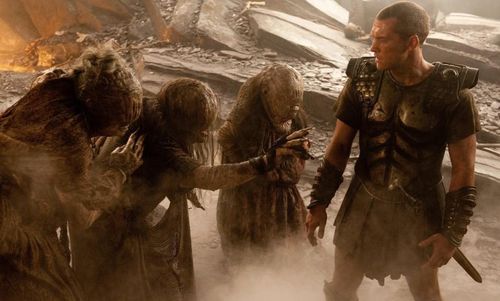
Surprisingly, the effects in Clash 1981 are better, not in the technical sense, but in the sense of enjoyability. The effects in Clash 1981, done by legendary special effects man Ray Harryhausen, feel more lively and maintain the spirit of mythology which surrounds Ancient Greece. You know these characters when you see them in Clash 1981. By comparison, the effects in Clash 2010 are dreary and nondescript -- you’ve seen them in a dozen other recent films and wouldn’t spot them as Ancient Greek creatures. If you were asked to draw or describe the creatures in each movie, you could easily describe the creatures in Clash 1981, but those in Clash 2010 would end up just as blurs. And that makes a huge difference in how memorable these films are.

The lead actors in Clash 1981 are better as well. Harry Hamlin portrayed the heroic young Perseus perfectly. He had enthusiasm, brashness, and was clearly captivated by Andromeda, whose life he must save. He also let the character be just naive enough that we could discover the world with him, which pulls the audience in, without making him stupid. Judi Bowker similarly gave Andromeda a regal dignity and a flirtiness in her interactions with Perseus, which made her worth saving.

By comparison, the lead actors in Clash 2010 are crap. Sam Worthington gives his usual lifeless effort. He’s dull and dumb and stiffer than a board. He whines. Even worse, his character is impossible to like. He lacks initiative. He’s not clever. He doesn’t want to be the hero, as he keeps telling us, yet for some reason he just keeps moving right along with the plot. It’s like he just had nothing better to do. He also cares so little about Princess Andromeda that you wonder why he’s bothering to save her.

Andromeda is just as bad. She’s played by Alexa Davalos, who you might remember as Olivia Wilde or Emily Blunt or Megan Fox. She’s as lifeless as Worthington and basically just mopes and occupies space. We are given no reason to like her other than her being smarter than the hillbillies around her. Frankly, by the time the mob gets her, it’s really hard to care. Heck, she doesn’t even seem to care.

But where Clash 2010 really falls apart, compared to Clash 1981, is in the substance. Clash 1981 may not have been authentic Greek mythology, but it gave you the sense that it was. The characters, the creatures and the gods all acted correctly according to what we know about them from mythology. Clash 2010 is too modern to make that claim. Consider the gods. Greek gods were flawed because they had (near)absolute power combined with the worst of human traits. They were petty, vengeful, jealous, vain, deceitful, etc. They were narcissists of the highest order, and Greek mythology crawls with their misdeeds.

Clash 1981 captured this as the story revolves around a series of characters who get caught up in the petty quarrels and sexual trysts of the gods. Indeed, the primary story involves vengeance on the people of Joppa for offending the vanity of the goddess Thetis. These gods lie and cheat and abuse their power to get their way, which is how Greek mythology paints their gods. By comparison, the gods in Clash 2010 are a reserved lot. They are mostly caring and largely passive until they are forced to act -- except Hades who has a grudge against Zeus. Indeed, they only punish the city of Argos because the people of Argos declared war on the gods first. In effect, Clash 2010 has Christianized the gods, and rather than being a gang of ultra-powerful but petty thugs, Zeus in Clash 2010 is more like the Christian God of the Old Testament and Hades is like Satan. In fact, Zeus is so caring that the thrust of his story is Zeus trying to reconcile with his bastard son Perseus. Huh?

Along similar lines, the people of Argos don’t make any sense either, and this leads to a larger point. They have declared war against the gods, but for no apparent purpose. There is no indication what they hope to achieve, nor is it ever clear if this is a philosophical issue or something else? In other words, is this a declaration of atheism or do they just want to be rid of these gods? At times the story seems to be crawling with atheistic messages, but it always undercuts itself. For example, Perseus whines repeatedly that he has no need of the gods and he’s his own man. Only. . . he’s not. In almost every scene he’s helped by the gods while the writer pretends Perseus “does it himself.” He gets magical gifts. Zeus gives him tokens he will need. The gods send an advisor/guardian angel who tells him everything he needs to know. His strength and fighting skill come from the gods. He is even told that it is his destiny to free man from the gods? Think about the ludicrousness of that statement – the mythical force of destiny has chosen Perseus to free man from mythical forces? So is this film about atheism? Who knows? The film sure doesn’t.

The problem here is that the writers never bothered to fundamentally understand the nature of the characters. Are these gods or just foreign tyrants? Are the people of Argos declaring atheism or just swapping gods? And if they’re just swapping gods, what are they seeking instead? There’s a big underwear-Gnome-class hole there. Is Perseus a hero or not? Everyone treats him like a hero, yet he achieves nothing on his own -- he is always relying on others to win his fights or tell him the way to go. Etc.

Even the mythical creatures don’t make sense in Clash 2010. Pegasus, the winged-horse which cannot be tamed, simply comes to Perseus like any other horse -- he doesn’t have to find it or tame it (nor does he really need it). Calibos, the man Zeus twisted into a wretch for killing all the winged-horses except Pegasus and who pines for Andromeda, is now little more than an animal who attacks Perseus because Hades tells him to. The deceptive and cryptic witches are neither deceptive nor cryptic. And Medusa is little more than a tall snake.

Moreover, the writers keep undercutting the story. Perseus needs to save Andromeda because. . . well? He doesn’t live in Argos and he can leave any time. He doesn’t love Andromeda either -- halfway through the film it is imply he kind of digs the girl the gods sent him (Io). So why is he trying to save Andromeda? And she doesn’t really want to be saved either. So why should we care? In Clash 1981, Perseus loved Andromeda and she really seemed to want to live. That made sense. In Clash 2010, that’s gone.

They keep undercutting the tension too. For example, Clash 2010 tells us Perseus is a poor “everyman” -- a fisherman who’s never even held a sword (what Greek male never held a sword?). But then we’re told he’s the bastard son of Zeus, and he has special powers. And when he picks up a sword for the first time, he proves to be the ultimate swordsman. . . so much for our everyman. Think about what this does to the rest of the film. With Hamlin’s Perseus, you never knew how he would do in any fight. He got gifts from the gods to help him, but he had no extraordinary skills with which to use them. Perseus 2010 does, thus with Worthington, there’s no suspense. He will win every sword fight. Yawn. Similarly, in Clash 1981, Perseus needed to figure out the puzzles himself. In Clash 2010, Perseus is given advisors directly from the gods to make sure he figures it out. Yawn. We’re even told it’s Perseus’s destiny to win the movie. Yawn.

Clash 2010 is the perfect example of what happens when you take all the “things” out of a movie but none of the substance, and then remake the movie using those things. What you get is a truly forgettable, generic film.

[+] Read More...

Tuesday, December 21, 2010

Film Friday: Avatar (2009)

Avatar, a.k.a. Dances With Smurfs, is a crappy movie. There is no other way to say it. If someone tells you they liked this film, punch them in the face. Not only is this the most politically correct film ever, but it’s poorly acted, poorly written and deathly dull. I feel like I’ve lost a portion of my life watching it.

** I would insert a spoiler warning here, but you can’t spoil this film. **
The "Plot"
Oh where do I begin. An evil corporation has invaded some planet (the unoriginally named “Pandora”) so they can mine something called “unobtainium” -- a word stolen from the infinitely better yet still crappy movie The Core. This unobtainium does something. We don’t know what exactly because James Cameron wasn’t smart enough to come up with anything, but just take it on faith that it’s important.

The main character, Jake Sully (we’ll call him “Lifeless” in honor of the acting non-talent of Sam Worthington), is a former Marine who lost the use of his legs. . . probably from sitting through this film. He takes a job on planet PandaOdor where he will be an avatar operator. What's an avatar you ask? Basically, Ripley from Alien came up with the idea that if you want to exploit a native people, you gotta look like the native people, then you can trick them into trading their land for your beads. So she invented these body-suit things that look like the locals. We aren’t really sure how the suits work or how they’re made because Cameron didn’t care about this aspect of the film. But don’t worry about it, you won’t care either because your mind will be numb by this point in the film. . . ten minutes in.

Lifeless’s job is to operate his avatar in such a way that he endears himself to the locals, a tall blue race called the Na’vi, who look an awful lot like Smurfs who’ve spent time on a Medieval torture rack. After a boring, boring, boring 20 minutes of watching animators try to make Lifeless emote as he runs through the forest of this standard videogame world, Lifeless comes up with a plan. He decides to get himself attacked by wild animals in the hopes that some borderline-retarded princess of the Na’vi happens by and saves him. Of course this works because you can’t swing a dead panda on PandaOdor without hitting a Na’vi princess and because chicks can’t resist a dude who is helpless, rude and stupid.

After a few more minutes of scenery and some pidgin English, these two fall in love and the Smurfs make Lifeless a trusted member of their tribe. Retarded-Princess then mates with Lifeless’s avatar. . . somehow. . . before we are “treated” to another thirty minute scene where Lifeless runs through trees and learns to fly on the backs of creatures on Smurfback Mountain as the other Smurfs learn to accept him and see him as the chosen one.

Suddenly, it’s back to the plot. For reasons Cameron never bothers to explain, the evil US Military decides that since they can now succeed with their plan of gaining the Na’vi’s trust, now would be the perfect time to ditch that plan and instead start killing them for fun. What?! Those aren’t the US military, you say? Well, you could have fooled me. Then the “plot” stops, a fight ensues, a lot of people die, as do many Smurfs, and forty minutes later the evil military loses and Lifeless becomes the leader of the Na’vi. Roll credits.
The Characters
Now that you know the plot, let’s talk about the characters. The characters are awful.

First, you have Lifeless. He’s a pointless character with little to add to the movie despite being the main character. His role is clearly a copy of Kevin Costner’s role from Dances With Wolves, but Worthington comes across more like a mental patient whose thorazine wears off every once in a while. Indeed, he seems incapable of displaying any emotions, despite suffering wild mood swings -- “I hate this place,” “no, I love this place, it’s paradise,” etc. etc. His character also is prone to saying really stupid things, but that’s ok because the other characters aren’t listening. In fact, one of the first things you’ll notice about this film is that none of the characters speak to each other, they deliver speeches to the audience. If it weren’t for the fact they do touch each other once in a while, you’d almost swear they filmed their parts separately and never met. Even simple lines, like "good morning fellow capitalist oppressor," seem to be spoken past the other characters.

The main bad guy is Colonel Cliché, who has a severe disability which prevents him from saying any line you haven’t heard in another film. He loves to kill. Sigourney Weaver plays a woman who occasionally uses scientific terms and then dies. She likes to be rude to people. And there are a whole bunch of other actors too, who presumably do something plot-wise, though it’s not really clear what. Finally, there are the Smurfs, whose main job is to speak like cliché American Indians, while pretending they aren’t American Indians. Not much more to say about them.
The “Writing”
The writing is awful. In fact, there wasn’t really a single line in the film that didn’t make me cringe. Every sentence was cliché-ridden and predictable. The word choice was around a fifth grade level. There was nothing subtle in the writing either. If they want you to know a particular character can’t be trusted, they will literally have multiple characters come on screen and say, “You cannot trust Character X.” And the only memorable line in the film was “The End,” words for which I was truly thankful.

The Political Correctness
Now that we’re done talking about the good parts of the film, let’s talk about the most serious problem with this sucker: this film is pure leftist propaganda. Every single line delivered in this film is crawling with politically correct bullsh~t. Seriously, these people can’t say good morning without making some leftist crack. These characters don’t speak, they make speeches. And here’s what they say: corporations are evil. The military is evil. Scientists who do the bidding of evil corporations or the military are evil. The American Indians are noble creatures who lived in an ideal world where no one died and their gods literally existed and everyone was a vegetarian and loved each other until whitey came along and killed them all and herded them into casinos. Save the environment from capitalist whitey and the military. The war on terror is evil. The American military are terrorists, shock and awe is evil. Shave the whales! Down with whitey!

The anti-white message in this film was particularly obnoxious. All the bad guys were white. In fact, the only minorities on staff (the Indian dude and the Hispanic chick) quickly changed sides and betrayed whitey to aid the Smurfs, as did all the women and the handicapped guy (what, no gays?). Whitey Colonel Cliché even asks Lifeless how it feels to betray his race, which may have meant “human” in this instance, but sure sounded like "white."

But before James Cameron goes patting himself on the back for being a full-blown worshiper of oppression theology, let me point out one irony. Why is it, James, that the only person who can save the backwards Na’vi is the white dude? And why would these peaceful people make him their leader, as they apparently do at the end of the film, when his only qualifications are being a solider and being a white dude? Are you saying that a moronic white dude is the best and brightest on their planet? That seems kind of racist. Seriously James, it’s amazing how easily your screed against white oppression seamlessly morphs into the noble savage fantasy that was so popular among empire builders in the late 1800s. I guess you see yourself as the man who would be king?

The anti-military message was obnoxious as well. All the soldiers are drawn entirely from the paranoid Hollywood clichés of soldiers. They are bloodthirsty and irrational and long for nothing more than subjugating the scientists and businessmen who run the show, just so they can kill the Na’vi because. . . well, just because. Sounds to me like James Cameron must have had a bad experience with a solider at one time. . . in a mensroom.

Unfortunately, these messages permeate everything you see and hear in this crap-fest. Indeed, there wasn't a line of dialog that didn't push these ideas. And that was a big enough turn off to anger me, whenever I awoke from my periodic movie-induced comas.
Conclusion
To sum up this film, all I can really say is that it swings wildly between boring and offensive, with a pretty lame videogame thrown in between. I am glad this turkey will be forgotten in a couple years, but saddened that James Cameron made any money. Maybe he’ll get robbed. . . now that is a happy thought!

[+] Read More...

Friday, April 30, 2010

Film Friday: Terminator Salvation (2009)

Terminator Salvation (“TS”), apparently, was written by machines, because there's little in it to interest humans. Like so much of what comes out of Hollywood’s sequel generating computers these days, TS is a soulless, halfhearted film that squanders a tremendous amount of potential. It goes wrong at the outset, in its basic story, and keeps going wrong(er) with poor story telling, indifferent characters, and wasted talent.

** spoiler alert **

As I’ve mentioned before, science fiction is one of the most interesting forms of story telling because it can touch upon any topic and it can delve into the kinds of questions that fascinate us. Terminator introduced the very cool premise of what happens if a bad guy from the future goes back in time to kill the parents of the good guy before he was born. Can you save the future? Terminator 2 expanded on this premise by asking whether you could change the future for the better now that you know what will happen. Terminator 3? Well, T3 did a “by changing the past, you cause the future” thing, but mainly they just wanted to see Arnold fight a chick in tight leather pants.

TS follows these films with the promise of moving the franchise into the future, after the machines have struck. So far so good. It follows John Connor (Christian Bale), who leads the Southern California branch of the human resistance against the machines. At this point, the Arnold terminators have not yet been created. Still good.

But then the problem starts. The machines have created a terminator, Marcus (Sam Worthington), whose job is to lure Connor to Skynet headquarters so he can finally be killed, because all their prior efforts failed. Yet, at this point, the machines wouldn’t know who Connor is. Indeed, the writers just assume the machines know exactly what happened in T1, T2 and T3, even though, from the machines’ perspective, none of that has happened yet and won’t until after they build the Arnold terminators, until after Connor become the leader of the resistance, and until after Kyle Reese grows up. For all the machines know at this point, Michael Ironside (who plays himself) is the leader of the resistance. So why are the machines fixated on Connor and why do they know how T1, T2 and T3 turned out?

This is a plot hole. But it’s more as well, it’s squandered potential. By skipping the time travel questions and assuming that everyone knows everything, the writers made the story much easier to write, but they also sucked out the very thing that made the first three movies so interesting -- the paradoxes. Moreover, in so doing, they sacrificed the chance to use the audience’s knowledge of Connor's importance, and the machines’ lack of knowledge, to add tension to the scenes. Wouldn’t it have been more interesting if the machines somehow made a decision that let Connor survive because they didn’t know his value? They also toss aside the chance to use Connor’s knowledge to tell us something interesting about his character, like how he might struggle with issues like fatalism or cockiness since he knows the future. Wouldn’t it have been more interesting to see how Connor handles having knowledge of the future? No, not to these writers. . . they just wanted simple plot points that moved the story from fight scene to fight scene.

And what about Marcus? Marcus is a prototype infiltrator terminator, who doesn’t know he’s a machine. This is classic science fiction story telling, because it lets the writer explore what it means to be human. But once again, these writers aren't interested. They just have Marcus move from scene to scene engaging in fights until he finally faces the difficult decision of “do I side with the machines or the humans” -- an "agonizing" decision that takes him 1/10th of a second to make and which he makes without ever sharing his thoughts with the audience. I guess the writers figured the audience wouldn’t care?

This lack of interest in the story is compounded with very poor storytelling. One of the axioms of storytelling is “show, don’t tell.” Yet, this movie has it backwards. Connor is the “prophesized leader of the resistance.” How do we know? Is it anything he does that makes him stand out? No. They tell us. That's it. Connor is married to Kate Connor (Bryce Dallas Howard). How do we know? They tell us. Is there a single scene that makes their marriage real? Nope. Connor is a great threat to the machines? Yep. Does he do something special? Nope. How do we know? We’re told. And they don't even bother telling us that much. Where did this resistance come from? Where do they get their weapons? Why isn’t Connor the leader? Don’t know, they don’t tell us.

Imagine how much better this movie would have been if they’d fleshed out the characters by trying to show us who they are and what they believe? What if they dealt with the time travel question rather than skipping it? What if they let Marcus explore his inner conflict? Naw. . . look shiny!

That’s why this movie stinks. It’s not Bale’s one-note acting (his best work from this film came here (NSFW)). It’s not the effects, which were quite good -- though they heavily ripped off War of the Worlds with their visual and sound effects. It’s not the good actors who were wasted in this film -- I am a fan of Bale, Howard (The Village) and Common (Smoking Aces), but they did nothing. It’s the total indifference to story telling. In fact, TS was so bland I thought long and hard about ditching this article and instead writing about Lady Gaga’s “Bad Romance” video instead, which I found more interesting. Sad.

[+] Read More...