Showing posts with label Stanley Kubrick. Show all posts

Tuesday, January 13, 2015

Kubrick: Will Dr. Strangelove Survive The Test Of Time?

Some time ago, I ran across an article which opined that Stanley Kubrick’s 1964 classic Dr. Strangelove would remain popular forever. I don’t buy it... not at all. To the contrary, I think Dr. Strangelove and Kubrick are both fading fast.

The article in question begins with the author stating that Dr. Strangelove is now 50 years old and just happens to be a film the author “constantly revisits” as a “favorite cinematic exercise in Kubrick’s storied career.” The author then notes that the purpose of their article is to “highlight those elements” of the film which provide the film with “its continued relevance to a post-Cold War society” and basically to explain why this film will remain popular forever.

Ultimately, however, the author comes up with little to nothing. Indeed, while at first glance the author appears to identify several elements which could arguably support the idea that the film could remain relevant and funny to future generations, it quickly becomes obvious that the author has simply repeated one idea over and over and over: this film will last forever because Kubrick used dark humor to parody something which scared the author and his friends... the potential of nuclear war being caused by crazed (American) leaders. But that point is a faulty point.

Here are the arguments given by the author:
(1) Kubrick’s use of humor and satire to tell a Cold War story was bold and innovative... a Cold War story, people!... a scary Cold War story about nuclear war!!... told with humor!! That’s fricken BOLD!!;

(2) Kubrick did this when Cold War saber-rattling was at its worst and terrified us all, ergo it was SUPER BOLD;

(3) the book this film was based on was a serious book, but Kubrick turned it to satire... a BOLD choice!!!; and

(4) Kubrick pokes fun at the military’s “mindless patriotism” and suggests that “warmongering is the business of men with sexual inadequacy issues,” thereby turning an anti-military indictment into a parody!
As I noted, however, each of these arguments is ultimately the same idea, that Kubrick was brilliant to use parody to address a topic which scared us then and continues to scare us today. But that’s wrong. Indeed, for his thesis to work, the author assumes that we are all terrified by the idea of crazed, incompetent Americans starting an insane nuclear war with the Russians. But that’s just not true.

The Cold War is dead and gone and younger generations don’t care about it. It is ancient history to them. They do not hate or fear the Russians, they never saw a Soviet, they don’t understand the ideological goals of communism nor have they seen it backed by military muscle, and they never grew up worrying about a nuclear exchange. Even my generation didn’t see nuclear war as something to worry about. We didn’t see it happening and if it did, there was nothing we could do about it. So at best, we were fatalists – something you see reflected in much of 1980's culture. And few Americans ever bought into the idea that our military is bloodthirsty or wants a nuclear war. So the author's premise that these issues resonate with us all is flat out wrong.

Nor can I say that Kubrick has done anything uniquely interesting in attacking a serious subject with satire. The author seems amazed by this, but I can name a dozen earlier films that did the same thing, like Chaplin’s The Dictator. And there have been others that followed, like Spies Like Us. So Kubrick’s film hardly stands out as unique in that regard. Moreover, Kubrick’s parody feels dated today as the modern military simply doesn’t look or act like the one being parodied, as the Russians are no longer the threat they were – in fact, nothing has replaced their omnipresence as an existential threat, and as many of the gags feel like they would no longer work in the age of computers and cells phone and live-satellite surveillance.

All in all, when I look at Dr. Strangelove, I see an interesting historical curiosity that was well done and deserves to be seen as a classic, but has no punch today. There is nothing about this film that feels the least bit relevant today, the gags feel dated and oft-copied, and none of the key elements that make this film work feel like they could happen today.

Moreover, I am starting to see Kubrick’s star fading. Indeed, while Kubrick was once seen as having entered the pantheon of eternity as one of the greatest directors of all times, since his death, he seems to be slipping fast into the ranks of good, but not-divine directors.

Why do I say that? Well, one way I judge longevity is by paying attention to how often films end up on television and how often they get referenced throughout the rest of the culture. A decade ago, Kubrick was everywhere. His films were a regular staple on various channels... A Clockwork Orange, 2001, Spartacus, The Shining, Eyes Wide Shut, etc. were on every week. Sitcoms, other films and politicians referenced them. They were parodied by other films. New films by Kubrick were an event. And Kubrick’s name automatically came up without dissent in discussions of the best directors ever.

None of this is true anymore, however. Outside of The Shining, few Kubrick films get much play these days. I can’t think of the last politician or political cartoon to mention his films. No one parodies his films anymore. And, since his death, he seems to be increasingly forgotten in the discussion of the great directors ever, with people being more interested in discussing whether Christopher Nolan and James Cameron should be on the list.

Now don’t get me wrong, as I’m sure some are already planning, but I’m not saying that Kubrick has been excised from the culture or that Dr. Strangelove will never be seen again. I’m sure he will always remain on the lists of film buffs and his films will continue to find a home on “classic” channels. But what really I’m saying is that Kubrick seems to have fallen a notch from the eternals to the really good, and his films now seem like a thing of the past rather than an influence on the present and something to be passed on to the future. And like it or not, I just don’t see Dr. Strangelove continuing to relate to future generations as it has no relevance to their lives.

Thoughts?
[+] Read More...

Friday, July 15, 2011

Film Friday: The Shining (1980)

You would think I wouldn’t like The Shining. Why? Because I don’t like Stephen King. His work is formulaic and stolen. Also, I respect Stanley Kubrick much more than I like his films. So I should hate The Shining, right? Well, no. At one point, King was a talented writer and The Shining was his high-water mark. And while I find Kubrick’s work lifeless, his casting of Jack Nicholson made this film great. Plus, there’s a lot more to this film than at first appears.

** spoiler alert **

You all know the story. Jack Torrance (Jack Nicholson) gets a job as the caretaker of the Overlook Hotel, where he and his family will be snowbound during the winter. He plans to use the time to finish his book. But things don’t go as planned as he and his son Danny start seeing ghosts. One thing leads to another and Jack goes insane and tries to kill his family. That sounds pretty straight forward. . . but is it?
Jack!
Before we get into the story itself, let me point out that the single most important element in this film is Jack Nicholson. Without him, this film would be a dud, and I mean that. As I’ve said before, Kubrick’s style is sterile and his characters are lifeless. They are not people you can care about. . . they are merely cardboard images that work the plot. But Nicholson is anything but cardboard. Nicholson is like a live grenade packed with the most excitable of human emotions. He is the kind of man who puts you on edge constantly. Even when he’s being nice, you watch him out of the corner of your eye for fear he may explode. He is the definition of “volatile.”

And that is exactly what the role of Jack Torrance needed. Torrance is an ex-alcoholic who seems to be falling into a “dry high.” As he falls, he gets increasingly paranoid and volatile. His paranoia is fed by the idea his wife and child are conspiring against him to blame him for being a failure as a father. This is the result of prior incidents where Jack lost his job for injuring a student and then injured Danny while he was drunk. Jack thinks his wife Wendy has never forgiven him for this and is poisoning their son’s mind. However, as written and filmed the role simply doesn’t have enough dialog to provide this information and its impact to the audience. That’s where the inner turmoil of Jack Nicholson comes in. He manages to convey all the instability, the paranoia, the repressed rage and the panicky instant-regret to tell you what you need to know about Torrance, even if the script doesn’t. Without Nicholson, Jack Torrance would be a boring man who inexplicably turns murderous.

Let me also add that Shelley Duvall is brilliant as the “abused wife” (Wendy). She is truly believable as she walks on eggshells around the explosive Jack and then shows genuine terror as he worsens.
Who Is Jack Torrance?
So, aside from Torrance’s inner nature, what isn’t so straight forward in this film? Well, let’s start with the ghosts. Are they real? If you read the novel, you might be surprised to discover that it’s very likely the ghosts aren’t real. Torrance is suffering the hallucinatory effects of a dry high and there is no evidence the ghosts exist. Even the injuries Danny sustains are likely caused by Torrance himself (interestingly, Wendy never does see the ghosts, only Jack, who is high, and Danny, who is abused). In the film, it’s more clear that the ghosts are real. In fact, in one instance, they actually help him in the physical world by unlocking a food locker and letting him out. So that kind of kills the mystery, right?

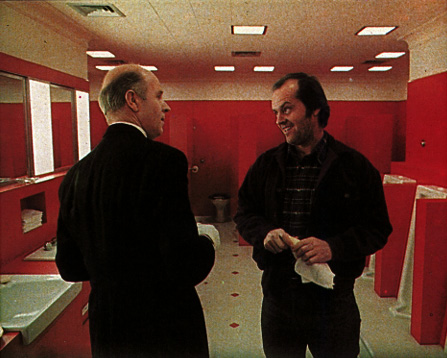
Yes and no. In its place you are given something much larger to consider. Who are these ghosts and what is their connection to Torrance? Obviously, they are haunting the Overlook and with Torrance being the caretaker, they have set their sights on him, right? Well, not so fast. In the scene in the bathroom between Jack and Grady, Jack identifies Grady the butler as the caretaker who killed his kids. But Grady denies this and responds, “You’re the caretaker, sir. You’ve always been the caretaker.” What does this mean? It could just be the ghost trying to trick Torrance, but there is one more piece of evidence to consider. At the end of the film, after Torrance dies, the camera pans in on a photo of a July 4th party at the Overlook in 1921. There, right in front, is Jack Torrance (see below). So how do we interpret this?

It’s possible the Overlook simply sucked him into its history and this is where it deposited him. But that’s unsatisfying as nothing else in the plot hints at people turning into photos. Where, for example, is the "new" picture of Dick Hallorann (Scatman Crothers)?

Could Jack be THE caretaker as Grady claims? It’s possible that Jack has reincarnated repeatedly and each time comes back as someone whose destiny is to become the caretaker and murder his family. This would be consistent with Grady’s statement that Jack has “always been the caretaker.” Interestingly, it would also be consistent with another piece of evidence. We are inclined to dismiss this idea because Jack points out that the butler is Charles Grady, the prior caretaker who killed his family. But the butler denies any knowledge of this and actually identifies himself as Delbert Grady. So it’s possible this man is not the Grady who was the caretaker. Does that make it Jack?

Maybe, except there’s a problem with the reincarnation theory. Charles Grady was the caretaker the year prior. That means Charles Grady and Jack Torrance were both alive at the same time. Thus, Jack could not be the reincarnation of Charles. It could be that both Jack and Grady are trapped in some sort of reincarnation circle, one after the other, but that would be kind of a new theory on reincarnation and there’s no evidence for it in the film. Thus, it’s unlikely this is what was meant. It could also be that Grady is simply lying, trying to manipulate Jack into following his lead. But then, how do we explain the 1921 picture?

We can’t discount the possibility that Kubrick simply threw in clues that make no sense, this wouldn’t be the first time (see the second black obelisk in 2001). But what about this: what if Jack isn’t really ever alive? What if Jack is a ghost. What if Jack did something in 1921 that trapped his soul at the Overlook, just like all the other ghosts, and now he’s destined to live out this nightmare of going insane and killing his family over and over and over again. One of the many views of hell or purgatory involves the person being forced to live their crimes/sins over and over forever. Maybe that’s what’s going on here? That would explain why he supposedly goes insane slowly over time, yet he started writing "all work and no play" instead of his book the moment he arrived at the hotel.

Sadly, there isn’t enough evidence to piece this together. But maybe that was intentional? Maybe the inexplicable aspect of this film adds to its terror? We honestly don’t know what is going on with Jack or why the ghosts have targeted him or why he’s so open to them. We don’t know what’s real and what isn’t. Who is Delbert Grady? Who is Jack? We see a wall of blood coming down the elevator, dead girls in the hallway and a woman turn into a rotting corpse, but is any of it real? We just don’t know. But maybe not knowing is more terrifying than knowing for sure -- it’s the fear of the danger yet to come as compared to knowing the extent of your trouble.

Also, maybe this is part of Kubrick’s plan to disorient us. He does this masterfully throughout the film. For example, he constantly switches back and forth between huge cavernous rooms that make us feel insecure, unprotected and exposed, and the cramped family quarters and narrow curvy hallways that make us feel claustrophobic. He gives us the promise of help, only to take it away the moment it arrives. He makes the ghosts unreal, only to let them do something in the real world (yet Wendy still never sees them, so are they really real?). He tells us Jack is slowly going insane, yet he started writing “all work and no play” in his book from the moment he arrived at the Overlook. Doesn't that mean he was insane before he got here? None of this adds up and as a consequence, we can never get a single point of reality onto which we can grasp. We are thus disoriented from the start, and we can never get our bearings. So maybe the fact that we can’t explain exactly what Jack is just adds to the terror because maybe he’s a real guy being haunted, or maybe he's just going insane, or maybe he’s something much worse that we can’t quite understand.

Interesting isn’t it?

[+] Read More...

Friday, February 11, 2011

Film Friday: 2001: A Space Odyssey (1968)

Many people list 2001 as the greatest movie of all time. I don’t. I don’t think it’s a very good film. Yes, the effects are great and Kubrick’s use of music is excellent. But the plot is weak and Kubrick could have told the same story in a fraction of the time; that’s not good filmmaking. Moreover, the main selling point to 2001 is the film’s “philosophy,” but Kubrick cheated on the philosophy. Still, it raises issues that are fun to think about.

** spoiler alert **

I’m conflicted when it comes to Stanley Kubrick. I recognize his genius, but I find his films hard to like. His topics are unpleasant, his style is sterile, and his characters are lifeless. His films are like a painting that perfectly recreates a bowl of rotting fruit -- you may marvel at the technique and feel “enriched” for having seen it, but you don’t really want to see it again. 2001 fits this pattern perfectly.
Why 2001 isn't a great film.
My biggest problem with 2001 is the dull and simplistic plot. 2001 consists of four loosely related stories. The first twenty minutes are the story of mankind evolving in the shadow of a mysterious black obelisk to learn to use tools. Nothing happens here that couldn’t have been told in a minute and in more interesting ways. The second twenty minutes are the story of an NSA-type man called to a futuristic moonbase to examine the first evidence of alien life -- another black obelisk. Again, Kubrick stretches two minutes of information into twenty and the information given is less than fulfilling. Moreover, despite his efforts to give the main character depth by feeding us images of his kids and talk of happier times, the character is as sterile as the environment. He’s so sterile, we don’t even remember his name. The next thirty minutes are the most famous as a spaceship’s computer, the HAL 9000 (a one letter shift from IBM), goes insane and kills the crew. This is the part everyone remembers as it involves the only real plot in the film. But again, what Kubrick presents could have been shown in a fraction of the time and the only interesting character is the computer -- the others are robotic and lifeless. The last thirty minutes are a drug trip filled with symbolism as lacking in subtlety as kids looking through a dictionary for dirty words.

Indeed, I have a good deal of contempt for the ending. Kubrick tries very hard to make a “deep” film at that point, but he doesn’t really have anything to say. So instead, he throw a series of symbols at the audience in the hopes that you think there is more going on here than meets the eye. There isn’t. These symbols are obvious and they all relate to a single point: creation/procreation. They include barely disguised religious symbols, stylized images of sperms and eggs and symbolic orgasms, and even a large fetus floating in space. Then Kubrick gives the illusion of progression by adding the symbology of one of the astronauts aging and dying, before the floating fetus is born. While he’s hoping this makes you think something deep is being said, all he’s really saying is: God, sex, birth, youth, old age, death, rebirth. That’s not very deep or original. He might as well have said: bread, fridge, mustard, ham, eat, store. Both represent the cycle of life.

What I do like about 2001 though, and what makes this film so memorable, are the mysteries Kubrick presents. Now I admit up front that Kubrick is playing us for suckers in this regard because there is no solution to these mysteries -- and they are likely tautologies and thus cannot have solutions. But they are still fun to talk about. Let’s discuss.
Mystery No. 1: What are the black obelisks?
The big mystery in 2001 is the appearance of the black obelisks. The first appears at a time when man was still an ape-like creature. It appears one day and does something we cannot see (though we hear it ringing). Soon thereafter, one of the apes learns to use a bone as a tool. This is the beginning of the rise of man, discovering the ability to use tools. From this, we can infer the obelisks are pushing along man’s evolution. The final obelisk seems to reinforce this when it results in astronaut Dave discovering the nature of the universe and morphing into some space-baby.

But what about the second obelisk? Obelisk 2 is a bit of a problem, because no evolutionary change appears to accompany its arrival. In fact, the sole function of Obelisk 2 seems to be to point the way toward Obelisk 3. Yet, surely, if these obelisks are there to cause evolutionary changes, then Obelisk 2 could have done what Obelisk 3 does, so why force mankind to travel to Obelisk 3? Was Obelisk 2 just out of order. . . "this aisle closed. . . go to next obelisk"?

It’s possible Obelisk 2 was there to mark the evolutionary point where man becomes dependent on his tools. If you compare the sterile, but still human characters you meet on the moonbase against the inert and robotic humans onboard the Discovery One, there is a remarkable change: the position of human and machine are reversed. Indeed, on Discovery One, HAL does everything as the humans sit idly by. And when HAL goes insane, the humans struggle with the question of whether they have the ability to control Discovery One without HAL. By comparison, the humans on the moonbase still handle everything themselves. We even see the pilots steering the Pan-Am spaceplane. Maybe this is what Obelisk 2 was really doing, heralding the replacement of mankind by the tools man created?

If this is true, then all kinds of interesting questions arise. Who built the obelisks? In other words, who is controlling our evolution? And is evolution inevitable, i.e. is it being forced on us or is it only a choice, i.e. can we reject it? Dave and Frank fight back against HAL, but they don’t survive the movie. And if it is God causing evolution, then why use the obelisks? Surely a supreme being could cause these changes without using a mechanical device? Perhaps, God was replaced by his own tools and these obelisks are the tools that took over the universe? None of this is addressed in the film, but it's interesting to consider.

On a final note, our inability to explain Obelisk 2 really could be a sticking point in the “philosophy” of 2001. If Obelisk 2 doesn’t have a meaningful purpose, then how can we say what purpose any of the obelisks serve? Maybe their only purpose is to give the viewer a mystery? If so, that would be a tautology: they are a mystery because they were meant to be mysterious. If that is the case, and it could be, then Kubrick really is a jerk, and 2001 starts to become a pretty big fraud. Hmmm.
Mystery No. 2: Why does HAL kill the crew?
So why does HAL kill the crew? Several explanations have been advanced for HAL’s murderous behavior. The first (and the one accepted by the film 2010) is that HAL was confronted with a paradox. He was told to complete the mission, but he was also told to protect the crew. When he became convinced the crew had become a danger to the mission, he resolved this conflict by killing the crew. There are some problems with this theory however. For example, HAL’s solution seems pretty extreme for such a sophisticated machine. A better solution would have been to lock the crew up, which he could have done. At the very least, there was no reason to kill the sleeping crew members. Also, how can HAL complete the mission without the crew?

Now it’s possible HAL simply saw all humans as flawed and, therefore, a danger to the mission. We get a clue about this with HAL’s insistence that any mistakes made by the 9000 Series computers were the result of human error. . . you damn dirty apes! But even if that was the case, why doesn’t HAL just kill the crew by cutting off the air? Why does he try to cover up his murders by staging an accident? If his decision really was based on logic, i.e. he followed his programming, he should have executed the humans and then reported his successful saving of the mission, just as he would report other functions. His deceit tells us something else was going on. And you can't argue that HAL was just responding to the threat that Frank and Dave intended to shut him down because HAL was already being deceitful at that point. Clearly, his decision to kill them was premeditated.

The best explanation is HAL had attained some level of consciousness and for reasons unknown became homicidal. But why become homicidal? One could argue that because he was programmed to mimic mankind, he included our worst traits as well as our best. But you would think his propensity to homicide would have shown up in the nine years of testing before he was installed. . . "hey, where's my lab assistant?" A better explanation is that HAL suffered a mental breakdown when he learned about the obelisk. In fact, this point also makes sense in terms of explaining the role of Obelisk 2. HAL represents man’s mind before Obelisk 2 was discovered, as he was programmed in 1992 to mimic human behavior. He is incapable of dealing with the idea that man is not alone in the universe. Thus, when he learns of the obelisks, he goes crazy and decides to kill the crew to prevent them from discovering the truth -- a sort of “if we ignore it, then it’s not there” approach. By comparison, the crew, who were evolved by Obelisk 2, are now capable of dealing with their loss of place at the center of the universe. HAL cannot because he is a machine and did not evolve.

Of course, this is just speculation again, as Kubrick gives us nothing to solve this mystery. HAL’s own words make no sense because killing the crew would end his ability to perform the mission. Dave never speculates. And no other facts appear to help us solve this riddle. In fact, looking only at what Kubrick gives us produces another tautology: HAL kills the crew because he becomes homicidal.

In any event, this raises additional interesting questions. How comfortable are we putting our lives in the hands of machines? Can we ever truly program a machine to handle the sorts of paradoxes and dramatically unexpected facts which humans apparently can handle with ease? And do we in fact infuse our own creations with our own vices, i.e. (kind of like the Blade Runner question) could we make a computer that only acts according to our better instincts, and how would it react when it finally met us?
Conclusion
All in all, 2001 is a film you should see. It’s culturally relevant. It brought science fiction to the adult world and made it respectable. It ushered in the realism phase of science fiction -- its treatment of the silence and frictionlessness of space is truly impressive. It is an important film. Just don't expect to enjoy it.

[+] Read More...