Showing posts with label tryanmax. Show all posts

Friday, March 2, 2018

Guest Review: The Osiris Child (2016)

by tryanmax

This is less of a review than it is a recommendation. The Osiris Child (a.k.a. Science Fiction Volume One) is the rare indie sci-fi project that can stand among the special effects blockbusters but still delivers on the human-level drama of a low-budget flick.

The story pulls together a lot of common tropes: a planet on the verge of destruction, a mega corporation with a hidden agenda, an officer who goes rogue to save his child, a team up with an escaped convict, a stop-off at a wretched hive of scum and villainy, and everyone has a complicated past. None of this undercuts the movie’s appeal.

To be sure, Osiris has some rough edges, but the pacing is brisk, so you never get to dwell on it. Some intense stuff happens out of frame (which may be good or bad, depending on your tastes) but there is still plenty of on-screen action including a couple great chase sequences and a prison riot.
The narrative unfolds in a very non-linear fashion. In a few places, this is frustrating, but overall, it’s a smart choice that both creates and solves mystery and propels the story. Chapter title cards help keep things clear while adding a bit of a graphic novel feel.

But the best part from a sci-fi perspective is how convincingly futuristic this film is. As in other films, the Australian Outback stands in for a sparse alien world. Special effects are used sparingly, so the ones they have are done well. Holographic displays may be ubiquitous even on cheap TV shows nowadays, along with spaceships and cityscapes, but those in Osiris are high-quality.
There are all sorts of little touches that sell the idea of being in the future. Everyone has a little device that they bump to transfer money, much like photo sharing on cell phones. A coffeemaker adds cream and sugar by voice command while an AI researches the main character’s ex-wife’s new boyfriend. Smart, subtle aesthetic choices hold the sci-fi feel without needing to have a hovercraft float by every few minutes. Fans of practical effects will be pleased, too, by the film’s creatures. (There are creatures!)

From a scripting perspective, the thing that really sets Osiris apart is how cooperative most everyone is. Unlike other action films that try to increase the tension through pointless bickering, everyone in Osiris seems to appreciate the larger stakes. Characters may start out suspicious of one another, but once motives are sussed out and found to reasonably align, everyone comes together rather easily. Even the meth-head gun dealers are basically decent fellas.
The Osiris Child is geared solidly at genre-lovers. Fans of Riddick, Mad Max, and Ridley Scott will definitely get the most out of this, but anyone who loves sci-fi action will warm to this. By the way, the ending is one of the best surprises I’ve encountered in a while.
[+] Read More...

Thursday, February 22, 2018

Guest Review: Black Panther (2018)

by tryanmax

The latest installment in the MCU franchise arrived amid massive hype and expectations. It handily exceeded box office projections and breathless believers are convinced that it represents a watershed moment in black cinema. In truth, Black Panther doesn’t tread much new ground in terms of the Marvel Universe or cinema in general. Where the film does succeed, it is by telling an origin story that doesn’t feel stale within a franchise that has already pumped out a bevy of origin stories and doing a large amount of world-building in a way that doesn’t leave the end product feeling over-stuffed. All told, Black Panther gets the job done.

The script follows a classic sins-of-the-father narrative. We are reminded briefly of the events of Captain America: Civil War, wherein King T’Chaka of Wakanda is killed, causing his throne and the mantle of the Black Panther to pass to his son T’Challa. As the story progresses, we learn that the dead king had a brother, N'Jobu, who went to Oakland, CA as a Wakandan spy and become obsessed with ‘liberating’ black people the world over using advanced Wakandan weaponry. A confrontation between the T’Chaka and N’Jobu leads to the latter’s death, leaving behind a son. The son grows up to become Killmonger, who seeks to fulfill his father’s ambitions and capture the Wakandan throne.
A few James Bond-esque sequences get the story rolling: a heist in London, a casino and car-chase in South Korea, joined in the middle by a trip to Q’s, er, Shuri’s workshop/lab. Shuri is T’Challa’s sister and the latest addition to the super-genius club that includes Tony Stark, Bruce Banner, Hank Pym, Rocket Raccoon, and Peter Parker. Shuri designs all of Wakanda’s technology and infrastructure using the near-magical substance vibranium. Thought to be extremely rare—with the bulk being tied up in Captain America’s shield—Wakanda just so happens to sit atop a mountain of the stuff. Thanks to Shuri and vibranium, Wakanda looks like a stop-off for the Guardians of the Galaxy if they encountered a planet with a thing for Afrofuturism.
In terms of breaking cultural ground, it has been amusing to watch the true believers scrabble about for a “first” that Black Panther qualifies for. Ultimately, it is merely the first black superhero movie of the MCU franchise. [Sidenote: Blade, starring Wesley Snipes, was the first box office success for Marvel, spawning a trilogy and paving the way for the comic company’s own studio and the MCU.]

However, just because Black Panther doesn’t live up to the excessive hype doesn’t mean it is a bad movie. As noted, the MCU is awash in origin stories and the addition of Black Panther calls for yet another one. Writer and director Ryan Coogler tackles this challenge by tying the character closely to the world that must also be built around him. T’Challa is a product of his upbringing and culture, and so the audience is able to learn who he is as they discover the myths, rituals, genealogies, history, and politics of Wakanda.

This is no straightforward task. Wakanda is awash in contradictions. It is the most technologically advanced society on the planet, yet it maintains ancient customs and rituals. They are united as a nation, but remain divided into tribes. They are isolated, yet the concerns of the outside world press upon them. T’Challa must navigate these and other contradictions if he is to succeed as the new king.
Additionally, Coogler uses the villain Killmonger as an appropriate foil to showcase what a Wakandan prince separated from his heritage might become. Both men are proud, but Killmonger’s pride is distorted by resentment. While this contrast could have been explored more deeply, Coogler isn’t philosophizing; it is an action movie, after all.

Despite not upping the special effects bar, there are some ingenious differences in the effects we see. For example, rather than your standard-issue hologram, Wakanda has a technology that renders a miniature 3D bust out of black (presumably vibranium) sand. There are some armored rhinos, which is fun. The overall look of the movie is really cool. African influences on the techno-designs render a look that diverges pleasantly from the Apple/Microsoft look we’ve become accustomed to.
Black Panther also avoids many potential pitfalls of both the genre and external pressures. For one, the film is in no way a political soapbox. When it comes to political themes, it is easily surpassed by Civil War. At the same time, Black Panther isn’t an endless slugfest, either. Plenty happens apart from the action to drive the story, and much of the action is story in itself. Meanwhile, the smaller scale story keeps all the world-building manageable; the script doesn’t feel overstuffed or rushed. If anything, the pace was a tad slow, but never close to dragging. And there aren’t any byzantine plot devices that fail to make sense by the time the credits roll.

In short, if you put aside the hype, Black Panther is a decent film that entertains, but probably won’t blow you away.
[+] Read More...

Wednesday, August 10, 2016

I watched some movies

by tryanmax

Andrew is right; the movies that have come out lately are largely blah. They’re not good enough to rave about, but they’re not bad enough to criticize. That said, I do have a few thoughts on some movies I’ve seen recently, just not enough to warrant an entire article on any one. Here we go:

The Butler (2013)

I liked this movie better when it was called Forest Gump. This is your typical nostalgia piece, rolling through the decades over the shoulder of a simple protagonist who had the smarts to go with the zeitgeist while everyone else was fighting it. Things to look for: cameos by big name actors doing pitiful impersonations of former presidents; Oprah reprises her role as Oprah.

Fant4stic Bore (2015)

This snooze fest handily steals the title of Worst Superhero Movie Ever from Catwoman. The Halle Berry vehicle merely squatted over the source material before kicking sand over it. Upping the ante, Fantastic Four forgoes even telling a story and has no characters in it. Oh sure, there are actors doing stuff and calling each other names that aren’t theirs, but who are these people? What do they want? What do they care about? Why does a black man have a black son but a white daughter? None of these things are addressed even as ugly John Cusack, the slut from House of Cards, the other Michael Jordan, and grownup Billy Elliot cross the streams and turn into X-Men—or something like that.
The Secret Life of Pets (2016)

Lest you think I just plan to rag on every movie, this one is really cute and I recommend it. There’s just not a lot to say as it is essentially a feature-length cartoon in the spirit of Tom and Jerry or Sylvester and Tweety. I loved the score so much, I bought the soundtrack on my phone before I even left the theater. Buying soundtracks is not a typical move for me.

Ex Machina (2015) / Terminator Genisys (2015) / Transcendence (2014)

A.I. is bad and it will kill you.

Actually, I enjoyed the Terminator sequel for what it was. Actually, maybe this is a reboot. With the messed up continuity of the Terminator franchise, who can tell? An interesting tidbit: the producers of Genisys didn’t have rights to reuse footage from the 1984 film, so they copied some of the original scenes.

Mortdecai (2015)

Oh, look! It’s Capt. Jack Sparrow! Again… Seriously, the only thing more tired than Depp’s drunken sailor routine are his claims that somehow each of the characters is based on something different.
We’re the Millers (2013) vs. Vacation (2015)

While neither of these movies warrants a full review, they do deserve a quick comparison. Obviously, Vacation is the official successor to the Chevy Chase franchise, with Ed Helms playing a grownup Rusty Griswold trying to relive his childhood road trip to Wally World. It tries, vainly, to replicate gags from its parent, but it is held back by PC sensibilities, overt partisanship, crude bathroom humor, and zero chemistry between the cast. Worse, a joint cameo by Chase and Beverly D'Angelo only kills what little momentum the movie has.

Conversely, the Millers feel much more like spiritual successors to the Griswolds. Jason Sudeikis plays a low-level weed dealer who, to get out of a bind, agrees to smuggle a “smidge” of marijuana into the US from Mexico. As cover, he recruits a stripper (Jennifer Aniston) and a couple of teen delinquents to form a fake All-American family on an RV roadtrip. Everything about this film is better: it’s funnier, it’s fresher, it’s edgier, it’s not driving any agenda, and most importantly, there’s excellent chemistry among the actors.
Jurassic World (2015)

If you like nostalgia, dinosaurs, and Chris Pratt—and I know I do—you’re sure to like this movie, because it has those things. Is this the best Jurassic Park movie yet? Not on your life. But it is an enjoyable time waster. I really like the direction they went with the backstory: Jurassic Park has become a commercial success to the point where both park management and visitors have gotten blasé about giant carnivores and safety protocols. That’s not so good. They don’t go too deep in the weeds about it, though, which is fine. Because what we really want to see are big dinos and Chris Pratt.

Well, those are some movies I’ve seen lately. There were others, but they were so unremarkable that I didn’t. In other viewing, if you haven’t watched Netflix’s Stranger Things, you should. And what’s wrong with you? Haven’t you heard everybody raving about it!?

Have you seen any movies lately that did nothing more than bring you 110 minutes closer to death? Feel free to drop a one, two, or three sentence review of a movie you don’t recommend.
[+] Read More...

Monday, March 21, 2016

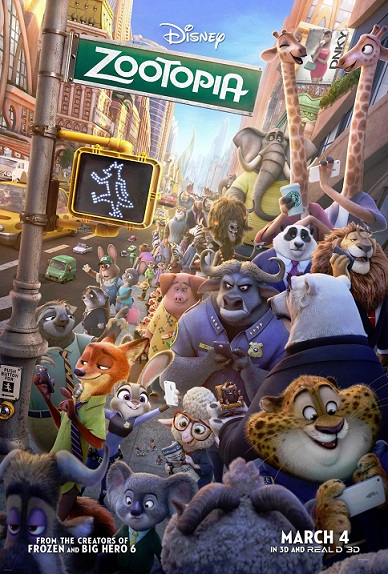
Zootopia: Not the Allegory You Were Expecting

by tryanmax

I’ve got to hand it to Disney. I think they’ve really pulled one over on the identity politics crowd. With their latest smash-hit Zootopia, the studio has given the usually unquellable race-baiters, gender-warriors, and plain ol’ Disney haters an allegorical placebo to shut them up. So satisfied are they that Disney finally “gets it” that one outlet went so far as to regard the new film as an apology for Song of the South, a film known almost solely by distorted reputation alone.
Spoiler Alert
All Disney really did, though, is recognize identity politics as a thing. The only message they conveyed with Zootopia on the matter is probably the best one that anyone can actually offer. Simply, “It’s complicated.” Let’s take a look at what they did.

I won't be discussing the plot, which is a twisty noir-ish tale, directly. As such, this article assumes the reader has already seen the movie. For a film synopsis, see here.
Lookin’ Good
In more than one way, Zootopia is all about appearances. For one, it is a visual treat to the eyes. Disney imagination is on full display in creating a world where animals of every species, from tiny hamsters and mice to giant giraffes and hippos, live alongside one another in an urban landscape. I remarked more than once how the characters looked so fluffy on screen that I wished I could reach out and touch them.
That’s a good segue for how Zootopia creates the appearance of handling identity issues. In one scene, a fox does just that, grabbing and handling a sheep’s bouffant while delightedly remarking how fluffy it is. His rabbit companion admonishes him that he can’t do that. This is clearly a reference to the supposed problem of white people always touching black people’s hair.

The script is peppered with little nods to so-called “micro-aggressions” such as this. The police force has a “Mammal Inclusion Initiative” which is clearly an affirmative action program. Judy Hopps, the beneficiary of said program and the first-ever rabbit on the force, asserts that she is not “some token bunny.” In another instance, she informs a cheetah that it’s okay for rabbits to call other rabbits cute, but not for other species. There’s a scene where an elephant store clerk asserts his right to refuse service to a fox. The assistant mayor believes she is only on board to court the “sheep vote.” The terms “articulate” and “patronizing” are conspicuously dropped into a conversation. The list goes on.

All of this is meant to signal that Disney is in-the-know on issues that virtually everyone is already aware of anyway. Otherwise the gags wouldn’t play. So, because Disney can demonstrate their consciousness, some have assumed that Disney is actually addressing the issues. But like the (literal) political animals in their film, Disney actually dodges the question entirely by re-framing it.
It’s Funny ‘cos It’s True
Probably the most memorable scene in the entire film is the one that takes place in the DMV. Judy Hopps is in a hurry but, to her chagrin, the entire office is staffed by sloths. She actually exclaims, “They’re all sloths!?” because she naturally assumes all sloths are slow and, well, they are. It’s actually amazing how well this works for laughs, not just once, but over a dozen times in the course of a couple minutes. At the same time, it totally reinforces that stereotypes do have a basis in real trends. Later, the film also breaks the stereotype when the main sloth is pulled over for street racing, but this is still in service to the same gag. Sloths are funny ‘cos they’re slow, but they’re even funnier if they’re fast.

Again, Zootopia is full of these types of gags. Being a rabbit, Judy has 225 brothers and sisters. Her sidekick, Nick, is a fox and a street hustler. Judy tries questioning an elephant who can’t remember anything. The city’s mayor is a lion. The mob-boss Mr. Big is revealed to be a tiny shrew. A group of lemmings mindlessly follow each other in buying popsicles. A hippie yak is unwashed and swarming with flies. This is Blazing Saddles style humor in a form that can slide past trigger-warning and safe-space sensibilities.

The very makeup of Zootopia (the city within the movie) itself is a gag. It is as much a theme park as a city and it is deliberately segregated by species, just as if it were a human-run zoo. Districts such as Tundratown and Sahara Square provide appropriate habitats for different species, while a neighborhood like Little Rodentia scales the urban landscape to its tiny residents. It’s both humorous and sensible, but it pushes aside any pat solutions to identity issues.
Where da White Bunnies At?
If there is one thing about Zootopia that has the identity politics crowd grumbling, it’s that they can’t quite figure out which animals represent which group of humans. I think that’s by design. Even though the animals of Zootopia inhabit a world very much like ours, even featuring similar political issues, it’s impossible to say that certain animals represent certain groups of people. Rather, all the usual signifiers are jumbled up.
At first, it looks like rabbits and other prey are the oppressed minority. After all, historically they suffered at the hands of predators, as the opening scene points out. But that isn’t the case. It turns out that Zootopia is 90% prey, and they are often openly prejudiced against predators. Yet, somehow, the mayor is a lion and predators occupy positions alongside prey everywhere. In most cases, it actually appears that size matters most, with large species like buffalo and bears filling the police ranks and big mammals generally throwing their weight around. Driving this home early in the film, the assistant mayor buddies up to Judy to say, “Us little guys have to stick together.”

The more you parse the animal groupings in the film, the more complicated it gets. Any attempt to draw straight lines between Zootopia and the real world is going to get uncomfortable really fast. As I already laid out, in Zootopia, minority = predator = savage. That equation ends careers if brought into the real world.

As I see it, the point is not to draw lines between the cartoon world and the real world, as tempting as it may be. Instead, by sidestepping the usual identity markers Zootopia is actually able to tell a compelling story while inserting a non-polarizing message of mutual respecting in a way that is better than simply mirroring current events.
[+] Read More...

Wednesday, June 25, 2014

Guest Review: The Lorax (2012) versus Fern Gully (1992)

by tryanmax

Those Holly-weird tree-huggers are always pushing their eco-weenie agenda onto our children. How dare they! Why can’t they leave us to trash the planet in peace? Apologies for the sarcasm, but it’s always been a point of irritation to me that conservatives have completely abandoned the cause of conservation. They share a root-word, people! I’m not saying that conservatives should start chaining themselves to giant sequoias, but knee-jerking against environmentalism looks like promoting pollution and destruction. Not good.
To better illustrate this point, let’s examine two animated films with similar themes: Fern Gully (1992) and The Lorax (2012). Both movies have been roundly criticized by the right as propagandizing to children by both pushing environmentalism and criticizing capitalism. But is this a fair assessment? In regards to Fern Gully, I say unequivocally, “yes.” But in regards to The Lorax, I think conservatives have leapt without looking.

First, a very brief synopsis of each:

Fern Gully is about a tribe of rainforest-dwelling fairies whose giant tree-home is threatened by a logging operation. The loggers are somehow being controlled by an ancient spirit of carbon emissions and petroleum byproduct. One fairy shrinks one of the loggers to her size so he can learn about the wonder and beauty of the blah, blah, Zzzzzzzzzz… Oops! I bored myself to sleep. Basically, it’s Avatar but it came first. Oh, and if the message that “humans are bad” isn’t driven home strongly enough, bat-Robin Williams raps about how evil they are.

The Lorax tells about a young boy living in a hyper-developed city who wants to find a real tree to impress a girl. To do so, he must find the Once-ler, who will tell him the tale of the short-sighted industrialist responsible for wiping out the Truffla trees that once covered the now barren and polluted land surrounding the town. At first the boy is impatient, wanting only to get his tree. But as the story unfolds, both come to realize the need to conserve the resources they depend upon.
I clearly have no love for Fern Gully. As propaganda, it’s about as subtle as a Molotov cocktail. It’s only saving grace is that its formulaic predictability works to undermine the intended message. Nature is worth protecting because it is magical and sacred and pollution is cast as opposing black magic. Responsibility is even shifted onto a giant black smoke monster who dupes the unwitting humans. At the end of the day, the message is simply to direct your faith/love/whatever toward the correct deity. This is pure emotionalism: pollution makes baby fairies cry.

While I’m poking at Fern Gully, I may as well point out its other flaws. This film traffics in the classic racist-liberal pairing of white man’s burden and the noble savage. The fairies are helpless to save themselves, despite possessing ancient wisdom and awesome magic, without the help of an obviously dimwitted youth of European descent. Plus, the film has aged terribly, not that timelessness is to be expected of every film. Stupid hairdos and ridiculous slang are forgivable, but having Mork from Ork rap should’ve been an obvious blunder at the time.
Just as obvious, I think better of The Lorax while admitting that it is hyperbolic in ways. However, that is how it achieves its impact, by extending real attitudes and actions to a satirical level. That Dr. Seuss imagined ends that remain fantastic to this day is impressive. Electronic trees and bottled air are ideas meant to be so absurd (for now) that everyone can’t help but agree about their badness. All can come together in the name of preventing something that likely wouldn’t happen anyway. Even the titular Lorax backs away from his absolutist cut-no-tree position.
However, conservatives don’t seem to be in on the joke. Reacting seriously to these absurd ideas, calling them indictments of industry or capitalism, ends up sounding defensive of wanton waste and pollution. Yet that is exactly how a lot of conservatives have reacted. They defend the obvious villain in the film and wonder why they are regarded as villains. Worse, they criticize the character who realizes the error of his material wastefulness which stands at odds with the usual conservative criticism of fiscal wastefulness. And if that weren’t enough, they equate The Lorax, a comparatively subtle fable, with Fern Gully which has even been dismissed by environmentalists as a blunt fairytale. In other words, conservatives come off as evil idiots.
It also doesn’t help that The Lorax is a pretty decent film in its own right. Dr. Seuss’ visual and narrative style is paired with catchy, Broadway-esque musical numbers. This bodes well for the potential longevity of the film, making it an even worse target for ridicule. Just to be clear, I’m not saying that conservatives should go soft on a film just because its production values are high. Unlike the ham-fisted, eco-magical Fern Gully, The Lorax ultimately finds a middle ground between conservation and modernity. Conservatives would do better to actually consider the content of a film before criticizing it.
[+] Read More...

Tuesday, May 13, 2014

Toon-arama: My favorite voices

by tryanmax

I’m going to admit it up front, this article is meant to generate controversy. I fully expect arguing and name-calling in the comments section. But that’s okay, because this article is all about what I like, and if I leave out any of your favorites, it’s up to you to defend their honor. Because here is a list of MY favorite voice-over artists.

I’ll start with the best, the legendary Mel Blanc. Blanc is famous for his 60+ year career voicing literally hundreds of popular and beloved characters. His most well-known work was for Warner Bros., creating distinct voices for Bugs Bunny, Daffy Duck, Porky Pig, and virtually the entire Looney Toons stable. Blanc’s talent was for creative voices that were on their own just as distinct as any other aspect of the characters. Other notable Blanc voices include Barney Rubble, Cosmo Spacely (The Jetsons), Speed Buggy, Woody Woodpecker, and Toucan Sam.

It’s an injustice that June Foray is nowhere near as well-known as Mel Blanc. While her work is not as iconic, it is certainly no less diverse. For Warner Bros., Foray provided the voices of Granny and Witch Hazel, as well as every incidental female character during her years with the studio. However, she is probably better known for The Rocky and Bullwinkle Show as Rocket J. Squirrel, Natasha Fatale, Nell Fenwick, and many minor roles. She also performed in many Rankin/Bass TV specials, most notably as Karen in Frosty the Snowman. Additional popular roles include Ursula on George of the Jungle, Cindy Lou Who (How the Grinch Stole Christmas), and the voice of the original Chatty Cathy doll, as well as the evil Talky Tina of The Twilight Zone.
If Mel Blanc set the standard, there are several who follow his example. Foremost in my mind is Billy West. West’s vocal versatility is absolutely incredible. He voices four widely different leads on Futurama—Fry, Prof. Farnsworth, Dr. Zoidberg, and Zapp Branigan. Before that, he proved his chops voicing Nicktoons’ titular Doug and Ren and Stimpy (both of ‘em). Futurama takes most of West’s attention, but he has found time to do voice matches for Bugs Bunny, Elmer Fudd, Woody Woodpecker, Shaggy (Scooby Doo), Popeye, and more.

Keeping pace with West is Dan Castellaneta, whom you may be forgiven for mistaking for the entire population of Springfield on The Simpsons. Homer Simpson is, of course, his main role, but he also produces a full range of characters from the gravel-voiced Krusty the Clown to the squeaky pimple-faced teenager. His talent isn’t just for voices, either. Castellaneta is known for great improvisation leading to many of the show’s most quotable lines, including Homer’s famous “D’oh!”

Tara Strong, what exactly can I say except to provide a partial list of her work? Hello Kitty (title character), Bubbles (Powerpuff Girls), Dil Pickles (Rugrats), Timmy Turner (Fairly Odd Parents), Princess Clara and Toot Braunstein (Drawn Together), Raven (Teen Titans), Batgirl (various), Terrance (Foster's Home For Imaginary Friends), Ben Tennyson (Ben 10), Melody (Ariel's daughter, The Little Mermaid II). She also has an extensive videogame resume, most notably Rikku of Final Fantasy. In other words, she’s damn good.
While the amazing versatility of the above-named actors commands much respect, there is something to be said for those who are simply born with the gift of voice. Arguably, these men and women are one-trick ponies. But how does that critique stand when the trick is performed so well?

Sterling Holloway lent his unique raspy tenor voice to the narration of several Disney animated productions—my personal favorite being that for Mickey and the Beanstalk—but it was as the beloved bear, Winnie the Pooh, that he is probably best remembered. An interesting bit of trivia, Holloway auditioned for the role of Garfield, but lost to Lorenzo Music.

The voice of Garfield the cat, in many people’s opinion including my own, is Lorenzo Music. His low, sardonic tone perfectly suited the mischievous yet lazy feline. He is also fondly remembered as Carlton, the unseen doorman from Rhoda. He also voiced Peter Venkman from The Real Ghostbusters before Bill Murray complained and put an end to Music’s portrayal of their shared character. Ironically, Murray would go on to voice Garfield in the live-action/CGI films.

Few voices are more perfectly, deliciously menacing than that of Elenor Audley, the voice of Sleeping Beauty villainess, Maleficent and also Cinderella’s Lady Tremaine. Her vocal style switched effortlessly from cool and threatening to booming and fierce. Though her resume is brief, Audley helped create arguably the most iconic Disney villains and the legacy thereof.
Every child of the 80s and 90s remembers the trauma of learning that the original bad boy, Bart Simpson was in actuality a girl. Though Nancy Cartwright had already proven her chops on shows like My Little Pony and Richie Rich, her breakout role was with The Simpsons. Originally auditioning for Lisa, she quickly gravitated to Bart, capturing perfectly the adorable mischievousness of the iconic elementary-school hooligan.

Christine Cavanaugh may not be a true one-trick pony, but she stuck to a particular vocal type. She mainly did nasaly, nerdy characters, such as Chuckie Finster (Rugrats) and Dexter (Dexter’s Laboratory), though my personal favorite was the rambunctious Gosalyn Mallard from Disney’s Darkwing Duck. Her biggest claim to fame, however, was voicing the titular pig in the movie Babe.

Finally, I want to give honorable mention to Walt Disney. To cartoon fanatics, he is rightly loved for a whole host of reasons. Thus his stint as the original voice of Mickey Mouse often gets overlooked as a reason. In all honesty, it wasn’t all that great; just a grown man squeaking in falsetto. But the act perfectly captures the audacity of the man.
[+] Read More...

Tuesday, March 18, 2014

Cartoons and Satire

by tryanmax

It’s no mystery that television writers will often promote their own values through their shows. It’s less of a mystery that Seth McFarlane uses his highly successful show Family Guy to that end. In fact, the only mystery is why there is still anyone who doesn’t realize that. What I didn’t realize until lately, however, is how absolutely simple the Family Guy formula is. And once I saw it, I started noticing it in almost every sitcom as well as shows in other genres. But before I discuss the formula, let me lay some groundwork.

Since before the days of animation, cartoons have been an ideal medium for satire. There are a multitude of reasons, but the foremost is that they make an obvious break from reality. We talk a lot about “cartoon physics” here in the Toon-arama articles, where humor is achieved by divorcing events from their consequences. Satire in comics is achieved by a similar mechanism we might call “cartoon psychology” where characters’ words and actions are divorced from their social ramifications. But unlike cartoon physics, cartoon psychology doesn’t just protect the cartoons, it also makes cartoons safe for the audience and the satirist.
What makes cartoons safe for the satirist is fairly obvious. Something about cartoons causes people to immediately let their guard down. This frees the satirist to broach taboo subjects, say politically incorrect things, and deliberately commit faux pas. Cartoons also remove the need for subtlety, which can be a hindrance to live-action or written satire. Where cartoons can be as outlandish as they need to be with little risk of being dismissed, other mediums need to walk a fine line between being outrageous enough to not be taken seriously, but not so outrageous as to be dismissed as absurd.

For the audience, the safety comes from being able to like characters without having to identify with them. That’s because cartoons deal almost exclusively in caricatures and stereotypes and, because they are drawn, there’s absolutely no confusing them with real people. Thus, where saying you like a bigoted character from a live-action show could be construed as liking him for his bigotry, saying you like a bigot from a cartoon says that you like the way he lampoons bigotry.

All these factors come together to make cartoons an excellent medium for spreading social and political messages, especially in narrative forms like an animated sitcom. While satire is certainly an art form, there are also methods to it. These methods aren’t exclusive to cartoons, but when applied to them, they can be more effective. On the other hand, because cartoons don’t worry about subtlety, they can also make the methods more obvious, which is what inspired this piece.
Remember what I said about cartoons dealing mainly with caricatures? Well, what I started noticing as I was watching unhealthy amounts of Family Guy is that the main characters all serve as double-caricatures. They are first “the lazy husband,” “the nagging wife,” “the smug liberal,” and so on, but these are all different covers for the same underlying caricature, which is “regular Joe.” This shouldn’t be surprising, really, but with so much else going on, it becomes easy to overlook the storytelling basics.

The purpose of “regular Joe” is to first be stubborn in his ways about some issue that arises, and then ultimately change his ways. For example, he might oppose gay marriage at the beginning, but ultimately embrace it by the closing credits. But where a live action show would have to aim lower to show a more plausible change, a cartoon can shoot for the moon without losing credibility and hammer home a message in one episode which might take another show its entire run to deliver. Furthermore—dare I say?—the genius of a show like Family Guy is that it has been set up in such a way as to let the writers pick one of four or five regular Joes to deliver the message based on which over-caricature seems most likely.

Now, I don’t want to leave anyone thinking I’m claiming that a formulaic cartoon can brainwash people. I’m not. But for those who are receptive to the kinds of messages injected into popular TV shows, cartoons are like a catalyst. They have the ability to go further and faster in making a persuasive case to such people than a similar live-action program.

As a counterpoint, let me close with an illustration of where the formula has been misapplied and ultimately failed. Mike Judge has had some hits that also land some social/political punches. His show The Goode Family about a clan of fastidious environmentalist liberals was not one of them. That’s because none of his main characters had a “regular Joe” underneath. They were only the obvious caricatures. Thus, when the show’s liberal characters came to any sort of realization, it wasn’t a shared experience with the audience. Instead, it merely provided schadenfreude to one part of the audience and disgust to the other.
[+] Read More...

Tuesday, March 4, 2014

What’s wrong with SpongeBob?

by tryanmax

There’s something about SpongeBob SquarePants that I’ve never been able to understand: why is he so polarizing? I personally like the little yellow sponge, so it’s not hard for me to understand why other people do, too. Like any long-running show, it’s had its misses, but overall, I think it is a really enjoyable show. What I don’t get is why there are almost an equal number of people who despise him. It just doesn’t make sense to me.

From my perspective, SpongeBob carries on the tradition started by the earliest cartoons of Disney, Warner, and Fleischer. It’s comic, surreal, and employs cartoon physics. It stars a bevy of distinct, idiosyncratic characters. It’s well produced, but not too polished. And is written on multiple levels such that children and adults can both enjoy it but for different reasons.
SpongeBob also contributes some new tropes the realm of cartoons. Foremost are the underwater gags. Other cartoons have played around with mixing land and underwater physics before, but because of SpongeBob’s underwater setting, such gags are routine. There are even knowing references to this, such as an episode where letters sent from the land are illegible due to running ink, so SpongeBob and his buddy Patrick throw them into an underwater campfire.

And yet, for some reason, those are the very attributes that a lot of people cite when they claim to hate SpongeBob. I can understand some of the things that might put someone off. SpongeBob has a high-pitched, nasal voice that is pretty much meant to be annoying. And yet, some of that description fits Bugs Bunny and Mickey Mouse. So, in those cases, maybe the people just don’t like cartoons?

Then there are the made-up controversies:

Not long ago, the University of Virginia stirred up some undersea controversy by publishing a study declaring that SpongeBob makes kids dumb. More specifically, they claimed it shortened attention spans, though how you gauge a preschooler’s attention span is beyond me. I don’t intend to argue the merits of the study. I just think it’s silly to lob such criticism against a show that is clearly not meant to be educational.
Then there is the most famous controversy regarding SpongeBob’s sexuality. I don’t mean to drag up a nearly ten year old ghost, but I don’t have to; it keeps popping up again and again. This, despite repeated explanations from creator Stephen Hillenberg that SpongeBob is essentially asexual—a perfectly natural orientation for a sponge.

This controversy originated way back in 2005 when the Muppets, Barney, Jimmy Neutron and several other children’s icons besides the yellow sponge starred in an animated music video for Sister Sledge’s “We Are Family.” For some reason, Dr. James Dobson of Focus on the Family decided this constituted homosexual propaganda and zeroed in SpongeBob in particular. Since then, this accusation has been kept alive with people citing things like SpongeBob’s fastidious nature, his high-pitched voice, his physical weakness, his love of bubbles, and his *gasp* friendship with another male all as signs of homosexuality. Basically, they are saying that, because SpongeBob fits the most unflattering of homosexual stereotypes, he must be pro-gay. Yeah, that wasn’t really thought through.
One of the more well-thought criticisms against SpongeBob is that he promotes Marxism. According to this theory, Mr. Krabs, SpongeBob’s money-grubbing boss, represents the ultimate commodity fetishist. Additionally, the relationship between Krabs’ restaurant, The Krusty Krab, and its perpetually foundering competitor, The Chum Bucket, is said to portray capitalism as farcical. Finally, Mr. Krabs exploits SpongeBob by paying him a minimum wage despite his nearly limitless productivity, adhering to Marxist predictions regarding the value of labor. Truth be told, it’s a pretty airtight theory, as long as you ignore the fact that Marxism is just as much a parody of economics as any cartoon. That and…

Late last year, Nickelodeon aired a special called “SpongeBob, You’re Fired” wherein the polygonal protagonist loses his job. His chronically jobless buddy, Patrick Star, attempts to show SpongeBob the benefits of “glorious unemployment” such as free time and free food. But SpongeBob insists he can only be happy when he’s working, and eventually gets his old gig back. This, of course, made him a conservative hero, but also earned the ire of welfare champions, minimum wage earners, and the like.

So, what are your thoughts on SpongeBob? Love him or hate him?
[+] Read More...

Tuesday, February 18, 2014

Shameless Merchandizing

by tryanmax

With The LEGO Movie totally dominating the President’s Day weekend box office, one thing is for certain: a ton of those tiny plastic blocks are about to go flying off the shelves. It makes me nostalgic for the days of my childhood, those halcyon days of the 80s when cartoons were just dressed up, 21-minute toy commercials occasionally interrupted with commercials for different toys and sugar-infused cereals. Let’s take a moment to remember some of the shameless merchandising.

Transformers – When it comes to TV/toy tie-ins, this is probably the top of the list. While the concept of cars and planes that turn into freakin’ robots (in disguise) is awesome enough on its own, the cartoon was pretty sweet, too, thanks to the usually well animated transformation sequences. Some folks have really gotten into the storyline, but for me, it was all about robots blasting each other.

He-Man/She-Ra – I might have actually liked Masters of the Universe the cartoon better than the toys. Transformers is credited with having a complex storyline, but He-Man had a storyline that a five-year-old could actually follow without being overly simplistic. I still have a soft-spot for Filmation animation to this day, functional and Spartan as it may be. And, of course, I had my He-Man figures, too.
G.I. Joe – The only thing as basic as a sword wielding barbarian like He-Man is a troop of soldiers fighting an international terrorist organization with excellent brand recognition. The hallmark of the cartoon series was that the opposing sides’ fire was distinguishable by color. And the hallmark of the action figures was that they were the same scale as the Star Wars figures, meaning that you could still have fun with latter even though you broke off your AT-AT’s legs.

M.A.S.K. – The Mobile Armored Strike Kommand was kind of like G.I. Joe meets Transformers. I don’t remember the cartoon much beyond the fact that the vehicles all converted to reveal hidden weapons and abilities. That was pretty much all there was to it. After all, the idea was to sell toys that did the same.

Care Bears – By day, I may have been storming the battle fields with He-Man and G.I. Joe, but by night, I had my trusty Care Bear to keep me cozy. (Bedtime Bear, if you must know.) Though my plush companion was indispensable, I can’t say I ever got on with the cartoons so much. Even as a child they hit me as too saccharine to bear. Pun most likely intended.
Jem and the Holograms – Let’s just say that this entered into a sibling’s childhood more than my own. Jem was a total Barbie rip-off, but with a couple clear distinctions: her own cartoon show and an awesome backup band. I can say that with some first-hand knowledge as I was subject to the soundtrack (on cassette) enough times for it to grow on me. Truly outrageous!

Strawberry Shortcake – Another one that didn’t come to me directly, Strawberry has had a number of cartoon iterations over the years, so I can’t be sure if the one from the 80s was even the first. (Fun fact: the voice work for the 2000s version of Strawberry Shortcake was recorded in Omaha.) Still, I’d be lying if I said I didn’t occasionally grab a whiff of her and her friends’ fruit scented locks.
Teenage Mutant Ninja Turtles – This is the franchise that really hooked me. The Ninja Turtles hit in 1987, just when I was finally pulling in enough allowance and odd-job money to actually build my own action figure collection, rather than relying on birthdays and Christmas. And, of course, I watched the cartoon show religiously. It actually got me out of bed on school days!

In case anyone is upset that I overlooked something, this is just a list of the ones that I remember the best. (Yes, I admit it, I totally missed the Thundercats. Don’t ask me how.) So, tell me about your favorites.
[+] Read More...

Tuesday, February 11, 2014

Toon-arama: Frozen (2013)

by tryanmax

The latest animated feature from Disney has received enormous praise, and deservedly so. Disney hasn’t quite mastered CGI yet, but they more than make up for it in storytelling prowess. When it comes to serving up a story full of heart, no studio can top them. And this time they’ve really outdone themselves.

** Spoiler Alert **

The Story
My praise begins with the script, as it rightly should. It is compelling, generous and efficient. More after a brief synopsis.

Elsa, princess of Arendelle, has the magical ability to create ice and snow, but she must hide it to prevent causing harm or fear. Her sister, Anna, unknowing of Elsa’s powers, thinks she is responsible for the rift between them and is desperate to make amends. When Elsa reaches the age to take the throne, her emotions get the better of her and her power is unleashed at the coronation. Arendelle is thrust into a perpetual winter as Elsa flees into the mountains and hides herself in an enormous ice palace.
Anna pursues her sister, determined to bring her home and end the winter spell. She finds the palace with the help of a mountain man named Kristoff and Olaf, an enchanted snowman brought to life by Elsa’s magic. Anna begs her sister to return home but Elsa refuses and, in agitation, accidentally strikes Anna with an icy blow to the heart. Without an act of true love to melt it, Anna will turn to ice.

Meanwhile, others intent on destroying Elsa capture her and are set to kill her. Though Anna has fallen in love with Kristoff and believes his kiss will save her, she instead goes to defend her sister. In the same moment that she rescues Elsa, Anna turns to ice. But because her sacrifice was an act of true love, her heart and the rest of her thaw and Elsa learns that love is the key to mastering her gift.

Trust me, that was brief. I’ve found “synopses” for Frozen that are four pages long.
Relationships are the driving force of this story—a narrative essential that is overlooked with alarming frequency. You care about these characters because of the way they care about each other. Yes, action is important, and in this film engaging, but it must be meaningful, and that comes from the characters’ motivations to act. In fact, I only recall two sequences that fell short for me, and they involve bit characters that are basically unmotivated.

The plot is very layered, especially for a children’s movie. I only told you about two of the storylines. There are at least three more. Despite their number, it isn’t the least bit confusing for a couple reasons. First, everything works to the same end, coming together naturally with thrift and at a steady, brisk pace. Second, the character of Olaf is a naïve observer who can state the obvious without it coming off ham-handed, so an adult can laugh at the simplicity of his assertions while a child is gently ushered toward the moral of the story.

The crowning achievement of this film, however is that Disney has finally managed to produce what so many have demanded of them for the longest time: an anti-princess movie. Fairly or unfairly, the specters of Snow White, Cinderella and Sleeping Beauty have hung over every Disney princess of the modern age. I personally feel that those three have been caricatured as less capable than they really were. Still, the ongoing demand is for heroines who are increasingly spirited, independent, and less interested in romance.

While romance still plays a big role in Frozen, the climax of action veritably spits in the eye of “true love’s first kiss.” That, in time, may become a mark against the film, just as the spunky princess who “gets the guy” was ultimately deemed unworthy even as she upended the trope of the prince who gets the girl. Still, I think the focus on sisterly love, an overdue reminder that love isn’t limited only to the romantic sense, is a real narrative coup for Disney.
The Music
Another area where Frozen has received lavish praise is on the music. Disney has taken a slightly different approach to the songs in this film than in previous musical features. Probably owing to the number of films that eventually found their way to Broadway, Disney tapped Broadway songwriters for the musical numbers and filled the cast with veterans of song and stage. The result is a distinctly modern musical sound. It also makes the film seem as though it was adapted from the stage instead of the (very probable) other way around.

The Broadway sound lends an instant familiarity to the music; there are more than a few earworms in the bunch. Having musical theater veterans on both sides ensures that the songs are packed and delivered with dynamism, power and expression. For the most part, the songs propel the plot while being able to stand just as well on their own.

The intro tune, “Frozen Heart” is easy to overlook but does a nice job of setting a Nordic tone for the film. The next song, “Do You Want to Build a Snowman?” is absolutely wrenching with its mix of cheer and longing. All that angst is released by “For the First Time in Forever,” a swelling, expository piece that is easily the most “musicalesque” number. The quirky, guitar-strumming duet “Love is an Open Door” is also a stage number that forces a broad smile and is regrettably brief.

The mood turns sharply with “Let it Go,” the show’s triumphant keystone song, sung powerfully by Wicked’s Idina Menzel. (Sorry, Demi Lovato, but you just don’t hold a candle.) This is where Elsa flees and feels free for the first time and is accompanied by spectacular visuals as she builds her ice palace. It arrives a bit early to be an Act I closer, but maybe they’ll work that out before it hits the stage, because it would be perfect.
Another sharp turn comes with “Reindeer(s) are Better than People,” a faux-duet novelty. It is little more than an extended one-liner set to music that is predictable and oh, so worth it. The introduction of Olaf the snowman leads into “In Summer,” another humorous piece (basically, Olaf longs for summer) that sets up a running gag for the rest of the show.

The only song I don’t care for is “Fixer Upper.” It feels contrived and formulaic, like it is trying too hard to be cute. But you can’t win ‘em all.

The Animation
This is the only aspect that offers a mixed bag. The animation certainly does not deserve a thumbs-down, but Disney doesn’t hold the mastery over CGI that they hold over hand-drawn animation. There is something of an unfair comparison embedded in that critique, but that’s a topic for another day.

You may have heard some slight controversy over the two main characters’ design, that they looked too much like Rapunzel from Tangled. Below is a comparison; I’ll let you be the judge.
Frankly, Disney has never labored toward diversity of appearance for its animated ingénues. The hand-drawn ladies all have acorn-shaped faces and tiny pencil-flick noses. This is par for the course. Plus, such criticisms conveniently overlook Merida from Brave.

The real disaster of character design is Olaf. Don’t get me wrong. I love the character, he’s adorable. And I understand the need to make a snowman who looks unique. But, really. Look at him.
Otherwise, the character designs are well done. There is nothing terribly original about any of them, but the characters look like Disney characters. The animation itself is not quite there yet. It is fluid (rarely a problem for CGI) but there is something robotic and weightless about some of it. It is not distracting, at least, no more than the visible sketch lines in Disney’s rush-projects of yesteryear. It is merely a sign that there is work to be done.

Conversely, the settings are magnificent. The backdrop of the Norwegian fjords is beautifully rendered, as are the snowy mountains. The kingdom of Arendelle is replete with quaint Nordic flourishes, and the CGI technology is really in its element as we witness the formation of Elsa’s ice palace.

Frozen is a huge win for Disney and it shows just how the company can compete and lead in the CGI arena. They delivered what people expect, a strong narrative, enjoyable music, and colorful characters. To keep moving forward, they only need to stick to those along with some technical ironing and, of course, a little luck.
[+] Read More...

Tuesday, November 26, 2013

Toon-arama Thanksgiving Special: A Charlie Brown Thanksgiving

by tryanmax

“We've got another holiday to worry about. It seems Thanksgiving Day is upon us.”

So says Charlie Brown near the beginning of his Thanksgiving special, and it pretty well sets the tone for the show as Charlie tries to cope with the demands of the holiday wedged neatly between Halloween and Christmas. I think it’s fair to say that, of all the holidays we celebrate, Thanksgiving is regarded as more of an ordeal than any others. A quick mental inventory of every Thanksgiving movie or special I’ve seen seems to confirm this. So while the Peanuts gang may be a cynical bunch, it seems to fit with the general outlook regarding this holiday.

Charlie Brown’s ordeal is this: Peppermint Patty has invited herself over for Thanksgiving dinner along with her friends Marcie and Franklin. The trouble is, Charlie already has plans to visit his grandmother for dinner, and he can’t cook. Linus suggests having a separate dinner beforehand. Enlisting the help of Snoopy and Woodstock, they prepare a feast of buttered toast, popcorn, pretzels and jelly beans. Patty is not impressed and demands to know where the turkey and mashed potatoes are. Charlie Brown is thoroughly humiliated. Marcie takes Patty aside to remind her of the reason for Thanksgiving, giving thanks. Patty apologizes to Chuck and, with amends having been made, Charlie calls his grandmother to explain he will be late and she invites the whole gang over. They pile into the back of the station wagon, singing “Over the river and through the woods,” despite Charlie’s misgivings that his grandmother lives in a condominium.
True to form for a typical Peanuts special, original strips do the work of storyboards and are strung together to form a loose narrative. Even if you don’t remember the original strips, the regular pattern of set up and punch line makes it pretty clear what’s going on. The Thanksgiving special is a close echo of the Christmas special that preceded it by a number of years. Linus’ table grace might not have the same impact as his nativity soliloquy, and Marcie tag-teams on driving the moral of the story home, but all the parts are there. It’s a neatly packaged, simple story leaving little to discuss.

What makes A Charlie Brown Thanksgiving worth talking about, honestly, is the filler. Of all the Peanuts specials, this is likely the most puffed up. Not only are there the usual gags we expect to see, like Lucy and the football and Sally flirting with Linus, but there is a ton of time devoted to Snoopy and Woodstock’s high jinks. Really, this is the story of how Charlie Brown’s dog single handedly prepares a Thanksgiving meal, sort of.
In a series of sequences that would normally be skimmed over via montage in almost any other show, we actually watch Snoopy go through all the steps of preparing his feast. We start with him digging through the garage for a table, only to get sidetracked by basketball, ping-pong, and literally wrestling with a lawn chair. The Vince Guaraldi tune “Little Birdie” which plays over this sequence, is still one of my favorite jazz tracks.

Then, Snoopy is off to the kitchen. I remember as a kid being fascinated by this scene for the various styles of toasters. Later, a remarkably inordinate amount of time is devoted to Snoopy plating up each of the guests. And, in a final gag, as Charlie Brown and the others head toward grandma’s, Snoopy and Woodstock return to the doghouse to feast on the turkey and pumpkin pie that Snoopy had been holding back from the rest of the gang. Thanks to Snoopy’s dominance, this Peanuts holiday special feels a lot more “cartoony” than many of the others.

What do you think? Is A Charlie Brown Thanksgiving just a nice story? Or did I miss something? Did I leave out any of your favorite bits? And while you’re at it, tell me some of your Thanksgiving horror stories.
[+] Read More...

Tuesday, November 12, 2013

Toon-arama: Oliver & Company (1988)

by tryanmax

What if I told you that a cartoon starring a lovable talking kitten and a rag-tag bunch of dogs who all sing and dance and discover the meaning of friendship wasn’t just run-of-the-mill Disney but was actually one of the most important animated features ever produced?

You’d probably think I was being silly. Or making outrageous claims for attention. (In fairness, I do do that a lot.) At a glance, Oliver & Company looks like just another formula piece—nothing special. But what you may not realize is that, at the time this film was produced, the formula had been forgotten.
By the mid-80s, to put it mildly, the Disney animation studios were in a slump. Not only had the pace of production fallen off considerably since Walt’s passing 20 years earlier, but the studio hadn’t had a big hit in nearly a decade. One by one, the fabled Nine Old Men, the original core of the Disney animation team, had retired or passed away and the best of the new crop, Don Bluth, had taken off to form his own studio. By all accounts, things had settled into a dismal state at the Disney animation studios. The cobwebs definitely needed dusting.

Cues from the classics

Enter the newly-appointed head of the film department, Jeffrey Katzenberg. Of the animation projects in queue when he took over, only one was early enough in development to make any significant changes. But when Katzenberg declared they would radically alter a proposed sequel for The Rescuers to become a singing-and-dancing Dickens adaptation, it was seen as a huge shakeup, even by Eisner-ian standards.

It was the choice to adapt Dickens’s Oliver Twist that would have the most profound effect. Upon announcement, the project was criticized as tackling too complicated and dismal a storyline—an ill-conceived effort to appeal to too many age groups. Since then, attitudes have changed and a children’s feature is blasted if it isn’t sufficiently complex.
[Brief synopsis: Oliver, an orphaned kitty gets taken in by a pack of stray dogs and a homeless guy in New York City. The guy is in deep to a loan shark, so the dogs try to pull a con to help him out. The con backfires, however, and Oliver ends up adopted by a poor little rich girl. Some stuff happens and the loan shark ends up kidnapping the little girl in an attempt to make his debtor pay up. But in classic Disney fashion, he gets his comeuppance and everyone (else) lives happily ever after.]

The other lasting effect of Katzenberg’s decision was that, when Shakespeare’s Hamlet was transported to the African savannah, The Lion King was billed as an original tale. It wasn’t until The Hunchback of Notre Dame that Disney dared to openly tackle adapting something not commonly regarded as children’s fare—to a strikingly similar effect.

Sing a song

The more obvious effect, however, was the return of the musical format. In the 1980s, the musical was so dead that even Disney had diminished or completely removed the musical aspects of its animated features. There were no songs at all in The Black Cauldron. To ensure favorable reception of Oliver, current pop musicians were cast, including Billy Joel, Huey Lewis, Bette Midler, Barry Manilow and Ruth Pointer.
Oliver also features the first Howard Ashman lyrics written for a Disney film. Ashman would go on to write lyrics for the next three Disney features. The success of the Oliver & Company soundtrack apart from the film itself allowed for the revival of the musical format in Disney animation and led to future collaborations with famous artists such as Elton John, Phil Collins, Randy Newman, and Alan Menken.

The wave of the future

Everyone knows Toy Story ushered in the age of CGI animation, right? Not so fast. While The Black Cauldron is officially the first animated feature to incorporate CGI, Oliver was the first to use it extensively. Skyscrapers, automobiles, a bridge and a scooter were all animated by computer and featured prominently onscreen.

A few criticisms

For all that Oliver revived, there are some aspects of that are decidedly un-Disney. Of all the films considered “Classics” this one has the shoddiest animation by far. The motion is often sluggish and the characters strike baroque poses more than just occasionally. It has an uncharacteristic “flatness” as well; one is very aware of watching moving drawings. In terms of quality, it is more on-par with Disney television animation—which is not terrible—than with other cinematic releases.

Taking on Dickens, while ambitious, was maybe too big a bite. The story takes precious little time for character development. Even so, the film feels rushed, especially when squeezing in those musical numbers, catchy as they may be. At the climax, one feels a tad confused about how everything arrived there.

The most inescapable flaw is how dated the film is. Sure, every Disney cartoon conveys a sense of when it was released, but generally they strive for the timeless and do quite well. Oliver is absolutely entrenched in the 1980s, from the visuals to the soundtrack to the dialogue. It may come to pass that, as we move further from the 80s, the dated effect will wear off as it has for films like 101 Dalmatians. Still, it remains an outlier among its peers.
So what happened?

Given Oliver’s relative obscurity in the Disney Classics lineup, one might think it was a flop. In reality, it had a very respectable box office performance. However, it was beaten in the same opening weekend by Bluth’s The Land Before Time. As history and 12 direct-to-video sequels have shown, baby dinosaurs have incredible appeal. (To Oliver’s credit, all the sequels were musicals, while the original was not.) A year later, The Little Mermaid’s opening figures dwarfed those of Oliver, cementing Mermaid’s legacy as the dawn of the Disney Renaissance and ushering in the age of the Disney Princess.

But imagine how different it and subsequent films would have been if, instead of following in Oliver’s footsteps, they instead traced the paths of Robin Hood or The Rescuers? It wasn’t just Disney films that were affected, either. Bluth, Fox, Dreamworks, and others released popular musical animated features in response, some of which are still mistaken for Disney films today. While I would never contend that Oliver & Company carries the importance of a Snow White or Pinocchio, Disney may not have ever returned to similar heights if this unassuming film hadn’t come first.
[+] Read More...