Showing posts with label Disney. Show all posts

Thursday, June 16, 2016

Film Friday: The Jungle Book (2016)

Disney has been "re-imagining" their classic animated films as live action films of late. Most have done really well at the box office, though frankly, undeservedly so. As a general rule, they've been poor copies of the originals with a few nods to modern cynicism and washed out storytelling. The Jungle Book is better than most, but not by much. It is an enjoyable film, but it underscores the problems with modern Hollywood.

Plot

By and large, the Disney re-imaginings have followed the storylines of the original animated films. There are changes around the edges and new themes and angles added, but generally, these have been re-tellings of the same story. Jungle Book falls into that same category and it mostly follows the original story. The story begins by introducing Mowgli as a member of the wolf pack. There is a drought. The animals all gather around a disappearing watering hole and call a water truce. At that point, Shere Kahn (Idris Elba) appears and says he will kill Mowgli because the script calls for it.
The wolves decide that the only safe place for Mowgli is the human village. Bahgeera (Ben Kingsley) agrees to take him there. As he goes, Shere Kahn attacks and they get separated. This lets Mowgli run into Kaa (Scarlett Johansson) and Baloo (Bill Murray). Baloo tricks Mowgli into helping him get some honey he cannot reach and them promises to let him live a life of leisure in the jungle. Meanwhile, Shere Khan has killed the leader of the wolf pack and basically promises to keep killing hostages until Mowgli is handed over to him.

Bahgeera finds Mowgli again. He and Baloo argue. In the meantime, Mowgli saves a baby elephant with his gadgets. Oh, did I mention that Mowgli is every Asian kid ever put on screen by Steven Spielberg? Yep, he makes gadgets as needed to serve the script. (Good thing he's not fat or he wouldn't be able to stop eating.) Anyhoo, Mowgli runs away when Baloo agrees that he will only be safe in the village. This leads to King Louie (Christopher Walken), a bizarrely oversized ape inappropriately played like a mobster. Eventually, there's a final fight with Shere Khan.
Why This Film Wasn't Better

Generally speaking, Jungle Book was a good film. It held my attention and I didn't feel like I'd wasted my time or money. I do wonder though if I would have enjoyed it as much if I didn't have the original to pre-excite me about the film? I wonder this because throughout the movie I found myself most excited as I waited in anticipation to see how they would handle the introduction of the next iconic character. Watching the scenes themselves wasn't as interesting. So I wonder if I did not have a pre-love of the film coming in, would I have been as interested in this film? I'm not sure. One thing I do know, however, is that this film handicapped itself with a number of typical modern Hollywood mistakes.

The first mistake was the desire to fill every role with a famous actor: Elba, Walken, Murray, Johansson, Kingsley, etc. This has become par for the course in Hollywood because they think this will bring fans of the actors into the film. Unfortunately, few named actors are any good at voice work. And when you hire them to play themselves, as they did with Walken, you get some awful moments.
The problem here, at a fundamental level, was that many of the voices never fit. Elba and Kingsley were fine. Murray lacked the bass to play a giant bear and came across more as Garfield (a character his voice suited much more appropriately). Even without knowing the original Baloo as a comparison, Murray's Baloo voice was too small and too weak. Johansson was a mistake too. Now, I don't care that they made Kaa a woman, but they definitely picked the wrong woman. First of all, let's be honest: women in Hollywood are so interchangeable that there was no point in attaching a famous name to the voice. Her voice, like a bevy of other blonde T&A models, simply lacks interest, character or gravitas. It was entirely too bland to represent a giant, hypnotic python. For that, the voice needed to be more unsettlingly sweet. It needed a layer of menace. It needed an actress who could add those qualities to her voice, i.e. a genuine voice actress.

The real crime though was King Louie. The original King Louie is an amazing character. He's an insane-ish ape who has surrounded himself with fools so he can play the king who would be man. Voiced by the incomparable Louie Prima, he stand unique in the world of cartoon villains as a complex character who wants something so simple, yet so impossible, and wrongly thinks Mowgli can give it to him. Walken loses all of that subtlety, as well as Louie's charm. He plays Louie as if he were the Godfather, only with Walken's semi-retarded speaking style. This doesn't fit the jungle, or the movie, or the character.
None of these mistakes kill the movie, though Louie comes close, but they detract. Louie sucks. Baloo isn't all he should be. Kaa becomes forgettable.

The film does an amazing job with CGI, by the way. All of the landscapes are CGI and you'll never be able to tell. The sets are gorgeous and pull you into the jungle in a fantastic way. The only real flaw is again King Louis. His was made too large to make sense in this world.

The other problem is character. Character remains a problem for modern Hollywood, as again seen in this film. In the animated film, Shere Khan is pure menace with class, always acting with reason. Baloo is a true, loyal friend who just happens to be irresponsible when it comes to life. Bahgeera is a loyal friend, but a worrier. Louie we've already discussed. Kaa is a menacing villain, but a coward. And Mowgli... Mowgli really is the main character. The story is about him meeting these characters as he tries to run away from his fear so he can remain in childhood forever. He is eventually forced to face his fears, to grow up, and to become a man. This is symbolized in the end when Mowgli goes to the man village of his own accord to be with the girl.
The remake lost most of that. In this film, Shere Khan is menace for the sake of menace. His motivation in hating Mowgli is messy and confused. It's implied that it's part sport, part fear of Mowgli getting fire, and part revenge for an injury Shere Khan suffered while killing Mowgli's father. Baloo is Garfield... a snarky reluctant hero. Kaa is a plot point. And Mowgli... well, Mowgli's just passing through the film as we watch the other characters do their thing. He's not looking to grow up. He's not running from any fear. In fact, he's not afraid of Shere Khan at all. He's not looking to grow up or become a man either, and he doesn't leave for the village at the end -- he remains perpetually a child in the jungle. What drives his character eventually is revenge as he learns that Shere Khan killed his father... because every event in a film must be tightly connected to the main character these days. Heaven help you if the final fight of the film doesn't sprout from the seeds of cosmic destiny.

Hollywood has lost the ability to tell a story that can be universally understood. A boy running from his fears is universally understood. A boy becoming a man is universally understood. The struggle between the worrier and the irresponsible is universally understood. Villains who act out of self-preservation (Kaa), fear (Khan), and jealousy (Louie) are understood. These are all things each of us experiences in our lives and things we instantly recognize and understand. But this film has none of those. This film replaces all of that with a standard revenge film and a series of set pieces.

That's why even though this wasn't a bad film, it wasn't a great film either and it certainly wasn't anywhere near the level of the original.
[+] Read More...

Monday, March 21, 2016

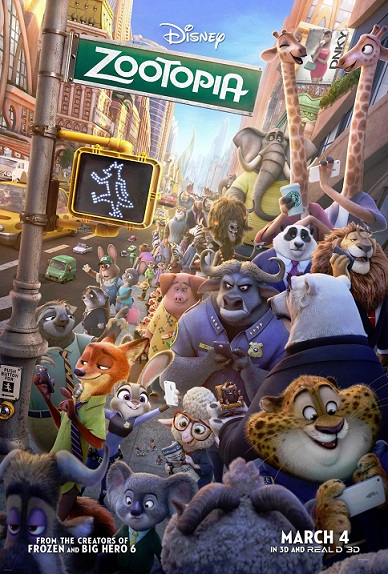
Zootopia: Not the Allegory You Were Expecting

by tryanmax

I’ve got to hand it to Disney. I think they’ve really pulled one over on the identity politics crowd. With their latest smash-hit Zootopia, the studio has given the usually unquellable race-baiters, gender-warriors, and plain ol’ Disney haters an allegorical placebo to shut them up. So satisfied are they that Disney finally “gets it” that one outlet went so far as to regard the new film as an apology for Song of the South, a film known almost solely by distorted reputation alone.
Spoiler Alert
All Disney really did, though, is recognize identity politics as a thing. The only message they conveyed with Zootopia on the matter is probably the best one that anyone can actually offer. Simply, “It’s complicated.” Let’s take a look at what they did.

I won't be discussing the plot, which is a twisty noir-ish tale, directly. As such, this article assumes the reader has already seen the movie. For a film synopsis, see here.
Lookin’ Good
In more than one way, Zootopia is all about appearances. For one, it is a visual treat to the eyes. Disney imagination is on full display in creating a world where animals of every species, from tiny hamsters and mice to giant giraffes and hippos, live alongside one another in an urban landscape. I remarked more than once how the characters looked so fluffy on screen that I wished I could reach out and touch them.
That’s a good segue for how Zootopia creates the appearance of handling identity issues. In one scene, a fox does just that, grabbing and handling a sheep’s bouffant while delightedly remarking how fluffy it is. His rabbit companion admonishes him that he can’t do that. This is clearly a reference to the supposed problem of white people always touching black people’s hair.

The script is peppered with little nods to so-called “micro-aggressions” such as this. The police force has a “Mammal Inclusion Initiative” which is clearly an affirmative action program. Judy Hopps, the beneficiary of said program and the first-ever rabbit on the force, asserts that she is not “some token bunny.” In another instance, she informs a cheetah that it’s okay for rabbits to call other rabbits cute, but not for other species. There’s a scene where an elephant store clerk asserts his right to refuse service to a fox. The assistant mayor believes she is only on board to court the “sheep vote.” The terms “articulate” and “patronizing” are conspicuously dropped into a conversation. The list goes on.

All of this is meant to signal that Disney is in-the-know on issues that virtually everyone is already aware of anyway. Otherwise the gags wouldn’t play. So, because Disney can demonstrate their consciousness, some have assumed that Disney is actually addressing the issues. But like the (literal) political animals in their film, Disney actually dodges the question entirely by re-framing it.
It’s Funny ‘cos It’s True
Probably the most memorable scene in the entire film is the one that takes place in the DMV. Judy Hopps is in a hurry but, to her chagrin, the entire office is staffed by sloths. She actually exclaims, “They’re all sloths!?” because she naturally assumes all sloths are slow and, well, they are. It’s actually amazing how well this works for laughs, not just once, but over a dozen times in the course of a couple minutes. At the same time, it totally reinforces that stereotypes do have a basis in real trends. Later, the film also breaks the stereotype when the main sloth is pulled over for street racing, but this is still in service to the same gag. Sloths are funny ‘cos they’re slow, but they’re even funnier if they’re fast.

Again, Zootopia is full of these types of gags. Being a rabbit, Judy has 225 brothers and sisters. Her sidekick, Nick, is a fox and a street hustler. Judy tries questioning an elephant who can’t remember anything. The city’s mayor is a lion. The mob-boss Mr. Big is revealed to be a tiny shrew. A group of lemmings mindlessly follow each other in buying popsicles. A hippie yak is unwashed and swarming with flies. This is Blazing Saddles style humor in a form that can slide past trigger-warning and safe-space sensibilities.

The very makeup of Zootopia (the city within the movie) itself is a gag. It is as much a theme park as a city and it is deliberately segregated by species, just as if it were a human-run zoo. Districts such as Tundratown and Sahara Square provide appropriate habitats for different species, while a neighborhood like Little Rodentia scales the urban landscape to its tiny residents. It’s both humorous and sensible, but it pushes aside any pat solutions to identity issues.
Where da White Bunnies At?
If there is one thing about Zootopia that has the identity politics crowd grumbling, it’s that they can’t quite figure out which animals represent which group of humans. I think that’s by design. Even though the animals of Zootopia inhabit a world very much like ours, even featuring similar political issues, it’s impossible to say that certain animals represent certain groups of people. Rather, all the usual signifiers are jumbled up.
At first, it looks like rabbits and other prey are the oppressed minority. After all, historically they suffered at the hands of predators, as the opening scene points out. But that isn’t the case. It turns out that Zootopia is 90% prey, and they are often openly prejudiced against predators. Yet, somehow, the mayor is a lion and predators occupy positions alongside prey everywhere. In most cases, it actually appears that size matters most, with large species like buffalo and bears filling the police ranks and big mammals generally throwing their weight around. Driving this home early in the film, the assistant mayor buddies up to Judy to say, “Us little guys have to stick together.”

The more you parse the animal groupings in the film, the more complicated it gets. Any attempt to draw straight lines between Zootopia and the real world is going to get uncomfortable really fast. As I already laid out, in Zootopia, minority = predator = savage. That equation ends careers if brought into the real world.

As I see it, the point is not to draw lines between the cartoon world and the real world, as tempting as it may be. Instead, by sidestepping the usual identity markers Zootopia is actually able to tell a compelling story while inserting a non-polarizing message of mutual respecting in a way that is better than simply mirroring current events.
[+] Read More...

Thursday, December 17, 2015

Film Friday: The Good Dinosaur (2015)

Pixar’s The Good Dinosaur is not doing well with audiences, and I’m not at all surprised. There is a fundamental problem with The Good Dinosaur, and that is that the film mixes a main character who is too cutsie with a plot that is anything but cutsie. The resulting mishmash satisfies neither those looking for a mindless baby distracter nor those looking for a more compelling story.

Plot

To put it simply, The Good Dinosaur is a western that uses dinosaurs instead of humans as the main characters. In fact, this is a very, very clichéd western, right down to the use of Sam Elliot to do voice work. The story involves the weak son of a noble farmer who must prove that he can live up to his father’s expectations and ends up in a survival film as he must find his way home through a dark and evil wilderness.

The story opens with the birth of the main character, Arlo, and his sister Libby and brother Buck. Their parents, Henry and Ida, are Apatosauruses. They live in a world where the dinosaurs were never wiped out and continued to, uh, evolve I guess (this is part of the problem with the film... it’s not clear what changed except that these particular dinosaurs are farmers).
Arlo is the runt of the litter and quickly proves not only to be incapable of doing the work required on the farm, but is a coward. He is afraid of basically everything. His father is patient with him however, though he simultaneously pushes Arlo to stop being such a whiny bi— uh, to become less of a coward. One of the tasks Henry gives Arlo in this regard is to trap and kill a pest that has been eating their corn... which they need to feed their chickens, who terrorize Arlo. The pest turns out to be a cutsie baby human! Oh goodie.

Arlo, of course, can’t bring himself to kill the human, and the human escapes. Henry then takes Arlo and chases after the human cave boy. They chase him up into some evil looking mountains, which end up flooding. The flood kills Henry and leaves Arlo stranded far away from home. Arlo then finds and befriends the human, who acts like little more than a puppy (he can’t even speak). The rest of the story is Arlo’s journey to find his way back to the farm.
Why This Film Doesn’t Work

This movie has a lot of problems, quite frankly.

The first problem is the simple blown potential. The trailer to this film was intensely clever. It asked, what would happen if the asteroid that wiped out the dinosaurs missed the Earth? And then you see the asteroid shoot by the planet and all the dinosaurs who had looked up at its approach return to their grazing. This trailer offered limitless potential. It opened the door to anything. It promised a world where dinosaurs had evolved to something beyond just being dinosaurs. It promised a world where man and dinosaurs co-existed in some friendly or hostile way. It promised something you had never seen before. The film even skips a few million years at the opening, suggesting that we would see dinosaur society evolved into the modern world... whatever that would look like.

But none of that happened.

Instead, you get a world that is indistinguishable from dinosaur times except for the presence of one cave-boy and the existence of one dinosaur farm. That’s it. What a waste.
The next problem probably tells us why the first problem exists: the filmmakers never bothered to lay down the rules that guide their new universe before they began. Is there really a dinosaur society or not? There’s the farm. There are three T-Rexes who are herding the dinosaur version of cattle. But that’s all you see. There is no sense if there are cities or if there is an economy – does the farmer sells his crops? Do the T-Rexes sell their cattle or just eat them? The other dinosaurs they run into seem to be standard feral dinosaurs. So is there a society or not? They never say, and the result is that it’s unclear what kind of world Arlo really lives in and everything feels ambiguous and confused.
As an aside, I was also personally bothered by the sense that much of what they encounter felt vaguely stolen. The human reminded me of Mogli from Jungle Book; he even has a similar storyline – leaving for human companionship at the end. The nyctosaurus and pterodactyls reminded me of the vultures from Jungle Book. The T-Rexes reminded me of a combination of Bagheera and the elephants from Jungle Book. There's even a seemingly hypnotic horned dinosaur (a Styracosaurus), right at the end of a snake scene, which is clearly Kaa from Jungle Book. The scene chasing the human felt like the apes rounding up the humans in Planet of the Apes. The whole Arlo story felt like a number of westerns involving a weak son who must avenge his father’s death. And so on. This is the first Pixar film where I felt I could pick out things that were copied from other films.
The real problem, however, is that the film is a mishmash of concepts. For whatever reason, Pixar chose a main character who is better suited for the preschool set. He’s cute and whiny and stupid and whiny and seems made for backpacks and plush toys. Put him in a story with his imaginary friends and magic tree houses and he would feel right at home. But then they rammed him into a story that has a truly adult storyline in the sense of being dark and not at all funny, and about the subtle goal of proving one’s worth to oneself. This is a farmer western combined with a survival drama like The Grey or The Edge. It is not a plot that in any fits the childish Arlo.
The result of this is an entirely unsatisfying story. The preschool crowd will not like the dark, very unfunny plot. The people who might like the survival story will find the whiny, child that plays the lead to be too annoying and unbelievable for this kind of story. And people who come in having seen the trailer are going to wonder how this movie managed to ignore the entire magic the trailer promised.

Pixar is an amazing company that does a great job with its movies time and again, but this one is a total miss. This one is entirely unsatisfying. It’s boring, indifferent, and just out of place. And that’s too bad given the amazing potential the backstory suggested.

Thoughts?
[+] Read More...

Thursday, April 2, 2015

Film Friday: Into The Woods (2014)

I didn’t know what to expect from Into The Woods. The trailer looked good and I do enjoy a good musical. And this one apparently did pretty well on Broadway and in London for over three decades. It seemed to have good actors in it too and great effects. So it probably should have been pretty good. Yet, I’m going to use this film to discuss what I really despise about Broadway.

Plot

Into The Woods binds together several fairy tale stories to create a new story. The plot is meant to come across as complex and clever, but honestly it feels derivative, predictable and muddled and far too cynical.

The story follows a whiny Baker (James Corden) and his Wife (Emily Blunt), who want to have a child. The reason they can’t have a child is because their neighbor, an evil Witch (Meryl Streep) cursed the Baker’s father because he stole magic beans from her garden. Her curse was that the Baker’s father’s family tree would be barren.
Streep, however, has decided that she wants to undo the curse. She doesn’t give a reason for her change of heart, but it seems that undoing the curse will give her back her youthful good looks, which were stolen from her by some other curse. To end the curse, the Baker must collect a white cow, a red cloak, a golden slipper, and some golden hair. So the Baker sets out into the forest to collect these items.

As you might expect, he trades Jack some magic beans for his white cow. He saves Little Red Riding Hood from the wolf. His Wife steals Cinderella’s (Anna Kendrick) slipper. And the golden hair comes from Rapunzel, who was his father’s daughter until she was taken by the Witch and hidden in the tower. Of course, each of these stories is corrupted to a degree and the characters all seem to be randomly roaming the forest as the plot needs.
Fast forward: the Baker gets the stuff and the Witch reverses the spell. That’s where the film should have ended, but it doesn’t. Instead of rolling credits, as should have been done, the film falls way off the rails. The Prince (Chris Pine) marries Cinderella and then proves to be unfaithful because he’s a prince and little girls need to be warned that they can’t rely on princes!! (Sorry, I was channeling a feminist.) He fools around with the Baker’s cougar Wife, who the writer seems to think is only living up to her potential by having an affair. Rapunzel learns to hate her mother the Witch for a reason she already knew long ago. A giant attacks and get this... it’s a woman! Ha ha! OMG Isn’t that clever?! Well, of course it is... because the characters tell us so four or five times. Several characters die because life is about suffering when you work in theater, and the story just kind of winds down with no one living happily ever after because leftists don’t know jack about how to end a story.

Why I Liked This Less and Less As It Dragged On

Where do I start about what I hated about this film. How about at the beginning?
The story felt derivative. And I don’t just mean because I saw Once Upon A Time first. The problem is this: the writer took the most well-known fairy tales and wove them together in the exact way you would have expected. No attempt was ever made to get off the most obvious path. For example, if you’re going to use Cinderella, the most obvious way would be to create a need to steal her slipper. Ditto on Red Riding Hood’s cloak and Rapunzel’s hair. Yet the writer never thought to make them important to the story for some other reason. Thus, there isn’t a single moment where you are surprised in the least.

The characters are awful too. I hated them all and just didn’t care what happened to them. The Baker was unbelievably whiny. Even worse, because liberals believe intent is what matter, we were supposed to like these people even though they spent their time abusing and defrauding everyone they met because they claimed to feel bad about it. Huh? The Princes (there are two) were gay lounge lizards. Jack was a thug in the body of a child. Red Riding Hood was as wooden as a robot and seemed psychotically cold about death. Cinderella was full of anguished indecision in every scene, but the things she anguished about weren’t things anyone cares about. And all of them, every single one, was self-obsessed. The end result was that the characters came across as rotten, whiny and unpleasant. They aren’t people you want to see succeed... or spend time with.
The songs were crap too. Did I mention that this was a musical? Yeah. It was the type of musical with very few actual songs, but lots and lots of dialog being sung as pretend songs. This is something I hate about many Broadway productions. It seems that there are three or four standard song formulas Broadway uses. Depending on the emotion of the scene, the correct formula song is chosen and the dialog is jammed into the form with the proper rhyme scheme. The end result is that you spend the whole time hearing them sing whatever stupid lyrics they have while humming the more famous versions of the same song from prior musicals... “Isn’t that ‘The Candy Man’ from Willy Wonka?” What’s more, the songs are so forgettable and generic that you can replace them with their counterparts from other musicals and I seriously doubt anyone would know the difference.

This is lazy and it’s annoying. It also encourages the actors to engage in melodramatic Broadway acting styles. “Golly gee whiz (swing arm like a newsie).” I find this super annoying. Why? Think of it this way. How sick are you of Johnny Depp playing the same drunk over and over on film these days? This is the same thing... only it’s being done in musical after musical for decades regardless of who the actor is. Talk about annoying!

The writer was an ass too. Three crimes against writing come to mind here in particular. First, it was obvious that the writer carefully avoided doing anything clever for the first four or five hours of the film... ok, it was only 124 minutes, but it felt twice as long. At no point does this writer ever trust the audience to use their brains; everything is spoon-fed to you and served on white bread. Secondly, the writer has insecurity issues. I know this because the story is full of moments where the writer has characters tell you how clever the writing is. If you find yourself doing that, it’s because you suck. And third, the ending is total crap.
The film should have ended about twenty minutes sooner than it does. But it didn’t. Instead, the characters venture back into the woods for no valid reason. Once in the woods, the writer has them engage in out-of-character moments (like having an affair) so he can effectively slander them one by one. Then the film just kind of ends. This entire scene is confusing, pointlessly dark, pointless and it doesn’t fit in with the rest of the film at all. And the only reason I can see for doing it is that the writer is a cynical prick who thinks it’s clever to twist these characters into rotten people. Since attacking these characters was a popular activity on the left at the time this was first written, I assume this was ideological.

All in all, I have to say that this film stunk. The characters are impossible to like. The story is mind-numbingly boring and predictable until the ending, which is random and hateful. The songs are entirely forgettable and derivative. And the story seems intent on making you hate fairy tale characters.

This is Broadway at its worst. Thoughts?
[+] Read More...

Tuesday, September 23, 2014

Is Disney’s Princess and the Frog Racist?

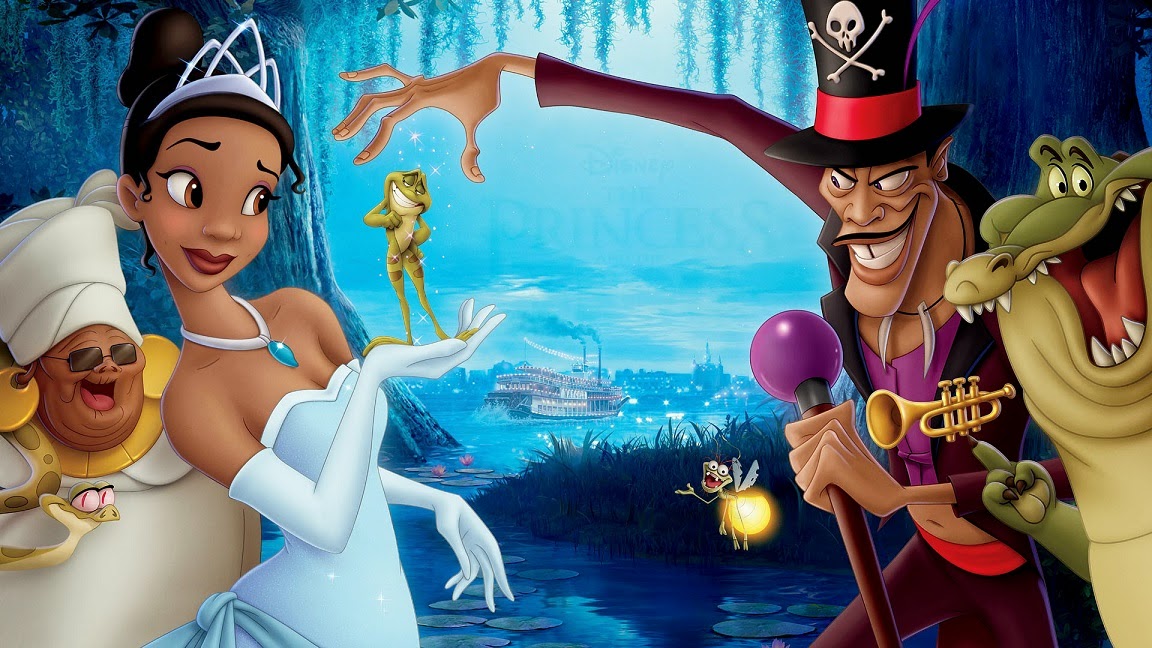
In its whole history, Disney has never had a black princess, at least until 2009 when it released The Princess and the Frog. But The Princess and the Frog is not a cause for celebration, claims the aggrieved-left, because the film is racist! Only, it’s not.

The Princess and the Frog is the story of Tiana, a black woman from New Orleans circa 1930s. She is a talented cook with dreams of opening her own restaurant, a dream she got from her father who has since passed. The story opens with Tiana working hard in a restaurant to save up enough money to buy an abandoned building to start her restaurant. She has finally saved enough! Hurray! Only, she's told that another buyer has appeared and she has only twenty-four hours to raise her offer, something she cannot do. Boo!
Tiana's friend is a spoiled, rich white girl named Charlotte, who wants to marry a prince, and it just so happens that a prince has come to town. This is Prince Naveen, who has been cut off by his family because he’s worthless and lazy. He and Charlotte are a perfect match -- he has the title, she has the money. However, the next time Tiana meets Naveen, he has been turned into a frog by a Voodoo witch doctor, who is plotting with Naveen’s servant to replace the prince, marry Charlotte and steal her fortune. Naveen convinces Tiana to kiss him to change him back into human form so he can prevent this. In exchange, he promises to buy her the restaurant. She agrees, but when she kisses him, she turns into a frog herself.
At this point, Naveen and Tiana must venture into the swamp to find Voodoo priestess Mama Odie so they can become human again. Accompanying them are Ray, a Cajun firefly, and Louis, a trumpet-playing alligator who wants to play jazz with the humans. Trying to stop them are the witch doctor and his army of shadow creatures.

All in all, this was an excellent Disney film, easily the best after a miserable decade for Disney. The story is fast paced and relatable despite being both ethnic and deeply Louisiana. The art work is beautiful. Bits of the film are clever. And the songs are well done in a Broadway sort of way, which is greatly appreciated after Disney’s two decade use of ultra-bland, entirely forgettable corporate pop, like the song Elton John and Phil Collins kept passing off as different songs throughout the 1990s.
So what could possibly be racist about this? Well, that’s a good question. Several attacks were made on this front. Some argued that it was racist that Disney's first and only black princess wasn’t born a princess and had, instead, to marry into it. Others argued that the film used black stereotypes. Neither argument is valid.
That Tiana isn’t a princess is a key plot point which makes the story work. It isn’t meant as a sleight or to devalue her character either. To the contrary, her character is easily the most noble in the story. Nor is there any suggestion of a racial component to her lack of princess status. In other words, there isn’t a single suggestion, spoken or implied, that her race is the reason she isn’t a princess to begin with. And it’s not like all Disney females are princesses (see e.g., Penny, Jenny, Alice, Eilonwy, Meg, Jane). Essentially, the only way to see the decision to start her as a commoner as being a decision based on race is to assume that based on her race alone.

The stereotype argument is even worse. For one thing, there are no negative black stereotypes presented. Each of the black characters is presented as smart, capable, and (except for the villain) strongly pro-family and pro-community. Nobody is living on welfare, selling drugs or having kids out of wedlock. Nor are there any presentations that fit the “Uncle Tom” mold. The closest would be Tiana’s mother, but she’s not a servant; she’s an ultra-talented seamstress and business owner.
Indeed, the more you look, the harder it becomes to find any black stereotypes. What you see instead are Louisiana stereotypes aplenty. You have toothless Cajuns, everyone being a jazz player, voodoo princesses and witch doctors, corrupt-but-lovable parish politicians, gumbo-lovers, etc. Similarly, you have all the trappings of New Orleans: the bayou, gumbo, riverboats, the light rail, gators, etc. Everything in this film is regional rather than racial.

I think where the “racist” argument springs from is the idea that it’s somehow racist to show blacks in roles they occupied historically if they are shown to be happy and not the victims of white oppression. Hence, the fact that Tiana doesn’t struggle against white oppression offends the aggrieved left as a whitewash. That is ridiculous, however. In fact, if you think about it, this argument would relegate every black story to being about white racism, and blacks could never tell their own stories without the focus being on whites. Now THAT would be racist!

Thoughts?
[+] Read More...

Tuesday, August 19, 2014

Summer of Films: WALL-E (2008)

WALL-E is a great film. On the surface, it’s a cartoon about a silent robot which falls in love with another robot. But it’s really so much more. In fact, WALL-E is the first Pixar film to truly show me the depth of their storytelling prowess.

Plot

Here’s the plot. In 2105, the Earth is ruled by a single corporation, Buy-n-Large Corporation (BnL). Because of pollution and garbage, the Earth has become uninhabitable. To solve this problem, BnL shoots the population of the Earth into space aboard luxury starliners, where they live in great comfort and happiness. Unfortunately, having nothing to do, as the starliners are automated and robots wait on their every need, the humans become morbidly obese and essentially incapable of movement as they become dependent on the machines.
Meanwhile, robots like WALL-E are left behind to clean up the garbage as everyone waits for the Earth to become habitable again. BnL, however, concludes that the Earth cannot be saved and it orders the automated starliners to take care of the humans in perpetuity.

WALL-E takes place seven-hundred years after the Earth was abandoned. WALL-E is one of the garbage robots, and the story begins when WALL-E discovers a small seedling on the Earth. He nurtures it, only to have it found by EVE, a robot sent from the starliner Axiom to search the Earth for signs of life. She reports her discovery, but when she does, the ship’s automatic pilot Auto, suppresses her discovery and tries to have her reprogrammed. WALL-E, who has fallen in love with her tries to save her, and she, WALL-E and the figurehead human Captain must fight Auto to free the humans from their gilded cage. At the end of the movie, they return to Earth where they discover millions of seedlings, and like Noah, they set about rebuilding the world.

Why This Film Excels

WALL-E is an amazing story. Why? Because it’s really several different stories, all told simultaneously and beautifully. For example, on the surface, WALL-E is a love story in which a robot which cannot even talk thoroughly convinces the audience that it has fallen in love with another robot. This is truly an impressive achievement. Having an audience believe that two characters are in love is already a difficult challenge. Making them cartoons doubles the challenge. Making one of them mute ups the challenge exponentially. And putting them into a story that is not a love story makes this a nearly impossible task... yet, Pixar pulls it off without a hitch or hiccup.
Next, WALL-E is an allegorical version of the story of Noah’s Ark from the Bible, but that’s just the beginning. Consider that Noah’s story is not exactly a strong story when it comes to filmability. Not to mention that Pixar doesn’t even get to use the spectacle of the flood to pump up the story. Further, the film takes place in the future, and it cannot be overtly religious. Again, these are serious hurdles that make Pixar’s ability to pull this off pretty incredible.

But there’s more... WALL-E is essentially Aldous Huxley’s “Brave New World” brought to film. Yes, it is. Whereas Orwell warned of a brutal, oppressive government crushing freedom, Huxley provided a similar warning in “Brave New World,” only he pointed out that government need not be heavy-handed to be insidious. Instead, it can use hedonistic pleasure to control the people just as easily as it uses violence. WALL-E delivers this identical message. Consider this:
On the surface, the humans seem happy. They have food and entertainment. They want for nothing. Notice also that the “government” is not inspired by evil. Indeed, Auto genuinely believes he’s looking out for the welfare of the people. His job is to protect the humans by keeping them on the ship, and that is all he wants to do. There is no better example of a benign dictator on film.

But first impressions are misleading or at least incomplete. The idea that the humans are happy is shown to be a mirage when they realize how helpless and dependent they’ve become. This awakens something inside them, something which drives them to regain their freedom despite everything they will lose.
The idea of Auto as a benign dictator falls apart as well. First, note that Auto suppresses information which runs counter to his mission. His motives may be good, but this is tyrannical behavior which strips people of the freedom to make their own choices. He even tries to destroy EVE, because he sees her as a danger to his mission. Suddenly, Auto’s methods are those of dictators the world over. Then, when the Captain orders Auto to set the humans free, Auto ignores his orders and fights the Captain to keep the humans prisoners. Essentially, in the name of doing good, Auto hides the truth, eliminates those who know the truth, and use his power to deprive the humans of their independence.

This is a truly subtle and difficult story to tell, yet Pixar does it and it does it without any false shortcuts, such as making Auto defective or secretly programmed to be evil. Evil just becomes natural to him because he has absolute power. Pixar lays this out without adding fake motives to try to explain away difficult truths. That's a hard sell for a cartoon. Add in that at the same time it does that, Pixar tells the Noah story and the love story, and you have a true achievement here.

Truly impressive.

Thoughts?
[+] Read More...

Tuesday, August 5, 2014

Guest Review: Fantasia (1940)

Fantasia and its sequel are like nothing else Disney, or any other major American studio, has ever made or attempted and is today widely hailed as a pinnacle in animation. However, when it was released, though the critical reception was mostly positive, audiences were less than thrilled, in fact Walt Disney later said in an interview that Fantasia “nearly broke us”, but defended it as an “artistic masterpiece”. He is right.

Fantasia is an art film. There is no other way to describe it. It has no overall story, linear or non-linear, instead it is a series of vignettes with each one centered around a particular piece of music, each introduced by Deems Taylor with the music performed by the Philadelphia Orchestra conducted by Leopold Stokowski. They are, with summaries, in order:
Toccata and Fugue in D Minor by Johann Sebastian Bach:
The Nutcracker Suite by Pyotr Ilych Tchaikovsky:
The Sorcerer’s Apprentice by Paul Dukas: A sorcerer
Rite of Spring by Igor Stravinsky
Pastoral Symphony by Ludwig von Beethoven
Dance of the Hours by Amilcare Ponchielli
Night on Bald Mountain by Modest Mussorgsky & Ave Maria by Franz Schubert
The first two feature absolutely no plot or story and are largely images to fit the music, especially Toccata and Fugue, which is here played on the strings rather than the usual organ, where the visuals can only be described as “impressionistic” in that they give a visual “impression” in animation of the music you are hearing. You “see” the violin strokes, you “see” the music played. In The Nutcracker Suite you have mushrooms and flowers dancing to the various tunes you hear in the suite.

The Sorcerer’s Apprentice is the most famous, with Mickey Mouse as titular apprentice to the sorcerer, Yen Sid (Hint: spell “Yen Sid” backwards). You probably know the story, the sorcerer having told the apprentice to fetch pales of water goes to bed leaving his magic hat behind. The apprentice then uses the hat to make the brooms do it for him but soon finds he can’t control it.
Rite of Spring uses Stravinsky’s most famous ballet, and one of my personal favorites, to tell the story of Earth from its birth in the cloud of dust around the sun and the volcanic eruptions of its early days to the ultimate rise and eventual extinction of the dinosaurs.

Pastoral Symphony features various “pastoral” creatures of Greek mythology such as centaurs and faun dancing and frolicking with the Greek god Bacchus in the day until Zeus appears and scatters the partying flock with his thunderbolts. This one is mostly light-hearted after the dark Rite of Spring.

Dance of the Hours, famous for providing the music for Allan Sherman’s “Hello Muddah, Hello Faddah” is even more light-hearted and comical with dancing ostriches, hippos, and an alligator chasing his hippo, not because he wants to eat her but because he has fallen madly in love with her.
A Night on Bald Mountain & Ave Maria is the final one and tells of the slavic god Chernabog (read: Satan) calling the ghosts and demons to Bald Mountain where he holds a terrifying black mass until the morning church bells chase him away. Fantasia then ends on a chorus singing Schubert’s Ave Maria.
What is Good About It
The animation and the music. Each one is genius in its own way and will have you watching and re-watching again and again. From the stunning strings of Toccatta and Fugue in D Minor to the beautiful chorus at the end the music is fantastic and needs little praise. The presentation is fantastic whether its the dramatic death of the dinosaurs, the terrifying demon Chernabog on Bald Mountain, or the hopeful, heavenly chorus of Ave Maria that closes the movie out.

But splendid animation and music does not a great film make. The true genius of the movie is that it never tells you what to take from it. There is no dialogue and Deems Taylor’s narration only gives a basic outline of what you are going to see, so the interpretation of it is largely up to you. You are never told how to feel about the events of the movie. You are never explicitly told how to feel about the dinosaurs dying out. It is shown, it happens, and the emotional response is up to you.

This means you cannot watch it like a normal movie. You can’t listen to dialogue and say. You have to free your mind and let the movie, and its images, music, and emotions wash over you. You can’t watch it, you have to experience it.

If Snow White is prose, this is poetry.

I will acknowledge, however, that certain moments are rather dull, for example, the Nutcracker Suite can drag on too long. And the movie, as you might have guessed, may be too adult for young children. But its an “artistic masterpiece” and one that is definitely worth checking out.
[+] Read More...

Tuesday, June 17, 2014

Toon-arama: To Sing or Not?

Have you ever noticed how many animated films are done as musicals? It almost seems like it's required that animated films be musicals. Disney after Disney is packed with fantastic songs -- I'm particularly partial to King Louie's song in Jungle Book. South Park is a musical. Prince of Egypt was a musical. I'm sure that all the Pixar stuff is musicals, right? Well, no. Most of the Pixar stuff is not done as musicals. And the more I think about it, the more it seems that non-musicals dominate.

As I said, at first glance, it seems that all cartoon films are musicals. When you think about the Disneys, they were all musicals. Then there's South Park, The Nightmare Before Christmas, An American Tale, Charlotte's Web, Anastasia, All Dogs Go To Heave, and of course, Disney's still doing it too: Frozen, Tangled, The Princess and the Frog, etc. People talk about the songs in these films. Awards shows tend to focus on the songs. Many of these cartoons now end up as live musicals too.
But the more I started thinking about it, the more I realized that many of the best films of the past couple decades were not musicals. Wreck-It Ralph, which is perhaps the best animated film in a generation is not a musical. Yes, it has a musical montage, but that does not a musical make. Indeed, what makes a musical is when the characters stop reality and break into a song about the plot. That doesn't happen here. WALL-E wasn't a musical, nor was Toy Story, nor was Monsters University. Wallace and Gromit and Despicable Me weren't either. Yes, these films typically had a song in them, but they weren't musicals.
This got me thinking. And it struck me that despite the perception that animated films are always musicals, the truth is that few are. I wonder what this means? For one thing, it suggests that the public has a skewed view of what cartoons are -- a view that harks back to Disney. But at the same time, the public has no issue with seeing a film that doesn't meet their expectation of what cartoons should be. On the other hand, few films completely give up on the musical number as most still do include a musical montage involving some current pop hit.
Equally interestingly, when you think about television cartoons, singing is actually quite rare. There are some instances. South Park sometimes does musical numbers. The Simpson's doesn't. A handful of the original Scooby Doos had musical montages, typically love songs as they monsters chased them. The copycats, like Jabber Jaw and Josie and the Pussycats involved the bands singing a song. But most cartoons did not. Even Looney Tunes, which uses vast amounts of classical music and opera almost never has their characters sing. So why do we expect something different from television cartoons than we expect from animated films?

I'm thinking this is a question of history. I'm thinking that animated films basically were Disney's domain for so long that we began to see the Disney traits as definitional. At the same time, television was packed with shorts that were more verbal, things like Looney Tunes and The Flintstones. So these two genres developed separately and created separate expectations that we still believe today, even if they are no longer true.

Interesting? Not interesting? Thoughts?
[+] Read More...

Tuesday, June 3, 2014

Non-Disney Television Shows

A couple weeks back, tryanmax came up with a stellar list of non-Disney cartoon movies of note. This got me thinking. Disney dominates the cinema, but when it comes to television, Disney is notably absent as an important player. It's not to say they haven't produced some good cartoons like Duck Tales, but they haven't really had any major hits with the general public. Here are the shows I would say have been the biggest and most important hits.

Looney Tunes: The Looney Tunes were original on film, but transferred very well to television and became THE staple of syndication. For generations, there wasn't a single child in America who didn't watch Looney Tunes at some point during the week. Because of this, names like Bugs Bunny, Daffy Duck, Yosemite Sam and Foghorn Leghorn are better known that George Mason and Daniel Shays.

The Flintstones: The Flintstones were the first real prime time hit for cartoons. They were basically the animated version of The Honeymooners and they showed that cartoons could reach a wider audience on television than children. That said, they were the only ones to do it with any real success until probably The Simpson's.
The Jetsons: A nicer version of The Flintstones set in the future rather than the past, I'm not sure there's anything significant about the show, but it's as well-known as The Flintstones and many Americans grew up watching it.

The Rocky and Bullwinkle Show: I list this one because it is the first example I can think of where you start to see a niche market develop. Bullwinkle is not an easy show for general audience to like. It is packed with political references and very clever, but not obvious jokes. This is the first attempt to serve smarter audiences than sitcom viewers and kids.

Scooby Doo: Scooby Doo seems to have ushered in a new age of cartoons. These were more lifelike in story and image than the Looney Tunes before them, they were episodic, and they had lower production values. It strikes me that Scooby represents a generational shift away from the WWII generation to the ME generation, a generational shift that will remain until The '80s Show.
The '80s Show: Ok, there was no '80s Show. What there was instead were a series of cartoons in the 1980's that entered the culture, sold products, and eventually spawned films. These shows include The Transformers, He-Man, G.I. Joe, Thundar the Barbarian, and other product placements shows, and they represented a new generation of cartoons that were more realistic in terms of story and imagery, but used toys as their main characters. In some ways, these were great cartoons because they had a good deal of substance in their stories. In other ways, these were just commercials. In either event, they killed off the old styles.

The Simpson's: The Simpson's started small as a series of shorts on The Tracey Ullman Show before getting their own show and, arguably, helping the FOX Network survive to maturity. The show has run for 15,000 years now past its time. But back in its prime, The Simpson's was edgy, must-see television. Bart became a national icon and even an object to attack for certain small-minded types. The success of The Simpson's showed that cartoons could attract adults and in prime time, and it spawned others like Futurama and the Seth McFarlane empire.
Ren and Stimpy: Ren and Stimpy was the first cartoon I recall that seemed to spark the attention of young people in my generation once they became adults. This one was loved by college students and mechanics alike and everywhere I went you could hear little references like "Happy, happy, joy joy." In terms of significance, I would say that this opened the door for other poorly drawn, snarky, satirical cable cartoons like Bevis and Butt-head and South Park and SpongeBob, and other less memorable, though interesting, cartoons like Duckman and most of Adult Swim lineup.
South Park: This is the BIG conservative cartoon. That alone makes this memorable. Even more to the point though, South Park has become deeply engrained in our culture and has become a strong social critic of much of the crappulance in our system and society. This isn't quite at the level of The Simpson's in popularity, but it's probably more important.

Family Guy: This show proved that Seth McFarlane could get rich selling nothing the least bit clever. No, I can't be kind about this dreck.

Batman: Finally, this show, in my opinion, represents the takeoff of the hardcore "graphic novel" fans exerting their muscle. This show represents the beginning of the superhero craze that has flooded our cinema as these caped and costumes characters become grim avengers, and you would be shocked at the people who have done voices for this show. Essentially, this show represents the new world of Hollywood, which is catering more to fanboys.
[+] Read More...

Tuesday, February 25, 2014

Toon-arama: Monsters University (2013)

Do you know what happens if you take a film like Revenge of the Nerds, Van Wilder or any other generic college film and you suck out all the sex and drugs and replace the characters with cute monsters? You get a surprisingly decent film, and that film would be called Monsters University.
Plot
Our story begins with young Michael “Mike” Wazowski (Billy Crystal) doing a factory tour of Monsters Inc., a company which scares human children because their screams can be converted to energy, which powers Monstropolis. Mike is so impressed that he knows what he wants to be when he grows up. He wants to be a scarer. (Mike will, of course, work for this company in Monsters Inc.)
Jump forward many years and Mike is a freshman on his first day at Monsters University. He’s enrolled in the University’s prestigious Scaring School so he can become a scarer. Once there, he meets James “Sulley” Sullivan (John Goodman), a blue-green monster with pink-purple splotches. Sulley comes from a renown family of scarers and has natural talent. He is, however, jaded and lazy because he’s always gotten along on talent alone. Mike, on the other hand, is not naturally scary and needs to work hard.
From there, we are shown the school. Conflict arises between Mike and some frats. And then disaster strikes. Mike and Sulley get kicked out of the Scaring School when they are unfairly failed by Dean Abigail Hardscrabble as retaliation for damage they do to her property. They have one chance to avoid this horrible fate: they need to win the Scare Games, a tournament put on by the schools frats and sororities. But to do that, they need to be in a frat and the only frat that will take them is the nerds of Oozma Kappa. They have no chance... or do they?
Good Fun
Monsters University is no Wreck-It Ralph, which I see as the current gold standard in animation, and it’s not quite as good as the original Monster’s Inc., but it’s an enjoyable film that is well worth seeing.

Two things really stand out about this film. First, Monsters University doesn’t include the sorts of hidden gags meant to appeal to adults. This story picks a rated-G level and stays there. There are no subtle sex jokes, no hidden messages, and no references to pop culture. Instead, the story relies on its characters and plot to entertain, and yet, that proves to be enough. The characters are likeable and you feel for them, and the “cartoon physics” they engage in are hilarious. Also, the story is truly a feel good story with just enough twists and turns to remain unpredictable from minute to minute even as you think you know how it will all turn out (hint: you don’t).
This raises the second issue. I’ve long marveled at how successful the generic college movies have been. Every one of those films just copies the others. They never add anything original. This film doesn’t either. Yet, it works. And not only that, it works despite the total absence of the usual adult content that seems to power the generic college films. What this suggests is that there is more to the generic college film than one would expect. In other words, there is something so universal about the conflicts inherent in these films that they appeal on that basis alone. It’s a bit like the Heroes Journey, which seems to appeal no matter what context it is found in.

So what are some of those conflicts? Well, there’s the issue of finding where you fit in in life. There’s the issue of maintaining your personality in the face of peer pressure. There’s the issue of proving yourself the equal or superior of self-appointed superiors who want to look down at you. There’s the issue of overcoming the rigged game. And finally, there’s the issue of coming together as a team to succeed at your goals.
Each of these is a universal theme that each of us has dealt with throughout our lives, and I think that makes the generic college story a strong story even as it wrongly seems to be about parties, alcohol and panty-raids. And Monsters University proves that point by showing how appealing a college movie can be without the alcohol and panty-raids.

In any event, this is a film you will enjoy. It may not be laugh out loud hilarious from start to finish, but you will like it throughout and you will find some very funny moments. It’s the kind of film that makes you happy that you watched it.
[+] Read More...