Wednesday, January 18, 2012

"A Night To Remember" -- The Titanic In Film Since 1953

By Tennessee Jed

Few, if any, events in modern times have captured public imagination as has the Titanic disaster. That assertion is bolstered by the fact four feature length films, not to mention two made for television movies, have chronicled its demise. Numerous other productions, some dating as far back as 1912, feature either Titanic or a thinly veiled substitute.

Excluding the 1943 German film Titanic which was strictly Nazi propaganda, the other major productions each helped create or revive fresh interest in the story. The sinking of R.M.S. Titanic is the perfect template for the “disaster genre,” made all the more intriguing by the fact it was an actual historical event. Facts surrounding the disaster include all the requisite elements for gripping drama: who lives or dies, bravery, cowardice, chivalry, class distinctions, celebrity, unresolved mysteries, and abundance of eerie “what ifs.” The viewer invariably asks “how would I react under those circumstances?”

Most people today associate with the 1997 box office blockbuster that garnered eleven Oscars, and propelled Leonardo DiCaprio to mega-stardom. Movies with multiple “remakes” make for interesting comparisons. While later versions benefit from advances in cinematic technique, it is also harder to find a “fresh” angle. As we approach the 100th anniversary of the sinking, let’s review the major productions. No spoiler alerts required:

Titanic ( 20th Century Fox, 1953) - This was the first Hollywood feature film about the disaster. Although several celebrity millionaire passengers and crew officers are briefly portrayed, the focus is almost exclusively on one fictional family. Clifton Webb and Barbara Stanwyck star as an estranged couple, Richard and Julia Sturges. She is traveling first class to take the children Annette and Norman back to America away from the foppish, high society world that engrosses her husband. In order to stop her, Richard secretly books passage in second class, then bribes his way “upstairs.” Their daughter falls for a young Purdue student named “Giff” Rogers (portrayed by a young Robert Wagner who looks eerily like Leo DiCaprio.) As Julia and Annette are being placed into life boats, Richard and Julia have a tearful reconciliation. Young Norman refuses his seat and remains with his father joining a chorus of doomed passengers singing “Nearer My God to Thee” (“Bethany” the American setting) as the ship founders. While helping lower lifeboats, “Giff” is knocked overboard, breaking his arm. He is pulled into a life boat and survives. Richard Basehart plays a young priest who had been suspended for alcoholism, but leads prayers as the ship goes down.

Modeling and special effects were pretty good for the time. Stanwyck was reputed to have been overcome with sorrow during the scene where she was lowered over the side in a lifeboat.

A Night to Remember (The Rank Organization, 1958) - is a highly faithful film adaption of Walter Lord’s 1955 best selling book. Because the book was so well written and the facts so compelling, it reads like a suspense novel. Lord scrupulously researched all information available at the time, reviewing testimony from boards of inquiry, plus newspaper and eyewitness accounts of survivors from both passengers and crew. There are a few scenes where slight artistic license is taken, but no wholesale fabrication of characters or fictionalized sub-plots. In reality, the film is more docudrama, yet never lacks for tension. Costuming was perfectly detailed and accurate, interiors perfect reproductions of the actual grand staircase, dining rooms, and smoking lounges were used. It is the most accurate of all Titanic films, even though exterior modeling shots were a bit weak.

The film stars veteran British actor Kenneth More as Second Officer Charles Lightoller, and is primarily told from his point of view since he was senior surviving officer and one of the more reliable witnesses. When I first saw this movie, I had not yet read the book, and knew little detail beyond that presented in the 1953 film. I was amazed to see how Lightoller survived after going into the freezing ocean, climbing onto an overturned collapsible life boat with several others, then somehow managing to keep it from capsizing by calling out commands to lean left or right as needed. All of this was accomplished for several hours without succumbing to hypothermia as ice formed on their soaked clothing. At first, I assumed this was merely incredible cinematic license only to discover it was a true account.

The British production, which took five months to film, added even more authenticity to the film with a cast mostly unfamiliar to American audiences. This film features an incredibly poignant scene with cellist John W. Woodward playing and singing “Nearer My God to Thee” in the more likely Horbury setting. It is fun to see a young David McCallum as assistant telegraph operator Harold Bride, plus Honor Blackman, and very brief uncredited appearances as crewmen from both Desmond Llewelyn and Sean Connery (the latter three later appearing together in larger roles in Goldfinger.)

S.O.S. Titanic (EMI, Argonaut 1979) - This production was first seen as an ABC “movie of the week.” At over two and a half hours without commercials it was presented over two nights. A shortened version cutting about 40 minutes was shown theatrically in Europe. Plagued by horrible editing, this unfortunately is the version used for subsequent VHS and DVD releases. Rushed into production prior to a rumored expedition to locate and raise the Titanic, it carries a definite television quality feel, but at least retains the distinction of being the first Titanic movie filmed in color.

The film stars and focuses on David Jansen as J.J. Astor, Cloris Leachman as Molly Brown, and David Warner as Lawrence Beesley (an actual second class passenger survivor who wrote a book about his experience.) Susan Saint James plays the fictional Leigh Goodwin, a school teacher and quasi-love interest for Beesley. As with the later Cameron film, a significant amount of time is spent with steerage passengers. In fact, there is a bit too much political sermonizing about the class distinctions of Edwardian England. Much of the footage was shot aboard the Queen Mary, and it appears several special effects shots were pilfered from A Night to Remember, then subsequently “colorized.” Bright spots include future great Helen Mirren in an early role as stewardess Mary Sloan, and Ian Holmes as J. Bruce Ismay. Despite some shortcomings it was a welcome addition to the Titanic catalog, the first re-telling in over twenty years.

Titanic (RHI Entertainment 1996) - Seventeen years later, another two part tele-movie premiered on CBS. It too leaned heavily on fictionalized characters to recount the experience of the sinking. Television, as is it’s habit, rushed production to capitalize on the hype generated by the forthcoming Cameron film. It shows, and this is clearly the weakest of the group in terms of sub-plots, dialog, and acting. Plotting yet again follows a pair of fictionalized first class and steerage passengers in romantic relationships. Perhaps the best thing about this version is that American audiences are introduced for the first time to the stunning beauty of the young Welsh actress, Catherine Zeta-Jones as Isabella Paradine, a married American passenger who is returning from Europe alone after attending a funeral. By chance, she meets her former lover, Wynne Park, played by the thoroughly dreadful Peter Gallagher, and they rekindle their long lost love while Mrs. Paradine struggles with the guilt of it all.

Before departure, a young pickpocket, Jaimie Perse (Mile Doyle), is saved from Queenstown police by two men in a crowded pub. One becomes quite drunk, brags about his upcoming passage on Titanic, and passes out permitting Jaimie to pilfer his steerage boarding pass. The other man who shielded Jaimie is the unsavory Simon Doonan (Tim Curry), a truly evil individual who happens to be a steward on Titanic, and uses his position and knowledge of the stolen pass to extort Jaimie. Curry is a fine actor, excellent villain, and produces one of the brighter acting jobs in the film. George C. Scott has a somewhat expanded role as the ship’s captain, Edward J. Smith. It may be the only time I’ve ever see Scott mail in a role, as his acting mainly consists of grimacing every time he speaks. Roger Rees (Cheers) overplays Ismay as the “go to” fall guy at fault for the disaster. In this film’s defense, almost all versions tend to unfairly promote a somewhat exaggerated, unflattering view of Ismay in that regard.

Also included is a gratuitous, inaccurate scene in which Doonan rapes Jaimieʼs love interest, Aise Ludvigsen, another steerage passenger he meets on board. Class bias is hyped and historical inaccuracies abound. On the bright side, discovery of the actual wreck in 1985 confirmed reports by many eye witnesses that the ship had in fact broken apart as it foundered. That effect was included, an improvement over prior films. The band does not play “Nearer My God to Thee” a distinct possibility.

Titanic (20th Century Fox/Paramount/Lightstorm 1997) – There is little that can be said about James Cameron’s Titanic that hasn’t already been said or written. Nominated for fourteen academy awards, winner of eleven, worldwide revenues over $1.8 billion. Essentially, this version became an incredible phenomenon, shattering all previous box office records. Cameron came up with a story that was original, and an angle that was fresh. He paid attention to details of historical accuracy, and put his $200 million of expenses to good use in terms of sets, costuming, and CGI. In short, the film deserves the success it attained. Once again, “Nearer My God to Thee” is featured as the last song played by the band using the “Bethany” setting.

This version of Titanic was first to make full use of the 1985 discovery and subsequent exploration of the wreck by modern deep water submersibles. The exploration is expertly woven into the story using a past and present format that permits the story to be told by the reminiscences of a 100 year old survivor. The screenplay proves just how well the events can be recounted utilizing fictional protagonists. Acting was overall first rate, particularly for the principals DiCaprio, Winslet, Zane, and David Warner. The inclusion of Warner in this film permits him to hold the unofficial record of three appearances in films featuring Titanic. (The third was Time Bandits which features a segment set aboard the ship.)

Cameron intends to re-release this film in 3D, 2D Imax, and Blu Ray as part of the centennial anniversary observance of the ill fated voyage.

Summary - We may never shake the grip the Titanic disaster still holds on so many of us a hundred years later. I admit to an unending fascination with the events, ironies, trivia, side stories, and human drama. As such, I appreciate all dramatic efforts to bring it to life. However, my own conclusion is that while the 1997 film Titanic is undoubtedly the best, most elaborate recounting ever made, A Night To Remember remains my personal favorite. The former is the most realistic visually and boasts a terrific screenplay. The latter unveiled more historically accurate events and a devotion to accuracy of sets and costumes than other films before or since. What is your favorite?

[+] Read More...

Tuesday, January 17, 2012

Defending Star Trek V

by ScottDS

Let’s go back in time to the summer of 1989. Indiana Jones and the Last Crusade, Lethal Weapon 2, Licence to Kill, Ghostbusters II, the juggernaut that was Batman. . . and Star Trek V: The Final Frontier, the film that easily could’ve killed the Star Trek franchise (but thankfully didn’t). I’d say a good 90% of Star Trek fans consider the film an unmitigated disaster – or at the very least, an odd curiosity, a vanity project for its director, a film that had the rug pulled out from under it by the studio. . . a film about Big Ideas without the Big Budget to pull it off. But I like it!

William Shatner and Leonard Nimoy had in their contracts a “favored nations clause” which stipulated that anything one actor received, the other would also receive. After Nimoy’s success behind the camera on Star Trek III and IV, it was Shatner’s turn. His original outline was titled An Act of Love and told the story of a holy man named Zar (later Sybok) who is searching for God. Zar hijacks the Enterprise and turns the crew against Kirk. After arriving at the planet where God supposedly resides, Kirk and Zar instead find Satan (and, by extension, God exists). Zar dies and Kirk manages to save Spock and Bones from being whisked away to Hell. The studio liked the idea but producer Harve Bennett (who had joined the franchise on Star Trek II) said it reminded him of a TV Guide logline: “Tonight on Star Trek, the crew finds God.” Immediately, the viewer knows this is impossible.

Ultimately, the crew would not find Satan, but instead an alien entity masquerading as God. Gene Roddenberry had his misgivings and both Leonard Nimoy and DeForest Kelley demanded revisions: neither Spock nor McCoy would ever betray Kirk. Screenwriter David Loughery was hired to turn Shatner’s outline into a script but two things were working against him: the 1988 Writers Guild strike and the studio brass who, after the success of Star Trek IV, wanted more humor in the film. The studio also demanded budget cuts, which meant Shatner had to scale back his vision for the ending, which involved angels and demons in a rather Dante-esque tableau. Shatner and Co. scrapped this and went with six lumbering rockmen. . . then later one rockman. . . then finally some flying energy bolts. Unfortunately, Industrial Light & Magic wasn’t available to produce the visual effects and the filmmakers went with Associates and Ferren in New York. As anyone can see from the final film, they were in over their heads.

Looking back at the film now with the benefit of hindsight, it’s actually not bad. I think it’s better than the last two TNG films (Insurrection and Nemesis) and I give this film all the credit in the world for having a big heart and for wearing it on its sleeve. As much as Shatner enjoys action, he also dares to ask the Big Questions about man’s purpose and relationship to the universe. This harkens back to the first film which, despite its flaws, had a good old-fashioned sense of adventure. Whereas most of the films are your standard action films with Hornblower-inspired space battles and fisticuffs (not that there’s anything wrong with that!), Star Trek V is an adventure in which our crew sails into the unknown, survives it, and emerges on the other side wiser for having faced the challenge. There’s also a great familial feeling on display. The trio of Kirk, Spock, and McCoy has never been better and they share some heartfelt scenes throughout the film.

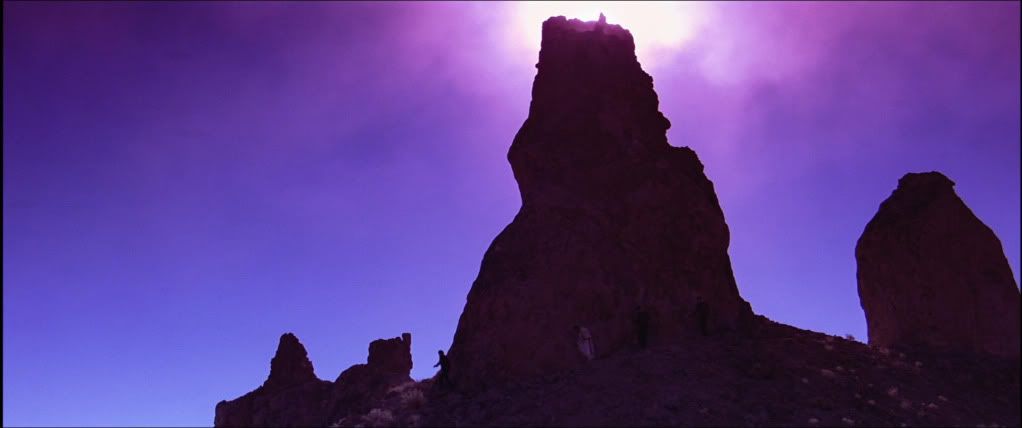
Shatner proves to be a capable director. This was his first theatrical film but he had prior experience directing theater and episodic television. I don’t entirely blame him for the difficulties he had to face here (all of the above plus a Teamsters strike!) and it’s a miracle we even got a watchable movie out of it. Shatner knows how to frame a shot and, as I wrote in my Temple of Doom article, establishing geography and spatial relationships is important. There are also some interesting camera moves (including a bridge shot which starts at an overhead angle, rotates, and eventually tilts to eye-level) and some great individual shots including one in the opening of Sybok riding his horse which looks like something out of Lawrence of Arabia, and another towards the end with Kirk, et al. walking down a mountain which is silhouetted against the sun.

The opening credits feature Kirk free climbing El Capitan in Yosemite National Park. While some may consider this nothing more than an ego trip for Shatner, I believe it when he says (in on-set interviews) that it is representative of man’s need to scale new heights. Kirk, Spock, and Bones share a poignant scene in front of a campfire where, as usual, they contemplate their own mortality and Kirk admits that he’ll die alone. This comes full circle wonderfully at the end when he tells Spock he thought he would die and Spock, having just rescued him, replies: “Nonsense. You were never alone.” Kirk also insists that men like them don’t have families – another line that is paid off when Kirk mentions that he lost a brother once but (looking at Spock) he’s glad he got him back. Bones: “I thought you said men like us don’t have families.” Kirk: “I was wrong.” It’s scenes like these that make geeks like me want to be a part of this universe and spend time with these characters.

Sybok is portrayed by Laurence Luckinbill, who does not get the credit he deserves for his performance. Sybok, it turns out, is Spock’s half-brother. He was banished from Vulcan for embracing emotion instead of logic. This is best exemplified in his first scene in which he laughs – something Vulcans aren’t exactly known for. Luckinbill portrays Sybok as cunning and manipulative (the character was inspired by televangelists after all!) but also strangely dignified and we genuinely feel for him at the end when he’s defeated by his own vanity and avarice. His best scene – and arguably the best scene in the film – takes place in the ship’s observation lounge in which he attempts to relieve Kirk, Spock, and Bones of their “secret pain” – which is how he’s able to amass followers, who are so grateful for the experience that they’ll follow him anywhere. We see Bones relive the experience of pulling the plug on his ailing father and Spock’s father’s initial rejection of him for appearing “so human.” Kirk will have none of this and the scene culminates in a great Kirk Speech in which he yells, “I don’t want my pain taken away. I need my pain!” It’s might be one of the best scenes in any Trek film.

Another item in the plus column is the excellent music score. This film marked the return of composer Jerry Goldsmith to the franchise ten years after his Oscar-nominated work on Star Trek: The Motion Picture. He reprises his theme to that film (which had since become the theme to TNG) along with his Klingon theme while developing four entirely new themes: a theme for Sybok, a theme for the “God planet” Sha Ka Ree, an Americana-flavored theme for the Yosemite scenes, and a four-note “quest motif” which he would use again in future Trek scores.

While most of the visual effects are subpar (Shatner and Co. admit this much on the DVD retrospective), there are a few great shots, including one of the Enterprise against the moon as well as a fun crash sequence in which a shuttlecraft barrels its way into the shuttlebay. The scale is off but it’s still exciting. No one will ever argue that Star Trek is about special effects but, sadly, this is one film in which they were sorely needed. Ironically, the low budget meant they had to produce many of the effects in camera (without compositing) and there are some good shots that resulted from this, mainly any shot in which we see outside the Enterprise through a window. With bluescreen, the camera would most likely have been locked down. . . but with rear projection live on the set, Shatner could have a moving camera and there would be no matte lines.

As much as I enjoyed the new Star Trek reboot, it wasn’t nearly as humanistic as this one, nor did it have that extra little bit of intellectual “oomph,” the Big Ideas that keep people thinking on their way out of the theater. At the end of the day, I think this film deserves another look. There are some good lines of dialogue and character moments and while some of the humor falls flat, some of it actually works, including the Yosemite “Goodnight” scene which must’ve been the filmmakers’ homage to The Waltons. If Paramount ever allows Shatner to produce a Director’s Cut of the film, I’ll watch it (he was already denied once) but if they don’t, I can live just fine with the film the way it is now.

Bonus: Captain Kirk is Climbing a Mountain (Techno Remix)

[+] Read More...

Sunday, January 15, 2012

The Great (film) Debates vol. 21


Worst. . . sequel. . . ever. . .?


Panelist: T-Rav

Spider-Man 3. No contest. There have been a lot of bad sequels, but none which killed my enthusiasm for the whole series so completely as this one did. It's the rare movie that just made me feel worse the longer I thought about it later.

Panelist: Tennessee Jed

Hmmmn . . . how about Jaws 3?

Panelist: ScottDS

Hmm... I can answer this in any number of ways. In terms of massive disappointments, my answer would have to be - wait for it - Indiana Jones and the Kingdom of the Crystal Skull. In terms of sequels that actually taint the original, we have The Matrix sequels. But as far as total cinematic clusterfraks go, my answer would have to be Superman IV: The Quest for Peace, which had a flawed premise to begin with, along with a couple of infamous producers - Golan and Globus of The Cannon Group - who slashed the budget at the last minute, which is why the visual effects are actually worse than the effects in the first film produced a decade earlier! You really can't help but feel bad for Christopher Reeve, who is probably the best thing in the movie. Oh, one more: Police Academy: Mission to Moscow, which went direct to video. Sure, the other films aren't exactly works of art but this film makes the first one look like Citizen Kane. I'm embarrassed to own it but it came in the box with the other six films. If I celebrated Christmas, I'd use the DVD as a tree ornament!

Panelist: AndrewPrice

Highlander 2. Highlander was a cool movie with a unique idea which came to a natural and complete end at the end of the film. Highlander 2 had no idea how to re-open the series, so it came up with some just awful reasons to explain why the first film really wasn’t the end and it could all sort of begin again. The film was so bad they basically ignored it when they started the television series and the later sequels. Essentially, everyone pretends it didn’t happen.

Panelist: BevfromNYC

This is a hard one. There are so many. I was most disappointed in the sequel to National Treasure. With the success of the original, the sequel was just a cheap imitation and the subject could have been interesting – The Book of Secrets – but it went off the rails.

Comments? Thoughts?

[+] Read More...

Friday, January 13, 2012

Film Friday: Tron: Legacy (2010)

Was Tron: Legacy the worst movie ever? Nope. I liked the soundtrack a lot, the effects were excellent and the actors read their words competently. It didn’t offend me either or bore me too much. So if that’s what you want, then this movie certainly delivers. Thumbs up! But if you’re one of those picky people who want more than a placebo for a film, then this one isn’t for you.

** spoiler alert **

I usually start my reviews by outlining the plot, but that’s not possible here because there really wasn’t one. Basically, the hero gets sucked into the computer world, does some disc fighting, has a motorcycle chase, meets the be-breasted NewTron (this time called Quorra. . . which is Latin for “not all there”), finds his dad, gets told how to get back out of the computer, and leaves. It takes 98 minutes before we even find out the bad guy (evil Jeff Bridges) is up to something more than just being evil, and even then we don’t really know what. He’s built an army and wants to do something to the outside world. But what exactly he wants to do is never really spelled out because this film has an aversion to substance. His big beef seems to be imperfection, which makes me think he’s a spell checker gone rogue.

The rest of the movie is pretty much nonsense too. First of all, the film is a scene-by-scene theft of Tron. Indeed, if you lined up the order of events in Tron, and the events here you will see they are identical, they’re just hidden by different effects. Also, much of the film is stolen directly from The Matrix, such as the effects in the digital desert, the techno music during the fights, the wire-fighting, and even the black-clad hero is just Neo with less personality. . . yeah.

The fascinating bit, though, is the utter lack of substance in this film. Observe:

This film supposedly takes place inside a computer world like the original, but nothing tells you that. One of the strongest aspects of Tron was that it was strangely believable. Sure, computers don’t really work this way, but Tron set up a believable world where the characters acted as one would expect computer programs to act if they were given human form. Their actions, their desires, their conflicts all reflected perfectly the kinds of issues that occur inside a computer -- struggles for access, energy needs, security measures, etc.

All that’s gone in Legacy and these programs never really act like programs. They attend gladiatorial games where they cheer the death of other programs. They attend clubs where they dance and drink. One program is suicidal. Several programs seem to be motivated by sex. And through this all, there is no sense that the actors were given rules to follow to make them act like programs rather than just club kids. Plus, in the end, these programs are all pretty pointless to the plot.

Neo is pointless too. He comes, he leaves. He does little else. Also, his character is set up as a generic rebel, but he never mentions anything he cares about -- either pro or con, and this “rebel” owns all the shares of the company and thus controls the company, so his once-per-year “struggle” against the evil company is nonsense. Beyond that, he’s pretty pointless.

The good Jeff Bridges (Neo’s dad) had a purpose before the film began. In flashbacks, we learn he wanted to create the perfect computer world where all of us could move. . . no, I’m not kidding. Then he found these living things which aren’t explained all that well, but they all got killed so now he lives in a cave. Beyond that, he’s pretty pointless except he knows the way to the exit.

Be-breasted NewTron really adds nothing to the story except breasts. It turns out she’s one of these living things, but that goes nowhere. The only reason they mention that is so Neo can take her back to his world and live happily ever after with his electronic dream girl.

There’s a guy who owns a bar. He looks like those Albino things in Matrix II and he seems kind of important for about five minutes, though I have no idea why from the script. All he really teaches us is that he likes to rip off Doomsday when he dances during fight scenes. Beyond that, he’s pretty pointless.

There seem to be some rebels too, but they don’t do anything except show that black and minority programs are socially conscious.

There’s old Tron too, sort of. He grunts a lot and you never see his face. His purpose seems to be to add wire-fu to the film, but that’s about it.

Then there’s the bad guy, evil Jeff Bridges. He’s a knock off of the Master Control program from Tron only he spends his time bored watching the games and chasing after good Bridges’s identity disc because that will give him the power to let his army go forth and do something or other. . . somewhere. His goals are revealed to us in a very bland speech that is meant to suggest fascist tendencies, but is actually nonsense if you listen to it. I honestly could not sum up his plans for you.

Heck, even the action is pointless. This is one of those “go to point A so they can tell you to go to point B where you will fight someone to win the movie” kind of movies. There is no actual plot. The bad guy has no plan except stop the good guy. The good guy has no plan except stop the bad guy. There is nothing the good guy really needs to do to make this happen except arrive at the end of the film. The people who help him along the way impart neither wisdom, clues or skills which the good guy will need, nor does he really need their help. Basically, they just help him pass the time. And the few times they venture into something that could generate substance, the characters spit out meaningless dialog before they start fighting.

I am not kidding when I say this movie is truly substance free. . . it is Michael Bay’s wet dream. And I find this pretty shocking. They’ve stolen two movies -- Tron and The Matrix -- which crawl with philosophical and moral questions and they turned them into village-idiot-grade pabulum. Tron established a world where users are as much a mystery to the inhabitants as God is to us. The Matrix deals with the nature of reality. And Tron: Legacy stole these two films wholesale yet somehow managed to ensure that not one single idea actually comes across to the audience.

I don’t know if I should be horrified at the idiocy of these plagiarists or stand in awe at their achievement. Was this a mental tour de force where they brilliantly showed their power to suck the life out of something inspirational? Or did they just leave out the hard parts they didn’t understand? I honestly don’t know.

In any event, as someone who loves science fiction, let me suggest that films like this are ultimately very destructive. Films like this mock the idea that science fiction is capable of anything more than blowing stuff up. Films like this are undoing the legacy created by films like 2001, Blade Runner, The Matrix and even Tron.

[+] Read More...

Wednesday, January 11, 2012

Movie Rewind: Where Were You in ’82?

By ScottDS

Along with 1939, 1982 is considered a banner year for Hollywood. Many films we now consider classics thirty years later (and a few we consider “guilty pleasures”) made their big screen premieres this year. Some struck box-office gold while others needed some time to be appreciated. Let’s take a look at a few members of the Class of 1982.

Blade Runner -- What more could possibly be said about Ridley Scott’s adaptation of Philip K. Dick’s story about replicant hunter (“blade runner”) Rick Deckard? The director clashed with crewmembers as well as Harrison Ford who, in turn, didn’t get along with Sean Young, and executives kept threatening to take the film away and recut it themselves. However, the film is visually stunning with details upon details threatening to overflow the frame, and features a stirring synth score by Vangelis, complex performances, an intelligent screenplay, and visual effects that still hold up to this day. Blade Runner was greeted with mixed reactions upon its release but found the fame it so deserved in the 90s with the discovery of an alternate cut. Ridley Scott later completed his Final Cut which you can find on DVD and Blu-Ray. “Wake up. Time to die!”

Star Trek II: The Wrath of Khan -- Paramount brought in TV veteran Harve Bennett to produce a Trek sequel that wouldn’t cost as much as the first film. Bennett, in turn, brought in Nicholas Meyer, best known for his Sherlock Holmes novels. Cobbling together bits and pieces from other drafts (including terraforming, a son for Kirk, and a protégé for Spock), Meyer turned in a script in 12 days. Leonard Nimoy and the studio eventually had second thoughts about killing off Spock so an epilogue was filmed in which we see his torpedo-slash-casket on the surface of the Genesis planet, thus proving that, in Star Trek, no one is ever truly dead. This film also marked the debut of Kirstie Alley (as Lt. Saavik) and was the first Trek job for effects house Industrial Light & Magic while the nautically-inspired score put young composer James Horner on the map. “Aren’t you dead?”

Poltergeist -- This film, chronicling the Freeling family and the malevolent ghosts that abduct their youngest daughter, remains controversial to this day. The question of who really directed it – co-writer/producer Steven Spielberg or Tobe Hooper? – still hasn’t been answered to some folks’ satisfaction while others consider the so-called “Poltergeist curse”: among other things, the use of real cadavers as props and the untimely deaths of actresses Dominique Dunne (strangled by her boyfriend) and Heather O’Rourke (septic shock during production of the third film). However, the film is a modern horror classic with likable characters, an ethereal score by Jerry Goldsmith, and wonderfully old-school visual effects. This was Spielberg in full “popcorn mode” and he’s never been able to top the string of hits he produced in the 80s. “This house is clean.”

E.T. The Extra-Terrestrial -- Oh, how I wish I had been around for the craze surrounding this film, which became the highest-grossing movie of all time, holding the record for 11 years. The story of a lonely boy who befriends an alien, Steven Spielberg’s sci-fi classic was spawned from a couple different ideas he had been toying with, including a story about childhood and another about malevolent aliens who terrorize a family. The film has also been subject to myriad interpretations with some calling E.T. a Jesus figure and others labeling it a Jewish story: the ultimate immigrant’s tale. Of course, one group that was disappointed was Mars, who refused to let the filmmakers use M&M’s! Spielberg’s technical prowess is in top form as are his collaborators, specifically composer John Williams and creature effects guru Carlo Rambaldi. “Well, can’t he just beam up?”

Tron -- This film is the very definition of “ahead of its time.” After years in development, first-time director Steven Lisberger finally found a home at Disney for his far-out vision combining video games and computer graphics, which at the time were about as advanced as Pong. The end result is a visually dazzling tale of good versus evil, with Jeff Bridges and Bruce Boxleitner as our heroes, Cindy Morgan as the love interest, and the always-entertaining David Warner as the villain who seeks (virtual) world domination. Greeted with mild box-office and mixed critical reception, the film later became a cult hit and spawned a series of comics, merchandise, and a rather unnecessary sequel in 2010. Pixar chief John Lasseter pays the film the biggest compliment when he says, “Without Tron, there would be no Toy Story.” High praise, indeed. “Now that is a big door!”

Porky’s -- Writer/director Bob Clark’s film tells the story of a group of Florida teenagers intent on losing their virginity. After being humiliated by the owner of the titular club who promised them a good time in exchange for all their money, the boys plot their revenge. Along the way, they manage to spy on their female classmates in the shower and let’s just say one boy regrets this after the appropriately-named Ms. Balbricker intrudes on the scene. Truth be told, the film is rather uneven and many of the characters tend to blend together. There’s also a ham-handed racism subplot (with a Jewish boy mistakenly referred to as a “kite”) and many of the laughs seem to come from watching other characters laugh… but it’s all harmless fun. “Please, can we call it a ‘tallywhacker’?” (Sadly, Bob Clark and his son were killed by a drunk driver/illegal immigrant in 2007.)

Fast Times at Ridgemont High -- In 1981, a young writer named Cameron Crowe spent a year undercover in high school researching a book. He later adapted it for this film, which also marked the directing debut of Amy Heckerling. The film takes place within the span of a school year and introduces us to a variety of characters, including: stoned surfer Jeff Spicoli (Sean Penn in the role that even his critics enjoy); Stacy Hamilton (Jennifer Jason Leigh), who loses her virginity and, in a rather dark turn of events, gets an abortion; Stacy’s brother Brad (Judge Reinhold) who hates his humiliating fast food job and is caught in an embarrassing moment by Linda Barrett (Phoebe Cates), whose pool scene caused many VHS tapes to be constantly rewound and subsequently damaged. (Oh, and be on the lookout for a young Nicolas Cage!) “Aloha. My name is Mr. Hand.”

The Thing -- John Carpenter’s adaptation of the novella Who Goes There? (which also inspired Howard Hawks’ 1951 production of The Thing) is a cold, claustrophobic, extremely effective horror film. After a tepid reaction at the box-office, the film has become a modern cult classic. Kurt Russell leads an extremely likable cast of character actors, including Wilford Brimley, Keith David, Charles Hallahan, Richard Masur, and Richard Dysart – just Average Joes living a humdrum existence on the edge of civilization as an evil force unknowingly lurks within. Rob Bottin’s make-up effects (this was before CGI) still amaze and disgust after all these years and the film ends on an ambiguous note as our only surviving characters decide to “wait [and] see what happens.” Production values are all top-notch. “I just wanna get up to my shack and get drunk.”

Also: Conan the Barbarian, Deathtrap, The Dark Crystal, Das Boot, Death Wish II, Diner, First Blood, 48 Hours, Night Shift, An Officer and a Gentleman, Tootsie, The Verdict, and Gandhi.

Will 2012 prove to be as memorable? I hate to sound like a cynic. . . but I’m doubtful.
[+] Read More...

Tuesday, January 10, 2012

Politics of Trek: “The Conscience of the King”

Let’s continue the Politics of Trek series with Episode 13: “The Conscience of the King”! This is a fascinating episode about a man who executed thousands of people to save thousands more. What conservative message could this send? How about, the ends never justify the means.
The Plot
As the episode begins, the Enterprise has been diverted to Planet Q by Kirk’s friend Dr. Thomas Leighton. Leighton claims to have discovered a new food source, but he’s lying. He really wants Kirk to investigate a visiting actor, Anton Karidian, whom Leighton believes to be Kodos the Executioner. Kodos was the governor of Tarsus IV, where he executed 4,000 people, including members of Kirk’s family. He did this because the colony was running out of food and Kodos hoped to save half the colonists by executing the other half. Kodos was believed killed when he was overthrown, but his body was never found. Kirk initially refuses Leighton’s request. But when Leighton is mysterious killed, Kirk arranges events so the Enterprise gives the acting troupe their ride to the next planet. One thing leads to another and Kirk confronts Karidian, who is in fact Kodos.
Why It’s Conservative
A fundamental difference between conservatives and liberals involves the question of whether motives can excuse behavior. With rare exceptions, e.g. self-defense, conservatives judge people on their actions, not on what motivated those actions. Liberals, by comparison, take motives into account. This is why they consider things like root causes, the relative economic power of the parties, and whether the person’s goals outweigh the tactics they use to achieve those goals, i.e. do their attempted ends justify their means. Conservatives reject this and look only at the means you have chosen. This episode comes down firmly on the conservative side.

For example, Leighton lies to bring the Enterprise to the planet and Kirk reprimands him for it, despite the extreme importance of his request. Kirk then engages in trickery himself and thereby alienates and endangers his friends and crew. Both times the message is that the ends, no matter how important, did not justify the chosen means. But the real focus is on Kodos. Here Kodos tries to justify his crimes to Kirk:
KARIDIAN: Kodos, whoever he was—
KIRK: Or is.
KARIDIAN: Or is. Kodos made a decision of life and death. Some had to die that others might live. You’re a man of decision, Captain. You ought to understand that.
KIRK: All I understand is that four thousand people were needlessly butchered.
KARIDIAN: In order to save four thousand others. And if the supply ships hadn’t come earlier than expected, this Kodos of yours might have gone down in history as a great hero.
KIRK: But he didn’t. And history has made its judgment.
KARIDIAN: If you’re so sure that I’m Kodos, why not kill me now? Let bloody vengeance take its final course! And see what difference it makes to this universe of yours.
KIRK: Those beautiful words, well acted, change nothing.
Kodos is walking through standard liberal arguments here. First he argues that he acted with the best of intentions. This is the argument liberals use to excuse abuses of power: that the ends were very important and justify the means. Then he argues that he deserves “understanding” because he was charged with making life and death decisions. This is moral relativism because it asks that he be judged under a different standard than others because of the circumstances he faced. This is the idea behind the liberal root-causes argument, which says that criminal behavior should be judged in light of a person’s economic circumstances or personal history. Finally, he argues that punishing him will not undo the crime. This is the liberal impulse to dismiss all aspects of criminal justice except reformation. Kodos essentially presents liberal criminal law in a nutshell.

Kirk rejects these arguments with disgust and derision and doesn’t even bother to refute the logic: “all I understand is that four thousand people were needlessly butchered.” That is conservatism: all that matters is what Kodos did, not why he did it. Guilty.

So what about punishment? McCoy, the show’s bleeding heart, suggests there’s no point in punishing Kodos because his victims are dead:
MCCOY: What if you decide he is Kodos? What then? Do you play God, carry his head through the corridors in triumph? That won’t bring back the dead, Jim.
KIRK: No, but they may rest easier.
Kirk rejects this because he sees justice as a matter of principle and asserts that it must account to the victims even if they are dead. Liberals increasingly see this view as “vindictive,” which is why they oppose long sentences, victim’s rights laws and so-called “victimless crimes.”

Kodos then suggests he has suffered enough when he says he no longer treasures life and he laments how he has been haunted by his crimes:
KARIDIAN: Blood thins. The body fails. One is finally grateful for a failing memory. I no longer treasure life, not even my own. I am tired! And the past is a blank.
Actor Arnold Moss does a tremendous job of conveying how this has tormented Kodos even with only these few words, but Kirk dismisses this idea out of hand. Unlike liberal Captain Picard in “The Survivors”, Kirk does not accept the idea that self-imposed suffering is sufficient. Instead, Kirk takes the conservative position that crimes must be punished objectively and cannot be overlooked just because the criminal thinks the punishment is too harsh.

So what does Kirk do? Interestingly, he tells Kodos that he won’t kill Kodos despite wanting to:
KARIDIAN: Did you get everything you wanted, Captain Kirk?
KIRK: If I had gotten everything I wanted, you might not walk out of this room alive.
This is the conservative answer, though it is frustrating. This is Kirk returning to conservative form after his earlier abuses of power. This is his declaration that he will not use improper means to achieve his desired ends, i.e. he will not repeat Kodos’ mistake. Instead, he will let the system extract justice, which dovetails with Kirk’s law-and-order / rule-of-law conservatism.

So Kirk has acted conservatively. But merely arresting a man who thinks he was justified in killing 4,000 people isn’t enough to establish the complete conservative moral, which requires the imposition of a proportional punishment. Since there’s no time to show Kodos’ trial and execution (plus television is about drama), the writer imposes a little proportional cosmic justice and in the process makes the dual points that great crimes require great punishments and evil begets evil. Indeed, it turns out Kodos’ daughter has been killing the witnesses who can expose him. Kodos thought he had shielded her from his past and it destroys him to learn his deeds have poisoned her.
KARIDIAN: What have you done?
LENORE: What had to be done. They had to be silenced.
KARIDIAN: All of them? All seven? More blood on my hands?
LENORE: No Father, not anymore. I’m strong, Father. It’s nothing. . . . Don’t you see? All the ghosts are dead. I’ve buried them. There’s no more blood on your hands.
KARIDIAN: Oh, my child, my child. You’ve left me nothing! You were the one thing in my life untouched by what I’d done. . . Murder, flight, suicide, madness. I never wanted the blood on my hands ever to stain you.
She then kills her own father while trying to kill Kirk. The punishment is complete, justice is had, and the moral is clear: evil means are never justified and evil will receive the punishment it deserves. And that is a strong conservative message.

[+] Read More...

Sunday, January 8, 2012

The Great (film) Debates vol. 20

People’s tastes change over time, which is good or we’d all be wearing bell bottoms and listening to grunge. And sometimes, this means our taste in films changes too.

What movie did you like a lot at one point, but no longer like. . . and why?

Panelist: BevfromNYC

Mary Poppins. I loved Mary Poppins when I was a child. It was colorful and magical and my parents bought me a “Mary Poppins In The Painting” doll when I was in the hospital after an appendectomy. And it was the first movie that I got to see twice! I loved Mary Poppins. Well, many years passed and I finally got a chance to watch it about 10 years ago. Hmmm, Mary Poppins was kind of mean and stern. And, though I still love Dick van Dyke as Bert, his cockney accent was just bad.

Panelist: T-Rav

There are many I no longer like, but one I used to really like was The Lost World: Jurassic Park. I thought it was a good film the first time I watched it, with lots of visuals, and you can't hate Jeff Goldblum. But there's a lot that bothers me about it now. The raptors are basically shoehorned in, the ending is little more than a rip-off of every Godzilla film, and the underlying political message is. . . just awful. Taking dinosaurs off the island is evil and wrong; therefore our "heroes" try to save them by destroying the would-be captors' equipment and thereby get a lot of those guys killed. But it's okay, because they're capitalists and mercenaries and we should be okay with their deaths. I wonder if this was the inspiration for Avatar.

Panelist: Tennessee Jed

Robert Altman's Nashville. I liked this film when it first came out. Years later, I bought the DVD for a song. Even liked it the first time I re-watched it. Then, I popped it in a few years later and it just sucked. Nothing worked - the jokes didn't work, the acting seemed wooden. I just had to turn it off. Comedy is the most fertile field for this phenomenon. If you are in the right mood, you can laugh yourself silly. Wrong mood and you don't even crack a smile. Jim Carey's Liar, Liar fell into that category.

Panelist: ScottDS

The Fifth Element. I didn't like it the first time I saw it. Then, for some reason, I watched it again once it premiered on HBO and I liked it. Several years passed by and it aired on HBO again. . . and I didn't like it. I'm usually the last person to complain about a film that tries to do something different but it's just too goofy and ridiculous (and French?) for me to take seriously. I like Bruce Willis and Gary Oldman, Ian Holm, and Brion James (R.I.P.) are always fun to watch... but I simply want to kill Chris Tucker whenever he's on the screen and, dare I say it, Milla Jovovich never did anything for me. There, I said it!

Panelist: AndrewPrice

I really hate saying this, but Octopussy. When I was a kid, this movie was awesome. You had dirty Russians, exotic locations, a nuclear bomb and James Fricken Bond! But as I’ve gotten older, I’ve started to realize a few things about this film. For one thing, every scene is ridiculous and the bad guys are incompetent. Those exotic locations? Well, the cinematography is so narrow it could have been shot outside Atlanta. The Indian guy is a lame, racist stereotype. The action is slapstick. And frankly, Roger Moore was getting too old and prissy by this point.

Comments? Thoughts?

[+] Read More...

Friday, January 6, 2012

Film Friday: Apollo 18 (2011)

I’m of two minds about Apollo 18. On the one hand, I’m glad I saw it. But on the other, I cannot recommend it and I never want to see it again. Why? Well, it has a solid story, ruined by its presentation. It had excellent effects, squandered by its presentation. It was simultaneously too long and too short, both because of its presentation. Put simply, this was a potentially excellent film ruined by a misused gimmick.

** spoiler alert **
The Plot
The last manned moon mission was Apollo 17 in December 1972. Or was it? In December 1974, the Department of Defense secretly launches three NASA astronauts to the moon aboard Apollo 18. Their ostensible reason for going is to install an ICBM detector on the moon to warn the US in the event of a Russian missile launch. But when they get to the moon, they discover a mystery in the form of an abandoned Russian moon-lander and a dead cosmonaut. Then things get worse.
Why This Film Could Have Been Excellent, But Wasn’t
When I first heard about this film, I was excited. After all, the plot description above is pretty stellar. It promises intrigue, mystery, action, science fiction and has tons of potential for terror. Imagine the horror of not being able to see or hear things approach, of not being able to breath outside of the suit or the capsule, of communications blackouts, and of the horrific unknown. Add in a trailer which appeared to show a dead astronaut walking around on the moon and this became one of the few films last year that I genuinely wanted to see.

Then it got released to universal derision. My hopes were dampened. Then I heard it was yet another “found footage” film and my hopes died. But it gets worse. Not only is this a found footage film, but they completely mishandled the already awful concept.

The concept of “found footage” films (e.g. Blair Witch and Paranormal Activity) is premised on the idea that someone has cobbled together a movie from film found at the scene of a mysterious tragedy, film taken by some amateur to whom the tragedy befell. This is actually a brilliant concept for several reasons. For one thing, it allows you to make movies cheaply because low quality film and cameras can be used. It also reduces the cost of special effects because any time something is too expensive to produce, the director just has the “amateur” photographer pan away from the action or drop the camera or something like that. Similarly, this approach gives great leeway in editing by allowing longer-than-normal shots with no cuts because audiences excuse the lack of multiple angles and Hollywood-style editing. It also allows jump cuts to skip over boring parts of the film because the director can simply pretend the amateur turned the camera off during that period or that the film was destroyed. This allows directors to skip from highlight to highlight while simultaneously allowing the director greater latitude in letting individual scenes develop.

But found footage films can be annoying for these same reasons: low quality images, the shaky cam effect, annoying jump cuts, and a tendency to over-tease the audience by revealing too little. All of these problems are present in Apollo 18 along with a new and truly annoying problem: aggressive, seizure-inducing edits.

Unlike most found footage films which rely on one camera, Apollo 18 involves at least five cameras which run simultaneously. Thus, it is legitimate to show scenes from multiple angles, which means more Hollywood-style editing can be employed -- this is usually not possible in found footage films.

Unfortunately, the director/editor took this way too far. Rather than doing something clever with the angles or some subtle manipulation, they pound your brain into submission with a never-ending stream of constant cuts, often settling on angles for less than a couple seconds. Even worse, to justify this constant hopping from camera to camera, each edit is preceded by fake interference to suggest the rest of that particular footage in that camera was destroyed. But this nausea-inducing style of constant quick cuts prevents you from ever seeing anything (like the special effects) and it starts to eat up considerable amounts of film time with nothing but annoying static.

Worse yet, the director/editor used these constant cuts as a way to hide a lack of story by trimming the dialog to short bursts of words. Thus, you will encounter large parts of the film which seem like a fever dream where the dialog only gives the impression of what is going on: “hold truths— [static/new angle] self-evident— [static/new angle] created equal— [static/new angle] perfect union.” Even the longer expositive scenes begin right as something is happening and end seemingly randomly before you have gotten all the necessary information to understand the scene: “That’s correct Bill, and the murderer is—” In many ways, the dialog is so disjointed it’s often like skipping ahead randomly in a film and only stopping for a few seconds at a time. What this does is take a story that seems compelling and make it meaningless. Indeed, the elements for a good story seem to be present, but they never show it to you, they only suggest it.

This approach also makes the film feel simultaneously too long and too short. At 85 minutes, the film is very short and it feels lightweight. It feels rushed and it feels like they took the easy route over and over again by cutting away every time you would normally expect something substantive -- not to mention a big chunk of time is lost to static. Yet, at the same time, this film feels far too long because the constant static and jumpcuts wear you down and make it impossible to get into the story -- because the story moves forward in random bursts. Thus, the story drags and feels laborious.

All and all, this could have been a tense and superb film. It had tremendous potential. The concept is solid, though not original. The premise, the setting, the effects, the ambiance are all top notch. The potential for mystery and horror are obvious throughout. Even something more deeply philosophical could have been done, e.g. what if they found something Biblical? But to pull that off, the film needed to be shot in a traditional manner where these things could have been exploited, or at least the found footage approach needed to be done more cleverly and less obtrusively, by for example, revealing the footage through a briefing where the pace could be controlled better and the mysteries better maintained.

But that didn’t happen and that’s too bad. This is a good film ruined by a gimmick.

[+] Read More...

Wednesday, January 4, 2012

The Power of Clichés


They say the eyes are the window of the soul. They also warn us there be monsters in a film. Monsters like the Cheese Burglar!


When the Cheese Burglar was young, he fell in love, which apparently makes you feel like you have a giant head. . . floating over the ocean.


But it was not to be. The fast lane was where he wanted to be, fast women, fast cars, fast food.


Arson, guns, unlimited cans of whoopass, this was his new life and he flame broiled anyone who got in his way. . . it was all so black and white.


But even arsonists get the blues, and things began to go crooked for our Cheese Burglar when he lent a friend money to buy a cheeseburger. . . he said he would gladly pay Tuesday.


He didn’t. Now the Cheese Burglar roams the streets alone looking for the man who took his money.


I noticed long ago browsing the video store aisles (and book stores) that movie posters and book covers are all about clichés. On the one hand, I guess, this is a good thing. Clichés exist because they have become universally recognized as having meaning. And since we all know what they mean, that lets you pack more information into simpler images. Indeed, single images can now tell whole stories and simple phrases can take the place of whole pages.

But too often clichés become a substitute for substance. When the clichés leave the marketing world of the movie poster and book covers, and they begin to occupy the substantive world of plots, then things go wrong. And too many films today are little more than clichés strung together to create the impression of a film.

Is it any wonder box office attendance is down 11% over two years? The problem isn’t even the topic of films or the incredible number of reboots or sequels, it’s that these films are lifeless, meaningless, and void of any substance when you get into them. This is because Hollywood has begun to speak in clichés rather than ideas. It’s stopped being the dream factory and become the film assembly center. And as long as they continue down that path, things will only get worse.

What are your most despised clichés?

[+] Read More...

Tuesday, January 3, 2012

Questionable Trek vol. 1

Let’s start Star Trek Tuesdays by introducing a new debate series: Questionable Trek. In this series, Scott and I will ask each other questions and debate the answers in a quest to get to the heart of everything Star Trek. Today we begin with a simple toss up question:

Rank the top five Star Trek films in order.

Andrew:
1. Star Trek VI: The Undiscovered Country
2. Star Trek II: The Wrath of Khan
3. Star Trek: First Contact
4. Star Trek: The Motion Picture
5. Star Trek: Nemesis
For me, there were two difficult decisions here. First, there’s the choice of Undiscovered Country over Wrath of Khan. I know that’s probably Star Trekrilege, but I just feel like Undiscovered Country is the better movie. It moves quicker, its plot is more unexpected, and the characters aren’t as depressed. That said, there is no more poignant scene on film that Spock’s death. The other difficult decision was choosing Nemesis over Star Trek V: The Final Frontier. Despite its flaws, Frontier is still fairly enjoyable and I think Sybok is great. But Nemesis is simply the better movie.

Scott:
1. Star Trek II: The Wrath of Khan
2. Star Trek IV: The Voyage Home
3. Star Trek: First Contact
4. Star Trek VI: The Undiscovered Country
5. Star Trek: The Motion Picture
I’ve never been good at ranking films (in case you haven’t noticed) and this was pretty tough. I honestly don’t think any of the Trek films are God awful - even the worst ones have one or two redeemable qualities. When I was younger, I’d watch Star Trek II at least once a week. It has arguably the best villain, quotable dialogue throughout, and the themes of aging and mortality are explored rather well, as opposed to future Trek films that simply try to shoehorn those moments into the story. Star Trek IV is just a lot of fun. Yeah, it’s a fish out of water tale and there are some dated elements but it’s just done so well and the crew’s chemistry has never been better. Star Trek: First Contact is the best TNG film though that may not be saying much. I’ve always enjoyed Star Trek VI but when I watch it now, I can’t help but notice some signs of a rushed production and Nick Meyer’s nautical quirks on display. Star Trek: The Motion Picture has, in my opinion, aged like a fine wine and, like Andrew says, it’s one of the only films where the crew gets to go on an actual adventure into the unknown.

[+] Read More...

Friday, December 23, 2011

Merry Christmas and Happy Holidays!

Merry Christas and Happy Holidays to everyone! I’m taking a break until January. But we’re planning some good stuff for the new year. . . All the posts will be moving to mornings instead of afternoon so you can tune in earlier. Also, Bev will be joining the film debates. And I’m adding a Star Trek Tuesday every Tuesday!

In the meantime, leave your thoughts below. Tell me what films you’ve seen that were good or bad or just ugly, and tell me if there’s anything you want to see at the site in the new year!
[+] Read More...

Wednesday, December 21, 2011

The Boiler Room Elves’ Top 5 Santa Films

As Boiler Room Elves, we’re usually pretty busy around Christmas time. There are cookies to bake and the boilers need extra attention in winter. But we don’t go in for that whole making presents for free thing. We may be unionized, but we’re not communists. So when Bossman Andrew asked us to write about Santa, we told him we didn’t have the time. Then he showed us our contract. Grr. So here are our five favorite portrayals of Santa.

1. Miracle on 34th Street (1947): Probably the best known Santa film, this one perfectly shows the true spirit of Santa. In it, a man is accused of being insane because he thinks he’s Santa. A trial is held. Is he the real Santa or not? The films lets you decide and it’s pretty heartwarming along the way. A bit of trivia here, the real Santa has a cameo. Next time you watch, see if you can spot him.

2. The Santa Clause (1994): This one completely annoys Santa and he won’t even watch it because he’s offended by the suggestion he’s under contract to be Santa! He does it all out of the goodness of his heart (plus he failed out of business school after some prof told him his business plan would never fly. . . but you didn’t hear that from us). Still, the movie is enjoyable, heartwarming and funny, just the kind of thing to make you laugh at Christmas time.

3. South Park: Red Sleigh Down (2002): How can you not love this episode: Santa Claus as action hero! In this South Park episode, Santa gets shot down over Iraq and must be saved by Jesus. And in the end, Santa dispenses a little hot red justice on his captors and then magnanimously tells people that they shouldn’t just think of Santa on Christmas, they should think of Jesus too. Good stuff.

4. Santa Claus Conquers the Martians (1964): True story. Elves are really big on documentaries.

5. Rudolph The Rednosed Reindeer (1964): Although this story is mainly about Rudolph, they do a great job depicting life at the Pole (minus a few labor violations) and Santa. The one complaint we have about this show it the depictions of the Elves. We’re waaaaaaaaaay cooler than that. And there aren’t enough cookies.

So if you want, list your favorite Santa films, memories or whatever below. Or more importantly, tell us what your favorite cookies are. You never know when you may get a surprise care package down your chimney.

[+] Read More...

Sunday, December 18, 2011

The Great (film) Debates vol. 19

A couple weeks ago we talked about our favorite James Bonds. But who would Bond be without a cool villain?

Who is your favorite James Bond villain?


Panelist: Tennessee Jed

Favorite Bond villain was Robert Shaw as Red Grant. He was a ruthless killing machine, and J.B. was lucky to survive. Probably the most realistic. Odd Job is a close second.

Panelist: T-Rav

I think you have to rank Blofeld pretty high up there. Maybe it’s because he dates to the Connery era, but he’s become almost as iconic as Bond himself. Well, maybe not, but he’s a major part of the stories regardless.

Panelist: ScottDS

If we’re including henchmen, then my answer would have to be Red Grant, played by Robert Shaw in From Russia with Love. I haven’t seen the film in years but it’s my favorite Connery Bond film and I just love Robert Shaw (he passed away too soon, at the young age of 51). He’s as cool and ruthless as ever in this film, with blond hair and piercing eyes. The fight scene aboard the Orient Express was particularly brutal for its day.

Panelist: AndrewPrice

I also picked Robert Shaw as Red Grant. He’s one of the few villains who was truly on Bond’s level. He was strong, smart, clever and unbelievably, ruthlessly violent. He was the only villain who legitimately got the drop on Bond and really tried to kill him. . . no inexplicable stupidity at the critical moment. My runner up would be Dr. No because he’s the grand daddy of them all.

Comments? Thoughts? Who would you choose and why? And while we're at it, who was the worst Bond villain?

[+] Read More...

Friday, December 16, 2011

It’s a Wonderful(ly Capitalist) Life(!)

by tryanmax
It’s a Wonderful Life, the quintessential tale of selflessness, gratitude, and the blessings of friends and family—traditional values all—is for many as much a holiday tradition as trimming the tree and baking cookies. So it may seem odd that Frank Capra’s beloved tale should be considered by many to be strongly anti-capitalist. Indeed, back in the HCUA days the FBI fingered the film in a memo entitled “Communist Infiltration of the Motion Picture Industry.” And just last year, Glenn Beck got into a back and forth with a progressive blogger over the issue.

One could simply brush off the interpretation of these Grinches, these Scrooges, these Mr. Potters, if you will, as “missing the point.” Yet that does little to reduce the embarrassment that a film so adored for epitomizing the best in human nature would cause to conservatism by disparaging the free-market. Gladly, this is not the case.

Quite the contrary, It’s a Wonderful Life praises a far more substantial vision of free-enterprise than its detractors seem to apprehend. Besides that, the film is also a tribute to family, a salute to Americanism, an homage to goodwill, and an ode to traditional values all wrapped up in a beautiful golden-age Hollywood Christmas card.
NOTE: If you haven’t seen It’s a Wonderful Life, what’s the matter with you!? Go out and find a copy and watch it right away! In the meantime, here it is re-enacted by bunnies in 30 seconds: LINK. Of course, there’s much more to the story, but for the sake of brevity (hah!), this article assumes familiarity with the film.
The Director
Before discussing the movie, I’d like to examine Frank Capra’s directorial style. Many of the ideas explored in It’s a Wonderful Life are not unique to that picture. Capra explored similar themes in almost all of his work. He intentionally centered his films around values he acquired growing up in the Italian neighborhoods of early 20th c. L.A.; hard work, self-reliance, and a love of freedom and the American Dream. (The real one, not that chicken-in-every-pot nonsense.)

This decision wasn’t made without controversy. His diatribe against political corruption, Mr. Smith Goes to Washington, met with unilateral opposition from the US Senate. Meet John Doe attacked exploitation of the poor by politicians and the media. His last film bearing a strong political message, State of the Union, took on special interests and crooked electioneering with a message that would likely resonate with the Tea Party today. If It’s a Wonderful Life contained an anti-capitalist message, it would be coming from the most unlikely of sources.
A Tale of Two Capitalists
How then can anyone find such a message in the film? I suspect it comes partly from accepting one of liberalism’s favorite bogeymen: the heartless capitalist. The confusion makes some sense because actual specimens do exist. There are unscrupulous men in this world who can justify almost anything that garners profit. (George Soros comes to mind.) The bogeyman is crafted simply by painting all entrepreneurs and businessmen with this broad brush. This is the sort of “capitalist” vilified in the film, and I shudder to think that any “conservative” would defend it.

Henry F. Potter is presented as such a capitalist, a wealthy businessman, banker, and slumlord who looks down on everyone and is frequently credited with “owning the town.” In other words, Potter controls virtually all means of production and exchange in Bedford Falls. He may be the primary purveyor of jobs, but he also has considerable sway over the way the town is run, which he is apparently not shy about exercising. Potter is the picture of a small-town oligarch rather than the enterprising businessman.

Opposite him is George Bailey, the reluctant but principled proprietor of the Bailey Building and Loan. While Potter’s form of capitalism is underhanded, monopolistic, exploitive, Bailey's is straight forward, even-handed, and, most importantly, competitive. The B&L is just about the only venture in Bedford Falls that Potter hasn’t got his fingers in, and he can’t stand it. Throughout the film, Potter attempts every angle to take over the B&L from takeover to buyout to outright theft.

Through all of Potter’s attacks, however, Bailey presses on and invests himself into turning the marginal B&L into a cornerstone of the community. He wards off a run by delivering an econ-lesson in brief, explaining how the patrons' money isn't in the B&L, but in the homes and ventures of all their neighbors. He founds Bailey Park, providing a modest but better alternative to Potter’s slums—and considerable consternation to Potter himself. Bailey doesn’t mean to irk Potter, it’s just a side-effect of his selfless approach.

A Visit to Potterville

To underscore the superiority of George Bailey’s brand of capitalism, Capra gives us, in a flight of fancy, a glimpse of the town as it would be if Potter were left to run roughshod over it. No one can argue that the pursuit of a dollar is still the driving force in town. However, without Bailey to compete with Potter, the emphasis has changed from the honest buck to the easy one.

Gone are the quaint storefronts, replaced with seedy bars and dance halls. Not only has the respectable nature of the town vanished, but so has the optimism. The vibrant Bailey Park is replaced by a cemetery (no subtle symbolism there). The human toll is apparent in the creased faces and impatient demeanors. Whereas Bailey’s enterprising ways lifted people up, Potter’s exploitation has brought them down.
What’s Missing
If that isn’t enough to convince you, It’s a Wonderful Life continues to praise the free-market in what it leaves out from the story. For one, not once does anyone insinuate that Potter is a criminal, or that he even ought to be. Until the climactic moment when Potter discovers Uncle Billy’s misplaced deposit, every thing he does is perfectly legal. Furthermore, even his sole act of theft goes undetected that we know.

Also, it is revealed that Bailey’s business acumen is such that he is able to build houses for half the cost of their finished value. With skills like his, Bailey could have easily padded his own salary and hiked his rates. Instead, he continues in his—and his father’s—original mission, to help his clients realize their own American dreams.
Final Thoughts
Like many good stories, It’s a Wonderful Life clues the audience in to what the story is about from the outset. It starts on Christmas Eve. The town of Bedford Falls lies still under falling snow. The only sound to be heard are the rising prayers of the townsfolk, all pleading for the same thing—the well being of George Bailey. Above, the prayers are received and an angel named Clarence is recruited to answer them.

“Is he sick?” Clarence asks of Bailey. “No, worse,” replies another angel, “He’s discouraged.”

Right away this exchange reveals this to be a story about discouragement and its counterpoint, hope. Capra’s message isn’t simply about what is right or wrong, and it certainly isn’t about what is fair. It is about the hope that upholds principles in the face of adversity. Hope isn’t just a bunch of fanciful wishful thinking as some might suppose. It is derived of opportunity and possibility. These things are also the underpinnings of a free society in all respects, be it in the market, speech, worship, or whatever.

[+] Read More...