Wednesday, December 14, 2011

My Problem with Judd Apatow

By ScottDS

Whenever the media does a story on today’s “Hollywood comedy renaissance,” one name continues to crop up: writer/producer/director Judd Apatow. While I’m a huge fan of his earlier work in TV (The Larry Sanders Show, The Critic, Freaks and Geeks, and Undeclared), his cinematic offerings leave me wanting. I don’t believe The 40-Year Old Virgin, Knocked Up, and Funny People deserve half the praise they’ve been given. I also want to stress that I have nothing against the man personally. He’s worked hard to get where he is and he is partially or wholly responsible for some classic television comedy. Also, I don’t entirely blame him for his reputation – that fault lies, as always, with the media.

The elephant in the room is improv comedy. Like anything else, it can be wonderful if wielded correctly but Apatow and Co. simply don’t know when to cut back. While filmmaking is a collaborative medium, there is a world of difference between a director asking his actors before a take, “Can you guys think of anything better?” and what Apatow does, which is to tell his actors, “We’re leaving the camera on for ten minutes. Go!” This is probably due (at least in part) to Apatow’s collaborations with Adam McKay, the co-writer/director of Anchorman, Talladega Nights, and The Other Guys (Apatow produced the first two). McKay is an alumnus of Chicago’s famous Second City comedy troupe (Apatow started as a standup comedian) and seems to belong to the “Throw everything at the wall and see what sticks” school of filmmaking. There’s nothing inherently wrong with this – I would say the same thing about the ZAZ team who brought us Airplane! and The Naked Gun – but McKay, like Apatow, simply doesn’t know when to stop. There are gags in Anchorman that look as if they were lifted straight off the improv stage, with the actors constantly trying to top each other with no payoff.

Let’s take the “You know how I know you’re gay” scene in 40-Year Old Virgin in which Seth Rogen and Paul Rudd ask each other this question for what seems like an eternity. It doesn’t really have anything to do with the story and it goes on for entirely too long. It’s telling that even critics who adore Apatow’s work think his films are too long, and the “unrated extended” editions that show up on DVD and Blu-Ray are even longer, with prolonged sequences that destroy the pacing and, in comedy, pacing is everything. To be fair, most of Bill Murray’s material in Caddyshack was improvised but director Harold Ramis knew when to rein him in and Murray is a much better actor than Seth Rogen. (On the other hand, I do credit Apatow with making me a fan of Paul Rudd.)

Technology also plays a role here. With digital cinematography becoming the norm, directors can let their actors go on without having to worry about how much film is left in the magazine. Likewise, with digital editing, directors and their editors can experiment, leaving things out, adding things in, etc. whereas they would’ve had to be more judicious in the past when the editor had to physically cut a piece of film – a laborious process if there ever was one.

Improv is also deadly for memorable dialogue. Quick, give me a line from Knocked Up! [waits five minutes] Yeah, that’s what I thought. Years later, we still quote the Marx Brothers, Abbott & Costello, Woody Allen, This is Spinal Tap (yes, it’s improvised but with much greater discipline and within a mockumentary framework), the various 70s/80s films of John Landis and Ivan Reitman, not to mention classic sitcoms from The Honeymooners to Seinfeld to The Simpsons. While there are the occasionally clever lines in Apatow’s films, improv, like jazz, is often ephemeral. There is no lasting impact because there was no thought put into the joke – it was simply the first thing the actor said and too many actors Apatow works with (cough, Rogen and Jonah Hill) don’t know any better so they resort to an easy F-bomb (I’m no prude but it loses its shock value after a while) or an easy pop culture reference, which will only date the movie in the years to come. Improv is a skill that’s tough to master but there’s nothing like a witty, well-crafted line of dialogue. Again, improv can be a good thing (see: the films of Christopher Guest) but it’s too often used as a main course when it should be desert.

Apatow’s films are also boring to look at it. Don’t get me wrong – in comedy, nothing can get in the way of the joke, but a director can still make a comedy that looks good. Blake Edwards, Billy Wilder, Mel Brooks, John Landis and Ivan Reitman in their prime… they all made comedies that looked good and, as far as today’s filmmakers are concerned, I would include Edgar Wright, Wes Anderson, Spike Jonze, and David O. Russell in that category as well. Lighting, color, contrast, framing… they are all tools in the director’s bag of tricks, yet Apatow’s films all look as if they switched on one key light and said, “Okay, let’s go!” I’m not saying his films need to look like Blade Runner, nor should they, but there is something to be said about films that are pleasing to look at. One explanation I’ve read is that, due to the heavy use of improv, Apatow uses multiple cameras which means the lighting has to have a more uniform look (one camera can’t capture an errant shadow, for instance).

I want to like Apatow’s films more than I do. I sat in the theater watching The 40-Year Old Virgin with a grin on my face but I have no need to see it again, I can only quote two lines of dialogue from it (one is a David Caruso reference!), and I still can’t believe my local paper gave it four stars. Knocked Up fairs even worse in this regard and there’s one shot during the birth scene that is completely gratuitous. I know Apatow can do better. Whether it’s a case of dealing with the restrictions imposed by the TV world (including HBO) or perhaps a change of actors is needed, I don’t know. I hate to sound like I’m looking at the past through rose-colored glasses but it’s telling that I’d rather watch a 70-year old comedy than one made five years ago and since Hollywood studios all love to capitalize on the latest trend, every other comedy that’s released today is basically “Apatow lite.” (I don’t blame him for this, but it doesn’t help.)

To wrap it up, while I remain an Apatow fan (albeit a slightly disgruntled one), I remember watching The 40-Year Old Virgin and, five minutes in, there was a gag that involved Steve Carell trying to urinate with an erection. My first thought wasn’t, “This is funny,” but, “I’ve seen this before… and this is the new comedy god the papers are raving about?”

[+] Read More...

Sunday, December 11, 2011

The Great (film) Debates vol. 18

At one point, Hollywood held a lot of mystery for average Americans. Actors were larger than life and lived exotic lives. These days they're all rehab junkies and political morons. But think back to Hollywood's Golden Age:

Who is your favorite classic Hollywood actor and what is their best role?

Panelist: AndrewPrice

This is one of those impossible questions. Bogart exuded "tough guy." Jimmy Stewart was the most honorable man alive. John Wayne was America personified. And Cary Grant defined class. But I'm going with Steve McQueen. I understand he was a bit of a monster in person, but on screen he was just compelling. You couldn't help but watch him and pull for him even when he was the bad guy.

Panelist: Tennessee Jed

Bogie. Why? he had a magnetism that is hard to explain. He isn’t an obvious looking "man’s man" like the Duke, but a "man’s man" he was. His best role? Maltese Falcon by a hair over African Queen and Sierra Madre. That may be due to a slight bias on my part for the genre. African Queen was one of the first "grown up" films I remember seeing.

Panelist: T-Rav

There are a lot of them I like--Clark Gable, Jimmy Stewart, etc.--but my personal favorite would probably be the lesser-known Danny Kaye. I watched his The Secret Life of Walter Mitty some years ago in high school and just loved it. He did a great job of playing the ordinary, looked-down-on guy who suddenly gets thrust into an important event. I think he was in White Christmas as well, or whatever that big '40s movie was; I liked him in that too. Great all-around actor.

Panelist: ScottDS

Ask a hard one, why don’t ya?! Since I can’t decide between Jimmy Stewart and Humphrey Bogart, I’ll go with James Cagney instead. I haven’t seen every film he ever did (far from it) but the one that sticks with me is Yankee Doodle Dandy. Yeah, it’s a little cheesy at times but it’s great and wonderfully optimistic. Anyone who thinks Cagney could only play gangsters needs to watch this film. He sings! He dances! He does not shove a grapefruit in a woman’s face! "My mother thanks you, my father thanks you, my sister thanks you, and I thank you."


Comments? Thoughts? Who would you choose and why?

[+] Read More...

Friday, December 9, 2011

Film Friday: The Muppet Christmas Carol (1992)

With Christmas just around the corner it’s time for a holiday film. There is no more quintessential Christmas story than Dickens’s “A Christmas Carol.” This story is so perfect that it’s been adapted at least 22 times in film and dozens of other times in other ways. So why is my favorite version the Muppet version? Read on. . .

The Plot

The story should be familiar to all. Ebenezer Scrooge (Michael Caine) is a money lender and a rotten man. He’s nasty and mean- spirited to his employees and unbelievably cheap. In fact, he’s so mean-spirited that his one loyal employee, Bob Cratchit (Kermit the Frog), must beg him to give the employees the day off for Christmas. Bah humbug!

On Christmas Eve, Scrooge is visited by the ghosts of his former business partners, Jacob and Robert Marley (Statler and Waldorf). They have been condemned to an afterlife in chains for their evil deeds, deeds which are shared by Scrooge. They have come to warn Scrooge that he will be visited by three ghosts who will show Scrooge the error of his ways.

These ghosts include the Ghost of Christmas Past, who shows Scrooge that he was once a decent man, the Ghost of Christmas Present, who shows Scrooge how miserable he is compared to others who value families over money, and the Ghost of Christmas Yet to Come, who reveals that Scrooge will die unlamented and his miserliness will lead to the death of Tiny Tim. Naturally, Scrooge changes his ways and the story ends happily.
Why The Muppet Version Is The Best
There are many fantastic version of this story. The 1951 version is excellent as is the 1984 version with George C. Scott as Scrooge. Bill Murray gives us an excellent modern version in Scrooged. Even the most recent Doctor Who had a nice adaptation of this. But of them all, the Muppets are the best. Why?

Different types of stories require different methods of storytelling to be effective. Alien would not have worked as a musical. Ghostbusters would not have worked as a drama. And A Christmas Carol works best as a fable, not as a drama as it is typically portrayed.

The goal of a fable is to impart certain lessons or warnings to the audience. This is done by a narrator who talks directly to the audience, explaining the motivations of the characters and their flaws, describing their mistakes, explaining the consequences of those mistakes, and then summarizing the lessons learned. It’s like a legal brief presented with puppets.

Dramas, by comparison, have none of this. Instead, they require the audience to draw its own conclusions from the actions and words of the characters and the consequences of the plot. Moreover, characters in dramas must come across as real before we can accept their plight and find their stories interesting. Characters in fables do not. In a fable, the only “real” person is the narrator who tells us the fable to impart some point. So long as the narrator entertains us sufficiently, the story is a good one without regard to how true the details of the story seem. Because of this, fables can be told in parts, i.e. vignettes, and we can simply be told of necessary changes in the characters or their circumstances between scenes. Dramas, on the other hand, must demonstrate such changes.

A Christmas Carol is, at its core, a fable. It is the moral of Scrooge’s failings and how he came to save himself. It is a series of vignette, each of which affect Scrooge differently and Scrooge has significant growth from scene to scene which is not shown in the plot. Thus, the best structure for telling this story is the fable structure, with a narrator to walk us through the story, point by point, and explain how each segment of the story, i.e. each vignette, affects Scrooge. Further, Scrooge is too one-dimensional to be a “real” character. This is intentional. Scrooge is an archetype of our worst, greediest, miserly natures, and he works best when we see him as such -- as part of ourselves rather than as a real person to whom these events transpire.

This is why the Muppet version is the best, because they treat this story as a fable. Gonzo acts as Dickens the narrator. Caine brilliantly provides the wide mood swings needed to be an archetype. And the Muppet players provide important levity and breaks to let us digest each scene before we move on and to distract us enough to let us think sufficient time has passed for Scrooge to undergo the personality changes needed. George C. Scott’s version may be excellent, but it is a drama and it lacks these critical elements which connect us to the heart of the story.

Finally, let me add two things. Michael Caine is an incredible actor. He never disappoints and he doesn’t disappoint here. Indeed, Caine does something brilliant. By soft-pedaling Scrooge’s cruelty and retaining his sense of humor, though he has misdirected it in cynical directions, Caine plays Scrooge not as a cruel man who must change his nature, but as a decent man who has lost his way. This connects us better to Scrooge than prior versions because (1) it is harder to connect with a truly cruel Scrooge because none of us wishes to see any part of ourselves as cruel, and (2) it is easier to believe a return to our better natures than a fundamental change of character.

And lastly, the Muppets deserve tremendous credit for playing this film “straight.” Specifically, the Muppets are adept at blending their antics into the film so you’re never distracted from the film. Too often when a comedian is brought into a film, they become a distraction (e.g. Robin Williams, Robin Williams, Robin Williams) as they turn their time on screen into an advertisement for themselves. Not here. The Muppets do the things you love about them, but they do them quickly and within the confines of the storytelling. Thus, there are no breaks in the story where you feel like you’re about to watch a couple minutes of a generic Muppet routine jammed into the film.

These are all brilliant choices which put this version ahead of all the others.

So what are your favorite Christmas films?

[+] Read More...

Wednesday, December 7, 2011

The Sound of Inconsistency

Humans are fascinated by time. We have a million words to describe it and explain it. We measure it and measure ourselves by it. And we wonder about its nature. Does it move in a straight line or does it exist all at once? Can we move through it? Can we go back in time and change the past or is the past simply gone? And science fiction loves this concept. But sometimes the concept gets mishandled.

In particular, I’m thinking about a film called A Sound of Thunder. This film bombed. Lousy effects, indifferent acting and a weak story all resulted in the film earning only $12 million against its $80 million budget. But I think the real failure was its utter misuse of the concept of time travel. Observe.

Based on Ray Bradbury’s short story of the same name, Thunder involves a private company that sells hunting tours to the past. For a large fee, you can go back in time and bag an Allosaurus. But wait! Won't that change the future? That’s what the butterfly effect tells us: if you go back in time and kill so much as a butterfly, you can change the present/future in unimaginable ways. Why? Because that's how butterflies roll.

To avoid changing history, this company has chosen a specific, doomed Allosaurus to be hunted. This Allosaurus is seconds away from sinking into a tar pit, and the tar pit will be covered by a volcanic blast a couple minutes later. Thus, killing the doomed Allosaurus a minute or two early won’t change anything.

But in the process of hunting the doomed Allosaurus, something goes wrong and one of the hunters steps on a butterfly. BamO! The future begins to change.

Right away, the flaws appear in this premise. For starters, how did they find this Allosaurus and pinpoint his time of death? And how can they take back more than one hunting party since each party will arrive at the same time? But much more importantly, how can killing the butterfly matter when the volcano will kill everything in the area, including the butterfly in a matter of minutes? In other words, if it’s ok to kill the doomed Allosaurus, why isn’t it ok to kill the doomed butterfly?

Then it gets worse. When they get back, nothing has changed. But a few hours later, things do begin to change. Only, they change in waves. At first, some of the plants become more jungle-like. Then some animals begin to change. Then some humans become more animal-like. Then new species begin to appear. And if our intrepid team can’t get back to the lab and go back in time and fix this by stopping the butterfly-slaughter (or maybe giving it mouth to mouth), then soon everything will change.

But this doesn’t really make any sense. Why would time change in waves? Further, why would it only change a little bit at a time, e.g. making some plants jungle-like, but not others, changing some humans, but not others. This reeks of "plot convenience"! Indeed, what’s going on here is rather than sticking with a consistent concept of how time should work, they are just doing whatever the plot needs. That makes the whole premise a joke.

This film highlights the real danger of doing time travel paradoxes in films. People find this stuff fascinating and they like to think about it. And if your theory isn’t consistent or doesn’t make sense then you’re doomed. You can’t just fake this stuff scene by scene because science fiction audiences are too savvy for that.

So while we’re on the topic, let me leave you with a couple questions.

1. Do you think time exists and can we change the past?
2. Would you change the past if you could?
3. What are some of your favorite time travel films/stories?

[+] Read More...

Sunday, December 4, 2011

The Great (film) Debates vol. 17

Casablanca was an ok film, but it could have been so much better with a bunch of young hotties like Justin Timberlake and the tragically constipated Kristen Stewart. . . what? You don't agree? Ok, then you tell me:

If you were going to recast Casablanca with modern actors, who would you choose?

Panelist: T-Rav

As Rick Blaine, I'd pick George Clooney. Yes, I know, but he can do the romantic lead and the debonair man of mystery very well in the right role. I could also see Russell Crowe playing this character. For Ilsa Lund--honestly, I don't think there are any actresses who could nail it as well as Ingrid Bergman. Only Naomi Watts and Cate Blanchett come to mind as capable of filling her shoes; I'd give it to Watts because she has a bit softer, '40s look to her. Victor Laszlo strikes me as kind of a stiff nonentity and not as important, but someone like Liev Schreiber could do a good job as him. And for Captain Louis Renault, I'd have to go with Geoffrey Rush, partly because he impressed me as the morally conflicted police inspector in a recent film production of Les Miserables.

Panelist: AndrewPrice

I am sorely tempted to make Jason Statham Rick, but I won't. George Clooney would be Rick. Maura Tierney would be Ilsa -- I think she plays tragic roles well -- and Daniel Craig would be her husband. Johnny Depp would replace Peter Lorre as Ugarte. Jean Reno would replace Claude Rains. Frank Langella would replace Sydney Greenstreet. And Gabriel Byrne would play Strasser.

Panelist: ScottDS

Hmm... Jon Hamm as Rick. Yeah, that’s my cop-out answer! Cate Blanchett as Ilsa, Guy Pierce as Victor Laszlo, Jude Law as Captain Renault, Andy Serkis as Signor Ugarte, Bob Hoskins as Signor Ferrari, and Bill Nighy as Major Strasser. I went through a lot of great British actors but they were either too young or too old. And for the love of God, keep Steven Soderbergh the f--- away! He had his chance to make a movie in the style of Casablanca but failed miserably.

Panelist: Tennessee Jed

I want Colin Farrell and Naomi Watts in the Casablanca leads.


Comments? Thoughts?

[+] Read More...

Friday, December 2, 2011

Film Friday: The Tourist (2010)

The Tourist can’t decide if it wants to be an unfunny comedy, a romance without chemistry, or a dull action film. In the end it splits the difference. It also adds an awful twist which makes everything so much worse. But its biggest flaw is rampant unbelievably.

** spoiler alert -- I will talk about the twist/ending **

The Plot

Angelina Jolie’s boyfriend is a financier who absconded with billions in mob money. He owes ₤744 million in taxes on this money. But he’s disappeared and got plastic surgery so no one can recognize him. Scotland Yard wants their money. They follow Jolie hoping she will lead them to him. And as the film begins, she gets a message from her boyfriend to board a train, find a man with his same build and features and make the cops think he is the boyfriend. She picks Johnny Depp, an American high school teacher who happens to be on vacation. Jolie takes him to Venice, where they get a mansion-like hotel room. Once there, mobsters try to kill him because they think he’s the boyfriend. Some stuff happens, there’s a twist, and everyone leaves the theater disappointed.
The Problems
This film stinks because there’s a total lack of chemistry between the stars. Indeed, Jolie and Depp have all the chemistry of an accountant and a construction worker sitting across from each other on a bus. But it isn’t all their fault. Before any relationship can work in film, be it a romance, a friendship or even absolute hatred between two enemies, the audience must believe the characters’ feelings are genuine. That’s impossible here.

For one thing, Jolie isn't believable in her role. She’s plastic and her acting is stiff. It’s like the director told her apathy is her motivation. She’s way overdressed for day-to-day life. And while she’s clearly rich, she has nowhere to live and owns nothing personal. In effect, she’s the kind of blank character who doesn’t exist off screen.

Moreover, her premise stinks. She’s supposed to be so in love with the boyfriend that she continues to pine for him every waking moment of her life even after he’s been gone a year, yet she never displays any passion about him. Even when she’s asked directly, she muddles something about not being sure she really loves him. Huh?! Then why live her life waiting for his call?! Nor is it ever explained why she didn’t go with him when he left in the first place. Why the Rube Goldberg plot contrivance of “hey, let’s separate for a year and then you see if you can spot me!”? Also, despite being so deeply in love, she immediately falls in love with Johnny Depp. This again contradicts her entire character which is premised on waiting for her true love’s return.

Depp is no better. The film tries to establish Depp and Jolie as a sort of “opposites attract” scenario with her being sophisticated Euro trash and Depp being an American bumpkin. But he isn’t. Depp is supposed to be a simple high school teacher on vacation, but nothing about him fits that description. He’s got traces of an English accent. He dresses unorthodoxly like an actor at a publicity function. He spouts views you would find in European political journals, and there’s nothing about him to suggest a real life outside the plot.

Further, his character is incredibly unappealing. He’s smug and effete. He’s also entirely reactive in the film. Not once does he take the lead in any scene. Instead, he allows himself to be pushed around by Jolie, by waiters, by hotel clerks and by the cops. And since these other characters are ridiculous, it gets tiring.

What do I mean by ridiculous? Simple. Their actions are not credible -- they act purely in ways to drive the plot. For example, a police officer watches the mobsters chase Depp across rooftops and shoot at him. But when Depp hits the ground and knocks the cop over, the cop magically forgets everything he just saw and arrests Depp for assaulting him. Why? So Depp can get arrested, betrayed by the cops to the mob, and then Jolie can save him.

The Scotland Yard officers are incompetent buffoons like the Keystone Cops, only without the sense they are meant to be funny. The head agent is obsessed and keeps the investigation going even after his boss cancels it. . . why the other agents go along with this is never explained. He also acts incredibly recklessly just to further the plot, like when he tells his snipers not to fire as the mobsters are about to kill Depp and Jolie just because he wants to see if the boyfriend will somehow show up to save them. At one point, in the climax of a stakeout just as the mobsters put a gun in Jolie’s face, he decides that he and the other officers should “have some fun” with Depp by pretending to think Depp is really the boyfriend. This. . . makes. . . no. . . sense! Cops do not play pointless practical jokes when someone they are watching is being threatened with a gun. Then, inexplicably, Depp escapes from the van unnoticed as the cops turn their backs.

It get worse. The agent waits too long to call the snipers, so Depp and Jolie die, right? Nope. The agent’s boss has come from Britain to Venice in the middle of the night, found the stakeout van, and arrives just in time to give the order to shoot. Huh?! How did he find them? They didn’t even know where they were going. And why did he find them at all? Why not call when he learns about the illegal operation and have the agent arrested? And how did he even know to give the order to fire? He literally just burst into the van a second before giving the order. For all he knows, they just realized they were aiming at the wrong targets. This. . . is. . . nonsense!

And it doesn’t stop there because there’s still the twist. Actually, there are two twists. First, Jolie is an Interpol agent. Surprise! Of course, this means nothing you’ve seen up to this point makes sense anymore. Why is a deep cover agent sent after a man who owes taxes? Just seize his bank accounts (he actually draws a check for the amount owed at the end). Heck, why did they even assign a deep cover agent in the first place? It’s not like he owed the taxes until he skipped out, so Interpol assigned a deep cover agent to seduce him before he even committed the crime. Why? And why the cat and mouse game between her and Interpol? Oh, because she went rogue somewhere along the way. Then arrest her. No, let’s leave her as bait and have twenty men incompetently follow her 24/7 for over a year. Yeah, good use of resources. Also, to make the plot move, she inexplicable decides to rejoin Interpol (and they even more inexplicably agree) only for this to turn out to be a trick with no discernable purpose whatsoever. Seriously. This decision does not affect the plot in any way. It is merely something the writer thought would be cool.

Then the second twist is revealed. Guess who the boyfriend is? Yeah, that’s right. It’s Depp. This is just awful. Now we’ve added an impossible coincidence to the story. She supposedly “randomly” picks Depp out of an entire train packed with people, yet somehow she just happens to pick the guy who is really her boyfriend? Bullship! And then, despite being in close proximity to him for a day and a half while she falls deeply in movie-love, she never recognizes him? This is incredible, even if he did have plastic surgery. And do you know how they “explain” this to us? Jolie makes a particular point of mentioning that she was fooled by him having his teeth whitened and straightened. Seriously. Would that keep you from recognizing someone you love?

This film is a clinic on sloppy writing at its worst. I am being kind when I say the writer is an idiot and should have his fingers broken. This was written by someone who stole a bunch of scenes from other movies and didn’t know how to tie them together, so he just rammed them into each other. When it came time to explain the parts that made no sense, he just plopped down a line of dialog with the first explanation that came to mind. There isn’t a moment of cleverness or beauty or competence in the entire script.

I honestly don’t know what could have made this film worse? Maybe Jar Jar Binks.

[+] Read More...

Wednesday, November 30, 2011

Defending Temple of Doom

by ScottDS

Few films stir up more conversation on this blog than Indiana Jones and the Temple of Doom, Steven Spielberg’s 1984 sequel (prequel, actually) to Raiders of the Lost Ark. I love the first three Indiana Jones films equally and while Raiders is rightfully accepted as a masterpiece, Temple of Doom does nothing but divide. It’s either an action-packed piece of pulpy fun... or an annoying mess of a movie – Spielberg and George Lucas doing nothing more than indulging themselves at the expense of the audience (and, at times, their stomachs).

I don’t think Temple of Doom is better than Raiders but it isn’t nearly as bad as its detractors suggest. It accomplishes exactly what it sets out to do, mainly serve as a delightful throwback to the two-reel serial adventures of old. It’s still more fun and more action-packed than most summer blockbuster movies made today. Having grown up watching these films on television, it never once occurred to me that this film was inferior. The central Macguffin may not be as relevant or meaningful as that of the first film (Sankara stones vs. the Ark of the Covenant) but does it really matter? After all, it’s only a plot device. Did anyone watching North by Northwest care about the secret microfilm? If Indiana Jones – played once again by Harrison Ford who’s game for anything – is interested, then we’re interested, and since the exposition is handled relatively well (i.e. not boring or confusing), then we know all we need to know and we’re not confused an hour into the film.

This brings me to sidekicks. Short Round never bothered me. In the pantheon of kid sidekicks, he is far from annoying and, unlike so many unnecessary supporting characters, he doesn’t just pop up out of nowhere (like Jar Jar Binks). Using history as a template, it’s established that Indy befriended Short Round after the kid’s parents were killed when the Japanese bombed Shanghai. The relationship between the two is rather endearing and “Shorty” gets a few good lines of dialogue as well.

And then there’s Miss Willie Scott. I know what you’re thinking… she does nothing but scream her way through the film. But that’s exactly what a sheltered showbiz dame like that would do in those situations. (It’s a miracle Kate Capshaw married Steven Spielberg after the arthropod hell he put her through!) I suppose when people watch this film, they can’t help but compare her to the strong, feisty Marion Ravenwood from the first film. Willie is your classic damsel in distress and her rocky relationship with Indy results in a fun seduction scene that is equal parts romance and screwball comedy. Besides, it works both ways: people who like her don’t have a problem and people who hate her get to see her put in uncomfortable situations!

As for villains, while Indy and Belloq had an interesting working relationship, Mola Ram, high priest of the Thuggee cult, is just a badass! He was played by an imposing Indian actor, the late Amrish Puri, and just oozes villainy without being campy. Subtle? Not at all. But he’s no 60s-era Batman villain either, speechifying with cheesy catchphrases. His sheer physical presence makes up for the lack of a previous “relationship” with Indy and the basic idea of the Thuggee cult is horrifying enough without any mustache twirling. He’s certainly more memorable than Walter Donovan, the Nazi villain from The Last Crusade, and Agent Spalco from Crystal Skull. Roy Chiao appears to be having a blast as the Chinese gangster Lao Che in the opening of the film and Roshan Seth plays the bespectacled Chattar Lal, sneering Prime Minister of Pankot Palace and Thuggee acolyte.

As for the film itself, it’s beautiful to look at and to listen to. The cinematography by Douglas Slocombe B.S.C. is lush, vibrant, and he and Spielberg knew how to take advantage of the widescreen 2.35:1 frame. Interestingly, Mr. Slocombe never used a light meter – he would simply judge the amount of light based on the shadow his thumb cast over the rest of his hand. Unlike many summer blockbuster films made today, the action is easy to follow, geography and spatial relationships are properly established, and the film is bathed in more than two colors. (Seriously, did you ever notice most action films today are a mix of blue and orange?)

Ben Burtt’s sound effects give the film a creepy ambience (as if the insects didn’t do that already) and the music score is one of John Williams’ masterpieces. He reuses his famous Raiders march from the first film and develops a love theme, a theme for Short Round, a march for the slave children, and he even reprises the Raiders “sword trick” music for a gag in which Indy reaches for his gun to dispatch two sword-wielding bad guys... and finds his holster empty. Even Cole Porter gets in on the fun with an opening musical number featuring Willie performing “Anything Goes” in Mandarin. I have no idea what audiences were thinking at the time but I applaud the filmmakers for doing something different. Imagine if The Bourne Supremacy began with Jason Bourne attending a performance of Cats!

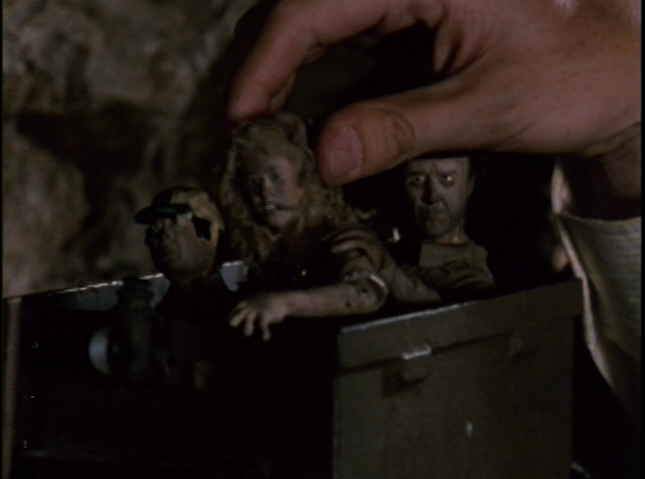
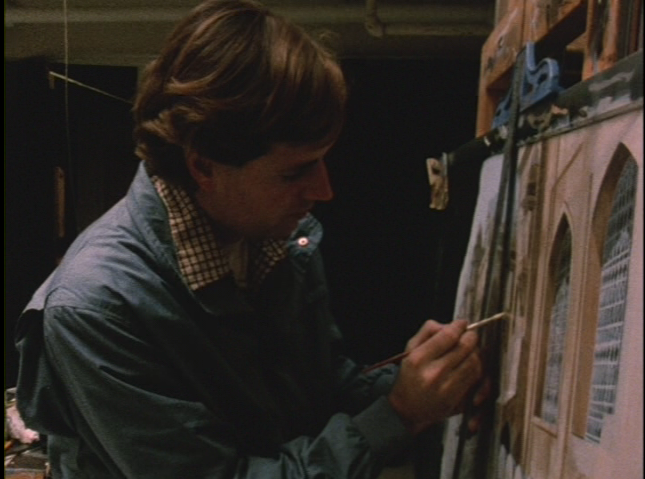
The Oscar-winning visual effects by ILM are top-notch. Miniatures, stop-motion, matte paintings on glass – they simply don’t make movies like this anymore. I’m not a member of the “CGI sucks!!” brigade – computers are just a tool – but the limitations of real-world objects and the photochemical process meant filmmakers more often than not had to improvise. For instance, a modified 35mm Nikon still camera was used to film the mine car miniatures. Speaking of mine cars, the last twenty minutes of this film are non-stop action: the fight in the temple, the aforementioned mine car chase, the waterfall, the rope bridge, the death of Mola Ram, and the arrival of the British riflemen... it simply never ends and it takes real talent to sustain that kind of excitement over an extended period of time without overwhelming the audience. Unlike most of the Star Wars films, we’re not constantly cutting from one battle to another and unlike the other Indy films, it’s less stop-and-start and more “This goes to 11!” Now that I think of it, the opening 20 minutes are a rollicking ride, too: an old-fashioned music number, a melee in the club (in which Indy accidentally punches a cigarette girl!), a car chase on the streets of Shanghai, a plane crash, and an inflatable boat ride down the slopes of the Himalayas and a raging river, all scored with wall-to-wall John Williams music.

In conclusion, this film has plenty to offer. It may not be fair to compare it to its predecessor or action movies of today but it does pass one very important test: if it comes on TV, I don’t change the channel!

“Kali Ma!”

[+] Read More...

Sunday, November 20, 2011

The Great (film) Debates vol. 16

Bond. . . James Bond. There have been many James Bonds, but some would say there was only ever one. But we don't accept half answers here, so tell us:

Rank the James Bond actors from best to worst.


Panelist: ScottDS

Connery, Brosnan, Craig, Moore, Dalton, Lazenby. I want to be clear that I like them all. Connery is the man - no doubt about that. My first theatrical Bond experience was GoldenEye in 1995 when I was 12 so I guess it’s only natural that I would rank Brosnan higher than other people might. In my opinion, his problem was that each film got worse and worse - I still think GoldenEye is his best but I admit nostalgia might be playing a part here. I enjoy the hell out of Craig (who cares if he’s blonde?!) but he’s batting .500 right now. I like Moore but The Man with the Golden Gun is my least favorite Bond film and I think he stayed on for one film too many. The one actor whose Bond films I enjoy in toto (probably because he only did two) is Dalton. Yes, I like Licence to Kill even though it’s more Joel Silver than James Bond. For a first-time actor, Lazenby wasn’t too bad. Unfortunately, he didn’t want to do any more Bond films so we’ll never know how good he could’ve been.

Panelist: Tennessee Jed

Connery, Nivan, Dalton, Craig, Lazenby, Brosnan, Moore.

Panelist: T-Rav

1. Sean Connery -- because he’s Sean Connery.
2. Daniel Craig -- No, really. I know some people were mad because he was the first blue-eyed Bond or something, but I thought he pulled it off well.
3. Pierce Brosnan -- Didn’t care for him that much, but he was effective.
4. Roger Moore -- because I could never take him seriously as Bond.

I don’t know about the other two guys who took the role (Timothy Dalton and someone), but they only had it for like one movie so I can’t imagine they were good.

Panelist: AndrewPrice

Connery comes first, hands down. He had it all. He was suave, handsome, charming and yet brutal. Surprisingly, my second choice is Craig. Craig has shown a real ability to shift between charming and brutal and projects an "I don't care what anyone thinks, I will get the job done my way" attitude which really fits Bond perfectly. I have to admit, I've even come around on his second film on re-watching. Then we hit a cliff. Brosnan was handsome and suave, but never tough enough. Lazenby was plastic, but was saved by his excellent Bond-Girl Diana Rigg. Then comes Roger Moore. He's the first Bond I saw and I thought he was great... but over time, he's come to seem prissy, snippy, uncomfortable and more suited to comic relief than the lead. Why is he wearing old-lady glasses? Finally, we come to angry, classless Timmy Dalton. His scripts were garbage. I honestly have a hard time seeing them as Bond films.


Who's your favorite?

[+] Read More...

Friday, November 18, 2011

TV Review: Hell On Wheels (2011-????)

I hate predicting how a series will turn out after only two episodes. But only two episodes into AMC’s new show Hell on Wheels, I’m having serious problems with the show and I think it’s only going to get worse because the problems lie within the writer’s liberal worldview and dishonest motives.

Hell on Wheels is the story of Cullen Bohannon (Anson Mount), an ex-confederate soldier seeking revenge for the killing of his wife. He takes a job working for Thomas Durant (Colm Meaney), who is building the transcontinental railroad through Nebraska in 1865. Bohannon takes this job because the man he wants to kill works for the railroad as a foreman. Bohannon gets the job and then goes to kill the foreman. But the foreman throws him for a loop when he mentions another murderer Bohannon knows nothing about. But just as the foreman is about to reveal the man’s identity, the foreman is killed by Elam Ferguson (racist rapper turned actor Common). Hilarity ensues.

My problems with Hell on Wheels actually started from the first word. For weeks before the show premiered, AMC ran ads implying this would be more than just a Western. Specifically, they used a line of dialog which implied something supernatural was taking place. But in the opening twenty seconds, we discover that "line" was in reality two separate lines spliced together to create a misleading impression. Rather than referencing some supernatural force they unleashed, the character was only whining about how evil he and the rest of the Union Army were in the Civil War. Boo fricken hoo.

And it doesn’t stop there. Soon we get blasted by characters whining about how evilly the South treated Union prisoners of war. . . how evilly the Union treated the South’s soldiers. . . how evilly the Southerners treated the slaves. . . how evilly whitey treated the Indians. . . how evilly the Irish were treated. . . how evilly whitey treated the Chinese. . . how evilly corporate America treated its workers. . . etc. etc. etc. Every racial, ethnic, religious, political or economic grievance you can conjure up about the era gets crammed into the first two episodes. That’s whiny liberalism at its worst.

Even worse, the characters accept the modern liberal worldview. Hence, they all lament how evil they are and almost every scene involves characters whining about some group-based grievance. And even worse, standard liberal hypocrisies apply. Thus, they are all hopelessly conflicted and dearly apologetic about all the evils done by their own people and they reject evils like racism and violence. . . unless you're black or an Indian, then it’s hunky dory. This is ridiculous. This show seems to be written from the worst end of the racial identity politics regime. If we swapped the characters’ races, you’d swear this was written by the Klan.

And it doesn't stop there. Our hero Bohannon is a cliché, being a cold-blooded killer in the tradition of Clint Eastwood’s spaghetti westerns. But he's also noble because he freed his own slaves before the war because he knew slavery was wrong. Really? This is ex post facto liberal false courage masturbatory disease. This is all those liberals who tell you proudly how THEY would have stood up to Hitler if THEY’d lived in Germany, or THEY would have led the Civil Rights Movement, or THEY would have ended slavery, or THEY would have been the first to [fill in the blank]. . . when the reality is they are abject cowards with a complete blindspot for the intersection of personal responsibility and morality. The Bohannon character is an attempt by liberal writers to feel morally superior by criticizing a long gone era using modern sensibilities knowing that they risk nothing by being so "brave."

The villain, Thomas Durant, is the ultimate liberal boogeyman, by the way. Not only is he entirely corrupt, as we’re told all businessmen apparently were at that time, but he’s murderous, gratuitously racist, he beats his underlings and needlessly humiliates people he bribes. He openly bribes and threatens Senators, tells the press his evil plans because he knows they would never go against him, and he laughs maniacally at all of his own evil doings. He actually sees himself as evil and revels in it. Indeed, Colm Meaney plays Durant so rottenly that Ebenezer Scrooge would cry foul.

But even beyond the politics, this story is full of inexplicable actions and plot conveniences. Why does Bohannon bother joining the railroad when he could have just rode up and shot his nemesis? Why stick around after the murder except to get caught -- he wasn’t told until later that Elam knows who the other killer might be. Why would Durant not hang Bohannon (he framed him for the foreman’s murder) just because Bohannon says he knows how to handle blacks? And what are the chances Elam would kill the foreman just as he was about to spill the beans, and then actually know the foreman’s secret when the foreman clearly never confided in blacks and when Elam wouldn’t even have any way to connect the dots? Or are we to believe the foreman liked to brag about the same murder that supposedly haunted him?

Almost every moment in this show feels manufactured. It is manufactured in the sense that the characters’ actions make no sense, they espouse beliefs that are anachronistic and inconsistent, and each scene feels set up just to let them espouse those beliefs. The actions binding the character together are nonsense and the characters themselves are laughably cardboard and seem drawn to act as liberal archetypes.

Even beyond that, there are problems. Is the show fast paced? Sure. But the acting is weak and the accents are horrid. The costumes are good, except Common looks too clean and modern to be a railroad worker from 1865. . . he looks more like a model. Does the plot twist and turn? Sure. But it’s not surprising.

But in the end, the real problem is that I keep feeling in scene after scene that I’m being fed propaganda. I keep being told revisionist history. I keep seeing extreme liberal boogeymen and I can’t help but see a sad liberal writer proudly telling himself, "that would have been me!" Yeah, sure. This show is dishonest and that’s the problem.

[+] Read More...

Wednesday, November 16, 2011

Guest Review: The Man Who Wasn’t There (2001)

A Film Review by Tennessee Jed

Few would deny the Coen brothers are among the most acclaimed film makers of their generation. Yet much of their work has not resonated quite as loudly at the box office as with the critics. Some claim the brothers dwell too often on negative or depressing themes. That could certainly be argued for one of their more obscure films, The Man Who Wasn’t There. Perhaps so, but it is probably my favorite Coen Brothers film for a variety of reasons which I’ll discuss below.

Format - The idea for this film germinated from a poster used in the film The Hudsucker Proxy which depicts various styles of haircuts from the 1940ʼs. As the brothers developed their idea, they settled on a film noir, black comedy set in the late 40ʼs. The Coens freely credit as their inspiration the gritty style of writer James M. Cain (Double Indemnity and The Postman Always Rings Twice.) As such, they chose to use black and white, and the conventional, straightforward filming techniques of the time. Along with thorough attention to realistic props, there is no question the movie accurately reflects the look of the period. Interestingly, cinematographer Roger Deakins points out he actually shot the movie on modern color stock, then modified it to black and white, claiming that gave the film a more smooth and lush texture (non-grainy) than could otherwise have been possible.

Themes - As with other works by the Coen brothers, this film implicitly explores the philosophies of both Soren Kierkegaard (Existentialism) and Albert Camus (Absurdism.) The latter is actually an outgrowth of the former and is grounded in the notion that it is impossible for man to make sense or order out of his life in a world that is fundamentally chaotic in nature. In fact, at the time of its release, several critics pointed out the numerous thematic similarities between this film and some of the works of Camus.
*** slight spoiler alert ***
Plot - This is a superb classic film noir story about a very ordinary man named Ed Crane (Billy Bob Thornton) a barber in Santa Rosa, California in the late 40ʼs. The character serves as the film’s narrator, and is instinctively recognizable as the quiet unassuming man everyone has known at one time or another who blends into the background to the point he is virtually invisible (as intimated by the title.) Crane is second chair in a barber shop owned by his brother-in-law, Frank (Michael Badulucco of L.A. Law.) Ed is settled into what could best be described as a stale marriage to Frank’s sister Doris (Frances McDormand.)

Doris works as an accountant at Nirdlingerʼs, a local family owned department store and drinks too much. Her boss, “Big Dave” Brewster (James Gandolfini) owes his own career to his marriage to Ann, the daughter of the store’s owner. Ed feels certain Doris is having an affair with “Big Dave” (“all the signs were there”) but true to his character, he appears outwardly to not particularly care all that much.

One day, Ed is cutting the hair of a stranger in town named Creighton Tolliver (Jon Polito.) Tolliver is looking for a silent financial partner in a new, potentially commercially viable process known as dry cleaning. Intrigued, but without the means to invest the required $10,000, Ed hits upon a scheme to anonymously blackmail “Big Dave” regarding his affair with Doris. Big Dave even confides in Ed that he is being blackmailed for $10,000 for an affair he is having with a married woman (not mentioning it is Doris, of course), asking him what he should do. Ed naturally advises Big Dave to pay, then secretly collects the money from the drop, and signs the paperwork for his partnership with Tolliver who is in the process of heading out of town.

However, as so often happens in well-crafted film noir, the web of deceit woven by Ed Crane becomes tangled and quickly spins out of control as a complex set of events conspire to create unanticipated consequences not revealed in this review.

Acting - Headlined by a masterful performance from Thornton (in which he puts on a clinic for the term “underacting,”) the strength of acting is uniformly top rate throughout the cast. In addition to Thornton’s role and an equally strong performance by Gandolfini, some of the “usual suspects” found in Coen brothersʼ films make their presence known as well. Frances McDormand (Joel Coenʼs wife) is her usual brilliant self playing Doris to perfection. I have had the pleasure of meeting Jon Polito numerous times before his career started (while he was at Villanova University sharing an apartment in Bryn Mawr with a high school buddy of mine.) Polito, who regularly collaborates with the Coen brothers, is one of the best character actors in the business. When people look him up and see his picture, everybody goes “Oh Yeah . . . him . . . sure!”

There are also several smaller roles with effective performances by a young Scarlett Johansson as Birdy Abundas, a teenaged neighbor and potentially talented piano student, as well as Tony Shaloub (Monk) as hot shot attorney Freddy Riedenschneider. I would be remiss, though, without mentioning a funny and fine performance by Richard Jenkins as Birdyʼs father Walter Abundas.

Direction - Joel Coen shared best director award at the 2001 Cannes Film Festival with David Lynch for Mulholland Drive. Both equally deserved the award. When you look at each scene carefully, it is hard to argue with most of the choices made by the director, although the occasional allusions to extra terrestrials and flying saucers were mostly lost on me. Still, the look, feel, and pacing of the film are all superb and credit must be given where it is due.

Summary - Much of the award nominations went to the cinematography, and I agree the techniques used to simulate a 40ʼs era film noir were superb. But really, this film works well on a lot of different levels. It is well plotted and scripted with plenty of black humor throughout, all expertly handled by the actors. The music soundtrack consisting mainly of Beethoven piano sonatas is, perhaps, unexpectedly effective given the genre. There is almost nothing I would change, but admit that Edʼs seeming indifference at the end to his ultimate fate might seem a tad unrealistic even from an absurdist point of view. Neverthless, it is a film I would highly recommend and remains my personal Coen Brothers favorite.

What are your thoughts about this film, and do you have a favorite Coen film?

[+] Read More...

Sunday, November 13, 2011

The Great (film) Debates vol. 15

These days we have a lot of celebrities, and we know way too much about their pointless lives. But history is full of great people with great deeds. Some of them deserve a little screen time.

If you could see a miniseries made about someone’s life, who would it be?

Panelist: Tennessee Jed

Queen Elizabeth the Second. I think she is the ultimate classy person and queen. Definitely leave in the scene where she is given an ipod of Obama’s speeches.

Panelist: T-Rav

Pope John Paul II. I think there’s already been one or two made-for-TV movies about him, but he had such a full life, it really deserves a more extended look. Plus, he had a more important role in defeating Communism than a lot of people realize, and that aspect of his achievements--and his spiritual way of looking at the world in general--needs more attention.

Panelist: AndrewPrice

This one is tougher than it seems because there are so many. I'd love to see a series on Napoleon. . . the inventor of the modern state and the man who started what should really be considered the first world war. Shakespeare fascinates me too -- he wrote that thing. . . or didn't. But right now, I'd go with J. Edgar Hoover (sans the smear job). He is one of the most important men when it comes to shaping the modern federal government and I'd be fascinated to see that story.

Panelist: ScottDS

Teddy freaking Roosevelt! If HBO doesn’t want it, then give it to Showtime or ReelzChannel. Bring in Edmund Morris (author of an excellent three-part biography) as a consultant and John Milius (TR fan and director of TNT’s Rough Riders movie) as a producer and possibly director as well. Some subtle CGI can bring turn of the century New York City and D.C. to life.


Comments? Thoughts? Who would you choose and why?

[+] Read More...

Friday, November 11, 2011

Politics of Trek: “Patterns of Force”

If you haven’t seen the original Star Trek series, you should. Not only is it deeply woven into our culture, but it hits a high-water mark in terms of science fiction addressing social issues without beating you over the head with the message. Moreover, whether they realized it or not, it’s a fundamentally conservative/libertarian show. So today I want to start a new series pointing out some of the most conservative Star Trek episodes from the original series. . . as compared to the ultra-liberal Star Trek: The Next Generation. Let’s start with Episode 50: Patterns of Force.
The Plot
This is “the Nazi episode.” The crew of the Enterprise is called to Ekos to investigate the disappearance of Federation historian John Gill. Gill, one of Kirk’s professors at Starfleet Academy, went to Ekos to observe their culture. As the Enterprise nears Ekos, they are shocked when a nuclear missile is fired at them. Beaming down in secret, they discover that the Ekosians have replicated Nazi Germany, right down to the uniforms, and the Ekosians are planning to exterminate their peaceful planetary neighbors, the Zeons. What's worse, John Gill has made himself the Führer!

Eventually, Kirk and Spock find a way to get to Gill. When they reach him, they discover he’s been drugged into a stupor and is little more than a literal figurehead. Deputy Führer Melakon is the real power.
Why It’s Conservative
On its surface, you might think a story about Nazis is left wing. After all, Hollywood wants you to believe the Nazis were a right wing phenomenon equivalent to Libertarianism/ Conservatism. This is laughable, as the national socialist Nazis were everything the left claims to love. Yet, many people still ignorantly accept the idea the Nazis were rightists rather than leftists because that’s what they’ve been taught by leftist teachers. So it shouldn’t surprise if a show about Nazis was meant as an attack on conservatives.

But “Patterns of Force” isn’t actually an anti-Nazi story. Rather, it’s a warning against the idea of the “benign” totalitarian government. To see this, we need only look at the episode’s payoff scene where Kirk questions Gill after McCoy counteracts the drugs given to Gill. Kirk angrily demands to know why Gill violated the Prime Directive (non-interference in alien worlds). Gill answers that the Ekosians were a divided people and Gill thought he could unify them using the Nazi model. Kirk then asks why Gill picked the Nazis, who were cruel and murderous. Gill (with an assist from Spock) explains that the Nazis, while ruthless, were highly efficient and highly organized. Gill believed he could recreate the good parts of Nazi Germany without the bad parts by being a benign dictator. Here's the transcript:
KIRK: Gill. Gill, why did you abandon your mission? Why did you interfere with this culture?
GILL: Planet fragmented. Divided. Took lesson from Earth history.
KIRK: But why Nazi Germany? You studied history. You knew what the Nazis were.
GILL: Most efficient state Earth ever knew.
SPOCK: Quite true, Captain. That tiny country, beaten, bankrupt, defeated, rose in a few years to stand only one step away from global domination.
KIRK: But it was brutal, perverted, had to be destroyed at a terrible cost. Why that example?
SPOCK: Perhaps Gill felt that such a state, run benignly, could accomplish its efficiency without sadism.
KIRK: Why, Gill? Why?
GILL: Worked. At first it worked. Then Melakon began take over. Used the. Gave me the drug.
This is not a liberal message. To the contrary, it is a fundamentally conservative message.

Liberals desire powerful government. They believe that even totalitarian regimes can be good so long as they are run benignly. Indeed, you’ll often hear liberals suggest that we should suspend things like rule of law and free elections or give the state tremendous power so it can achieve some supposedly noble goal that can’t be achieved the legal way.

Conservatives, on the other hand, know you cannot give power to one person without taking away freedom from another, and they understand that what sounds like benign power to some is tyranny to others. They also understand that when too much power is given, tyranny will always follow. That’s the point of Lord Acton’s most famous quote: “Power tends to corrupt and absolute power corrupts absolutely.”

This difference in belief is the core or fundamental difference between conservative and liberal thinking.

And while it is true that many liberal stories involve people fighting against oppressive governments, it is important to note that they rarely (if ever) criticize the concentration of power. Instead, they merely attack those who would misuse the power, i.e. those who would use the power for purposes of which the liberals don’t approve -- this is why oppressive governments in liberal stories are always police states, military dictatorships or theocracies. And in many cases, the resolution of the story involves the replacement of the evil government with a benign council of experts or bleeding hearts who will then use that power “to help people.”

“Patterns of Force” rejects this as faulty logic. It warns that you cannot have a benign dictator. It warns the problem is the concentration of power itself because the misuse of that power is inevitable. And no matter what the intentions may be for the creation of the state, the very concentration of that much power will attract someone who will misuse the power for evil.

And that makes this a fundamentally conservative message.

[+] Read More...

Sunday, November 6, 2011

The Great (film) Debates vol. 14

Classic Hollywood produced some wonderful actresses. They had style, grace, and they could act.

Who is your favorite classic Hollywood actress and what was her best role?


Panelist: ScottDS

Miss Barbara Stanwyck, and I would say her best role is a toss-up between Phyllis Dietrichson in Double Indemnity and Jean Harrington in The Lady Eve. In fact, when people ask me who my celebrity crush is, I mention a few modern day actresses and I top it off with "Barbara Stanwyck circa 1941 when she did The Lady Eve and Ball of Fire." A friend of mine thinks she resembles a girl I had a crush on in film school but the jury is still out on that one. "There’s a speed limit in this state, Mr. Neff. Forty-five miles an hour."

Panelist: Tennessee Jed

Joanne Woodward (of course) in Long Hot Summer. Hepburn is the obvious choice, but you did say favorite!! I liked Long Hot Summer over 3 Faces of Eve even though the latter won her an Oscar. The rationale for that is probably as a native Georgian, she was a natural in LHS.

Panelist: T-Rav

Judy Garland. Obviously, The Wizard of Oz would be the high point of her career; it's hard now for me to imagine Dorothy being played by anyone else but her. She had several good movies after that, of course, like Meet Me in St. Louis (on my mind right now for obvious reasons), and through the '40s and '50s she probably had a better set of pipes than anyone else in Hollywood, in my opinion. I wonder what more she might have done, if not for her sad descent and premature death.

Panelist: AndrewPrice

I was tempted to say Rosalind Russell because she was a fantastic actress and I've liked her in everything I've seen her in. But for favorite, I just can't get away from Lauren Bacall. Her performance in To Have And Have Not is one of my all-time favorites and she was solid in every film after that -- even as late as the 1970s, when she starred in Murder On The Orient Express. There isn't a character she couldn't play.


Comments? Thoughts? Who would you choose and why?

[+] Read More...

Friday, November 4, 2011

TV Review: Boardwalk Empire (2010-????)

HBO has another hit on its hands: Boardwalk Empire. It’s a really good drama with a lot to love. It does have flaws, but they’re easy to overlook -- except they do hold the series back from being truly addictive. Interestingly, most people compare this to Sopranos, but it’s actually very different in some key ways, and I think that’s where the flaws lie.
The Story
Created by Terrence Winter, who wrote 25 episodes of The Sopranos. Boardwalk Empire is an hour-long series on HBO centered around historical crime kingpin Enoch “Nucky” Johnson (renamed “Thompson” for the series). Nucky (Steve Buscemi) is the boss of Atlantic City when Prohibition becomes the law of the land. He controls the local government. He controls the police. And now he control the liquor industry in the city.

As of the middle of season two, the story has been primarily about the struggle between Nucky and a group led by “the Commodore” (Dabney Coleman), who are fighting to wrestle control of Atlantic City from Nucky. Meanwhile, Nucky is fending off outside gangsters including a young Al Capone, Lucky Luciano, Arnold Rothstein and more, while dodging Federal Prohibition Agents led by religious extremist Nelson Van Alden (Michael Shannon). Interestingly, neither Lucky nor the Commodore’s group had resorted to violence until recently, so this isn’t a traditional mob story.

Where Empire Fails
I’m enjoying Empire a lot, but I do have some criticisms. For one thing, there are too many characters. There are 16 characters listed in the cast and another 13 listed as recurring characters, with more coming all the time. In and of itself, a large number of characters isn’t a problem, but Empire tries to touch upon each of these characters at least once per episode. That means too much is tossed at you in any one episode and it’s typically treated too shallowly because there just isn’t enough time to go into depth with that much competing for screen time. Also, some of these subplots add little to the story. Often, minor characters get lengthy contemplative scenes, such as disfigured WWI sniper Harrow spending five minutes getting his picture painted and later spending another ten minutes contemplating suicide. But these add nothing to the plot and the characters are too minor for us to care about their inner thoughts.

At the same time, this many-short-scenes approach leaves us with too little insight in Nucky himself. This is where the Sopranos comparison comes in. It’s clear that Empire is structured like Sopranos. But there are key differences and it’s those key differences that keep Empire from being as addictive as Sopranos. For one thing, you liked Tony Soprano. You couldn’t help but like him. He was a bumbler who wasn’t well-equipped to handle the problems he encountered. He desperately wanted to be the good guy but he didn’t know how. His decisions, while made from his heart, always came across as dictatorial and stupid and blew up in his face time and again. But you liked him because you knew how hard he struggled to be good, even when he ordered the murder of close friends.

Nucky is not Tony. Like Tony, Nucky has serious flaws which blind him to what is going on around him and his decision-making process is flawed. But unlike Tony, Nucky is cocky, arrogant and competent. Tony’s failures came from not knowing how to act, Nucky’s failures come from being a jerk. That makes him hard to like.

Also, whereas the Sopranos was really the story of how Tony dealt with his family, Empire all but ignores this part of Nucky. Yes, we see his home life in each episode, but he never leaves the office, so to speak. Indeed, the only times we see him at home is when he rushes home to explain what he’s doing before he rushes off to another meeting. Moreover, even though Nucky is in most scenes, we are never privy to his thoughts. So we never really get a chance to know Nucky the person.

To me, these are significant flaws which keep the story from reaching its potential. Nucky is too hard to like. Thus, it’s hard to care about what happens to him. There are too many subplots and characters to give us the chance to care about anyone else either. Also, the plot itself is pretty obvious and the surprises are not surprising. At the same time, too much remains vague and goes unexplained.
Where Empire Succeeds
With all that being said, I am really enjoying this show very much. The sets and costumes are great. The acting is stellar. The story is solid and unpredictable enough scene-to-scene to keep your interest. The characters are interesting, if not likable, and there’s a real sense the story is building to something much more interesting with each passing episode. The writing is fantastic too. Each line is beautifully written and the show is packed with great lines, yet these lines never feel forced. Also, the characters are all unique and deep. This isn’t simply Goodfellas or The Godfather or The Untouchables transferred to the 1920s.

Finally, the story is historically smart. Most shows like this give you one or two cliché moments to let you know they looked up the era on Wikipedia, e.g. they introduce a famous boxer from the period. This show goes way beyond that. You meet famous entertainers, sports figures and politicians, some of whom get wrapped into the plot. Historical events like Prohibition, World War I, and the influx of the Irish are constantly in the background. Even day to day life is portrayed accurately. Indeed, every scene is deeply ensconced in things that make you believe this is really the 1920s.

All in all, I highly recommend Boardwalk Empire. It might take a couple episodes to get you interested, but when it does, it’s well worth the time.

[+] Read More...

Wednesday, November 2, 2011

The Myth of Foreign Films

I am calling bull on the idea of “foreign” films. For decades, we’ve been told that foreign films offer “something different.” They are deeper and more thoughtful. They aren’t structured for quick commercial sale like everything coming out of Hollywood. They are supposed to offer us a glimpse into an entirely different way of seeing the world, a glimpse you just can’t get from Hollywood. Uh.... no.

I’ve seen a vast number of foreign films. And yet, it’s the truly rare foreign film that offers something unexpected. Yes, they are often slower and typically much more talky and they don’t look quite like our films, but they function in the exact same ways Hollywood films do. Specifically, they establish their heroes using the same tricks. They designate their villains in the same way. Their conflicts aren’t anything you haven’t seen in American films. And their resolutions follow the standard format we all learned in high school English. Good luck finding a story that starts with the climax, or which has no climax.

Sometimes, you find something culturally interesting. For example, the substitution of a noodle cook off for a gun fight in Tampopo, which is really a remake of the Spaghetti Westerns, which were themselves remakes of Kurosawa’s work. Or the high premium placed on honor in the wuxia style fantasy/kung fu films from China. But these aren’t foreign concepts, they just aren’t so much in vogue right now in Hollywood.

Indian musicals are unpleasant unique, I’ll give them that. But only because their singing style is different. Other than that, they aren’t much different from 1950s musicals. Hong Kong films are direct rip offs of American action films. The Japanese are excellent filmmakers, and occasionally offer something unique, but still rarely venture far from the American formulas. German films are full of angst, but little originality and, frankly, I don’t even see much culture in them. And French films are the most Hollywood out there, unless you count British films as foreign.

Ran is King Lear. High and Lo is Ransom!. Stalingrad is Platoon. Strictly Ballroom is the classic ugly duckling story. Etc.

At one point, I decided to see what the world had to say about romance or love. So I rounded up a bunch of foreign films on the topic. I was hoping to see something distinctly non-Hollywood. I didn’t. There were some glimpses, but each film still fell pretty firmly within the formula. Interestingly, the best foreign romance film I saw wasn’t even a romance, it was Hero (2002), a Jet Li wuxia martial arts film based around a tragic love story.

Where I have had some success has been in the odd-ball films. Diva was an odd French film which presented a strangely likable stalker. Hero, as I said, had a great love story. The heroine in the Korean My Sassy Girl was interesting because she’s so hard to describe. She’s both self-destructive and sadistic, but not in the sexual way Hollywood interprets the term. . . there’s no easy way to describe her, which makes her rather unique. Shall We Dance was great because it had all these aspects of Japanese culture in them -- the remake was typical Hollywood stereotypes. Run Lola Run was neat because of its pounding pace and writing trickery. And Kurosawa’s Ikuru, though quite old, was easily the best film I’ve ever seen about the problems of bureaucracy and how people stand in the way of good deeds.

Don’t get me wrong, there are many good foreign films (and many more stinkers), but I’ve come to the conclusion that few really offer what foreign films supposedly offer -- a glimpse into a strange world with a very different set of rules than our own. Ultimately, I guess that’s a good thing because it means humans have a common culture. That means we should all one day be able to work together. But in the meantime, it kind of sucks the life out of the foreign film experience.

So give me some help here. Tell me some foreign films you’ve seen that really struck you as unusual, deeply explicative of culture, or just really good.

[+] Read More...