Showing posts with label Books To Film. Show all posts

Thursday, July 7, 2016

Film Friday: The BFG (2016)

When Steven Spielberg announced he was turning Roald Dahl’s book The BFG into a movie, I suspect a lot of people had the same reaction I did: “huh… I never heard of it.” But kids movies are big business and Spielberg is a talented director and a lot of the people who do know this book currently have kids, so I assumed it would be huge. But it wasn’t. And I know why it wasn't.

The Plot

The BFG is a kids story from the 1980’s. It involves a giant who roams Britain at night blowing dreams into the rooms of little kids. Why he does this isn’t very clear except that he captures dreams and then seems to like dispensing them to some kids because that gives him charm.

One night, this giant is spotted by a little girl who lives in an orphanage. Her name is Sophie, and she’s an insomniac. In a panic, the giant grabs the girl and takes her with him back to giant country. He does this because he’s afraid that humans would hunt the giants if they knew that the giants existed. As an aside, the other giants are all cruel, “cannibals” (they eat humans). The BFG eats rotten vegetables.
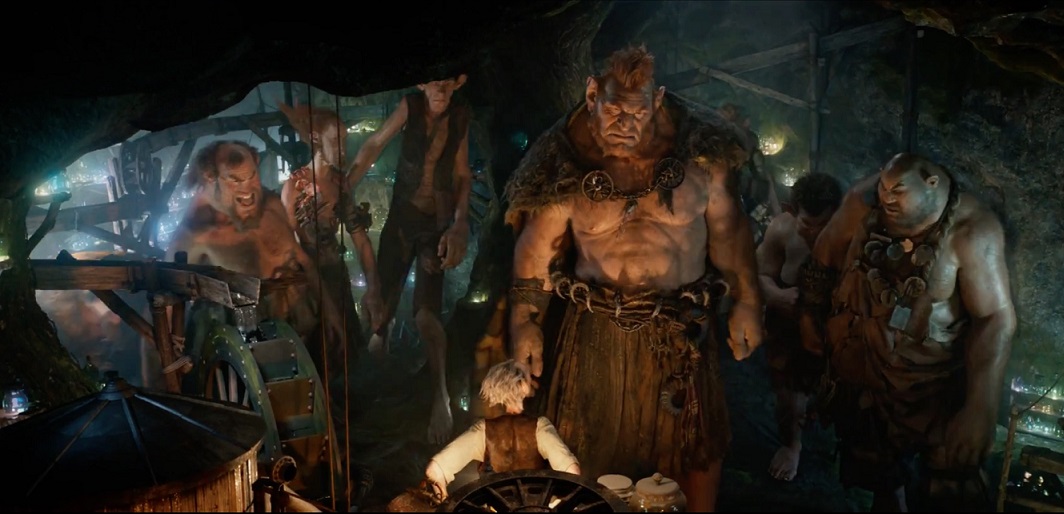
After the kidnapping, we learn that the giant is a moron. He makes up words and gets confused – some of the words will be familiar from Willy Wonka. He also no think good, but that’s ok because he’s a comfortable cliché. He’s the simple working man/janitor who dispenses wisdom... earthy wisdom... magic negro wisdom. He also can’t get enough of telling us just how stupid his is.

Anyways, the moron and little girl go through the motions of fearing each other and then become fast friends. We also learn he calls himself The Big Friendly Giant, and likes the way some kid he previously kidnapped shortened that to the BFG. So the girl calls him that and all is well.

But there is a problem. See, even though this giant is nice and cuddly, it turns out that there are other giants who are much bigger and much nastier and they kidnap and eat children. What’s more, the other giants have come to suspect that the moron has a human stashed somewhere.
The BFG realizes that he can’t protect the girl and he decides to return her to the human world. But that won’t work so the girl comes up with a plan to solve their problem. They visit the queen of England and get her to authorize a military strike against the evil giants. She does and the day is saved.

Meh

I’m actually a little torn about this film. On the hand, this film is beautifully shot. The effects are fantastic and believable. The acting is good. The story moves along at a good pace. There is little I can fault throughout the film. It’s even quite earnest and without cynicism... something I really do appreciate. So overall, I see where this film should have been a huge success and part of me wants to tell you to go see it.
Sigh.

But story matters and this story just never got interesting.

At no point does this story ever reach any sort of climax, and that makes the film dull. Take the meeting with the giant. Sophie gets taken by the giant. She gets dragged to his cave. In the cave, she hides from him, but he always knows where she is... so there’s no drama. The giant says he will keep her forever. She resists at first, but she’s an orphan with nowhere to go... no drama. Then she decides she wants to stay, though the BFG has done nothing to earn it... no drama. Now the BFG wants to return her, except we already know the bad guys know about her, so he can’t leave her... no drama.
Then Sophie comes up with a plan to go to the queen and convince her to attack the other giants. Before she goes, we meet the queen and see that she’s the nicest, most caring woman on the planet and it would be impossible for her not to help anyone in need. So there is no drama when Sophie makes her sales pitch. Then the queen calls out the military. She gives a command that is so simple that the film's writing is telegraphing that the plan can’t fail. Sure enough, right before the soldiers attack, all but the worst giant get knocked out of the fight with bad dreams. That makes the fight a walkover. And almost the moment the soldiers attack, it's over. No drama.

The key to any good story is to keep the audience unsure of what will happen next. Be it the outcome of a fight or battle, the need for reconciliation between two characters, the roll of a dice or the execution of a plan, the more uncertain the audience is of the success of the character they want to win, the greater the tension and the more the audience will be interested. Yet, at every single turn, The BFG telegraphs how a particular conflict will be resolved basically at the point it is mentioned.
Ernest Hemingway was brilliant in many ways. His two most important skills were his ability to make the complex seem incredibly simple (something imitators don’t understand) and the way he could take a simple point of conflict in a story and torture you by stretching it out. For Whom The Bell Tolls, for example, starts with a man who is about to explode a bridge. It seems like the bridge is going to explode in the next sentence. But it doesn’t. Instead, Hemingway spirals away to tell his story, always using the about-to-be-exploded bridge as a way to tell his story and ratcheting up the tension the whole time. Spielberg in BFG completely misses that. There is nothing that isn't resolved the moment it first gets mentioned and Spielberg spends the film defusing such tension before he even tells you there is tension.

This is why the film comes across as so utterly dull. Imagine being shown a football game, but first being handed a list containing the details of every score. How exciting would that game be? It’s the same thing here.

It’s sad. This was a film with tremendous potential. All the pieces were there, and Spielberg knows how to tell a story. This time, however, he failed... and the blame really does lie with him.
[+] Read More...

Monday, March 28, 2016

Books To Film: James Bond

I’ve been doing a lot of reading lately. In particular, I started reading the original James Bond books by Ian Flemming. In the past couple weeks, I’ve read the three “SPECTRE” related stories: Thunderball, On Her Majesty's Secret Service, and You Only Live Twice. It has been fascinating to compare these books to the films.

Movies rarely follow the books they adapt. More often than not, significant changes are made to make the book work on screen. As a general rule, I’ve found that it’s rare that a movie is as good as the book that inspired it, and even more rare that a movie is better than the book. So imagine my surprise to find that Thunderball, On Her Majesty’s Secret Service, and You Only Live Twice are all far superior as films than the books from whence they came.
To start with, the plots of the films are rather different than the books. Thunderball is the least changed, but it still has significant differences. In Thunderball the book, Bond goes to the health spa, as he does in the film, where he gets into a tit-for-tat with SPECTRE agent Count Lippe. Unlike the movie, where this scene is key to leading Bond to the Bahamas however, the book scene is only tangentially related to the bomb plot and Bond never seems to connect the dots. This makes the scene largely superfluous. In fact, M sends Bond to the Bahamas on M’s own hunch, rather than Bond connecting Lippe to Dominique. The rest of the story is fairly similar to the film, though with some caveats addressed below.

By comparison, You Only Live Twice is completely different from the film. In this book, Bond has lost his will to be an agent because of the death of his wife in On Her Majesty’s Secret Service and his inability to capture Blofeld for the crime. He is given a supposedly impossible assignment by M to prove why he shouldn’t be fired. This assignment takes him to Japan where he is supposed to befriend the head of Japanese Intelligence and get them to share their files because the CIA has cut British Intelligence off. In the process, Bond learns that a man who could be Blofeld his built a castle full of poisonous plants which has become a popular place for Japanese people to commit suicide. Bond wastes a lot of time, then goes to apprehend Blofeld and Blofeld ends up dead. No stolen space ships. No devastating plan. Zip.

On Her Majesty’s Secret Service is similarly without action, as Bond romances Tracy and then spends the rest of the book at Blofeld’s Swiss lair theoretically trying to find a way to arrest him, though there doesn’t seem to be any action in that regard.
Plot-wise, On Her Majesty’s Secret Service and You Only Live Twice both lack anything close to the punch of the films. You Only Live Twice got so dull that I struggled not to start skimming the page-long paragraphs that conveyed little information. Thunderball still works, but it takes a lot of twists and turns which end up as dead ends and it undermines its own tension.

Worse yet, the Bond character is not a good one in these novels. On film, he’s an amazing character. He’s suave, savvy, and violent yet playful. He’s like a combination of everything a man could want to be. Not so in the books. First, book-Bond has little in the way of savvy. He never displays anything approaching keen insight and, to the contrary, misses many obvious signs. He doesn’t seem to have any spy knowledge either, nor does he seem to like his job. He knows little about foreign cultures or languages, nothing about alcohol, and doesn’t seem to have much in the way of specialize combat knowledge. He is best described as a brawler. He doesn’t have the razor wit that film-Bond has either. Instead, he comes across more as a petulant employee.

Perhaps the biggest sin, from a character perspective, is that book-Bond is largely a passive character despite the occasional moment of big talk. In the films, Bond does it all, and he does it with a sense that what he can do easily, others simply cannot do. In the books, Bond lets others do all of the work. He falls into leads rather than chasing them down. He comes across more like a detective than a spy. And he lets others take the risks. Honestly, it’s a wonder that anyone reading these books would think they would make good films and then would transform the book-Bond into the film-Bond.
To make these films out of these books, the producers/directors/screen writers needed to completely overhaul them:
● They needed to give dead-end moments in the plot some meaning and sharpen the consequences so that the stories flowed better and the excitement level was much higher.

● They needed to reinvent the villain to give him bigger, more menacing ideas and a stronger organization (SPECTRE in the books is kind of like an alliance of petty thieves, blackmailers and cranks), to raise it to a world-class organization worthy of Bond’s attention.

● They needed to reshape Bond to be much smarter, more clever, more knowledgeable, more worldly and braver than in the books. They needed to swap out the character traits which make him come across as a petulant clerk who occasionally goes to arrest people for the traits of a solitary hunter, the traits of an indifferent policeman for those of an assassin, and the traits of a by-stander for a man of action. They even needed to give him the Bond-identifiers we have come to expect, like the Austin Martin, the vodka martinis, the sharp suits and “Bond... James Bond.” This is a bit like taking Columbo and turning him into Jason Bourne.
This is one time – three actually – where I’m glad they basically strip-mined the books and then made their own films using the elements they liked. That’s not something I will say often, but it is true here.

Thoughts?

** Hopefully, you enjoyed this article. I’m planning this as a new series, but it will take time because I need to read the books before I can write the articles. I do have a few more ready to go though. :)
[+] Read More...